The water kept on rising and Dad made another notch on the post of our stair.
It is the season of siyamsiyam we call in Ilocano nepnep, the phenomenal – or is it proverbial? – “nine-plus-nine days of continuous rainfall” which occurs usually in August, the rainiest month in the country and peak of the monsoon in the Asian region. But it had been raining much longer than that, and dad said it would last for forty days, citing the story in the bible about Noah’s Flood.
I was in the elementary but I was then strong enough to wade and retrieve our empty basi jars or burnay being swept away by the flood. Since there was no dry ground left I pulled the jars from the rushing current. It was not easy to restrain a jar partly filled with water so that you have to empty it as much as you can before you could pull it to safety. Dad and I barely understood each other at the top of our voices in the downpour and rumbling flood, but I knew he was telling me to let the jars go because of the extreme danger, pointing at the main current just across the house.
But I simply ignored him not realizing the danger until he pulled me, letting off the jars to roll with the current sometimes banging at one another. We never gave up though with whatever we could under the extreme situation. My brother Eugene was even more daring, overtaking the jars before they were swept to the street. Manang Veny kept a watchful eye on the jars in the cellar and under the sagumbi (kichen-granary).
When we were nearly exhausted Dad examined the water level he marked earlier. It was down two marks which meant the water was receding. Only then did we realize we had been working in danger, cold and hungry, for the whole morning. In the afternoon the jars came to a halt in the muddy sediment. The flood was over. I thought I saw a white dove flying above.
Where did the floodwater come from? Towards the east is the edge of the Cordillera range running parallel with the coast of South China Sea. Dad used to tell me that when he was like me then, it was verdant green, bluish in the morning mist and before dusk.
I realized how different it was on that day the floodwater came down. It is worse today. When the day is clear you can see the scars of erosion in roan and orange and ochre, breaking the monotony and giving it a somewhat romantic touch. But these are not good signs. In fact they are signs of destruction of the forest cover, the watershed of the narrow strip of flat land spreading out northward and spilling westward to the South China Sea. Along it is a chain of villages around towns wedged by the mountain and the sea. One can imagine the movement of water when it rains, and how ground water is trapped and stored to irrigate tobacco, vegetables and other summer crops.
But without trees, runoff water simply rushes down into flood, scouring on its way riverbanks, farms and houses. There is not enough time and foothold for rain to seep into the ground and feed the spring and aquifers. And there is not enough ground water to be drawn out from wells. Because water is scarce and too deep trees succumb in summer and brushfire often sweeps and consumes the dying vegetation.
Many years has passed since the Noah’s Flood of my childhood. I trained my tired aging eyes over the Cordillera of my childhood. It too, is now old, tired and worn.~
Lesson of former Paaralang Bayan sa Himpapawid (People's School-on-Air) with Ms Melly C Tenorio 738 DZRB AM Band, 8 to 9 evening class Monday to Friday (www.pbs.gov.ph)
Part 6 Legacy of Old Faithful Bubon'
Dr Abe V Rotor
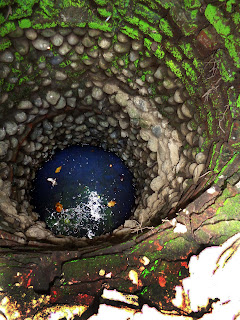
Composite views of an 18th century well at San Vicente Botanical Garden,
San Vicente, Ilocos Sur
Old Faithful Bubon' now a ruin, intermittently flooded in monsoon, damp and dry in summer, speaks of old days in Spanish time, Commonwealth era, World War II, fledging Republic - and now faces postmodernism's abandon and neglect;
Old Faithful Bubon', abode of toads and frogs, trapped in their search for water or mate, or simply fell in, croak in unison or alternate calls, inside and outside of the well, fill the night air with scary tales of old folks, or children's bedtime stories;
Old Faithful Bubon, abode of the silvery bulan-bulan fish, glistening in the sun and moonlight for which it got its name, feeding on algae and morsels that accidentally fall, a pet and indicator of freshness and safety of the water for potable use.
Old Faithful Bubon', source of water for drinking, for the kitchen and garden through generations, was once fitted with a bamboo lever-on-fulcrum (babatwagan Ilk), an indigenous version of the pulley-and-wheel, later replaced by bucket tied to a rope.
Old Faithful Bubon', a greenery of algae and mosses, epiphytes and annual plants, makes a unique garden, representing the phylogeny of the plant kingdom on the lower scale, offers a unique study of plant diversity and evolution in an isolated environment;
Old Faithful Bubon', seat of Darwinian evolution in microcosm; trapped organisms like shrimps, fish and protists, evolve independently, detached from their populations in the open, to become ultimately through time new species, a process called speciation.
Old Faithful Bubon', indicator of underground water volume and quality by its water level, clarity, smell and taste - fresh, clean and sweet as old folks would guarantee its potable use, even without undergoing water treatment we do today;
Old Faithful Bubon', setting of movies and stories, of hideouts and "bahay-bahayan" (housing game), fascinates old and young alike, in tales and fiction, like A Journey to the Center of the Earth, by Jules Verne, and prospective treasure-hunting stories;
Old Faithful Bubon', once its crystal-clear water reflected the blue sky, flying birds, and nearby tree tops, in a perfect scenery of a pristine landscape, with a young boy seated on its rim, looking downward, his face reflecting lofty dreams and thoughts deep and far beyond.
Old Faithful Bubon', three generations later, fell into obsolescence, losing aesthetics and function, replaced by modern water system; its water no longer potable due to pollution generated by industrialization, and affluent living;
Old Faithful Bubon', now a ruin, repository of fragments of history and technology, anecdotes and legends, ancestral socio-economics, now an attraction to tourists, among them an old pilgrim who once sat at its rim dreaming of the world on its water. ~
ANNEX - Kaliwa Dam, Sierra Madre
‘It gives life’: Philippine tribe fights to save a sacred river
from a dam
Keith Anthony S. Fabro
9 May 2023AsiaIndigenous Peoples and Conservation
Acknowledgement Source: Internet
Each year, members of the Dumagat-Remontado tribe gather at the Tinipak River to observe an Indigenous ritual to honor their supreme being and pray for healing and protection.
This year, the rite had an additional intention: to ward off an impending dam project they fear will inundate the site of the ritual.
The Kaliwa Dam, part of a program aimed at securing a clean water supply for the Manila metropolitan region, is already under construction and scheduled to go online in 2027.
The project has faced resistance from civil society groups as well as many of the Dumagat-Remontado, who say they fear it will cause both environmental and cultural damage.
See All Key Ideas
DARAITAN, Philippines — Members of the Indigenous Dumagat-Remontado, young and old alike, stood out against the greenery in their traditional red loincloth and tapis. On a scorching Good Friday morning, their brows were knit, their footsteps quiet yet firmly grounded, as they wound through the Tinipak River in the Philippines’ Sierra Madre Mountain Range.
After half an hour of trekking through a windy, rugged riverscape walled by verdant mountains, chirping birds and a rippling river heralded their arrival to a brook they consider sacred. It’s a site where medicinal herbs grow in abundance, and is believed by the Dumagat-Remontado to host spirits and have healing powers, curing a wide range of ailments.
“We have grown accustomed to entrusting to the river the supernatural healing of our sick children, siblings, and parents,” Indigenous leader Renato Ibañez, 48, told Mongabay. “We either bring them here to bathe them with its water or get them water for drinking when they cannot walk.”
During Holy Week in predominantly Catholic Philippines, members of the tribe from across Rizal and Quezon provinces on the island of Luzon traditionally gather here to honor their supreme being, Makijapat, and ancestors, and to pray for healing, blessings and protection. “In exchange for our loved ones’ healing, we offer whatever we can and have at our disposal,” Ibañez said. “For instance, we promise to visit this sacred space in the Tinipak River every Holy Week or every birthday of the cured person. When their health is restored, we return here to do the ritual.”
This year’s rite is no different, except this time it’s performed to ward off the impending China-backed Kaliwa Dam project, which the group fears will submerge this valley, ruining the collective memory and identity associated with the river as well alivelihoods it supports.

Renato Ibañez, a Dumagat-Remontado Indigenous leader, spoke to Mongabay about the importance of Tinipak River to his community. Image by Keith Anthony S. Fabro for Mongabay.
Resistance continues
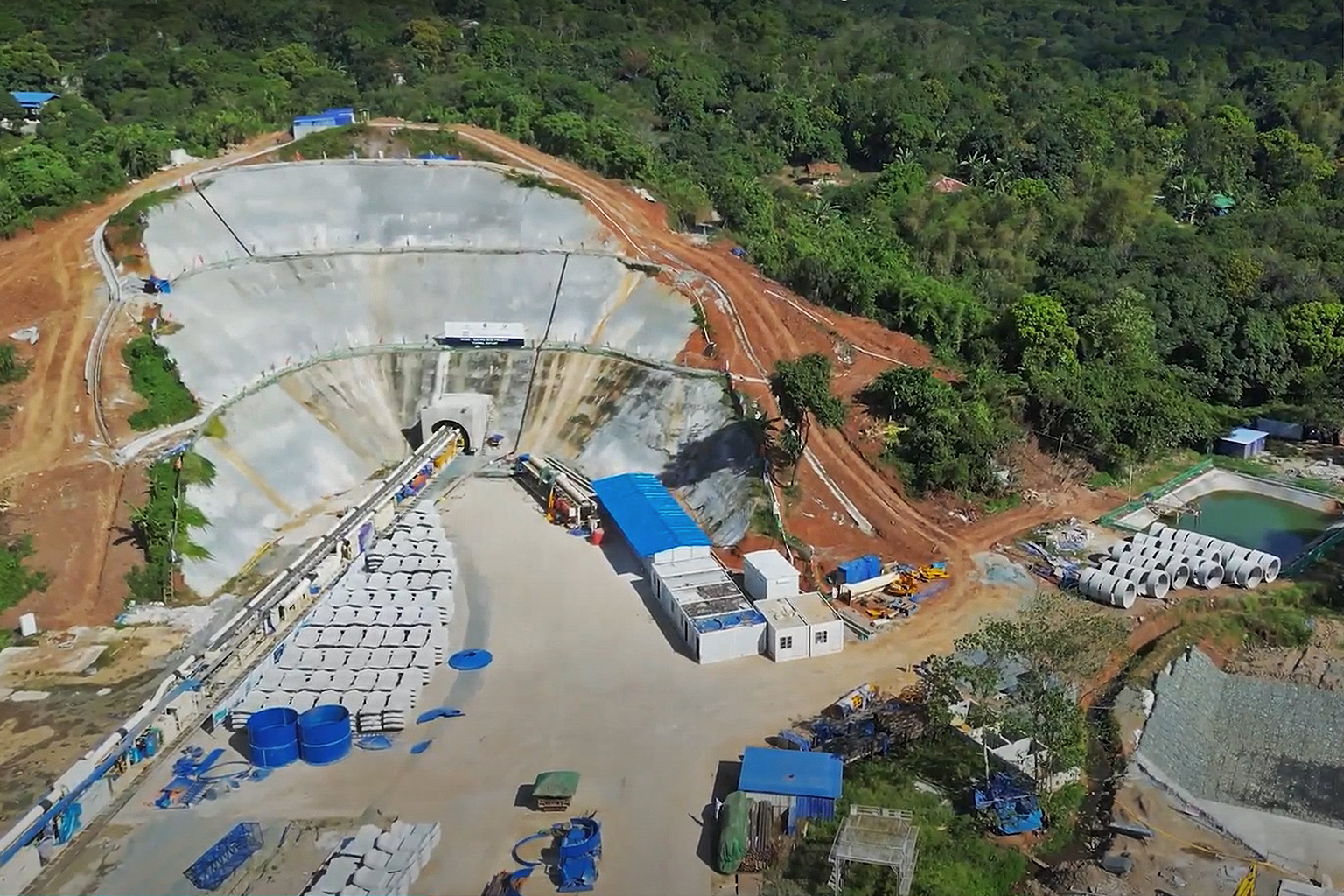
The Kaliwa Dam is part of the New Centennial Water Source, a program pushed in 2019 by then-president Rodrigo Duterte and financed by a $211 million loan deal with China. The 63-meter-high (207-foot) concrete gravity dam, which will capture water and transport it through a diversion tunnel, is seen as a way to avert yet another water crisis in Metro Manila, home to 13 million people. Once operational in 2027, it will have the capacity to provide the capital region with an additional 600 million liters (159 million gallons) per day, according to proponent Metropolitan Waterworks and Sewerage System (MWSS).
The Stop Kaliwa Dam Network (SKDN), a national coalition of civil society organizations, has launched both a series of legal challenges and an online petition against the project, saying that it violates environmental laws and imperils upstream and downstream communities as well as the Sierra Madre’s biodiversity. The network says the dam risks damaging the habitat of 126 species, will submerge 291 hectares (719 acres) of forest, and endanger 100,000 residents downstream with the risk of massive flooding. Additionally, the SKDN says the dam will affect the ancestral forests where 5,000 Dumagat-Remontado live in the Sierra Madre, and submerge at least six sacred sites, including the Tinipak River.
The coalition has filed four cases against the project, both civil and criminal, all of which are currently either pending or have been dismissed on technicalities.
“The case of Kaliwa Dam is a manifestation of a deeply imperfect legal system that perpetuates the marginalization of Indigenous peoples,” said Leon Dulce, a campaigner with the Legal Rights and Natural Resources Center, an SKDN affiliate. “In spite of having a landmark Indigenous People’s Rights Act, its problematic implementation, and oftentimes conflict with contradicting land and natural resource laws, has made the legal challenges against the Kaliwa Dam an uphill struggle.”
The 63-meter-high (207-foot) concrete gravity Kaliwa Dam will capture water and transport it through a diversion tunnel to Metro Manila. Image courtesy of Metropolitan Waterworks and Sewerage System.The Stop Kaliwa Dam Network says the dam risks damaging the habitat of 126 species, will submerge 291 hectares (719 acres) of forest, and endanger 100,000 residents downstream with the risk of massive flooding.
Dulce said the network has “pending petitions to review some of the unfavorable decisions we have faced in our legal actions and administrative complaints.”
“We continue to consider our legal options based on the evolving situation where development activities of Kaliwa Dam are persisting despite their lack of regulatory compliance and lack of meaningful action from public authorities,” he told Mongabay via instant message.
Duterte’s successor, Ferdinand Marcos Jr., has continued the project, despite stiff opposition from civil society, including the Indigenous Dumagat-Remontado. Three years after the project was approved by the Philippine environment department, the developers also gained the nod of the country’s Indigenous commission in September 2022. In December 2022, excavation began for a 22-kilometer (13.7-mile) tunnel outlet connecting the dam to the planned reservoir in the town of General Nakar.
In its environmental impact statement and information campaign, MWSS has vowed to observe environmental and Indigenous laws as it eyes project completion by 2026. As of March 31 this year, the project was 21% complete, MWSS project manager Ryan Anson told Mongabay via email. Activities completed, he said, include the detailed engineering design, temporary facilities at the outlet portal, and 353 m (1,158 ft) of tunnel excavation. Anson also said no work is being carried out so far on Indigenous land. “All project activities are within MWSS acquired properties that are outside ancestral domains and protected areas.”
Meanwhile, the project has since divided the Indigenous Dumagat-Remontado communities. According to the SKDN, at least 33 of 46 affected communities, including the “direct impact area” Daraitan, rejected the project during consultations; in videos produced by MWSS, pro-dam Indigenous leaders say only 46 households will be directly displaced by the project. In February 2023, MWSS turned over a one-time 160 million peso ($2.9 million) “disturbance fee” to Indigenous organizations who had consented to the project. This occurred as their protesting counterparts marched for nine days alongside other civil society groups from Quezon to the Malacañang Palace, the home of the president, in Manila.
Sociocultural importance
In their annual ritual on the Tinipak River, the Dumagat-Remontado participants reiterated their resistance to the project. Elders, known as gemot, began the ceremony with the narration of the site’s history and their personal experiences with its water, which they believe healed them from different illnesses and is responsible for their longevity.
Like the villagers present, Fely Cuerdo grew up drinking and bathing in the Tinipak’s water with her parents every Holy Week. “Even if I’m more than 60 years old, I’m still physically strong, and I feel that whenever I drink water from Tinipak, I become stronger,” she said, standing before an attentive crowd clad in traditional red clothing.
Once, she said, she was bedridden due to an unknown ailment and asked her son to fetch her water from Tinipak to wash her frail body. “I’ve been feeling well since then,” she said. “It is alive and gives life and I can attest to its healing power. That’s why I am ready to take a stand and defend this water source against whatever [projects] that will hinder or harm it.”
A torch with almaciga (Agathis philippinensis) resin was lit, alongside a variety of traditional coconut-based food placed on anahaw (Saribus rotundifolius) leaves. The silence filling the air made the bubbling brook more audible. An elderly woman then crouched down and uttered an offertory and supplication prayer to their supreme being, Makijapat.
After the prayer, two elderly men butchered a chicken and let its blood spilled into the river. Young men and women then picked up the offerings, and one by one brought them to a cracked boulder from which water gently springs forth. Each of them prayed in honor of the water, soil, trees and air — elements that have sustained their tribe since time immemorial.
“We’re doing this sacred ceremony to show the project proponent that they’re going to destroy not just our environment but our culture as well. We want to let people know how precious it is for us,” Ibañez said. “What they will ravage is not just our sacred river and cave, but our very source of water, forests, mountains, and livelihoods.”
Members of the Dumagat-Remontados Indigenous group gather each April at a spring along the Tinipak River for their annual ritual . Image by Keith Anthony S. Fabro for Mongabay.
Losing tourism, farmlands
The Tinipak River and other nature-based attractions found in the Dumagat-Remontado ancestral domain in Daraitan village aren’t just culturally significant, but also economically important for attracting throngs of tourists year round. Ibañez’s group calculates that tourism activities here employ 1,800 Dumagat-Remontado as tour guides, tricycle and boat operators, bridge watchers and campsite staff, and generate at least 50 million pesos ($904,000) in annual revenue for the community.
“We’re happy about it because visitors come and go all year round,” Ibañez said. The steady surge of tourists has transformed this once sleepy village, whose 6,000 inhabitants now enjoy access to power and communication lines, and improved roads and transportation modes, among other basic services. “No one can deny how much our [village of] Daraitan has improved and progressed because of tourism,” Ibañez said. “That’s why we are saying, they [the government] shouldn’t have developed our community if they are also planning to destroy it.”
The bustling tourism here has created a demand for agroforestry products, such as a variety of tropical fruits, vegetables, herbs and root crops that are grown here among native tree species. This allows the Dumagat-Remontado to practice their buhol magtanim and pasaeng rituals respectively before the planting season in May and after the harvesting season in November. During these ceremonies, the community gathers for several days to offer traditional food and showcase performances and games to honor Makijapat.
Owing to the region’s abundant water supply, Indigenous farming households like Marites Pauig’s are thriving. On her inherited 11-hectare (27-acre) agroforestry site, threatened tree species like almaciga and narra are interplanted with crops including ginger, calamansi, coconut, jackfruit, mango and banana, providing daily sustenance for her extended family even during the COVID-19 pandemic. Pauig, who leads other Indigenous women farmers in Daraitan, told Mongabay that her family harvests 2,000 pesos’ ($36) worth of organic eggplants a week.
She said she worries, however, that the dam project will exacerbate the effects of the climate crisis that has already caused her crops to stunt and rot even before harvest. “It will be difficult for us when the dam comes to inundate our farmlands,” said Pauig, in her late 40s, as she carried her toddler grandchild while chewing an areca nut that has turned her teeth reddish brown. “If that happens,” her watery eyes squinted, “we will not be able to plant and provide for our family.”


Dumagat-Remontados Indigenous people fear that construction and operation of the Kaliwa Dam project will negatively impact their agroforestry livelihoods that support their daily cash income needs. Image by Keith Anthony S. Fabro for Mongabay.
River tourism is a primary income-earner for Daraitan villagers, especially to the Dumagat-Remontados people who are employed in the local hospitality businesses. Image by Keith Anthony S. Fabro for Mongabay.
Human rights threats
Indigenous leaders say community members have been blocked from entering the reservoir location in Quezon province since construction began on an access road. This, they say, has limited their right to practice farming and hunting traditions during customarily allowed periods.
Indigenous leaders also report being “red-tagged” for their opposition to the dam, a pernicious practice by Philippine law enforcement agencies where those critical of state-backed projects are accused of being communists or terrorists. This often results in critics being physically and psychologically harassed, or worse, gunned down by unidentified assailants even in broad daylight. According to human rights watchdog Global Witness, the Philippines is among the deadliest countries in the world for land and environmental defenders, with fatal attacks disproportionately affecting Indigenous peoples. Between 2012 and 2021, the organization recorded 270 killings in the country, of which 114, or more than 40%, were Indigenous.
“Our fear as tribal leaders is getting killed as we’re red-tagged,” Ibañez said, recalling how he and another vocal leader were tailed by unidentified men while driving home a few years back. “They [state forces] can frame us by planting guns in our homes so they can incriminate us and make us appear ‘enemies of the state.’”
Bella Daz, however, said she remains undaunted, despite being accused of links insurgent groups multiple times since she began joining in 2015. Two years ago, she said, she was interrogated by military officials about her identity.
“They asked me if I’m affiliated with the communist terrorist groups and whether we get support from them. I told the officials, ‘Why would I confess to being a subversive when in fact I am really not?’” the 60-year-old woman said, gasping while negotiating the rocky riverbank leading to their sacred site. “You see, I’m having a hard time walking, and then they would call me an insurgent who runs around the mountains?”
Speaking animatedly before the ritual participants, the feisty leader placed her hand on her chest as she stood her ground: “If I would die, tell the public that I died as a hero who up to her final breath fought against Kaliwa Dam.”
Banner image: Located in the biodiverse Sierra Madre Mountain Range on the Philippines’ Luzon Island, Tinipak River is famous for its boulders and clean waters, and for serving as a vessel of Dumagat-Remontados’ cultural memory. Image by Keith Anthony S. Fabro for Mongabay.
Related story:
A Philippine tribe that defeated a dam prepares to fight its reincarnation