
Tuesday, June 30, 2015

Saturday, June 27, 2015
Re-discovering Aesop’s Fables.
Are fables still relevant in our times?
Dr Abe V Rotor
Living with Nature - School on Blog

Aesop's Fables have been told and re-told, then written and re-written countless times as a form of entertainment and education. Anecdotal and comic sketches were everyday forms of amusement in ancient Athens and Delphi. Today these works envelop many realms of life including psychology, politics, spirituality, education, health and well-being. Whether the man himself or Aesop the modern construct of scholars, his influence and commentary on human behavior has been firmly established. (C.D. Merriman)

 Fox and the Rooster
Versions and Interpretations of Aesop’s Fables
The interpretation of an Aesop fable may vary. For example, The Fir tree and the Bramble, has this earlier interpretation, from Oliver Goldsmith, citing Bewick’s version.
Poverty secures a man from many dangers; whereas the rich and the mighty are the mark of malice and cross fortune; and still the higher they are, the nearer the thunder.
To have a better view of the moral, let me cite the fable from Bewick’s. The fable starts with a verse, as follows:
Minions of fortune, pillars of the state, Round your exalted heads that tempest low’r! While peace secure, and soft contentment wait On the calm mansions of the humble poor.
So the story goes like this. “My head, says the boasting Fir-tree to the humble Bramble, is advanced among the stars; I furnish beams for palaces, and masts for shipping; the very sweat of my body is a sovereign remedy for the sick and wounded: whereas thou, O rascally Bramble, runnest creeping in the dirt, and art good for nothing in the world but mischief. I pretend not to vie with thee, said the Bramble, in the points that gloriest in. But, not to insist upon it, that He who made thee lofty Fir, could have made thee an humble Bramble, I pray thee tell me, when the Carpenter comes next with the axe into the wood, to fell timber, whether that hadst not rather be a Bramble than a Fir-tree?”
Compare the same fable with this simplified version for children. Here it goes.
One day, on a hill top, a fir tree said to a bramble bush. “Look at me. I am tall, strong, graceful and very beautiful. What good are you? You are small, ugly and untidy.”
This made the bramble bush very unhappy because it knew the fir tree was right. But next day some men carrying axes came up the hill. They started to chop down the fir tree. They wanted to use it to make a new house.
”Oh dear!” cried the fir tree, as it started to fall. “I wish I were a bramble bush, then the men would not have cut me down.” x x x
Dr Abe V Rotor
Living with Nature - School on Blog
Paaralang Bayan sa Himpapawid with Ms Melly C Tenorio
738 DZRB AM, 8 to 9 evening class, Monday to Friday
Aesop's Fables have been told and re-told, then written and re-written countless times as a form of entertainment and education. Anecdotal and comic sketches were everyday forms of amusement in ancient Athens and Delphi. Today these works envelop many realms of life including psychology, politics, spirituality, education, health and well-being. Whether the man himself or Aesop the modern construct of scholars, his influence and commentary on human behavior has been firmly established. (C.D. Merriman)
Aesop did not write down his fables. He
told many people the stories and they remembered them. It was nearly two
hundred years before the stories were collected together and published. The
fables were not published in English until the 15th century, but since then
they have been read by people all over the world. Their moral lessons are as
true today as they were 2,500 years ago when Aesop was alive.

Childhood Lessons from Fables
The first lessons I learned from my father came from Aesop’s fables. Quite a number of them are still fresh in my mind nearly fifty years after. Fable or fibula in Latin is a story or tale, especially a short story, often with animals or inanimate objects as speakers or actors, devised to convey a moral. So simple and universal are fables that no one could possibly miss the lesson of each story.
Before I proceed let me say a few words about the genius behind this ancient art of storytelling. Aesop, the founder of fables, was a native of old Greece, a former slave who earned his freedom out of his genius and wit, a master in allegorical philosophy. It is for this natural gift that he also gained fame – and ironically, it is also for this that he met a lamentable end in the hands of enemies whom his fables created.
Aesop is the greatest fabulist of all time, and if there are other prominent fabulists after him and at present, there is likely a trace of Aesop in their stories. Even modern fables like the movie Babes, about the pig that gained its right to live by learning to be a"sheep dog," reminds us of Aesop. Or take the case of George Orwell’s Animal Farm, a story about man’s folly and greed for power and wealth and lavish living.
But little can we perceive the original morals of Aesop in most of today’s animations. There is simply too much fantasy that masks the lesson, especially so with the versatility of technology that emphasizes scenarios that heighten the plot as if fables are running entertainment stories. What technology misses is that it fails to capture the refinement of presentation and the purposeful message that lingers in afterthought. Aesop has a unique way of making his reader to first look within himself before casting judgment upon others. Like many philosophers in his time, he believed that change is basically internal and often, discreetly self-atonement and non-effacing. Aesop is Aesop for such extraordinary character as can be gleamed from records about the man. To wit -.
“It is probable that he was of a low and diminutive stature, though agreeable in his complexion, and polite in his manners. It is however, certain that he had a great soul, and was endowed with extraordinary mental qualification; his moral character approached to a degree of perfection to which very few have attained. He appears to have had a true sense of morality and a just discernment of right and wrong; his perceptions and feelings of truth were scrupulously nice, and the smallest deviation from rectitude impressed his mind with the greatest antipathy.
“No considerations of private interest could warp his inclinations to as to seduce him from the path of virtue; his principles are steadfast and determined, and truly habitual. He never employed his great wisdom to serve the purposes of cunning; but, with an uncommon exactness, made his understanding a servant of truth.” (Oliver Goldsmith, Life of Aesop)
While we recognize Aesop as the father of the fable, there were fabulists ahead of him like Archilochus who wrote fables one hundred years before. But it is certain that Aesop was the first that brought that species of teaching into reputation, building upon the style of using animals and inanimate objects to describe the manners and characters of men, communicating instructions without seeming to assume authority of a master or a pedagogue.
Here is a story from which we can gleam the Aesop’s indomitable reputation. He adopted a unique strategy to reconcile his master and his estranged wife who had left him. It is said that Aesop, then a slave of Xanthus, went to the market and brought a great quantity of the best provisions, which he publicly declared were intended for the marriage of his master with a new spouse. This report had its desired effect, and the matter was amicably settled. And at a feast to celebrate the return of his master’s wife he is said to have served the guests with several courses of tongues, by which he intended to give a moral to his master and wife, who had by too liberal use of their tongue almost caused their permanent separation.
In another occasion, Aesop astounded the sages of Greece. An ambitious king having one day shown his vast riches and magnificence, and the glory and splendor of his court, asked them the question, whom they thought was the happiest man. After several different answers given by all the wise men present, it came at last to Aesop to make his reply. He said: “That Croesus was as much happier than other men as the fullness of the sea was superior to the rivers in his kingdom.”
If we were to base Aesop’s sagacity and severe morality his answer would rather be one of sarcasm rather than compliment, but he was undoubtedly understood by the king to be a great compliment, that in his vanity exclaimed, “The Phrygian had hit the mark.” Afterward, alone with a friend, Aesop commented, “Either we must not speak to Kings, or we must say what will please them.”
While he was living at the court of King Croesus, now a free man, celebrated and famous, he was sent on a journey to the temple of Apollo at Delphi. There he was accused by the Delphians of sacrilege, and he was convicted by an act of the greatest villainy. They concealed among his baggage, at his departure, some golden vessels consecrated to Apollo, and then dispatched messengers to search his baggage. Upon this he was accused of theft and sacrilege, and condemned to die. The angry Dephians pushed him over a steep cliff to his death.
Aesop’s ironic death is not the first among respected citizens of Greece, paradoxically when Greece was at its peak of power, as we can only imagine with this aphorism “the glory that was Greece.” Not far after Aesop’s time, Socrates, the greatest philosopher of Athens in his time and one of the greatest minds the world has ever known, was condemned to die by drinking poison hemlock for “corrupting the minds of the youth.” Socrates opened the gate of enlightenment; the concept of the Lyceum or university.
I have selected a number of Aesop fable to suit the purpose of conveying important messages related to contemporary issues in a manner that they can be understood at the grassroots. This is the purpose of Paaralang Bayan sa Himpapawid (school-on-the air) to impart functional literacy to the masses. It is not the intention of the lessons to impose moral authority, much less to proselytize our society of its failures and weaknesses. It merely seeks to elevate awareness for change, in the humblest manner we may find ways to reform, through the lessons in the fables Aesop related more than two thousand five hundred years ago.
Here are some of the popular fables of Aesop with the morals they convey.
The first lessons I learned from my father came from Aesop’s fables. Quite a number of them are still fresh in my mind nearly fifty years after. Fable or fibula in Latin is a story or tale, especially a short story, often with animals or inanimate objects as speakers or actors, devised to convey a moral. So simple and universal are fables that no one could possibly miss the lesson of each story.
Before I proceed let me say a few words about the genius behind this ancient art of storytelling. Aesop, the founder of fables, was a native of old Greece, a former slave who earned his freedom out of his genius and wit, a master in allegorical philosophy. It is for this natural gift that he also gained fame – and ironically, it is also for this that he met a lamentable end in the hands of enemies whom his fables created.
Aesop is the greatest fabulist of all time, and if there are other prominent fabulists after him and at present, there is likely a trace of Aesop in their stories. Even modern fables like the movie Babes, about the pig that gained its right to live by learning to be a"sheep dog," reminds us of Aesop. Or take the case of George Orwell’s Animal Farm, a story about man’s folly and greed for power and wealth and lavish living.
But little can we perceive the original morals of Aesop in most of today’s animations. There is simply too much fantasy that masks the lesson, especially so with the versatility of technology that emphasizes scenarios that heighten the plot as if fables are running entertainment stories. What technology misses is that it fails to capture the refinement of presentation and the purposeful message that lingers in afterthought. Aesop has a unique way of making his reader to first look within himself before casting judgment upon others. Like many philosophers in his time, he believed that change is basically internal and often, discreetly self-atonement and non-effacing. Aesop is Aesop for such extraordinary character as can be gleamed from records about the man. To wit -.
“It is probable that he was of a low and diminutive stature, though agreeable in his complexion, and polite in his manners. It is however, certain that he had a great soul, and was endowed with extraordinary mental qualification; his moral character approached to a degree of perfection to which very few have attained. He appears to have had a true sense of morality and a just discernment of right and wrong; his perceptions and feelings of truth were scrupulously nice, and the smallest deviation from rectitude impressed his mind with the greatest antipathy.
“No considerations of private interest could warp his inclinations to as to seduce him from the path of virtue; his principles are steadfast and determined, and truly habitual. He never employed his great wisdom to serve the purposes of cunning; but, with an uncommon exactness, made his understanding a servant of truth.” (Oliver Goldsmith, Life of Aesop)
While we recognize Aesop as the father of the fable, there were fabulists ahead of him like Archilochus who wrote fables one hundred years before. But it is certain that Aesop was the first that brought that species of teaching into reputation, building upon the style of using animals and inanimate objects to describe the manners and characters of men, communicating instructions without seeming to assume authority of a master or a pedagogue.
Here is a story from which we can gleam the Aesop’s indomitable reputation. He adopted a unique strategy to reconcile his master and his estranged wife who had left him. It is said that Aesop, then a slave of Xanthus, went to the market and brought a great quantity of the best provisions, which he publicly declared were intended for the marriage of his master with a new spouse. This report had its desired effect, and the matter was amicably settled. And at a feast to celebrate the return of his master’s wife he is said to have served the guests with several courses of tongues, by which he intended to give a moral to his master and wife, who had by too liberal use of their tongue almost caused their permanent separation.
In another occasion, Aesop astounded the sages of Greece. An ambitious king having one day shown his vast riches and magnificence, and the glory and splendor of his court, asked them the question, whom they thought was the happiest man. After several different answers given by all the wise men present, it came at last to Aesop to make his reply. He said: “That Croesus was as much happier than other men as the fullness of the sea was superior to the rivers in his kingdom.”
If we were to base Aesop’s sagacity and severe morality his answer would rather be one of sarcasm rather than compliment, but he was undoubtedly understood by the king to be a great compliment, that in his vanity exclaimed, “The Phrygian had hit the mark.” Afterward, alone with a friend, Aesop commented, “Either we must not speak to Kings, or we must say what will please them.”
While he was living at the court of King Croesus, now a free man, celebrated and famous, he was sent on a journey to the temple of Apollo at Delphi. There he was accused by the Delphians of sacrilege, and he was convicted by an act of the greatest villainy. They concealed among his baggage, at his departure, some golden vessels consecrated to Apollo, and then dispatched messengers to search his baggage. Upon this he was accused of theft and sacrilege, and condemned to die. The angry Dephians pushed him over a steep cliff to his death.
Aesop’s ironic death is not the first among respected citizens of Greece, paradoxically when Greece was at its peak of power, as we can only imagine with this aphorism “the glory that was Greece.” Not far after Aesop’s time, Socrates, the greatest philosopher of Athens in his time and one of the greatest minds the world has ever known, was condemned to die by drinking poison hemlock for “corrupting the minds of the youth.” Socrates opened the gate of enlightenment; the concept of the Lyceum or university.
I have selected a number of Aesop fable to suit the purpose of conveying important messages related to contemporary issues in a manner that they can be understood at the grassroots. This is the purpose of Paaralang Bayan sa Himpapawid (school-on-the air) to impart functional literacy to the masses. It is not the intention of the lessons to impose moral authority, much less to proselytize our society of its failures and weaknesses. It merely seeks to elevate awareness for change, in the humblest manner we may find ways to reform, through the lessons in the fables Aesop related more than two thousand five hundred years ago.
Here are some of the popular fables of Aesop with the morals they convey.
Popular Aesop Fables
1. The fox without a tail – Wise people are not easily fooled
2. The shepherd boy and the wolf – If we tell lies, no one will believe us when we speak the truth.
3. The boastful traveler – People who boast are soon found out.
4. The crow and the fox – Beware of people who say nice things they do not mean.
5. Who will bell the cat – Some things are more easily said than done.
6. The crow and the swan – Think well before you copy other people.
7. The wolf and the lamb – People who want to do something bad can always
find an excuse.
1. The fox without a tail – Wise people are not easily fooled
2. The shepherd boy and the wolf – If we tell lies, no one will believe us when we speak the truth.
3. The boastful traveler – People who boast are soon found out.
4. The crow and the fox – Beware of people who say nice things they do not mean.
5. Who will bell the cat – Some things are more easily said than done.
6. The crow and the swan – Think well before you copy other people.
7. The wolf and the lamb – People who want to do something bad can always
find an excuse.
 Fox and the Rooster
8. The lion and the hare – It is sometimes wiser to be content with what
you have.
9. Brother and sister – It is better to be good than to be just good looking.
10. The goose that laid the golden eggs - A greedy man can lose all he has.
11. The wind and the sun– Kindness often gets things done more quickly than force.
12. The trees and the axe – Be careful when you give way over small things,
or you may have to give way over big ones.
13. The dog and his reflection – If you want more because you are greedy, in the end
you might find you have less.
14. The fir tree and the bramble – People who are too proud may be sorry later.
15. The ant and the dove – No one is too little to be helpful.
16. The boys and the frogs – Do not do things to other people that you would not
like to be done to you.
17. The raven and the jug – If you try hard enough, you may find you can do something
that at first seems very difficult.
18. The dog in the manger – Do not stop others having what you don’t need.
19. The fox and the grapes – It is silly to say that you do not want something just
because you cannot have it. (idiomatic expression: sour grapes)
20. The wolves and the dog – Those who cannot be trusted deserve to be treated badly.
21. The fox and the lion – Things are not always what they seem to be at first.
22. The bear and the travelers - A real friend will not leave you to face trouble alone.
23. The fox and the stork – If you play mean tricks on other people, they might do
the same to you.
24. The man and the partridge – No one loves a traitor.
9. Brother and sister – It is better to be good than to be just good looking.
10. The goose that laid the golden eggs - A greedy man can lose all he has.
11. The wind and the sun– Kindness often gets things done more quickly than force.
12. The trees and the axe – Be careful when you give way over small things,
or you may have to give way over big ones.
13. The dog and his reflection – If you want more because you are greedy, in the end
you might find you have less.
14. The fir tree and the bramble – People who are too proud may be sorry later.
15. The ant and the dove – No one is too little to be helpful.
16. The boys and the frogs – Do not do things to other people that you would not
like to be done to you.
17. The raven and the jug – If you try hard enough, you may find you can do something
that at first seems very difficult.
18. The dog in the manger – Do not stop others having what you don’t need.
19. The fox and the grapes – It is silly to say that you do not want something just
because you cannot have it. (idiomatic expression: sour grapes)
20. The wolves and the dog – Those who cannot be trusted deserve to be treated badly.
21. The fox and the lion – Things are not always what they seem to be at first.
22. The bear and the travelers - A real friend will not leave you to face trouble alone.
23. The fox and the stork – If you play mean tricks on other people, they might do
the same to you.
24. The man and the partridge – No one loves a traitor.
Versions and Interpretations of Aesop’s Fables
The interpretation of an Aesop fable may vary. For example, The Fir tree and the Bramble, has this earlier interpretation, from Oliver Goldsmith, citing Bewick’s version.
Poverty secures a man from many dangers; whereas the rich and the mighty are the mark of malice and cross fortune; and still the higher they are, the nearer the thunder.
To have a better view of the moral, let me cite the fable from Bewick’s. The fable starts with a verse, as follows:
Minions of fortune, pillars of the state, Round your exalted heads that tempest low’r! While peace secure, and soft contentment wait On the calm mansions of the humble poor.
So the story goes like this. “My head, says the boasting Fir-tree to the humble Bramble, is advanced among the stars; I furnish beams for palaces, and masts for shipping; the very sweat of my body is a sovereign remedy for the sick and wounded: whereas thou, O rascally Bramble, runnest creeping in the dirt, and art good for nothing in the world but mischief. I pretend not to vie with thee, said the Bramble, in the points that gloriest in. But, not to insist upon it, that He who made thee lofty Fir, could have made thee an humble Bramble, I pray thee tell me, when the Carpenter comes next with the axe into the wood, to fell timber, whether that hadst not rather be a Bramble than a Fir-tree?”
Compare the same fable with this simplified version for children. Here it goes.
One day, on a hill top, a fir tree said to a bramble bush. “Look at me. I am tall, strong, graceful and very beautiful. What good are you? You are small, ugly and untidy.”
This made the bramble bush very unhappy because it knew the fir tree was right. But next day some men carrying axes came up the hill. They started to chop down the fir tree. They wanted to use it to make a new house.
”Oh dear!” cried the fir tree, as it started to fall. “I wish I were a bramble bush, then the men would not have cut me down.” x x x
What? We import waste? Again from Canada?
What? We import waste? Again from Canada?
I stayed in Canada long enough to love the country and people. I have a different feeling today.
Dr Abe V Rotor
Environmental protesters raise a banner that reads "Pilipinas: Hindi tambakan at sunugan ng basura" to stress that the Philippines is not a waste dumping and burning zone in front of the Canadian embassy in Manila on Thursday, May 7, 2015. Eco Waste Coalition/Released (Reprint of news at the end of this article)
From Canada? Asked PDI Editorial, February 19, 2014.
-------------------
 Part 1 - 2014 Waste Importation
Yes, 50 container vans. That's a mountain of garbage. that can litter a whole town or city. Litter irreversibly. Because the waste is non-biodegradable. Toxic. Obnoxious. Pathogenic. Carcinogenic.
Canadian Foreign Affair Bldg
Otherwise you wouldn't get rid of it. Waste that can be made into compost and organic fertilizer, waste that can be recycled like paper, waste that can generate biofuel - such wastes wouldn't find their way out of the country of origin. Because they are a resource. Valuable resource to create recycled goods and services, employment and industry. Take Germany as model in waste recycling.
But Canada? I was there some forty years ago. I learned to love the country because it is the most pristine of all natural environments on earth. Its people are gentle. It is the home of aborigine, migrants led by the English and French who founded the country more than two centuries ago.
Now the image is tarnished. Social media opened the eyes of the world. Even Canadian activists are themselves enraged at the news, and blamed their government for it, says the Editorial of the Philippine Daily Inquirer.
What makes it easy to move waste from one country to another? Well, politics and underground arrangement. This is not the first time that the Philippines became the intended dumping ground for waste of other countries .
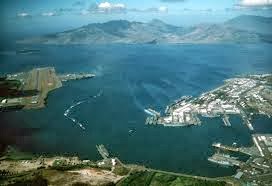 In
2012, a US naval ship dumped toxic waste in Subic.(aerial photo) Waste
from the US Navy vessel Emory Land. Contrary to claim the waste passed
pre-treatment, it was raw and very dangerous. It was just released in
Philippine waters. How the waste killed marine life, polluted the
estuary, reached land by seawater intrusion, and many other consequences
is another. A bigger story beyond belief of people who are reasonable
and of integrity. Who are victims themselves.
In
2012, a US naval ship dumped toxic waste in Subic.(aerial photo) Waste
from the US Navy vessel Emory Land. Contrary to claim the waste passed
pre-treatment, it was raw and very dangerous. It was just released in
Philippine waters. How the waste killed marine life, polluted the
estuary, reached land by seawater intrusion, and many other consequences
is another. A bigger story beyond belief of people who are reasonable
and of integrity. Who are victims themselves.
In 2006, under a planned Economic Partnership Agreement between the Philippines and Japan, the first to break the ground so to speak was a shipment of toxic and hazardous waste from Japan to be dump here. It could have been the first of many garbage shipments, courtesy of peacetime Japan to a former war country-victim.
Canada, United States, Japan - environmental crusaders and ecological cavaliers, and technologically the most advanced countries. Just like Canada I had the chance to visit the two countries. I admire how they manage being clean - streets, parks, schools, business centers. That was in the seventies and eighties.
That was as long ago as Rip Van Winkle had slept for a long twenty years.
I would like to end up with a sigh and take the armchair by the hearth. Except that I have a book of Dylan Thomas. One poem of his is Don't Go Gentle into the Night. ~
Effects of hazardous imported waste
1. It is demeaning, loss of national pride, if it's a pre-condition to aid, negotiation, and trade.
2. Waste from hospitals is not only toxic, it is pathogenic (pest and disease carrier)
3. Nuclear waste (nuclear energy generators, nuclear ships and submarines) contains long term radiation reaching hundreds of years.
Part 2 2015 Waste Importation


Living on with Nature - School on Blog
Lesson Former Paaralang Bayan sa Himpapawid with Ms Melly C Tenorio
738 DZRB AM, 8 to 9 evening class, Monday to Friday
--------------------------Environmental protesters raise a banner that reads "Pilipinas: Hindi tambakan at sunugan ng basura" to stress that the Philippines is not a waste dumping and burning zone in front of the Canadian embassy in Manila on Thursday, May 7, 2015. Eco Waste Coalition/Released (Reprint of news at the end of this article)
From Canada? Asked PDI Editorial, February 19, 2014.
-------------------
Part 1 - 2014 Waste ImportationYes, 50 container vans. That's a mountain of garbage. that can litter a whole town or city. Litter irreversibly. Because the waste is non-biodegradable. Toxic. Obnoxious. Pathogenic. Carcinogenic.
Canadian Foreign Affair Bldg
Otherwise you wouldn't get rid of it. Waste that can be made into compost and organic fertilizer, waste that can be recycled like paper, waste that can generate biofuel - such wastes wouldn't find their way out of the country of origin. Because they are a resource. Valuable resource to create recycled goods and services, employment and industry. Take Germany as model in waste recycling.
But Canada? I was there some forty years ago. I learned to love the country because it is the most pristine of all natural environments on earth. Its people are gentle. It is the home of aborigine, migrants led by the English and French who founded the country more than two centuries ago.
Now the image is tarnished. Social media opened the eyes of the world. Even Canadian activists are themselves enraged at the news, and blamed their government for it, says the Editorial of the Philippine Daily Inquirer.
What makes it easy to move waste from one country to another? Well, politics and underground arrangement. This is not the first time that the Philippines became the intended dumping ground for waste of other countries .
In 2006, under a planned Economic Partnership Agreement between the Philippines and Japan, the first to break the ground so to speak was a shipment of toxic and hazardous waste from Japan to be dump here. It could have been the first of many garbage shipments, courtesy of peacetime Japan to a former war country-victim.
Canada, United States, Japan - environmental crusaders and ecological cavaliers, and technologically the most advanced countries. Just like Canada I had the chance to visit the two countries. I admire how they manage being clean - streets, parks, schools, business centers. That was in the seventies and eighties.
That was as long ago as Rip Van Winkle had slept for a long twenty years.
I would like to end up with a sigh and take the armchair by the hearth. Except that I have a book of Dylan Thomas. One poem of his is Don't Go Gentle into the Night. ~
Effects of hazardous imported waste
1. It is demeaning, loss of national pride, if it's a pre-condition to aid, negotiation, and trade.
2. Waste from hospitals is not only toxic, it is pathogenic (pest and disease carrier)
3. Nuclear waste (nuclear energy generators, nuclear ships and submarines) contains long term radiation reaching hundreds of years.
Part 2 2015 Waste Importation
Canada criticized for waste shipments amid
Aquino trip
By Mike Frialde (philstar.com) | Updated May
7, 2015

MANILA, Philippines — An environmentalist
group on Thursday staged a protest before the embassy of Canada in Makati City
and demanded that the Canadian government take back hazardous wastes shipped to
the Philippines.
According to the Eco Waste Coalition that
staged the protest, Canada allegedly shipped 50 container vans loaded with
hazardous trash.
The container vans are still at the ports of
Manila and Subic after arriving in batches in 2013. Their contents, said the
Eco Waste Coalition, were misdeclared as recycled plastics.
Eco Waste Coalition protest coincided with
the state visit of President Benigno to Canada from May 7 to 9.
Outside the Canadian embassy at the corner of
Ayala Avenue and Gil Puyat Avenue, the
protesters raised a big banner that read:
"Pilipinas: Hindi tambakan at sunugan ng basura" to stress that
the Philippines is not a waste dumping and burning zone.
"Mindful of the threat posed to our
people's health and the environment by the mixed garbage, President Aquino
should tell Canada to re-import their trash and (Canadian) Prime Minister
(Stephen) Harper should not object to such a legitimate demand," said Eco
Waste Coalition coordinator Aileen Lucero.
She added that it will be
"scandalous" for Aquino to allow the imported trash to be landfilled
in his home province Tarlac or elsewhere, incinerated in Cavite or used as
alternative fuels for cement plants in Bulacan.
"Our communities should not be forced to
bear the burden of increased environmental pollution due to Canada's
garbage," Lucero said.
The group said environmental groups have been
appealing for Canada to take back their waste since 2013.
"We are talking about 50
forty-footer-container vans filled with mixed waste and trash, illegally
brought and misdeclared," Lucero added.
A rallyist holds a photo of hazardous waste
in a container van allegedly shipped from Canada to the Philippines. Eco
Waste/Released
Lucero said that as parties to the
"Basel Convention on the Control of Transboundary Movements of Hazardous
and Their Disposal," Canada and the Philippines must act with resolve the
garbage shipment issue to protect human health and the environment.
Amang Mejia, a lawyer for Eco Waste Coalition
added that the Philippines has the sovereign right to ban the entry or disposal
of foreign hazardous wastes and other wastes in its territory.
"Returning the unlawful garbage
shipment, which government prosecutors had earlier determined to be in
violation of the country's laws, to the state of export and punishing the
culprits will send a strong signal to waste traders that the Philippines does
not condone illegal traffic of trash," he said.
According to the Eco Waste Coalition, the
Department of Justice last November said the shipment "falls squarely
within the prohibited prohibitions" under Republic Act 6969, or the
"Toxic Substances and Hazardous and Nuclear Wastes Control Act of
1990," and DENR Administrative Order No. 28, Series of 1994, or the "Interim
Guidelines for the Importation of Recyclable Materials Containing Hazardous
Substances."
The Eco Waste Coalition has maintained that
Canada's garbage shipment flouts the Basel Convention, Republic Act 6969 and
other relevant regulations.
Socio-Cultural Issues (True or False, 25 items)
Here are the answers. Share this test with your family, in your school and community
Dr Abe V Rotor

____1. We are now experiencing a very advanced world predicted by Charles Darwin, in his theory of evolution. T
____2. Alvin Toffler’s book, Future Shock, written in the early seventies is a fiction, like Dan Brown’s Da Vinci Code. F
____3. Propaganda is actually guided media, that is, it is designed for evil or for good, in various forms of disguise and smokescreen. T
____4. Filipinos excel abroad because of their being part Filipino and part foreigner in blood. F
___ 5. We can destroy a rainforest; at any rate, we can always replace it through reforestation if we really want to, especially through strong political will. F
____6. The setting of Paradise Lost and Paradise Regained by John Milton could well be the Tropical Rainforest because it is the richest ecosystem in the world.T
____7. Ideally industrialization should be based on strong and stable agriculture – a model for developing countries. T
___ 8. Women’s liberation started in socialist countries, because of the principle of equality. F (Movement grew with equally opportunities in the modern world.)
___ 9. Neocolonialization is a form of intervention by the “big brother over the affairs of his smaller brother” (Orwellian syndrome, George Orwell’s book, “1984” written in 1948). T
___10. By lifting trade barriers and implementing free trade among countries under the World Trade Organization, small countries are the most benefited. F (on the contrary.)
___11. Cults are strictly religious. People first renounce their faith before joining cults. F (not necessarily)
___12. Media must advocate for divorce, because this is the real solution to our country’s worsening problems about the Filipino family. Take the Western countries as model for divorce. F (But lately Pope Francis pronounced that "Ending Marriages Can Be 'Morally Necessary'.")
 ___13. We have been eating products of Genetically Modified Organisms (GMO) without our knowledge - much less, consent. T (Examples Bt corn, GM soybean)
___14. Genetic engineering enables scientists to combine different genes from bacteria to plants, jellyfish to mice, virus to animals, (and easily between and among family, orders and phyla) without respecting the natural barriers of natural reproduction. T
___15. Social stratification is transitional or temporary. People have the power to rise above their present status. F (Ideally true)
___16. Nanorobotics is the use of ultra-minute robots (virus, bacteria, prion) to repair genes and gene structures in the coming new age of medicine known as Gene Therapy. T
___17. The average age of consumers of cigarette and alcohol is getting younger and younger. Now we have introduce to the young coffee, cola, tea – all containing mind bending substances. T
___18. The new field of medicine is gene therapy. It means that doctors will be able to detect a genetic defect before it is expressed as a disease showing signs and symptoms. T (but it will take a long time)
___19. With the computer today we can now publish books, produce movies, prepare advertisement, print photographs, compose music at home or in a small shop. T
___20. There nothing wrong with pornography, because it is an expression of art and therefore, must be accepted as part of our culture and the humanities. F
___21. Natural medicine is exclusively the use of herbals.F (Include avoidance of health risk food, lifestyle)
___22. The idea of natural is beautiful is to let the body express itself with the wonderful gifts of God to man, which include fineness in culture, intelligence, human relationships. T
___23. Globalization is one giant pool that homogenizes peoples of all nations – their culture, science and technology, beliefs, values, and destiny. It is the antithesis if diversity. T
 ___ 24. The idea of Globalization
to economists is progressive, while to ecologists, it is suicide –
leading to the endangerment of the Homo sapiens, our own species. T (Genetic diversity narrows down, such as integration of indigenous genes into a common gene pool.)
___ 24. The idea of Globalization
to economists is progressive, while to ecologists, it is suicide –
leading to the endangerment of the Homo sapiens, our own species. T (Genetic diversity narrows down, such as integration of indigenous genes into a common gene pool.)
___ 25. Stem cells from embryonic source poses moral issues. Even the US, then President Bush openly opposed to it. T
Stem cells are produced continuously by the body declining with age, a natural process of replacing worn out tissues (Internet photo)
Score Rating
24-25 Outstanding; 20-23 Very Good;
15-19 Good; 10-14 Average; Below 10, Fail
Dr Abe V Rotor
Living with Nature - School on Blog
Paaralang Bayan sa Himpapawid with Ms Melly C Tenorio
738 DZRB AM, 8 to 9 evening class, Monday to Friday

"Ending Marriages Can Be 'Morally Necessary'" - Pope Francis
____2. Alvin Toffler’s book, Future Shock, written in the early seventies is a fiction, like Dan Brown’s Da Vinci Code. F
____3. Propaganda is actually guided media, that is, it is designed for evil or for good, in various forms of disguise and smokescreen. T
____4. Filipinos excel abroad because of their being part Filipino and part foreigner in blood. F
___ 5. We can destroy a rainforest; at any rate, we can always replace it through reforestation if we really want to, especially through strong political will. F
____6. The setting of Paradise Lost and Paradise Regained by John Milton could well be the Tropical Rainforest because it is the richest ecosystem in the world.T
____7. Ideally industrialization should be based on strong and stable agriculture – a model for developing countries. T
___ 8. Women’s liberation started in socialist countries, because of the principle of equality. F (Movement grew with equally opportunities in the modern world.)
___ 9. Neocolonialization is a form of intervention by the “big brother over the affairs of his smaller brother” (Orwellian syndrome, George Orwell’s book, “1984” written in 1948). T
___10. By lifting trade barriers and implementing free trade among countries under the World Trade Organization, small countries are the most benefited. F (on the contrary.)
___11. Cults are strictly religious. People first renounce their faith before joining cults. F (not necessarily)
___12. Media must advocate for divorce, because this is the real solution to our country’s worsening problems about the Filipino family. Take the Western countries as model for divorce. F (But lately Pope Francis pronounced that "Ending Marriages Can Be 'Morally Necessary'.")

___14. Genetic engineering enables scientists to combine different genes from bacteria to plants, jellyfish to mice, virus to animals, (and easily between and among family, orders and phyla) without respecting the natural barriers of natural reproduction. T
___15. Social stratification is transitional or temporary. People have the power to rise above their present status. F (Ideally true)
___16. Nanorobotics is the use of ultra-minute robots (virus, bacteria, prion) to repair genes and gene structures in the coming new age of medicine known as Gene Therapy. T
___17. The average age of consumers of cigarette and alcohol is getting younger and younger. Now we have introduce to the young coffee, cola, tea – all containing mind bending substances. T
___18. The new field of medicine is gene therapy. It means that doctors will be able to detect a genetic defect before it is expressed as a disease showing signs and symptoms. T (but it will take a long time)
___19. With the computer today we can now publish books, produce movies, prepare advertisement, print photographs, compose music at home or in a small shop. T
___20. There nothing wrong with pornography, because it is an expression of art and therefore, must be accepted as part of our culture and the humanities. F
___21. Natural medicine is exclusively the use of herbals.F (Include avoidance of health risk food, lifestyle)
___22. The idea of natural is beautiful is to let the body express itself with the wonderful gifts of God to man, which include fineness in culture, intelligence, human relationships. T
___23. Globalization is one giant pool that homogenizes peoples of all nations – their culture, science and technology, beliefs, values, and destiny. It is the antithesis if diversity. T
 ___ 24. The idea of Globalization
to economists is progressive, while to ecologists, it is suicide –
leading to the endangerment of the Homo sapiens, our own species. T (Genetic diversity narrows down, such as integration of indigenous genes into a common gene pool.)
___ 24. The idea of Globalization
to economists is progressive, while to ecologists, it is suicide –
leading to the endangerment of the Homo sapiens, our own species. T (Genetic diversity narrows down, such as integration of indigenous genes into a common gene pool.) ___ 25. Stem cells from embryonic source poses moral issues. Even the US, then President Bush openly opposed to it. T
Stem cells are produced continuously by the body declining with age, a natural process of replacing worn out tissues (Internet photo)
Score Rating
24-25 Outstanding; 20-23 Very Good;
15-19 Good; 10-14 Average; Below 10, Fail
Thursday, June 25, 2015
Research is... (Thesis and Dissertation)
Dr Abe V Rotor

Living with Nature School on Blog
Paaralang Bayan sa Himpapawid (People's School-on-Air) with Ms Melly C Tenorio
738 DZRB AM Band, 8 to 9 evening class, Monday to FridayResearch
- based on facts
- starts from a complex problem
- free from personal bias or opinion
- uses objective measurements
- systematic
- controlled, not cursory
- uses evidences to confirm or refute the hypothesis
- empirical data to base conclusion
- requires expertise
- based on empirical evidence and observable experience

Research Process
- identify problem
- formulate hypothesis
- collect data
- analyze, classify, tabulate data
- synthesize data
- substantiate or refute hypothesis
- draw conclusion
- recommend action, further research Upper photo: Graduate students pursuing Masteral and Doctoral degrees in biological science with the author as their professor; lower photo: University professors conducting Field Research in Guimaras Island with author as resource person.
- historical
- descriptive
- developmental
- case and field method
- correlational
- causal-comparative or "Ex post facto"
- experimental
- survey
- action
- evaluation research
- title
- introduction
- theoretical framework
- review of related literature
- theoretical and conceptual framework
- hypothesis
- research design
- methodology
- instruments
- data-gathering, analysis
- statistical treatment
- data presentation
- references
- annexes: project timetable, budget, etc ~
The balete tree (Ficus benjamina) is the home of bad spirits.
The balete tree (Ficus benjamina)
is the home of bad spirits.
Dr Abe V Rotor

Brace roots of balete wrap around an acacia tree,
UST Manila. Photo by the author.
Balete has indeed a bad reputation. In fact its real name is strangler fig because it slowly strangles its host tree to death, using its trunk as if it were its own until the latter decomposes underneath the invader's interlacing roots and branches. Years after nothing can be traced of its once benevolent host.
The juvenile balete is popularly made into bonsai, and the young tree is domesticated into shrub and graces our homes, roadside and parks. But in the forest, it is a monster, taking over towering trees. Some wrest with the emergents, trees that rise above the canopy layer of the forest, virtually piercing through the cloud.
The tree house in the novel, Swiss Family Robinson, written by Johan Wyss in the 17th century, was built atop a huge balete. A proof of this contention is that the core of the trunk is hollow, which could only mean, the tree strangled its host tree to death. I had the chance to climb the Swiss Family Robinson tree at the Disneyland in Los Angeles, USA, through the tree’s interior spiraling stairs. From the tree house everything below is Lilliputian. Here the Robinsons were safe from the beasts of the forest; it served as their watchtower, too. Of course the tree in Disneyland is made of steel and concrete, but it appeared real the way it is described in the novel.
The juvenile balete is popularly made into bonsai, and the young tree is domesticated into shrub and graces our homes, roadside and parks. But in the forest, it is a monster, taking over towering trees. Some wrest with the emergents, trees that rise above the canopy layer of the forest, virtually piercing through the cloud.
The tree house in the novel, Swiss Family Robinson, written by Johan Wyss in the 17th century, was built atop a huge balete. A proof of this contention is that the core of the trunk is hollow, which could only mean, the tree strangled its host tree to death. I had the chance to climb the Swiss Family Robinson tree at the Disneyland in Los Angeles, USA, through the tree’s interior spiraling stairs. From the tree house everything below is Lilliputian. Here the Robinsons were safe from the beasts of the forest; it served as their watchtower, too. Of course the tree in Disneyland is made of steel and concrete, but it appeared real the way it is described in the novel.

Anyone who gets near an old balete will develop goose bumps. Imagine walking along Balete Drive (Quezon City) at night and meet a white lady (PHOTO Internet).
Old folk will tell you it was a balete Judas Escariot hanged himself. Others will relate how a kapre (black hairy monster) sits high up in the tree, his long thin legs dangling with its cavernous prop roots.
But in India and other parts of Asia, the banyan tree, a relative of the balete (Family Moraceae) is the home of kind spirits. Banyan is among the longest living tree species after the Redwood and the Bristle Pine.
Unlike the latter, the banyan actually “walks around,” its prop roots colonizing the immediate surroundings so that a centuries-old tree may reach a diameter of twenty meters or more.

Imagine how massive and extensive the banyan is – it can house a temple under its prop roots, making it Ripley’s living house of worship.


A huge banyan tree sits on an ancient temple in Cambodia. Head of
a stone Buddha emerges from a maze of brace roots of banyan in Thailand. Internet ~
Wednesday, June 24, 2015
Tuesday, June 23, 2015
Ten Syndromes that Haunt Humankind
Dr Abe V Rotor
Living with Nature School on Blog
Paaralang Bayan sa Himpapawid (People's School-on-Air) with Ms Melly C Tenorio
738 DZRB AM Band, 8 to 9 evening class, Monday to Friday
1. Syndrome of Facelessness - Wearing the mask of anonymity, arrogance, indifference, coldness – in partnership, too.
2. Narcissism or the Syndrome of Images – Reality turned into Fantasy
3. Frankenstein Syndrome – Man is the victim of his own invention. “Science may have found a cure for most evils; but it has found no remedy for the worst of them all - the apathy of human beings.” (Helen Keller)
4. Utopian Syndrome – in Search of the Lost Atlantis
5. Tower of Babel Syndrome – short cut to Heaven. “Optimism is the faith that leads to achievement. Nothing can be done without hope or confidence.” (Helen Keller)
6. Syndrome of Re-Creation in pursuit of Perfection (E.g. Genetic Engineering defies natural law of life and evolution.)
7. Quicksand Syndrome Defeats Mankind Itself. This can be visualized from the painting of Spanish painter, Francisco Goya in the 18th century depicting two men clubbing each other to death as they are being swallowed by quicksand.
8. Janus Syndrome - We wear the mask of the Greek god; we are Dr. Jekyll and Mr Hyde – at one time or another; we ride on the goodness and evil of mankind; and on the Four Horsemen of Apocalypse as well.
9. Quest for Immortality Syndrome. The concept of resurrection and eternal life is no longer confined in the spiritual realm and fantasy.“The time has been that when the brains were out the man would die, and that’s the end.” (Macbeth)
10. Syndrome of Periodicity and Fatalism. “Something was dead in each of us, and what was dead was Hope.” (Oscar Wilde)
“Never lose the child in you - that Little Prince must never grow old.” AVR
Rock Pool - Child of the Sea
Dr Abe V Rotor
Living with Nature - School on Blog
Paaralang Bayan sa Himpapawid with Ms Melly Tenorio
738 DZRB 8 to 9 evening class, Monday to Friday

Rock Pool by the Sea I, in acrylic by the author
How can the sea, so deep and vast leave behind an offspring
between two worlds?
Wonder if Nature is kind, abiding to the laws and values
of Man as her guardian;
If there was any mistake in God's creation after His rest
on the seventh day;
If perfection is but a long time goal beyond man's time
and imagination.

Rock Pool by the Sea II, in acrylic by the author
Wonder if creation is a long and painful process called evolution
in the book of sages;
And change is a continuing process on a crossroad of possibilities,
chartless and endless;
Yet in every second or in man's life time, creation goes on and on
beyond his understanding;
And soon the rock pool becomes a sea in itself, a miniature copy
of its magnificence.
Wonder if creation is a long and painful process called evolution
in the book of sages;
And change is a continuing process on a crossroad of possibilities,
chartless and endless;
Yet in every second or in man's life time, creation goes on and on
beyond his understanding;
And soon the rock pool becomes a sea in itself, a miniature copy
of its magnificence.
Subscribe to:
Posts (Atom)