Saturday, April 30, 2022

Pomegranate - ancient, sacred fruit

 Pomegranate - ancient, sacred fruit 

Pomegranates represent fertility, but also a pause in fertility
—in myth and in life.

Dr Abe V Rotor
Living with Nature School on Blog

  
Two common varieties of pomegranate locally called granada or grenade for the shape and interior of the fruit; the flower is popularly the design of royal crowns in ancient times, which is still popular today.
-------------------------------------------------------------
The pomegranate, botanical name Punica granatum, is a fruit-bearing deciduous shrub or small tree growing between 5–8 meters tall. The pomegranate is widely considered to have originated in Iran and has been cultivated since ancient times.
--------------------------------------------------------------
I remember the pomegranate trees dad planted around the house. The bright red flowers resembled a royal crown that breaks the dull landscape, especially in summer. The fruits dangle almost to the ground we children can pick when ripe.

The fully ripe fruit easily cracks and spills some seeds like a grenade, a botanical phenomenon called dehiscence. It is for this, together with the shape of the fruit that the plant earned its name. Oh, how we kids loved to eat the fleshy seeds, then force them out when spent like blowgun and start a war as ancient as the history of the plant itself.

Pomegranate is a very old crop probably first domesticated in Persia, modern day Iran. From there it spread throughout the Middle East, then to Asia, the Americas, and to other tropical countries.

But it was the Greeks who treasured its myth. To them, it was pomegranate that caused the seasons. In a shortened version, Hades, god of the underworld, kidnapped Persephone to be his wife, and to keep her from returning to her mourning mother on earth, he deceived her into eating six seeds of the sacred but fatal fruit. In her deep sorrow Persephone's mother, Demeter ceased in giving life to earth for six months which represents the dry season, and were it not for the intervention of Zeus, the earth would have been totally lifeless the whole year.

The ancient Greeks regarded pomegranate as the "fruit of the dead," and to appease the gods, gave importance to it at weddings and funerals. It is traditional to them to break a pomegranate on the ground at weddings and on New Year. Pomegranate decors abound their homes and buildings. To this day we can find their influence to art through Renaissance Europe, finding its way to the Philippines during the 400-year Spanish colonization.

There are other myths associated with pomegranate. The ancient Egyptians regarded the pomegranate as a symbol of prosperity and ambition. Goddess Hera is sometimes represented offering the pomegranate. Even among Christians, the pomegranate is regarded as sacred, symbolized by Mary and her child Jesus holding a pomegranate. In many countries it is a practice that when one buys a new home, it is conventional for a house guest to bring as a first gift a pomegranate, which is placed at the home altar, as a symbol of abundance, fertility and good luck.

Pomegranate in the hands of Madonna and Child

Pomegranate was the symbol of fertility in ancient Persian culture. In Persian Mythology, Isfandiyar eats a pomegranate and becomes invincible. In the Greco-Persian Wars, Herodotus the Greek historian, mentions golden pomegranates adorning the spears of warriors in the phalanx. Even in today's Iran, pomegranate may imply love and fertility.


Iran produces pomegranates as a common crop. Its juice and paste have a role in some Iranian cuisines, e.g. chicken, ghormas and refreshment bars. Pomegranate skins may be used to stain wool and silk in the carpet industry. Pomegranate Festival is an annual cultural and artistic festival held during October in Tehran to exhibit and sell pomegranates, food products and handicraft.

To the Chinese pomegranate is a symbol
 of long life and fertility

In some Hindu traditions, the pomegranate (hindi: Beejapuram, literally: replete with seeds) symbolizes prosperity and fertility. So with the Chinese.

But what made pomegranate popular worldwide?
Medical science found its many benefits to health that it is virtually an elixir, a panacea. First, let’s take a cursory look at its nutritional value

Nutrition Facts of Pomegranate per 100 grams

Calories 83 % Daily Value*
Total Fat 1.2 g 1%
Saturated fat 0.1 g 0%
Polyunsaturated fat 0.1 g
Monounsaturated fat 0.1 g
Cholesterol 0 mg 0%
Sodium 3 mg 0%
Potassium 236 mg 6%
Total Carbohydrate 19 g 6%
Dietary fiber 4 g 16%
Sugar 14 g
Protein 1.7 g 3%
Vitamin A 0% Vitamin C 17%
Calcium 1% Iron 1%
Vitamin D 0% Vitamin B-6 5%
Vitamin B-12 0% Magnesium 3%
*Per cent Daily Values are based on a 2,000 calorie diet. Your daily values may be higher or lower depending on your calorie needs. FeedbackSources include: USDA

Metabolites of pomegranate juice ellagitannins (urolithins) localize specifically in the prostate gland, colon, and intestinal tissues of mice, leading to clinical studies of pomegranate juice or fruit extracts for efficacy against several diseases.
In 2013, 44 clinical trials were registered with the National Institutes of Health to examine effects of pomegranate extracts or juice consumption on a variety of human disorders, including:

· prostate cancer
· prostatic hyperplasia
· diabetes
· lymphoma
· rhinovirus infection
· common cold
· oxidative stress in diabetic hemodialysis
· atherosclerosis
· coronary artery disease
· infant brain injury
· hemodialysis for kidney disease
· male infertility
· aging
· memory
· pregnancy complications
· osteoporosis
· erectile dysfunction

Reference: Wikipedia, other Internet sources, Living with Nature Series, AVRotor

Among the recommended fruits we should include to popularize in the Philippines - among the common fruits on the backyard and in the market - is pomegranate. Lately we came to realize its importance to senior citizens, especially those taking maintenance medicine. Its medicinal and nutritive properties indeed makes it worthy to be elevated as “sacred” as the Greeks and other cultures held for centuries - and up to the present.

Our pomegranate trees at home stood the test of time in the absence of caretakers. We left for our studies in Manila, and when dad died, the backyard gave way to other plants. Lately my wife brought home a big pomegranate (first photo, top). “I will plant the seeds,” I said, remembering the beautiful pomegranate trees of my childhood at home in San Vicente (IS). I waited for the seeds to germinate. After almost a month one seed germinated. To me it is new hope for the young generation. I proudly showed it to my children and grandchildren and related a long story that actually started with the ancient Greeks. ~

Seedling of pomegranate - ancient and sacred, 
elixir and secret of long life.

-----------------------------------------------------------------------------
Pomegranate is used in cooking, baking, juices, smoothies and alcoholic beverages, such as martinis and wine.

The rind of the fruit and the bark of the pomegranate tree is used as a traditional remedy against diarrhea, dysentery and intestinal parasites. The seeds and juice are considered a tonic for the heart and throat, and classified as having bitter-astringent taste plus a range of taste from sweet to sour, depending on ripeness. Thus Pomegranate is considered a healthful counterbalance to a diet high in sweet-fatty (kapha or earth) components. *

Lesson on former Paaralang Bayan sa Himpapawid (People's School-on-Air) with Ms Melly C Tenorio 738 DZRB AM Band, 8 to 9 evening class, Monday to Friday

Friday, April 29, 2022

The Sound of Nature - Classical music is patterned after natural music.

The Sound of Nature
Classical music is patterned after natural music.
Also visit Naturalism- the Eighth Sense
Dr Abe V Rotor

The Sound of Nature in acrylic by AVRotor, 2016

The greatest composers are nature lovers – Beethoven, Mendelssohn, Chopin, Rachmaninoff, and our own Abelardo, Molina, Santiago, and San Pedro, to name a few. 

Beethoven, the greatest naturalist among the world’s composers was always passionately fond of nature, spending many long holidays in the country. Always with a notebook in his pocket, he scribbled down ideas, melodies or anything he observed. It was this love of the countryside that inspired him to write his famous Pastoral Symphony. 

If you listen to it carefully, you can hear the singing of birds, a tumbling waterfall and gamboling lambs. Even if you are casually listening you cannot miss the magnificent thunderstorm when it comes in the fourth movement.

Nature's music in the treetops in acrylic by AV Rotor

Lately the medical world took notice of Mozart music and found out that the music of Wolfgang Amadeus Mozart music can enhance brain power. In a test conducted, a student who listened to the Sonata in D major for Two Pianos performed better in spatial reason. Mozart music was also found to reduce the frequency of seizure among coma patients, improved the interaction of autistic children, and is a great help to people who are suffering of Alzheimer’s disease. The proponents of Mozart’s music call this therapeutic power Mozart Effect.

What really is this special effect? A closer look at it shows similar therapeutic effect with many sounds like the noise of the surf breaking on the shore, rustling of leaves in the breeze, syncopated movement of a pendulum, cantabile of hammock, and even in the silence of a cumulus cloud building in the sky. 

 Melodies in cycles, in acrylic by AV Rotor

It is the same way Mozart repeated his melodies, turning upside down and inside out which the brain loves such a pattern, often repeated regularly every 20 to 20 seconds. This is about the same length of time as brain-wave patterns and those that govern regular bodily functions such as breathing and walking. It is this frequency of patterns in Mozart music that moderates irregular patterns of epilepsy patients, tension-building hormones, and unpleasant thoughts.


No one tires with the rhythm of nature – the tides, waves, flowing rivulets, gusts of wind, bird songs, the fiddling of crickets, and the shrill of cicada. In the recesses of a happy mind, one could hear the earth waking up in spring, laughing in summer, yawning in autumn and snoring in winter – and waking up again the next year, and so on ad infinitum.
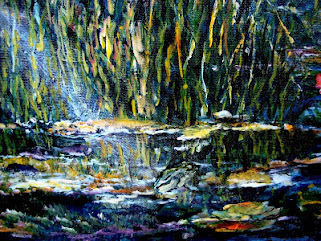
Music of Sunrise on the Pond 
in acrylic by AVRotor

There is more enchantment in ethnic music than in modern music. 
Each kind of music has its own quality, but music being a universal language, definitely has commonalities. For example, the indigenous lullaby, quite often an impromptu, has a basic pattern with that of Brahms’s Lullaby and Lucio San Pedro’s Ugoy ng Duyan (Sweet Sound of the Cradle). The range of notes, beat, tone, expression - the naturalness of a mother half-singing, half-talking to her baby, all these create a wholesome effect that binds maternal relationship, brings peace and comfort, care and love.

Serenades from different parts the world have a common touch. Compare Tosselli’s Serenade with that of our Antonio Molina’s Hating Gabi (Midnight) and you will find similarities in pattern and structure, exuding the effect that enhances the mood of lovers. This quality is more appreciated in listening to the Kundiman (Kung Hindi Man, which means, If It Can’t Be). Kundiman is a trademark of classical Filipino composers, the greatest of them, Nicanor Abelardo. His famous compositions are

· Bituin Marikit (Beautiful Star)
· Nasaan Ka Irog (Where are You My Love)
· Mutya ng Pasig (Muse of the River Pasig)
· Pakiusap (I beg to Say)

War drums on the other hand, build passion, heighten courage, and prepare the mind and body to face the challenge. It is said that Napoleon Bonaparte taught only the beat of forward, and never that of retreat, to the legendary Drummer Boy, a bold version of the original piece. ~

Pondscape in acrylic by AV Rotor.  Try to compose a melody to capture the ambiance of this painting.

Thursday, April 28, 2022

Home Garden as Insect Laboratory (San Vicente Botanical Garden Series)

San Vicente Botanical Garden

Home Garden as Insect Laboratory

Dr Abe V Rotor
Living with Nature School on Blog 

NOTE: Entomology (study of insects) is best studied in the field in order to gain on-site and hands-on experience. A school garden, such as the former Eco Sanctuary of Saint Paul University QC, UST Botanical Garden Manila, Miriam College ecological garden QC, serve the purpose for regular field work. Ideally, schools with sprawling campuses are ideal. Ateneo de Manila University for one, and University of the Philippines Diliman, and of course, UP Los Banos in Laguna. I wrote this article at the former Eco Sanctuary of SPUQC sometime in the 1998.

Daddy-long-legs, relative of the mosquito, quakes continuously when at rest by swaying its body back and forth in all directions, causing blurred view to a would-be attacker, and mesmerizing a potential prey. In the open, such optical illusion is enhanced by the shadow of the moving organism. Note the hind pair of wings reduced into halteres or balancer, characteristic of Dipterans. There is another kind of daddy-long-legs which belongs to Arachnida.
With increasing population, traffic and commerce all around a community, there is one place, a garden, that offers a wildlife sanctuary, specially insects. Here they live freely in the trees and shrubs, on annuals, inside the greenhouses, around the ponds, in loamy soil, and in the shade of buildings, and even visit homes seeking a suitable abode.

I have the feeling that of all animals, insects are the most adapted to the varied aspects of human activities, from the sound of hurrying feet to soft echoes of prayer and hymns – and loud music. When there are humans around, insects feed on morsels, paper and crayons, drink on fruit juices and beer. They aestivate in flower pots and boxes to tide with the harsh summer months. Or hibernate when the cold Siberian High comes. I think Pavlov’s conditioned learning works with insects as well.

 Interestingly, as an entomologist, I have been monitoring the insects in some gardens, listing down a good number of species that include those not readily found elsewhere. These include a giant click beetle, a rhinoceros beetle with horns resembling a triceratops, Ficus pollinating wasp, leaf-curling thrips of ikmo, long horned grasshoppers, sulfur and Papilio butterflies.

A brood of black stink bug nymphs, Order Hemiptyera, on sweet potato which dried up as a consequence of their feeding.  Stink bugs suck thje sap of their host plant.  

Well, it is a fact that there is no escape from insects - good or bad ones. In terms of species, there are 7 insects out of 10 animal’s organisms of earth. Insects comprise 800,000 kinds and scientists estimate that their kin - lobster shrimps, spiders, ticks, centipedes, millipedes and scorpions if these were to be added, the phylum to which they all belongs, Phylum Arthropoda, would comprise 80 percent of all animals organisms. To compare, plants make up only one-half million species.

What secrets have insects in dominating the animal world, and surpassing the geologic history of dinosaurs, fishes, mammals and even some mollusks?

Well look at the ants, termites, and bees, the so-called social insects. Their caste system is so intact and strict that is was long regarded as a model of man’s quest for a perfect society. It inspired the building of highly autocratic empires like Egyptian and Roman Empires, and the monarchial Aztecs, Inca and Mayan civilizations.

Antlion's traps. The predatory larva of this Neuropteran (Dendroleon obsoletum) lies buried at the bottom of the pit waiting for an unwary ant to fall and become its meal. The adult resembles the damselfly. 

Take the case of the butterflies and moths. Their active time is not only well defined - diurnal or nocturnal, but their food is highly specific to a plant or group of plants and their parts. Their life cycles allow either accelerated or suspended metamorphosis depending on the prevailing conditions of the environment, a feat no other animal can do more efficiently.

One time my students gathered around me by the ponds. There I explained to them the bizarre life of the dragonfly, once a contemporary of the dinosaur. Its young called nymph is a fearful hunter in water as the adult is in air. Apparently this is the reason on how it got its legendary name. I showed them the weapons of insects: the preying mantis carries a pair of ax-and-vise, a bee brandishes a poisonous dagger, while a tussock moth is cloaked with stinging barbs, a stink bug sprays corrosive acid on eyes or skin. The weevil has an auger snout, the grasshopper grins with shear-like mandibles, and the mosquito tucks in a long, contaminated needle.


Artistic representation of a damsel fly, Museum of Natural History, Mt Makiling Botanical Garden, UPLB Laguna

We examined a beetle. Our thought brought us to the medieval age. A knight in full battle gear! Chitin, which makes up its armor called exoskeleton, has not been successfully copied in the laboratory. So with the light of the firefly, the most efficient of all lights on earth.

Wait until you hear this! Aphids, scale insects and some dipterans, are capable of paedogenesis, that is, the ability of immature insects to produce young even before reaching maturity!

Numbers, numbers, numbers. This is the secret of survival and dominance in the biological world. King Solomon is wise indeed in halting his army so that another army - an army of ants can pass. Killer ants and killer bees destroy anything that impedes their passage, including livestock - and human.

Invisibility is another key to insect survival and dominance. Have you examined the inside of leaf galls in santol, Ficus and ikmo? Well, you need a microscope to see the culprit - thrips or red mites. I demonstrated to my students how insects, being very small, can ride on the wind and current, find easy shelter, and are less subjected to injury when they fall. Also, insects require relatively less energy than bigger organisms do. All of these contribute to their persistence and worldwide distribution. Insects surely are among the ultimate survivors of a disaster.

In an article I wrote, A Night of Music in a Garden I described Nature’s musicians, the cricket and the katydid. While their sounds are music to many of us they are totally coded sounds similar to our communications. Cicadas, beetles, grasshopper, have their own “languages”, and in the case of termites and bees, their language is in the form of chemical signals known as pheromones. It is from them that we are learning pheromones in humans.

A Walking Stick, a perfect example of  mimicry. (Former SPUQC Eco Sanctuary)

Without insects, we are certain to miss our sweetest sugar which is honey, the finest fabric which is silk, the mysterious fig (Smyrna fig) which is an exotic fruit. We would be having less and less of luscious fruits, succulent vegetables, the reddest dye, unique flavor in cheese, and most likely we will not have enough food to eat because insects are the chief pollinators, and main food of fishes and other animals. They are major links in the food chains and food webs, the columns of a biological Parthenon.

Without insects, the earth would be littered with dead bodies of plants and animals. Insects are the co-workers of decomposition with bacteria and fungi as they prepare for the life of the next generation by converting dead tissues into organic materials and ultimately into their inorganic forms. Together they help bridge the living and the non-living world.

A garden without bees and butterflies mirrors a scenario of the biblical fall. And if the other creatures in that garden strayed away from its beautiful premises as our first forebears began their wandering, they too, must have learned the true values of life, which they share to us today.
Green Beetle

Beautiful is the verse from A Gnat and a Bee, an Aesop fables. To wit:


“The wretch who works not for his daily bread,
Sighs and complains, but ought not to be fed.
Think, when you see stout beggars on their stand,
The lazy are the locusts of the land.”


In The Ant and the Grasshopper, Aesop, acting like a father with a rod in hand, warns. He was referring to the happy-go-lucky grasshopper.

“Oh now, while health and vigour still remain,
Toil, toil, my lad, to purchase honest again!
Shun idleness! Shun pleasure’s tempting snare!
A youth of rebels breeds age of care.”

Ecologically insects are the barometer of the kind of environment we live in. A pristine environment attracts beneficial insects, while a spoilt one breeds pests and diseases. 

I have yet to see a firefly in a city garden. I remember an article in Renato Constantino’s series of publications, Issues Without Tears. Its title is, You don’t See Fireflies Anymore, a prophesy of doom, a second to Rachel Carson’s Silent Spring.

Maybe. But I have not lost hope. Someday, a flicker in the night may yet come from a firefly and not from a car or cigarette - if only others will share with me the same optimism. ~

Ficus pseudopalma and its exclusive wasp pollinator, a classical example of co-evolution. Only this species of wasp can pollinate and subsequently fertilize the introverted flower of this fig plant. Wasp is magnified 20x under a

Lesson on former Paaralang Bayan sa Himpapawid with Ms Melly C Tenorio 738 DZRB AM Band, 8-9 evening class, Monday to Friday

Wednesday, April 27, 2022

I talk to the trees - and they listen to me.

I talk to the trees - and they listen to me.

"When in bloom golden, only for a day or two;
confetti follows where the bees have gone,
in every flower is born a new life
in another place and time."

Dr Abe V Rotor


Tagbilaran, Bohol

Saplings race to meet the sun,
lanky to posts they shall become;
sans branches but bole and round
soon fall to the ax one by one.


Mt Makiling, Laguna

You bear the hardest wood -
ebony in deep shiny black;
your foes no less my kind
feeling and love we lack.


Tierra Pura, Tandang Sora, QC

Sunrise, sunset, the ground is alive,
lilting children under your care
that make up for your loneliness
in a world with so little to share.


Masinloc, Zambales

You were once doomed by the wind,
but benevolence saved you;
by your fruits and resting limbs,
sanctuary and playground, too.


Mt Makiling, UPLB Laguna

Black and white makes you bold and real
of your strangler's reputation,
climbing on your host tree to the sky,
a piece of mystery of creation.


Burgos, La Union

Tree house I see built on your limbs
has stolen your view on the scene,
the breeze in your leaves hushed away,
a living monument unseen.


Cebu City

Embroidered leaves by the bagworm,
turning to crimson and fall;
mutual indeed is host and tenant,
nature and creatures all.


Kaohsiung, Taiwan

Re-incarnation - this elephant tree had been
once roaming around in band;
threatened, endangered and gone,
what would it become the next time around?


Lagro QC

Whoever felled this old balete tree,
drove the deities away;
and the spirit of the tree shall not rest,
no prayer can repay.


UST Manila

Shadow of death I see across the lawn,
save the sun all mourning;
haunting the playground empty and quiet,
save a dead tree walking.


Ateneo de Manila University QC

To the conscious passerby,
in the morning holy,
in the evening scary,
a veil to laugh or to cry.


St Paul University QC

Young devil tree, but you aren't;
your eyes but holes to your heart;
your arm raised to praise, to call
a friend, such is nature's art.


Agoo, La Union

Over laden, if all these fruits,
a burst of a lifetime -
young to die like a mother
cut in her prime.


UST Manila

Living cradle to while away the time,
to catch up with many a lost sleep;
watch out, a nap gone over the clime,
where time and opportunity slip.


AdMU QC

Pendants you wear in the night,
blinking with the chilly air,
bring tidings beyond your shade,
to far places poor and fair.


Narra in Bloom (
Pterocarpus indicus)

When in bloom golden, only for a day or two;
confetti follows where the bees have gone,
in every flower is born a new life, the embryo,
seed to a tree in another place and time. ~

Tuesday, April 26, 2022

The Last Tree Sentinel

                                      The Last Tree Sentinel

"Once upon a time there was a Paradise

abandoned by man in search for glory. " - avr


Dr Abe V Rotor

Sentinel on Tagaytay Ridge - but for how long? March 24, 2013


I braved the wind and storm, drought and rain,

     vandals and lovers carving their pledge, 

the beetle and caterpillar, all that has to gain

     from me standing on this ridge at its edge.


I was as proud as a king, tallest among my kin,

     home of countless tenants and refugees;

by height and place I was keen at touching the sky,

     though so little I felt on Babel's knees.


The view around was lush and green, verdant 

     in the sun as mist and fog would unfold;

a woodland was my world, I was once a part,

     until humans came to replace the old.


My neighbors are gone, I lost track of my lineage, 

     I've no one to talk to, though humans can 

in queer sound far from the gentleness of breeze

     all day long and after the sun is down. 


I lost sight overlooking the famed volcano, 

     its lake within a lake shining in the sun;

my vantage is blocked by roofs and walls and smog,

     an orphan I became by progress of man. 


I no longer hear plaintive and joyful songs,

     recitation of verses under my wing; 

weary travelers no longer stop to take a nap,

     nor birds nest in my branches and sing.


I live in fear for the woodsman, the engineer,

     but I've lived with fear enough to understand

the world of man: fear akin to his existence

     hidden in want - guideless, boundless in band. 


Man's era shall reign over nature, but for how long?

     I can only tell from my ancestors' story:

once upon a time there was a Paradise 

    abandoned by man in search for glory. ~ 

Sunday, April 24, 2022

Two Worlds We Live In

 Two Worlds We Live In

Details of a wall mural by Dr Abe V Rotor
Living with Nature School on Blog

Landscape view from a cave

Bats emerge from their abode  

Wonder how our ancestors lived
with birds and bats in their abode;
wonder how we live like them today
in two worlds - modern and old. 
 
Wonder why the city never sleeps,
why gregariousness our comfort;
wonder if by design or adaptation,
we crave to move from port to port. 

Wonder what we make of the future,   
caves to high rise, we rule the sky,
time and space, change our earth,
and we look up to heaven and cry. ~  

 
Nature on the Wall mural by AV Rotor (30ft x 5ft), at author's residence Lagro QC

Lesson on former Paaralang Bayan sa Himpapawid (People's School on Air) with Ms Melly C Tenorio 738 DZRB 8 to 9 evening class, Monday to Friday


Saturday, April 23, 2022

Will You Draw a House?

 Will You Draw a House?

Dr Abe V Rotor


The children made a house, each his own:
Post, walls, stair, window, door.
Cheek on palm, eyelids moving, thought of
TV, garage, swimming pool, Corinthian patio.
Twirling a pencil, pondered:
Trees, hills, mountains, cloud, sun.

“Here,” they showed their houses,
Proudly each his own.

“There’s something missing.”
Back to drawing board:
Birds in the sky and trees singing.

“Here,” they showed again their houses.

“There’s still something missing.
Would you like to live in your houses?”

Silence.
Fingers moved, lips tight:
More lines, shades, colors, now with flowers.

“Here,” they showed again their houses.”

“But there’s still one more missing.”

Pause.

A little girl in a corner drew and drew:
A house nearby, people around.

She showed her house.


And the children chorused: “Neighbor!” ~

Reprint from Sunshine on Raindrops by Dr Abercio V Rotor 2000, pp 13-14

Enigmatic Himbabao or Alukon - Exotic Vegetable (SV2World Series)

San Vicente Ilocos Sur to the World Series Part 2 
Enigmatic Himbabao or Alukon - Exotic Vegetable 

Dr Abe V Rotor


Deciduous Himbaba-o or Alukon (Ilk), on-the-spot pastel drawing by the author. The tree is referred scientifically as Broussonetia luzonica (Blanco) (accepted name) Family Moraceae. It's referred to as Birch Flower.
What comes to mind painting or drawing a culinary subject, such as the alukon standing in a thicket on a hillside away from town? Imagine being a Survivor searching for any available food in the wild. Or Henry David Thoreau living alone by the Walden Pond. (And writing a treatise of man and society of this title.)

For me as an Ilocano, I've known this tree since childhood. We kids, in my time, would gather its worm-like flowers with bamboo pole when it was impossible to climb the tree - which is dangerous, not only because it is tall, but its wood is weak and fragile. Seldom is the tree logged for furniture or construction. On reaching home, our harvest goes to the shimmering pot to the delight of our folks. What a sumptuous lunch

It's a delicacy of the Ilocanos - alukon
to the Tagalogs in Quezon - himbaba-o
It comes in other names in other places;
its flowers cooked into diningding or stew,
with kamote to thicken its soup - buridibud,
and topped with broiled tilapia or hito.

Picking alukon flowers from a juvenile tree (Alokon is propagated by cuttings);
closeup of harvest of flowers and tops. Alukon flowers are kept fresh in banana 
stalk for transport.

What do we know about this plant? Botanists have yet to agree the real species that yield the edible staminate (male) flowers, from those that bear "fruit" which is not edible. Some claim the former to be the male, while the latter is the female.

We have a big alukon in our garden which has been providing us regularly with the edible flowers. Now and then we prune it to make harvesting convenient, and have cuttings for planting. This is how a particular productive tree is propagated "true to type."

Flowers (per 100 g) yields water (86.8 g), energy (52 kcal), protein (2.9 g), fat (0.9 g), carbohydrate (8.1 g), fiber (1.5 g), ash (1.3 g), Ca (278 mg), phosphorus (75 mg), iron (4.3 mg), carotene (300 µg), vitamin A (50 µg), and thiamin (0.06 mg).

Note: While reportedly rare in the Northern Luzon, Himbabao is common in the Quezon area. Local describe two species by flowering and fruiting characteristics: Himbabao, with its long slender, spike-like flowers) and Himbabaong-lalaki, with its gray, puckered and wrinkled fruit. There is disagreement on whether it is a flower or fruit. There is also differing opinions on blogs: some referring to the fruit-bearing tree as male alukon and the spike flowering variety to alukon, and vice-versa. Or, perhaps, they are separate species

                  
         Deciduous Himbaba-o or Alukon (Ilk), on-the-spot pastel drawing by the author. 

Acknowledgement: Godofredo U. Stuart Jr., M.D., Philippine Medicinal Plant, Internet ~

Friday, April 22, 2022

Gregariousness - Biological Instinct of Collective Survival (110 Terms of Gregariousness)

Gregariousness - Biological Instinct
of Collective Survival
110 Terms of Gregariousness

What is the plural of cattle? Herd. Fish? School. Why do living organisms occur in groups and populations? Here are collective terms to describe such natural grouping.

Dr Abe V Rotor

School of carp fish (Oscar) in a home aquarium, QC

Flock of migratory birds moving down south to evade the
winter in the northern region.


Colony of ants on the move, and nest atop a tree. (Hantik
or green tree ant). Novaliches QC


Colony of bacteria (Streptococcus) 


A floating mass of kiapo (Pistia crassipes); a stand of tree saplings


A brood of tussock moth caterpillars; a horde of red fire ants 
(Solenopsis geminata) attacking a fallen bee.


A mass of nata bacteria (Leuconostoc mesenteroides) in making nata de coco;
nodules of Nitrogen-fixing bacteria (Rhizobium) on legume. 


A clump of bikal bamboo (Phylostachis) Tagaytay, and
horsetail (Equisetum) Mt Makiling, Laguna.
 

A community of squatters in Manila. A congress of spiritual leaders. 
University of Santo Tomas, Manila.


A carpet of epiphytes om acacia (Ateneo de Manila University QC);
a grove of kamatchili (Pithecolobium dulce) across a farm road. 
Sagpat, San Vicente, Ilocos Sur  


A coalesce of galls in Erythrina tree caused by a parasitic wasp.
A flush of mushrooms on a dead tree trunk. (St Paul University QC)


A pasture of plankton - phytoplankton and zooplankton -
at the lighted (photic) zone of lakes and seas.

Here is a long list of terms given to groups of animals and other organisms.

1. A COLONY of ants
2. An ARMY of ants
3. A STATE or SWARM of ants
4. A HERD of asses
5. A DROVE of asses.
6. A TROOP of baboons
7. A CONGRESS of baboons
8. A COLONY of bacteria
9. A CULTURE of bacteria
10. A BATTERY of barracudas
11. (A BATTERY of lawyers)
12. A SHOAL of bass
13. A COLONY of bats
14. A CLOUD of bats
15. A SLOTH or SLEUTH of bears
16. A COLONY of beavers
17. A FAMILY of beavers
18. A GRIST, HIVE, SWARM of bees
19. A CLUSTER or NEST of bees
20. A FLOCK or FLIGHT of birds.
21. A POD of birds (small flock)
22. A VOLARY of birds (in an aviary)
23. A BRACE (a pair of game birds or waterfowls)
24. A DROVE of bullocks
25. A KALEIDOSCOPE of butterflies
26. A FLUTTER of butterflies
27. A RAINBOW of butterflies
28. A CARAVAN, FLOCK or TRAIN of camels
29. An ARMY of caterpillars
30. A HERD, DROVE or DRIFT of cattle.
31. A MOB of cattle (US and Australia)
32. A POUNCE of cats
33. A KINDLE, LITTER OR INTRIGUE (for kittens)
34. A BROOD, FLOCK, RUN or PEEP of chicken
35. A CLUTCH OR CHATTERING of chicks
36. A HERD of cows
37. A KINE of cows (12 cows are a FLINK)
38. A PACK of coyotes
39. A TRAIN of coyotes
40. A BAND of coyotes
41. A ROUT of coyotes
42. A HERD, SIEGE or SEDGE* of cranes
43. A CAST of crabs
44. A CONGREGATION or NEST of crocodiles
45. A BASK or FLOAT of crocodiles.
46. A HOVER, MUSTER, or PARCEL of crows.
47. A MURDER of crows
48. A HORDE of crows
49. A PARLIAMENT of owls
50. A LITTER of cubs

51. A TROOP of dogfish
52. A PACK (wild dogs) or KENNEL of dogs
53. A LITTER of puppies
54. A FLIGHT or DOLE of doves
55. A TEAM, FLIGHT or FLOCK* of wild ducks in flight
56. A CONVOCATION of eagles
57. A CONGREGATION of eagles
58. An ARRAY of eels
59. A HERD or PARADE of elephants
60. A CRASH of elephants
61. A HERD of elks
62. A GANG of elks
63. A CHARM of finches
64. A SHOAL, DRAFT, NEST, SCHOOL of fish.
65. A RUN of fish in motion
66. A STAND of flamingos
67. A FLAMBOYANCE of flamingos
68. A CLOUD, HATCH or SWARM of flies
69. A SKULK of foxes
70. A CLOUD, TROOP or COMPANY of foxes
71. A GAGGLE or FLOCK of geese
72. A SKEIN, TEAM or WEDGE of geese (in the air)
73. A PLUMP of geese (on water)
74. A CLOUD OR HORDE of gnats
75. A FLOCK, HERD or TRIBE of goats
76. A TRIP of goats
77. A CLOUD of grasshoppers
78. A SWARM of locusts
79. A NEST of hornets
80. A SCATTERING, SEIGE or SEDGE* of herons
81. A CHARM of hummingbirds
82. A BEVY of larks
83. An EXALTATION of larks
84. An ASCENSION of larks
85. A PARTY or SCOLD of jays

A cloud of bats


86. A TROOP of lemurs
87. A SCOURGE of mosquitoes
88. A PACK or SPAN of mules
89. A WATCH of nightingales
90. An ENCHANTMENT of nightingales
91. A TEAM or YOKE of oxen
92. A DROVE or HERD of oxen
93. A BED of oysters
94. A SQUADRON of pelicans
95. A FLOCK or FLIGHT of pigeons
96. A DROVE OR STRING of ponies.
97. A NURSERY of raccoons
98. A MURDER of ravens
99. A CONSPIRACY of ravens
100. A HERD, HAREM, TRIP or ROOKERY* of seals

101. A DEN, BED, PIT or SLITHER of snakes.
102. A NEST or KNOT of snakes
103. A HOST of sparrows
104. A FLIGHT of swallows
105. A BALLET of swans
106. An AMBUSH or STREAK* of tigers
107. A COMMITTEE of vultures
108. A SCHOOL of whales
109. A HERD of whales
110. A ZEAL, HERD or DAZZLE of zebras
A rainbow of butterflies

Acknowledgement: Thanks to Hint and Things Collective Nouns,
Internet Wikipedia,