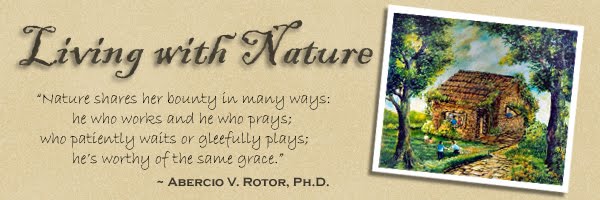
Let's Visit Nature in Murals
Former Title: A Visit to Nature's Garden in Murals
"The world is but a canvas to our imagination."
- Henry David Thoreau
Mural Paintings of Dr Abe V Rotor
Living with Nature Center
Author's Residence, San Vicente, Ilocos Sur

Eroded Shoreline of Palauig, Zambales
Continuous battering of waves and tides where every day the sea and river meet,
where runoff after rain flows down, rills to gullies grow, soil washed away and the bedrock exposed, seemingly beautiful, serene, strong. But it is not, it is a landscape changing, now in the making, now in a state of ruin, typical in many parts of the world where man has laid his hands on Nature's architecture in pursuit of agriculture and industry, and lately settlement and tourism.

Western Edge of the Cordillera, Santa Paradise, Ilocos Sur
The rocky shores of Santa is a favorite stopover of travelers for respite and relaxation. A popular lore tells us that when the scribe of the Spanish explorers was naming the places where they already established settlements, the scribe had a difficult time of thinking of a Catholic Saint's name of saints to name the place (Santa Catalina, Santa Lucia, and Santa Maria were already taken), so the town was simply named "Santa."

Watershed Stream, Mt Makiling, Laguna

Hornbill Sanctuary, Northern Tip of Luzon, between Ilocos Norte and Cagayan
The Luzon hornbill (Penelopides manillae), sometimes called Luzon tarictic hornbill, is a species of hornbill in the family Bucerotidae. It is endemic to forests on Luzon and nearby islands in the northern Philippines. As is the case with all Philippine tarictic hornbills, it has been considered a subspecies of P. panini.

Underground River, Puerto Princesa, Palawan
The Puerto Princesa Subterranean River National Park is a protected area of the Philippines. The park is located in the Saint Paul Mountain Range on the western coast of the island of Palawan, about 80 kilometres north of the city centre of Puerto Princesa, and contains the Puerto Princesa Subterranean River.

Pinsal Falls, Sta Maria, Ilocos Sur
for Aran, leaving a large mark of his footprints that locals call as “Tugot ni Angalo”.
The said footprint is now a naturally-made pool.
Ang-ngalo and Aran: The Creators
With the possible exception of Lam-ang and Kannoyan, hero and heroine or the Ilocano epic, perhaps there are no more famous characters in Ilocano saga than Ang-ngalo and Aran, cyclopean beings who, according to some Ilocano myths, were the first beings on earth. Ang-ngalo and Aran, popular beliefs say, lived before the creation of the sky, the sea, the land, and, for that matter, man. They were beings, with human form, of formidable proportions. They are believed to be the biggest giants in legend. Internet

Tabon Cave, Rizal, Palawan

No comments:
Post a Comment