Part 10 - Trees in Winter in Brisbane, Australia
“It seems like everything sleeps in winter, but it’s really a time of renewal and reflection.”— Elizabeth Camden, Until the Dawn
Photographs and Painting by Dr Abe V Rotor
"With paintbrush and acrylic colors, half lying on the lawn, I tried to capture the scene on canvas, the sun overcast revealing the undergrowth as temperate trees are mainly deciduous, save the evergreens mainly gymnosperms - cypresses and pines." - AV Rotor
"I found new life in a dead tree, a pair of birds singing." - AV Rotor
"Laughter is the sun that drives winter from the human face." — Victor Hugo
"One can follow the sun, of course, but I have always thought that it is best to know some winter, too, so that the summer, when it arrives, is the more gratefully received.” — Beatriz Williams
In winter meditate and reflect. "The tree is more than first a seed, then a stem, then a living trunk, and then dead timber. The tree is a slow, enduring force straining to win the sky." - Antoine de Saint-Exupery
The woods, unlike our tropical rainforest, are sparse as the trees undergo hibernation in winter. In the Southern hemisphere the seasons are exactly the opposite of ours in the northern hemisphere, when it is summer, it is winter in Australia,*
"Do trees, like many of us humans, feel lonely and alone in winter? There is a
difference between being alone and being lonely. Being alone is being away from others because you choose to. Being lonely is when there is no one there for you."
Winter is grace, winter is preparation. Meditate in the woods and learn more about life.
“If we had no winter, the spring would not be so pleasant; if we did not sometimes taste of adversity, prosperity would not be so welcome.”— Anne Bradstreet,
“Winter is a season of recovery and preparation.”— Paul Theroux
“Grace grows best in winter.” — Samuel Rutherford
Meditation with the trees. "The tendinous part of the mind, so to speak, is more developed in winter; the fleshy, in summer. I should say winter had given the bone and sinew to literature, summer the tissues and the blood." - John Burroughs
"I do an awful lot of thinking and dreaming about things in the past and the future - the timelessness of the rocks and the hills - all the people who have existed there. I prefer winter and fall, when you feel the bone structure of the landscape - the loneliness of it, the dead feeling of winter. Something waits beneath it, the whole story doesn't show.” — Andrew Wyeth"Signs of spring, though still a month ahead, are found in garden
plants growing in flower pots and plots cared by human hands."
Part 11 - Music in the Trees in Wintertime
Brisbane, Australia
Each leaf a note with the wind and in falling to the ground, a firefly beams with flashes of notes, crawlers in cadence of their own, and the treetops like the grass sway in cantabile, the winter wind chills in vibration, the germinating seeds whisper - all in keeping with the baton of Nature.

The Woods in Brisbane in Wintertime, Painting in acrylic
by the author. July 2023
How I love to paint the trees on the backyard of my daughter's family house in Brisbane, just across a railing to a park, kept in its natural state which I call "woods", reminiscent of Robert Frost's description of woods in his poem, to quote, "the woods are lovely dark and deep."
But the woods here are sparse as they undergo hibernation in winter, because in the Southern hemisphere the seasons are exactly the opposite of ours in the northern hemisphere, when summer to us is winter in Australia, owing to the inclination of the earth's axis.
When I, my wife and son, took a vacation in Brisbane the temperature was less than 10 degrees Celsius on the average, with occasional gusts of wind and drizzle, and fog that would shroud the trees, rivers and lakes, yet as a whole the climate was invigoratingly fresh, though quite cool.
There with paintbrush and acrylic colors, half lying on the lawn, I tried to capture the scene on canvas, the sun overcast revealing the undergrowth as temperate trees are mainly deciduous, save the evergreens mainly gymnosperms - cypresses, and pines, like agoho that we know.
The birds came to greet us, I supposed, or they were attracted by the music of my violin as I played some popular and semi-classical tunes, including our Kundiman. Isn't music universal, understood differently by all creatures, not only man but animals and plants - and the minutiae, as well?
Each leaf a note with the wind and in falling to the ground, a firefly beams with flashes of notes, crawlers in cadence of their own, and the treetops like the grass sway in cantabile, the winter wind chills in vibration, the germinating seeds whisper - all in keeping with the baton of Nature.
I viewed my painting for a long time, long enough to meditate on its rendition, not for its incompleteness or simplicity, for after all, there's no end at aiming perfection, and it is the viewer who completes what the artist may have missed. Such is the mystery of art, it reflects upon us beyond our comprehension in awe and reverence.
* The earth's vertical axis tilts by 23.5 degrees, equivalent to an angle of 66.5 from the orbital plane. The earth maintains this tilt throughout its revolution. This is known as the parallelism of the earth's axis which explains the reason for the occurrence of seasons alternately occurring in opposite phases between the northern and southern hemispheres.
AUTHOR'S NOTE: The painting hangs at the sala of the home of my daughter, her husband, and their two young children who joined me, their Lolo, in this rare adventure with nature.~
Part 12 - Greet Sunrise through the Trees
"Morning comes early as the sun peeps through the trees;
greet the birds and butterflies, lovers and artists." avr
Dr Abe V Rotor
Wake up under the green umbrella of trees,
cool and invigorating;
Breathe freely, away from the stale city air,
and catch the breeze passing.
Let the morning settle down on dewdrops,
on mist like curtain parting;
Just let the world go by on Nature's scale,
and life's sweet rhythm singing.
Wake up from too much haste and worry,
life's not a race for winning;
You may have the happiest moment in life,
listen to the trees singing. ~


Canopy of heritage trees laden with lianas and ferns,
Living with Nature Center, San Vicente, Ilocos Sur
Greet Sunrise Through the Trees in acrylic by the author. ~
“Trees are poems that the earth writes upon the sky.”
— Kahlil Gibran
*Original Title - 2022 Year of the Trees
Part 13 - Listen to the Trees
"I like to take the time out to listen to the trees, much in the same way that I listen to a sea shell, holding my ear against the rough bark of the trunk, hearing the inner singing of the sap. It's a lovely sound, the beating of the heart of the tree." - Author: Madeleine L'Engle"
Photos by Dr Abe V Rotor
Caimito (Chrysophylum cainito); Talisay (Lugo Ilk) Terminalia catappa)
I'm a pygmy among giant trees,
like walls of a fort guarding
against gust, noise, dust and glare,
whispering and singing.
They greet me as the sun rises,
bid me before sundown;
to my forebears and my children,
bestow them the biggest crown. - avr
Macopa or Wax Apple (Syzygium samarangense)
"I hear them laugh with the breeze
and make my life at ease;
I talk to them when lonely and sad,
and hush me when mad." - avr
"Listen to no one's advice except that of the wind in the trees. That can recount the whole history of mankind." - Claude Debussy
"I love the sound of the wind in the trees and the song of the birds and the shuffle in the leaves of my many woodland friends." - Jason Mraz
Living stumps of Gmelina arborea
felled by typhoon Lawin in 2016
Knock, knock, who is there?
whispers the passing wind,
wake up, it's time to eat. - avr
"There was no sound but the murmur of nasty little stinging insects, the occasional crack of a falling branch, and the whispering of the trees discussing religion and the trouble with squirrels." - Author: Terry Pratchett
"With watercolour, you can pick up the atmosphere, the temperature, the sound of snow shifting through the trees or over the ice of a small pond or against a windowpane. Watercolour perfectly expresses the free side of my nature." - Author: Andrew Wyeth
"Listen ... With faint dry sound, Like steps of passing ghosts, The leaves, frost-crisp'd, break free from the trees And fall." - Author: Adelaide Crapsey
Towering heritage anahaw (Livistona rotundifolia)
"Living towers you thrill us all,
sentinel, belfry, flagpole." - avr
Trees do not preach learning and precepts. They preach, undeterred by particulars, the ancient law of life." ― Herman HessePart 14 - DON'T CUT THE TREES, DON'T
Dr Abe V Rotor
“To see the world in a grain of sand
And a heaven a wild flower,
Hold infinity in the palm of your hand
And eternity in an hour,”
William Blake, Auguries of Innocence
Many years ago I recited this verse before my teachers in literature in high school, Mrs. Socorro Villamor and Miss Leonor Itchon, at the Colegio de la Imaculada Concepcion, now Divine Word College of Vigan. Hesitatingly I proceeded to interpret it.
Because I lived on the farm, the world I knew then was a physical one and the kind of life associated with it was as simple as the passing of seasons - when the rains come and the fields turn into a carpet of green until harvest time comes when the grains turn gold. I recalled my childhood in this poem I wrote years later.
Ambiance of Autumn in the Philippines in acrylic by the author c 2002
Childhood is when nobody misses
The morning before the sun rises,
Before the herons stake for fish,
And finches chirp in the trees.
War is fought with kites and fishing poles,
In hide-and-seek and barefoot races;
Faith grows with seasons the sky extols,
Virtues all that friendship embraces.
Summer is short, rainy days are long,
All these are but passing imagery,
For the young can’t wait, yet all along
The years, remains a lasting memory.
To recite again Blake’s verse brings out a larger view of life and the world. The innocence of childhood has given way to realities of adult life. The environment has lost much of its pristine nature. A revolution of knowledge has reached global proportion.
The essence of the verse now touches the dimension of philosophy rising above its own literary meaning. Its humility has turned into a challenge, like Markham raising a social issue against society, viewing poverty in Millet’s romantic painting, The Gleaners.
Indeed, progress has brought folly to man to dream of power – even to the point of transgressing creation, a dream that borders between reason and passion, temperance and lust, waking up a sleeping god in man that drives him to wrest control over time and space, pursue beauty and pleasure as he wishes. He has cracked the atom and the DNA, and amassed tremendous wealth and power. And he has started to probe the universe. Which only means man is playing God, the old sin of disobedience. “Quo vadis, Homo sapiens?”


Heritage trees, Mt. Makiling, UPLB Laguna
After retiring from government service and subsequently finding a niche in the academe, I found time once again to read the works of my favorite authors such as John Milton’s Paradise Lost and Paradise Regained and Ernest Hemingway’s The Old Man and the Sea.
I found again Alexander Pope, Thomas Gray, William Shakespeare, and Henry Wadsworth Longfellow - and of course, our very own Ophelia Dimalanta, Jose Villa, Sionil Jose, NVM Gonzales, Nick Joaquin, Rolando Carbonel, to name some local literary giants. From them I found valuable lessons, not only about nationalism, culture and the art of living, but techniques and style of using English, being a second language to many of us.
Henry David Thoreau (Walden Pond) and the great naturalist Charles Darwin (The Origin of Species), brought me close to Nature and led me to experiment in combining ecology and literature.
As I was writing this book, I could not help but ask myself, Will man ever regain his place in Paradise while he is on earth?
I can only imagine what the great French sculptor Auguste Rodin must have been thinking while at work at his masterpiece, The Thinker. What inspired Michelangelo's The Creation showing an omnipotent Creator reaching out for Adam at a spark’s distance from His finger? I remember other thought-provoking masterpieces like Salvador Dali’s Melting Clocks, and Vincent Van Gogh’s Starry Night. Perhaps Helen Keller who wrote, If I were given Three Days to See, saw more about the world than some people do who are not blind.
From where I was transfixed in reflection, absorbed in serious thoughts, a flock of pigeons soared into the sky. A chilly breeze whistled through the trees and joined the lilting children playing, and the sound of busy feet on the camino real. Time passed and a kind of stillness settled. I recited the old verse again. It brought nostalgic reflection of the past and the sinking sun.
As I prepared to leave for home I noticed a weed growing along the path that I was to take. I gently picked the lowly plant and examined it against the reddening sky. Why it bore flowers in disguise!
From here I began writing Don’t Cut the Trees, Don’t.~
Haunting shadow of a standing dead tree (camphor, Cinnamomum camphora) UST campus; requiem to a giant balete tree (Ficus benjamina), Lagro Subdivision QC.
--------------------
Don’t Cut the Trees, Don’t is a collection of ecology poems and paintings of nature. The tree is taken to represent the environment. Each poem and each painting is like a leaf of a tree each revealing a little of the many marvels of this unique creation. Each poem and each painting is a plea on behalf of this new vision and of this new ethics. Concealed behind each poem and each painting is the spirit of the author, Dr. Abercio V. Rotor, a man whose love and passion for the environment is well-known. (Armando F. De Jesus, Ph.D., Dean, UST Faculty of Arts and Letters)
It is a substantial collection, departing from the usual stale air of solitariness and narcissism which permeates most poetry today. It is therefore a welcome contribution to Philippine poetry in English, livened by visuals that add color to the poetic images. The oeuvre is not only pleasurable because of this. The poetic ability of the poet himself enriches the whole exciting poetic experience, a blurring of the line separating man from the rest of the living creatures outside. Every poem indeed becomes “flowers in disguise” using the poet’s own words. (Ophelia A. Dimalanta, Ph.D. Director, Center for Creative Writing and Studies, UST) ~
Part 13 - Trees are Benevolent Hosts
Dr Abe V Rotor
 The tree laughs, talks, with all the joys of childhood.
"A tree is a joy forever." Tandang Sora QC
 Playing hide-and-seek in a bamboo grove. The
spirit of the place gives quaintness to living.
Taal, Batangas
 A fallen mango tree makes a romantic
ambiance. (Atimonan, Quezon)
 Phylodendron gains foothold on Dita tree (Alstonia
scholaris) as it reaches for the sun several meters high.
UST Botanical Garden
 Algae and mosses live on the spongy bark of acacia,
providing nutrients to the tree, and creating a
favorable microclimate. UP Diliman, QC
 Balete (Ficus benjamina) strangles emergent tree
with interlacing roots and branches locking its host
to certain death, hence gaining a notorious name of
Strangler's Fig. Mt Makiling, Laguna
 Roots are exposed by slow erosion reveal tenacity
of this tree. The tree allows growth of plants and
animals like millipede and land snails, as well as
micro-organims, many are symbionts to the tree.
Mt Makiling Botanical Garden, UPLB
 Interlacing roots, principle of inarching, riprap
slopes and banks, provide abode to many organisms.
Mt Makiling, Laguna.
 Fruticose lichen clings on bark of tree. Lichens are
communities of algae and fungi. They aid in food
production and recycling of organic matter, as well
as help conserve water. Caliraya Lake, Laguna
 Crustose lichen coats trunk of young tree. Lichens are
important to the tree; they also indicate pristine
condition of the environment. Caliraya Lake, Laguna
 Drynaria fern as ephipyte helps conserve water, attract
wildlife that protects trees from pests and diseases.
It is not unusual that a branch gives way to the weight
of the tenant fern. St. Agustin Parish, Tagudin, Ilocos Sur
 Even after death the tree remains a host to red
mushroom, termites, other saprophytes and
decomposers, giving off its entire energy to
serve the living world.
Part 14
A tree fell and took with it its tenants and symbionts.
Everything was quiet, then came a gust of wind from nowhere. It sent a ten-year old samat tree crashing across the street.
Dr Abe V Rotor
Workers in the neighborhood in Lagro QC clear the blockage to restore traffic flow and electricity. Samat or binunga (Macaranga tenarius) though sturdy is no contest to the power of wind. But where did the cyclone-strong wind come from in a fine weather?
I felt obliged to do my own research having been the one who planted the tree in 2003 from a seedling I got from our home in San Vicente, Ilocos Sur. I needed the mature and yellow leaves in brewing wine and making vinegar. Marlo, my son needed the fruits in his thesis in the graduate school. The leaves are rich in tannin and other medicinal compounds. Its bark produces latex and resin.
Because of its thick crown the year round, the tree is a good shade and buffer against noise and dust. It was in this tree that birds that were not seen for many years suddenly appeared, among them the kikiaw (kiaw Ilk) or yellow and black oriole thought to have become extinct locally. Migratory birds would find the samat tree a lodging place in their long migration at the onset of winter in the North which marks our Amihan season when cold winds from Siberia sweeps across Asia down to the Pacific.
Then there were house sparrows that found shelter in the tree's thick crown. And not to be outsmarted was the pandangera or fantail bird. It would complain when disturbed sitting in her nest. And when a cat would get near the tree, the pandagera together with her mate would swoop down and drive the intruder away.
One time I released a gecko lizard on the tree. It did not stay long, when our parrot started imitating its mating call. Perhaps on discovering the hoax it left for the real call from its own kind in some trees in the La Mesa watershed which is very near us.
The green tree ants regularly built a nest or two in the tree. It was good because they controlled other insects, and they are good janitors. They glean on any food leftovers, and kept the surroundings clean, especially around the doghouse. Houseflies generally don’t thrive on clean environment.
When the tree fell it took with it the lianas, orchids, ferns clinging of its limbs. So with the lichens and mosses that are natural indicators of good air by their abundance.
You see, the tree is not just a tree. It is a host. A host of many organisms depending on it in various categories. Call it parasitism for feeding caterpillars, symbiosis for epiphytic bromeliads and orchids, commensalism for mosses and lichens. Free board and lodging for the seasonal perperoka. Fungi growing on the tree’s dead branch are saprophytes, bees and beetles and butterflies as pollinators.
When new leaves form, photosynthesis gets a boost. So the tree produces more food, and more oxygen that replenishes the carbon dioxide that we in the animal kingdom expel. And what happens to the “food” accumulated in the tree? It is further made into complex organic substances – cellulose and lignin in wood which we harvest for construction, crafts and fuels. Tannin for cure of diabetes. Xanthophyll and carotene for vitamins and natural dye, and many more.
All these attest to the tree’s role more than just a passive standing host. It is a system in itself, an ecological system or ecosystem in short.
The meaning of this is that when the tree dies the whole system also dies. And the sad thing is that the loss is irreversible.
I mourn for the felled samat tree on behalf of the creatures that benefited from it that have too died, and luckily for others, they have migrated and may have found another benevolent host.
But the puzzle remains. Everything was quiet, then came a gust of wind from nowhere. It sent this ten-year old samat tree crashing across our street.
 Theories are not rare to explain the incident. The most plausible is poor foothold. The tree was virtually sitting on adobe bedrock characteristic of the geology of QC, so that its root system had no other way of spread but sideways instead of downward with a tap root as principal anchor.
 Author displays cured samat leaves used in brewing basi wine and making vinegar.
There is a nearby drainage through which various wastes flowed - oil, detergents, alkali and acid rain, ultimately finding their way into the root zone and destroying much of the roots. The tree however held on without apparent sign of weakness.
On the meteorological aspect, thunderstorms have become more frequent, as a consequence of global warming, a phenomenon that is not yet well understood. But global warming is spawning more - and stronger - typhoons, hurricanes, and tornadoes all over the world. Extreme weather is now felt more often. Too much rainfall in one place causes flood, while too little rainfall causes drought in another place. Freak weather disturbances are not unusual, among them was a sudden thunderstorm on that fine day that toppled my favorite samat tree. ~
Part 15 - Bonsai is Nature's Art
Natural bonsai is Nature's art, that has for centuries inspired man to create miniaturized landscapes that fulfill his yearning for a connection to nature.
Dr Abe V Rotor
Manicured bonsai tamarind trees. Grand Palace, Bangkok, Thailand
When I saw the tamarind bonsai, it flashed into my mind the story of a wise man from the Orient who was asked, "What tree lives the longest?" to which he confidently answered, "The bonsai."
About the same time a scientist from California was asked of the same question. To which he replied with scientific authority, "The Sequoia."
For a long time the world debated about the issue. I found myself a fence sitter in my college days. Until I became a biologist.
Centuries old bonsai trees grace many parks and homes in China, Japan and Korea, the origin of the art of dwarfing plants into what we know today as bonsai. They are of course minuscule to the giant Sequoia or redwoods in western United States which stand twenty to thirty storeys high.
Some of these trees were already bearing cones at the time of Christ. That's more than 2000 years ago. So these trees held the record for a long time. Until...
The record gave way to gnarled dwarf trees, among them the Bristlecone, living on windswept rocky shores in the Mediterranean and other parts of the world where conditions of survival are extremely difficult.
Which brings about the puzzle - what really is the key to longevity?
I examined the tamarind bonsai in Thailand. Why they are pampered with care! By man, under the rule of monarchy.
I read extensively about the redwoods. Why they are pampered by nature! They dominate the ground, space and sky. They are the monarchs of the forest.
And neither gives the convincing answer to the puzzle.

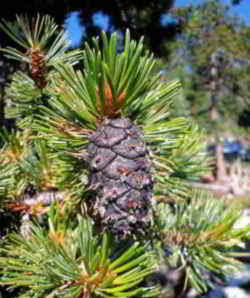
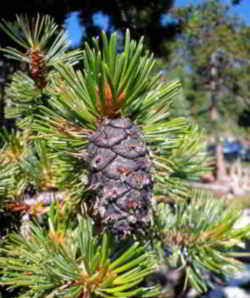
It is because the longest living tree, the Bristlecone (PHOTOS), is left all by itself to fend itself against the extreme conditions of the environment.
This strengthened by belief that natural resistance is the key to survival and longevity. It is natural resistance that enables the organism to survive and to live long. And here are the premises.
1. Controlled growth reduces need for food, water, space and nutrients.
2. Metabolism is slowed down when these requirements for growth and development are placed under restrictive control.
3. Extreme conditions "temper" organisms. Tempering is hardening of cells, tissues and organs, basically the protoplasm.
4. Tropisms are likewise honed under extreme conditions. Roots penetrate deeper to reach the source of water. Phototropism encourages the plant to reach out for the sun, chemotropism triggers survival tools such as chemical secretion. Latex and resin are protective substances.
5. On the cell level, slower cell division lengthens life. Fast multiplying cells are shorter lived than slow multiplying ones. Chromosomes get shorter every time the cell multiplies, their telomeres shrink every time the cell divides. This leads to faster senility and early demise of the cell. These premises I believe, hold the key to the so-called "green thumb" in the bonsai expert.
These premises are found in the giant Sequoia, although its size is deceiving. The truth is that the old Sequoia, like the bonsai, has reached virtual dormancy. Any organism in a state of dormancy or torpor undergoes very slow metabolism, which contributes to long life.
Beside, the Sequoia (PHOTOS) has other advantages in its natural habitat. It produces resin as a survival tool sealing off its attackers and healing the wound that they inflict. Here too, the Sequoia exhibits natural rejuvenation. It can recover from injuries to a point that a new tree may grow from the trunk and roots of a fallen one, like a tiller arising from its parent. It is natural tissue culture. Which leads us to the question, When does longevity end, when does it start?
I examined the bonsai tamarind trees and made reference to these factors. Well, I estimated their age to be about two centuries or so. Which is confirmed by the history of the Grand Palace. I compared them with the two bonsai tamarind trees at home which have shrunk into two-foot shrubs. An kindly old lady entrusted them under my care fifty years ago. Under natural condition tamarind grows into a very large tree.
This comparison points out that organisms of the same species don't only grow into different sizes in nature - they are actually controlled. More food and they grow fast and big, probably lanky and weak. On the other hand, starved them and they will become dwarf. Hardened and tough, and they live long.
On hind sight, does this hypothesis apply to animals? To humans? If so, then deprivation and exposure to adverse conditions - and not a bountiful life - is the key to long life.
Indeed, longevity is a mystery. ~
Part 16 - Trees for Peace
“Trees give peace to the souls of men.” - Nora Waln
Paintings by Dr Abe V Rotor
Convergence in acrylic by the author 2022
Tree of Liberty in acrylic by the author
"All I need to do is to climb a tree,
and all the world knows I'm free." avr
“You were born with wings, why prefer to crawl through life.” - Rumi
"White doves, emissaries of peace;
Trees, living monuments of peace." avr
Somewhere between the valleys and mountains,
caves and cliffs, streams and rivers;
man craves for something beyond his Being,
in verses and songs - and prayers. - avr
Wonder how birds in the sky see us down,
how minuscule we are, like their kind;
wonder how we look at them in the blue sky,
worlds apart we say yet we are one. -avr
“The bird who dares to fall is the bird who learns to fly.” - D. W. Journals ~Part 17
Do you believe in tree spirit?
Dr Abe V Rotor
Living with Nature - School on Blog (avrotor.blogspot.com)
Also open Naturalism -the Eighth Sense
Children playing at the edge of a forest in acrylic by the author
Call the kapre, dwende, tikbalang
to scare or just for fun;
call goddess Maria Makiling,
and Helios, the sun;
Imagine the world without them
- without them around.
Children wouldn't be home before dark;
and dogs at night wouldn't bark.
why sunflowers always face the sun,
and go to sleep when gone,
trespasser, beware, take the road instead,
else on some spirit you might tread;
over the hills and valleys thunder rolls
when angry Thor growls;
and mushroom spontaneously appear
breaking the ground like spear;
phosphorescence fascinates us,
after the fire has gone into ash;
look up they're but one - fireflies and stars,
fireflies are the missing stars;
holiest is the altar of nature unspoiled,
where logging was foiled,
where the kapre lives in big trees,
and scares with a sudden breeze;
paddies sigh, bamboos creak and whisper,
unseen - creatures or not - slither.
The world is alive with tales and legends;
untrue yet true, for they are a twin;
and if you pass by a tree, stop and listen
to the spirit that throbs within. ~
Children Camping by a Forest Stream in acrylic by the author
Part 18 - Nativity in the Forest
Dr Abe V Rotor
Nativity Scene, Christmas 2012. Forest mural by the author, 2010
Creatures in the forest welcome a holy guest:
the wild and tough wake up to a stirring,
the feathered and furred, the mimicked and camouflaged,
follow a beam of light in a clearing.
It is an altar hemmed by a cathedral of giant trees,
curtained by the living art of the vine;
and marked by emergent towers, the home of the eagle
that proclaims the birth of a child divine.
Woodsmen there who live in communities ever since,
join their children sing the songs of the trees,
fiddling crickets and hooting owls and playful primates,
the wind tamed into the whisper of the breeze.
Here the sun is sieved into moving shadows and art,
the rains nourish life from ground to the sky,
epiphytes of liana and orchid in grandiose bloom,
shower the newly born, birds singing up high.
How benevolent the wild, how humble the creatures,
how simple the scene created by nature;
here beauty is simple, unspoiled by civilization,
it offers comfort and refuge and nurture.
Unconventional the forest seems the bastion of faith
for those seeking life's meaning here and far,
for lack of a manger for the spirit of modern man,
to find here a Child and protect the green altar. ~
Part 19 - Towering Anahaw Palm Trees
Living with Nature Center
San Vicente, Ilocos Sur
Dr Abe V Rotor
Rising up to more than fifty feet through the canopy of nearby trees, and into the sky as emergents, these heritage palm trees are a living treasure of the arboretum of the Living with Nature Center. Their trunks are virtually perfect Parthenon columns of nature, the leaves shaped into a huge umbrella. Old leaves remain hanging in the crown drooping like a well-knit skirt, which serves as abode of fruit bats, their sleeping quarters in the day, and working station at night, indeed an ideal home for these unique nocturnal residents of the local ecosystem.


Anahaw (Livistona rotundifolia or Saribus rotundifolia) is regarded as the Philippine national leaf. Anahaw leaves are also a widespread symbol in the Philippines that is often used in awards and medals to represent high achievement, strength, and loyalty. The Anahaw leaf features a large, round outline and is glossy green in color. Livistona is used as natural parasol in Malaysia. In Australia.* The young nuts, the size of marble, are picked and eaten in their soft stage. The rind is trimmed with knife, the inner membrane peeled by hand, and the white soft core finds its way to the palate one after another. It was a popular snack in our time as kids when anahaw abound on the upland and forested areas. Today, Livistona is a threatened species; in fact endangered in many populated areas even on the countryside.

Radially arranged leaves of anahaw are made into shingles for roof thatch, superior in coolness, beauty and durability to the traditional nipa (Nipa frutescens) and cogon (Imperata cyclindrica). In my time, in pre-plastic era, the whole leaf was crafted into free-hanging raincoat (annanga Ilk), an indigenous wear on the farm, and in going to school and market as protection from monsoon rain. It was worn with woven hats made of the same material, or from leaves of coconut, pandan (Pandanus tectorius) or buri (Corypha elata). Imagine how the outfit looked like, complete with wooden clogs (bakya* or suekos Ilk), and abel shirt and short pants (puruntong) made from cotton.
* Internet. The Bakyâ or wooden clogs were once the most commonly used footwear in the Philippines before the introduction of rubber sandals. Part 20 - The Tree that Wears a Veil
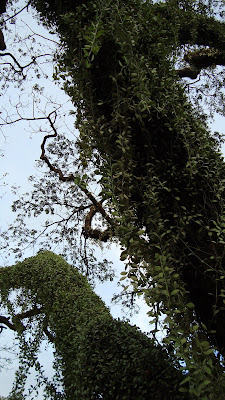
Verse and Photos by Dr Abe V Rotor