Monday, October 26, 2026

AUSTERITY: Tighten your belt in these difficult times.

AUSTERITY 
Tighten your belt in these difficult times.
Are you living an austere life?
Self-evaluation, 25 items

                    
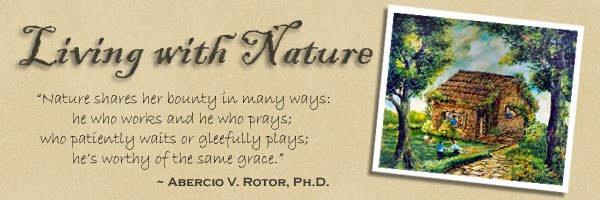
Austere Life on the Countryside, painting by the author
Austerity is practiced where there is not much money, so that money is spent only on things that are necessary. It is a condition of ​living without ​unnecessary things; a ​practice,​habit, or ​experience of living with limited resources. Austerity is a necessary economic tool of survival - and recovery - during difficult times, often as a policy of government. On the other hand, austerity is regarded as a virtue in the light of freeing oneself from the clutches of ostentatious and luxurious living.

Austere living keeps families and communities closer, a collective way to enjoy life with the least amenities, devoid of ostentatious show of wealth. Answer Yes to items you are presently practicing and/or those which you agree with.

1. You would rather buy things in bulk (paint, cooking oil, rice), or by the dozens (eggs, soft drinks) for ready supply at home, particularly these days when prices are increasing and supply is unpredictable.

2. You keep these tools and materials which you personally use now and then in various handiwork such as house repairs and gardening: a pair of pliers, hammer, set of screw driver, nails and screws, GI wires, electrical tester, and the like.

3. You would rather have your laundry and ironing once a week rather than daily or every other day, scheduling it usually on a weekend, thus saving precious water and electricity, and getting more helping hands from the family.

4. As a general policy of any state, the government should pursue a self sufficiency program in food, particularly staple (rice and corn) as the best way to insure food security, even if there is adequate supply in the world market.

5. In economics, austerity is when a national government reduces its spending in order to pay back creditors. Austerity is usually required when a government’s fiscal deficit spending is felt to be unsustainable. Austerity must cut down spending on development projects (countryside development funds from pork barrel), welfare and other social programs (subsidies and charitable expenditures).

7. The best way to save money is to set aside immediately a part of your salary, say 20 percent, and budget strictly the 80 percent. This is more effective than setting 20 percent after having budgeted and spent 80 percent of your salary.
                                                    
8. You participate in the informal economy just like the farmer’s wife who goes to market to sell farm products and comes back with various household supplies. This is contemporary barter system. This is entrepreneurship on the grassroots.

9. Food supplementation reduces our dependence on conventional food, discovery of new food sources like seaweeds, wild food plants, as well as the discovery of new ways to prepare food comes at the heels of austere living. Hamburger from banana flower (puso), roasted rice for coffee or roasted corn, papait vegetable, sea cucumber, kuhol, the many uses of gabi, substitution of wheat flour with rice flour. Substitution of staple food with root crops (camote, cassava) to save on precious rice.

10. Postharvest losses reduces our supply, in fact to one-half, that by saving even only 10 percent of what is wasted, would be sufficient to fill up our annual deficit in rice and corn. Austerity is reducing our waste on all levels – production, post production, food preparation.

11. Austerity is the most practical weapon to fight obesity. It means avoidance of junk food, moderation in eating, and consumption of natural food. It is also favorable to health. Less kidney trouble, liver ailment, cardiac problem, high blood pressure. It means less hospital cases, cancer, ulcers, less alcohol consumption, etc. Austerity means natural beauty, good fit, good stride, and happy disposition.

12. There are more and more good schools in the provinces and chartered cities. We would rather send our children in these schools for practical reasons.

13. Grains would rather be used directly as food and lessen the amount of using them in producing animal protein by feeding the grains to poultry and animals. By doing this we maximize the value of food and make them available to ordinary people.

14. Israel as an emerging new state adopted an austerity program lasting for 10 years (1949-1959). When USSR collapsed, Cuba adopted an austerity policy (1991 onwards) to be able to survive as an “orphaned socialist” state. Austerity is aimed at attaining self-reliance at a time of crisis.

15. Private banks or institutions like IMP may require a country pursues an austerity policy if it wants to re-finance loans that are about to come due. The government may be asked to stop issuing subsidies or to otherwise reduce public spending. We call this as “IMF conditionality.”

16. People’s power – the cry of the first EDSA Revolution – fizzled out because the newly acquired empowerment was not used put to proper use as evidenced by unsuccessful cooperative movement, agrarian reform which turned out to be confrontational between right of property and right of tillage, rampant and blatant graft and corruption in the government, declined productivity in agriculture and industry, spread of poverty.

17. Family planning refers to limiting the number as well as proper spacing of your children. If there is a sin of commission or omission, there is also a sin of neglect – and if that neglect is within the knowledge of the sinner, and the consequence is the ruin of the lives of those under his care as parent, atonement is almost unthinkable.

18. It is easier to meet our needs than our wants to most people although to many, affluence is pursue even before needs are met.


It's time for the family and clan to stick together in weathering down the effects of economic crisis.

19. Youth today are torn between choices of white collar jobs and blue collar jobs. They are lured to easy education – diploma mill, and on the modern method of leaning on the computer which actually does not offer an “end course” that makes one a professional like a doctor, lawyer, agriculturist, and the like. Austerity calls for a re-definition of courses that are functional in nature and p[practical in application, and relevant to the changing times.

20. Limits to growth come like a moving vehicle suddenly running out of fuel, its tires worn-out and flat, engine conking out, while the road is getting rougher, narrower and steeper. Austerity is applying the brakes before all of these happen. It is anticipating the limits to growth, before it turns against you.
  • People for manpower turning overpopulation, unemployment
  • Industrial growth turning out pollution
  • Agriculture causing erosion, siltation; invading wildlife
Austerity brings awareness, it gives us time to plan out, to review our goals in these difficult times.

21. Hi-tech is expensive and it is the consumer who ultimately pays it. It is to the people the users of Hi Tech charge its cost. Austerity calls for a moderation in technology. Austerity and innovative technology are compatible. Innotech is people’s technology.

22. Modeling of successful projects such as coops (farmers multipurpose cops), agro-eco center (Cabiokid), Kabsaka (Sta. Barbara, Iloilo), mangrove farming, seaweed farming, Irrigators’ association, Dr. Parra of Iloilo – these must ride on Filipino trait of gaya-gaya. Gaya-gaya put to good use. Peer teaching and learning is effective among the masses, and should be complementary with formal education. Austerity opens a gateway to look into models we can adopt under our local conditions.

23. “Necessity is the mother of invention," so “crisis is the sphinx of survival.” (Story of the Sphinx.) What is it that walks on all fours in the morning, two at noon and three in the evening?”) Crisis is Darwin’s theory of survival of the fittest. It rewards the strong, eliminates the weak, humbles the proud, deepens the soul, and elevates the spirit. - of those who can make it.” Crisis is the time to test man’s soul.” Soul is the ultimate of man’s capacity to survive. (Thesis of Victor Frankl – A Search for Meaning)

Reference on living close to nature by the author

24. You practice the 8Rs in Waste Management: Reduce, Recycle, Refurbish, Renovate, Restore, Reserve, Revere (and Rotor – Rotate). These 8Rs are vital tools in living an austere life.

25. The more closely related supply and demand cycle in a given community, the more self-reliant the community is. This means that in that community, people produce what they consume; consumption motivates production and vice versa. This according to Dr. Anselmo Cabigan is a basic tenet of austerity, because the self-reliant community becomes less dependent on external factors and the vagaries of the larger environment.

When does Austerity come in? Wartime, recession and depression (US), epidemic, high inflation, queuing for food, disaster, embargo (N Korea), new settlements, poor harvest, political turmoil, religious conflict, El NiƱo, cyclone (Burma), earthquake (China), etc.

All questions are answered with Yes. You may use these items as your ready guide and reference for your home, school, and community outreach program.

Saturday, October 24, 2026

^ How do we celebrate THANKSGIVING DAY in the Philippines?

How do we celebrate THANKSGIVING DAY
in the Philippines?

US Thanksgiving Day Celebration   
Fourth Thursday of November 
November 27, 2025

Researched and organized for avrotor.blogspot.com  
TATAKalikasan AdMU Radyo Katipunan, and Usapang Bayan 
radio programs, by Dr Abe V Rotor

Do we celebrate Thanksgiving in the Philippines?
No, Filipinos do not traditionally celebrate Thanksgiving as a public holiday, though many have adopted it as a cultural tradition, blending it with Filipino customs. While American Thanksgiving is on the fourth Thursday of November, Filipinos often celebrate a similar concept of "pasasalamat" (giving thanks) around any significant milestone, such as graduations, homecomings, or exams. When celebrating American Thanksgiving, they may incorporate Filipino dishes like lechon or pancit into the feast. AI Overview-Internet
 
Filipinos often celebrate a similar concept of "pasasalamat" (giving thanks) around any significant milestone, such as fiestas, birthdays, graduations, homecomings, anniversaries and other occasions.
(Acknowledgement with gratitude: Internet Photos)

Ever since the pilgrims, Americans have celebrated days of thanksgiving, but until 1863 there was no one day of the year that people thought of as
thanksgiving day.

Sarah Josepha Hale who wrote the nursery rhyme, "Mary has a Little Lamb," thought there should be. Starting in 1827, she wrote to every president, urging him to establish one, but no one listened until Abraham Lincoln, after the victory at Gettysburg, issued a proclamation setting aside the last Thursday of November as a day to give thanks for the survival of the nation.

US Thanksgiving Day marks the end of the American Civil War

The American Civil War was the culmination of the struggle between the advocates and opponents of slavery that dated from the founding of the United States. This sectional conflict between Northern states and slaveholding Southern states had been tempered by a series of political compromises, but by the late 1850s the issue of the extension of slavery to the western states had reached a boiling point. The election of Abraham Lincoln, a member of the antislavery Republican Party, as president in 1860 precipitated the secession of 11 Southern states, leading to a civil war.

The Union won the American Civil War. The war effectively ended in April 1865 when Confederate General Robert E. Lee surrendered his troops to Union General Ulysses S. Grant at Appomattox Court House in Virginia. The final surrender of Confederate troops on the western periphery came in Galveston, Texas, on June 2.

It is estimated that from 752,000 to 851,000 soldiers died during the American Civil War (more than all US soldiers combined who died in WW1 and WW2 and other wars America was involved, including Vietnam war*). This figure represents approximately 2 percent of the American population in 1860. The Battle of Gettysburg, one of the bloodiest engagements during the Civil War, resulted in about 7,000 deaths and 51,000 total casualties.

Reference: Who was Abraham Lincoln? By Janet Pascal, illustrated by john O'Brien, Grosset & Dunlap 2008; Internet

Thanksgiving is a national holiday celebrated on various dates in October and November in the United States, Canada, Saint Lucia, Liberia, and unofficially in countries like Brazil and Germany. It is also observed in the Australian territory of Norfolk Island. Date: Thursday, November 28, 2024; Observed for: 403 years

As an American colony from 1898 to 1946, the Philippines celebrated Thanksgiving on the same day as the United States. Internet
Photo 

President Manuel Quezon even declared it an official local holiday in 1935. Commemoration paused during the Japanese occupation, although locals still celebrated secretly. The tradition returned during the administration of former President Marcos, who even moved the date to September 21. It ended after the 1986 EDSA People Power Revolution.

Today, though Thanksgiving is no longer an official holiday in the Philippines, many Filipinos celebrate it as a cultural tradition. Some restaurants even create special menus featuring classic dishes, like lechon or roasted pig* in lieu of turkey.. Internet

AUTHOR'S NOTE: Let's set an official Thanksgiving Day in the Philippines for Filipinos to look forward for peace and unity, security and stability.  It is a date to rally the people to save our country from corruption and disintegration, hopelessness and Bahala Na syndrome. Thanksgiving is a goal to celebrate as a nation, not only personal and isolated celebration. Not an aftermath of undefined "victory", but a purposeful achievement. and glory. - AV Rotor 

AI Overview
Thanksgiving Day in the Philippines

The Philippines historically celebrated Thanksgiving on the fourth Thursday of November during the American colonial period, later shifting to September 21 under President Marcos, and a 2026 House bill proposes reviving it on the fourth Thursday of November.
Overview
Thanksgiving is not currently an official nationwide holiday in the Philippines, but it has a long and evolving history influenced by American rule and later political changes.

Historical Timeline
o  American Colonial Period (1901–1935)Thanksgiving was celebrated in the Philippines on the fourth Thursday of November, mirroring the U.S. tradition. Philippine News Agency
Act No. 345 (1902) made it an official public holiday. Philstar Life
o  Commonwealth Era (1935–1941) President Manuel L. Quezon continued issuing proclamations declaring Thanksgiving a national holiday. Philstar Life
o  Japanese Occupation (1941–1945) Americans and Filipinos celebrated Thanksgiving secretly. Philippine News Agency
o  Post‑War to Early Marcos Era. Thanksgiving continued to be observed annually through presidential proclamations. Philstar Life
o  Marcos Era (1973–1985) Proclamation No. 1181 (1973) moved Thanksgiving to September 21, aligning it with the “Bagong Lipunan” ideology. Philippine News Agency
This observance ended after the 1986 EDSA Revolution. Philippine News Agency

Modern Developments
o  Proposed Revival (2026) House Bill No. 7613 was approved on third reading in August 2026, proposing National Thanksgiving Day on the fourth Thursday of November.
o  The bill aims to promote gratitude, unity, and national solidarity. Philstar Life
It still awaits Senate approval before becoming law.

Cultural Context. Thanksgiving is widely recognized due to American influence but is not a traditional Filipino holiday today.
Filipinos typically focus on “ber-month” holidays such as All Saints’ Day, All Souls’ Day, and Christmas. beholdphilippines.com

Key Dates Summary
Period Thanksgiving Date Notes
1901–1935 Fourth Thursday of November American colonial rule 
1935–1972 Fourth Thursday of November Continued by Quezon and successors
1973–1985 September 21 Marcos-era “National Thanksgiving Day”
Post‑1986 None Holiday discontinued
Proposed (2026) Fourth Thursday of November Pending Senate approval

The Philippines’ Thanksgiving observance has shifted significantly over time, reflecting changes in governance and cultural identity.  Official pronouncement of Thanksgiving Day 
still awaits Senate approval before becoming into law.

^ "Take me for a moment away from you, Mother Earth, that I may see my friends, neighbors and me."- avr

 Mother Earth's Day

"Take me for a moment away from you, Mother Earth,
that I may see my friends, neighbors and me."- avr
Formerly, Scenic Rural Iloilo from the Air 

                    Photos and Poem by Dr Abe V Rotor

  
 Biggest spotlight - the sun - reveals a typical farming community, the fields 
basking with the golden color of grain and color of the earth after harvest.

Take me for a moment away from you, Mother Earth,
higher than the highest mountain, the tallest building,
that I may view life whole and solid and unabridged
in a perspective beyond details, and without stirring:

I see clouds shrouding you from the sun and blue sky,
in cumulus like giant mushroom on the horizon, rising,
and released into nimbus, becoming heavy, falling as rain
in the accompaniment of wind, thunder and lightning.

I see rivers swell and lakes fill to the brim in monsoon,
flooding fields and pasture, spilling through the valley,
meandering, roaring over waterfalls and boulders,
resting in swamps and estuaries, then flowing to sea.  
  
I see farmers in the field, women and children, too,
and work animals pulling the plow and the harrow;
I hear singing and laughter and joyous conversation,
barking of dogs, cackling  of fowls trailing the furrow.

I see harvesters gather the golden grains by hand;
drying shocks in the sun, and building  haystacks;
I see flocks of pigeon and native chicken gleaning,
women and children, the sun setting on their backs.  

I see the fields scorched, a smoke here and there - 
brush fire! when the grass dries up bursts into flame
spreading all over, burning anything on its path - 
what a waste! but it is nature's work and game. 

I see poor harvest, good harvest, where and why,
crops early or late, and fields never planted at all;
I see farming a way of life, farming as a business,
and farm life in all seasons, happiness its goal.

I see children flying kites of various makes and colors,
beside them grownups cheering, coaching, flying
their own kites too, oh, they have not forgotten
the art of their childhood, so do I, reminiscing.

I see children playing patintero, trompo and sipa,
games of old folks when they too, were children;
games of beetles and spiders as gladiators;
palo de sebo and pabitin cannot be forgotten.   

I see tourists, I see balikbayan, I see old and young;
familiar and unfamiliar faces, sweet, shy, and bold;
I see children going to school, housewives to market,
people of all walks of life, always on the move. 

I see the hills and mountains, to me they're the same,
but where have the forests gone, the pasture?
I see the rivers, the lakes and ponds old as they are,
I have always loved all of these as I love nature.  

I have seen enough, let me return, Mother Earth,
to my home, sweet home, on the farm, to my family;
and tell them of what I've seen in my short sojourn; 
down below I saw my friends, my neighbors, and me. ~  

  
  Geometric parcels of farmland in parallel formation apparently 
   show diversified farming and system of crop rotation. 

 
It's the peak of summer, and the rains have not arrived.  
Green patches are fields irrigated from shallow wells.

Residential houses huddle on one side of a creek (left); 
farms undergo fallowing, a resting period in summer.

Misty air looms over the dry landscape - a prelude to monsoon.

 
This fringe of land appears to have a sub-climate of its 
own influenced by the surrounding sea, while the
 rest of the island undergoes the normal dry season. 

  The uplands were once covered with forests and grasslands, 
now converted into agriculture and human settlements.  
A wisp of smoke greets the lazy morning air from among 
the trees that line a creek appearing like a miniature forest. 

 
A unique symmetry created by a natural waterway crowded 
with trees that form a natural windbreak and  sanctuary of 
surrounding organisms specially in summer. ~ 
--------------------------------------------------
AI Overview
"Take me for a moment away from you, Mother Earth, 
that I may see my friends, neighbors and me."- avr
Living with Nature School on Blog 
Naturalism - The Eighth Sense 

The line expresses a momentary longing to step back from the burdens, wounds, or overwhelming realities of the natural world, while still acknowledging a deep bond with Mother Earth.

How this fits Dr. Abe V. Rotor’s ecological themes
Dr. Abercio V. Rotor is widely known for eco-poetry that highlights humanity’s relationship with nature, environmental justice, and the urgency of ecological care. De La Salle University. His works often portray Earth as a living, nurturing presence — a mother figure — while also confronting the damage humans inflict on the environment.

Given this context, the line can be understood as:
o  A plea for temporary escape from environmental suffering — disasters, degradation, or the emotional weight of witnessing ecological decline. Rotor’s eco-poetry often “dismantles disasters to bring forth survival through witnessing” suggesting that environmental awareness can be emotionally heavy.
o  A moment of human vulnerability, where the speaker feels overwhelmed by the responsibility or grief tied to caring for the planet.
o  Not a rejection of nature, but a brief pause — a breath — before returning to the work of stewardship.

Symbolic meaning “Mother Earth” signals affection, dependence, and reverence. Rotor’s poetry consistently frames Earth as a nurturing but endangered presence

“Take me… away from you”
suggests emotional fatigue: the speaker is overwhelmed by what they see — destruction, imbalance, or humanity’s failures.

“For a moment” is crucial: it implies the speaker will return. The bond is unbroken.
In essence, the line captures the tension between love for nature and the pain of witnessing its suffering — a recurring theme in Rotor’s eco-literary work.

Why this interpretation fits Rotor’s eco-literacy
Rotor’s ecological literacy emphasizes:
o  Mutualistic relationships between species and environments
o  Environmental justice and testimony against ecological abuse 
o  Using poetry to inspire sustainable though

A line asking for temporary distance from Mother Earth aligns with the emotional dimension of ecological witnessing — the need to step back, reflect, and regain strength before continuing the work of caring for the planet. ~
 

^ I am Nature Crucified

 I am Nature Crucified

I am Nature crucified by the unending pursuit of progress, 
the goal and measure of the Good Life.
 Dr Abe V Rotor

  Silhouette of a tree skeleton, QC. Photo by the author

I am Nature crucified, Paradise lost to my own guardian
whom my Creator assigned custodian of the living earth;

I am Nature crucified by loggers, my kin and neighbors 
annihilated, forever removed from their place of birth;

I am Nature crucified by slash-and-burn farming dreaded
- once lush forests now bare, desertification their fate;

I am Nature crucified, greedy men with giant machines
take hours to destroy what I built for thousands of years;

I am Nature crucified in the name of progress, countries 
vying for wealth and power, fighting among themselves; 

I am Nature crucified, rivers are dammed, lakes dried up,
swamps drained, estuaries blocked, waterways silted;

I am Nature crucified, the landscape littered with wastes,
gases into the air form acid rain, and thin the ozone layer;

I am Nature crucified, flora and fauna losing their natural
gene pools by selective breeding and genetic engineering;

I am Nature crucified, the earth is in fever steadily rising,
ice caps and glaciers melting, raising the level of the sea; 

I am Nature crucified, privacy and rest becoming a luxury
in a runaway population living on fast lanes, and rat race. 

I am Nature crucified, inequitable distribution of wealth
the source of conflict, greed and poverty, unhappiness;

I am Nature crucified by the promise of heaven in afterlife,
the faithful restrained to regain Paradise while on earth.

I am Nature crucified by scholars of never ending debates,
on the goodness of the human race in fraternal praises;

I am Nature crucified by the many denominations of faith,
pitting God against one another in endless proselytizing;

I am Nature crucified by licenses of freedom in extremism,
human rights and democracy - tools of inaction and abuse;

I am Nature crucified by mad scientists splitting the atom,
building cities, tearing the earth, probing ocean and space;

I am Nature crucified by capitalism, consumerism its tool
to stir economy worldwide, wastefulness its consequence;

I am Nature crucified by the unending pursuit of progress,
the goal and measure of superiority, nation against nation;

I am Nature crucified by man’s folly to become immortal:
cryonics, cloning, robotics - triumvirates for singularity.

I am Nature crucified, hungry, thirsty, imprisoned, naked,
abandoned – wishing some souls to stop, look and listen. ~

                 Published Lagro Gazette Jan-Mar 2017; reprint from Living with Nature in our Home and Community,                               2023pp 229-232, Sadiri Publishing


ANNEX A _ AI Overview
 “I am Nature Crucified”

The phrase “I am Nature Crucified” expresses how human greed and destructive behavior inflict suffering on the natural world, portraying nature as a victim sacrificed by human actions.

Context from Dr. Abe Rotor’s work

The article appears in Living With Nature in Our Home and Community, where it is listed among three pieces that warn of the consequences of man’s destructive behavior and folly toward affluence. This grouping signals that the phrase is meant as a powerful environmental metaphor, not a literal statement.

Core meaning
o  Nature as a crucified figure — The phrase evokes the image of crucifixion, a symbol of extreme suffering and unjust sacrifice. Rotor uses this to show that nature bears the pain of human exploitation, pollution, and overconsumption.
o  Human responsibility — By personifying nature, Rotor emphasizes that environmental destruction is not abstract; it is harm inflicted on a living system that sustains human life.
o  Affluence and folly — The web result notes that the article warns against the folly of affluence
o  This suggests that the “crucifixion” is caused by modern lifestyles driven by excess, convenience, and disregard for ecological limits.

Moral and emotional appeal — The metaphor encourages readers to feel empathy and guilt, prompting reflection on how everyday choices contribute to environmental degradation.

How it fits into Rotor’s broader themes
Dr. Rotor’s writings consistently highlight:
o  Nature as teacher and provider
o  The need for conservation and mindful living
o  The dangers of consumerism and environmental neglect
o  
“I Am Nature Crucified” aligns with these themes by dramatizing the consequences of ignoring nature’s limits and treating the environment as expendable.

Why the metaphor is effective
o  It personalizes environmental harm.
o  It connects ecological issues with ethical responsibility.
o  It frames environmental destruction as a tragedy caused by human choices, not fate.

"I am Nature crucified, hungry, thirsty, imprisoned, naked,
      abandoned – wishing some souls to stop, look and listen."  ~

Friday, October 23, 2026

"Nature, Nature on the Wall, A Beautiful Life to Recall.” In loving memory of the late Veneranda V Rotor, ofs

"Nature, Nature on the Wall,
A Beautiful Life to Recall.”

In loving memory of the late Veneranda V Rotor, ofs
on her birth anniversary October 23, 1939-2024

“Humans love the art of make-believe,
  Scenic Nature painted on the wall,
  Once empty and forgotten now alive,
  Bringing in friends to the call.” - avr

       
Sor Veny V Rotor (seated) and Ms Helen I Nolasco (in red) pose before a mural 
painted by the author. Sor Veny was the author's sister, the eldest of 
three  siblings of the late Matias Rotor and Enriqueta Valdez..

“Sitting on the rock, reaching for the sky,
All day if you wish with no one asking why.”


“Grace is something in the spirit to share,
That grows the more we love and care.”

     
Sor Veny left, led house guest on a short walk at the botanical garden.

         What makes a house green
other than the color green;
but a verdant garden scene
happy and healthy to live in.

     
Sor Veny (foreground) led a short prayer before the 
Resurrection at her family's residence,

Apo Resureccion
How many times do we die and live again?
When we fall down and rise,
   we fail and succeed,
   when we are blind and see,
   deaf and hear,
   sin and atone,
   hate and love,
   love and care,
   ad infinitum;
the message of the Resurrection.
     

“Oh, heart on the wall,
Do you still feel?
Do you still throb,
The throb of love?
Ivy, ivy on the wall,
Don’t hide a living heart.”


“Heavenly rays above your head, an experience full,
Enlightening to the heart and soul;
Listen to a voice once on Damascus Road to Saul,
Shh… just listen, listen to His call.” - avr

     
Stairway connects art gallery and library.

Stairway connects
the past and the present,
man and his Creator,
events current and future,
known and unknown
now and hereafter.

     
Sor Veny Rotor (right) explained to house guest some modern 
paintings at the gallery, among them are her works.

Modern art
Impressionism to surrealism,
Dali, Matisse, Picasso to blame;
Avant-garde and graffiti, the same;
Please roll back to realism.

Sor Veny V Rotor and Ms Helen I Nolasco (in red), house guest 2020
Living with Nature Center Rotor Residence
San Vicente Ilocos Sur ~