
Usapang Bayan July 31 2026, 2-3 pm
Environmental degradation
is the most serious global abuse
Part 2 - Environmental Revolution - A Historical Perspective
Part 3 - Fifteen Urgent Environmental Issues - Subject of Presidential Debates
ANNEX - Environmental Revolution through activism, policy, and societal change.


4. Gases in the atmosphere trap heat from escaping, thus solar heat together with heat generated by the earth and man’s activities collectively contribute to global warming at an alarming rate. Climate change has been the cause of climatic adversities (typhoons, tornadoes, drought, blizzards), erratic weather, and other unexplained atmospheric phenomena.
5. In Al Gore’s “An Inconvenient Truth” the world is getting warmer and warmer at a geometric rate, far exceeding any period of the history of the earth except in its early formation. Warming is traced to increasing amount of CO2 in the air, the principal gas of combustion mainly of fossil fuel that runs agriculture, industry, transportation, and illuminate whole cities around the world.
6, The failure of timely shift to alternative fuel even as fossil fuel sources are dwindling, even as alternative energy is available, even as population demand tremendously increased in the past one hundred years, has grave consequences which we are feeling today, and this is just the beginning - fuel shortage, high cost of living, increasing inequity leading to mass poverty.
7. Environmental degradation is the most serious effect, not only in meeting actual need, but unending want of affluence apparently of no end. The earth is slowly choking with deadly gases, its surface defaced and stripped of natural cover, man-made materials dumped on land and water, in fact its geography has changed and continues to be modified directly and indirectly by man.
 8. Reminiscent of the Dust Bowl of the Dakotas in the US in the early 20th century are similar desertification cases, farmlands becoming wastelands due to excessive farming and poor management, such cases include the Sahel region (Africa) struck in the 60s by extreme drought, farmlands around the shrinking Aral Sea (Russia), the source of irrigation now only a measly fraction of its original size.
A comparison of Aral Sea in 1989 (left) and 2014 (right)
10. All over the world lakes and rivers are dying: Lake Chad of Africa, Aral Sea of Russia, tributaries of Mississippi in the US, Nile in Egypt, Yangtze in China, Mekong in Vietnam. Who would believe that odor of methane and hydrogen sulphide from the polluted harbor of Hongkong is the first to greet passengers even before landing on the sprawling modern airport? So with tourists on reaching the deck of the 100-storey Sears Tower on Lake Michigan in the US. ~

Decline in Carrying Capacity
Lost Civilizations
Need of a Conservation Program8
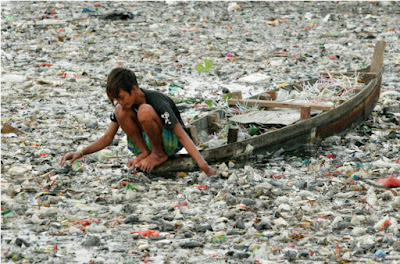 Floating Garbage, Manila Bay
 Dump Site, Payatas, QC
In the three presidential debates, the agenda of each of the candidates as far as environment is concerned, have not been defined, much less presented to the people. Yet environment is very basic to progress and development. Here are issues to look into as vital concerns for policy consideration and program implementation.
1. Desertification - Unabated expansion of arid areas formerly croplands and pastures, likewise former forests and woodlands. Remember the Great Dust Bowl of the Dakotas and Kansas in the US in the 1930s. The edges of deserts of the world called Steppes are expanding at an alarming rate causing famine and eco-migration.
2. Deforestation - The foothills of Mt Makiling have been converted into subdivisions, commercial centers and resorts. Mt Apo and Mt Pulag, two highest mountain in the
Philippines have lost their once thick vegetation. Deforestation pf Mangrove is as rampant. Mangroves are natural barriers against tsunami and tidal waves.
3. Pirating rivers and coastal areas and converting them into resorts, fishponds, and settlements - formal and informal (squatters), creating bottlenecks that impede flood waters, swamps that breed pests and diseases, and depriving freshwater and marine life. destruction of fish nursery.
4. Protection of threatened and endangered organisms. Remember Pamana (juvenile Philippine Eagle), our national symbol and pride. Hundreds of plants and animals belong to these two categories. The world has lost thousands which are remembered only by their fossils and in the archives.
5. Preservation of our natural gene pools - Establishment of natural gene banks, such as botanical gardens, modern concept of zoos (simulated natural wildlife) of native plants and species. Uphold strict regulation against genetically modified crops and animals such as Bt Corn and Golden Rice. Uphold Supreme Court decision to suspend indefinitely researches on genetic engineering. This is security from experimental genetically modified biological warfare.
6. Over fishing - regulate catch, fishing gears, observe off-season, protect fish sanctuaries, adopt quota system by area, by fishing unit, prosecute dynamite and other destructive illegal fishing.
7. No Garbage Importation. No to imported garbage, special mention of the controversial 2500 tons of garbage from Canada (See succeeding post). Earlier Japan did the same to us. We imported their garbage! The Canadian Garbage issue has not been resolved to date. (Check Internet)
8. Close down Payatas QC dump site. IT IS POLLUTING THE LA MESA RESERVOIR main source of drinking water for Metro Manila. A sub-culture has grown in this area which tourists are curious to visit. The site is a breeding place of criminality, sub-human subsistence, diseases, and toxic materials which include dioxin, the most poisonous substance ever created by man.
9. National and local waste management needs updating (state-of-the-art, like in Germany and the US), and strict implementation. Biogas generation, controlled incineration, compost fertilizer manufacture, more efficient recycling.
Landfill must be reviewed of its effects to health, ground water supply and long term consequences such as sink holes, liquefaction in case of earthquake.
10. Deteriorating and shrinking watersheds. Squatting and illegal fixtures, intrusion and other violations. are rampant. The life of our dams such as Ambuklao, Magat, Angat, Pantabangan, Binga is apparently being reduced, so with their efficiency in providing electricity and water supply. Destruction of their vegetative cover results in erosion and siltation. Their ability to attract clouds to become rain is reduced, thus there is less water to impound.
11. Air pollution. Metro Manila has the worst air quality, what with daily heavy traffic. There are solutions but they are easier said than done. For example, implement the Clear Air Act (Law), or decongest. Establish residence in less polluted areas, i9n the province. There are a number of solutions. List down those that every citizen or home should do.
12. Natural farming eliminates much of the preservatives and pesticides that destroy our environment. Natural products enhance good health and balanced environment. Save the animals. Bring back the natural predators of destructive pests like frogs, house lizards, spiders and ladybugs.
13. Water Impounding - Small Water Impounding Projects (SWIP) for irrigation, electricity, fisheries and wildlife conservation. Rainwater impounding is complementary on-farm and in urban areas. A series of small dams (China model) saves runoff water that otherwise flows out to sea or wasted along the way. We have a number of SWIP models in the Philippines (Sta. Barbara, Iloilo).
14. Parks and reservations on the national, regional and barangay levels for wildlife sanctuary, ecological, educational and recreational purposes. Proper maintenance is vital, so with updating the concept of parks and reservations, and not merely for pasyalan o pang turista lamang. These should be integrated with educational, research and other institutions. Models are found in many countries, which we may modify according oto our conditions.
15. Sanitation and orderliness - Our towns and cities need to be presentable on the standards set by many countries. Public places and markets, schools, government offices, transport stations, comfort rooms, are deplorably ill maintained. Epidemic breeds on dirty places. Informal communities are hardest to tow the line in the absence of a comprehensive program.
The environmental revolution represents the global shift toward recognizing, protecting, and sustaining the natural world through activism, policy, and societal change.
Historical Roots

The environmental revolution has deep historical roots, beginning with early human awareness of nature’s importance. Ancient civilizations, including those in India, China, and Peru, practiced soil conservation and sustainable resource management over 2,000 years ago, while Hindu and Buddhist philosophies emphasized interconnectedness and minimizing harm to all life forms. In Europe, medieval regulations, such as bans on coal burning in London, reflected early recognition of human impact on the environment. The Industrial Revolution intensified environmental degradation, prompting the first modern environmental laws in the mid-19th century and sparking organized activism Encyclopedia Britannica1.
Key Philosophies and Movements
The environmental revolution encompasses diverse philosophies. In the United States, conservationists like Gifford Pinchot promoted the efficient use of natural resources, while preservationists like John Muir and Aldo Leopold emphasized protecting wilderness and developing a land ethic that views humans as part of nature. Globally, environmentalism integrates ecology, human health, and social justice, recognizing humanity as a participant in ecosystems rather than an adversary Wikipedia
Modern Environmentalism
Contemporary environmental movements address climate change, pollution, biodiversity loss, and sustainable development. Activism now includes grassroots campaigns, policy advocacy, and technological solutions, with a focus on renewable energy, conservation, and environmental justice. The “25% Revolution” highlights the power of a committed minority to drive societal change: when roughly a quarter of a population consistently acts on environmental principles, it can shift the behavior of the majority. Earth Day.
Impact and Challenges
The environmental revolution has led to significant achievements, including the establishment of protected areas, stricter pollution controls, and global climate agreements. However, challenges remain, such as bridging the gap between environmental awareness and consistent action, addressing inequities in environmental impacts, and fostering international cooperation Wikipedia. The movement’s interdisciplinary nature—combining science, ethics, economics, and activism—remains crucial for developing holistic solutions.
Conclusion
The environmental revolution is an ongoing societal transformation that seeks to harmonize human activity with ecological systems. From ancient conservation practices to modern climate activism, it reflects humanity’s evolving understanding of its responsibility to the planet and the need for sustainable, collective action Encyclopedia Britannica ~
Environmental degradation is the most serious global abuse, not only in pursuit of actual human need, but his unending want of affluence apparently of no end. The earth is slowly choking with deadly gases, its surface defaced and stripped of natural cover, man-made materials dumped on land and water, in fact its geography has changed and continues to be modified directly and indirectly by man.

Ms Melly C Tenorio, host, and Dr Abe V Rotor, Guest
1. What withheld the world to shift to alternative energy was the cheap fossil fuel, virtually oozing from the ground and flowing through pipelines around the globe to feed the industrial boom and millions of cars as affluence rose to the point of ostentatious and frivolous living. But each car’s exhaust is a miniature volcano, erupting daily, worse than a Mt Pinatubo (Philippines) and Mount St Helens (US) combined.
2. The air accumulates gaseous materials and particulates, building acid rain that turns soil acidic and unproductive, defacing valuable works of art (historical relics and artefacts), causing illnesses heretofore unrecorded in medical books, and triggering other diseases as well, including the resurgence of ancient diseases like tuberculosis.

 Thinning of the ozone layer over Antarctica. Ozone hole has been detected over the Arctic.


3. The ozone layer, a protective blanket against radiation from space is being thinned by CFC and other gases. A hole at the southern hemisphere as big as continental USA, exposes millions, particularly children, in Australia and New Zealand to ultraviolet rays, a major cause of skin cancer. A smaller ozone hole is building up over the Arctic region.
4. Gases in the atmosphere trap heat from escaping, thus solar heat together with heat generated by the earth and man’s activities collectively contribute to global warming at an alarming rate. Climate change has been the cause of climatic adversities (typhoons, tornadoes, drought, blizzards), erratic weather, and other unexplained atmospheric phenomena.
5. In Al Gore’s “An Inconvenient Truth” the world is getting warmer and warmer at a geometric rate, far exceeding any period of the history of the earth except in its early formation. Warming is traced to increasing amount of CO2 in the air, the principal gas of combustion mainly of fossil fuel that runs agriculture, industry, transportation, and illuminate whole cities around the world.
6, The failure of timely shift to alternative fuel even as fossil fuel sources are dwindling, even as alternative energy is available, even as population demand tremendously increased in the past one hundred years, has grave consequences which we are feeling today, and this is just the beginning - fuel shortage, high cost of living, increasing inequity leading to mass poverty.
7. Environmental degradation is the most serious effect, not only in meeting actual need, but unending want of affluence apparently of no end. The earth is slowly choking with deadly gases, its surface defaced and stripped of natural cover, man-made materials dumped on land and water, in fact its geography has changed and continues to be modified directly and indirectly by man.
 8. Reminiscent of the Dust Bowl of the Dakotas in the US in the early 20th century are similar desertification cases, farmlands becoming wastelands due to excessive farming and poor management, such cases include the Sahel region (Africa) struck in the 60s by extreme drought, farmlands around the shrinking Aral Sea (Russia), the source of irrigation now only a measly fraction of its original size.
 A comparison of Aral Sea in 1989 (left) and 2014 (right)
9. We don’t have to go far. Our own Laguna Bay, bigger than the Sea of Galilee, is dying, its once pristine blue water as I saw it in the sixties as a UPLB trainee in a lakeshore barangay, Gatid, Sta Cruz, is now shallow and muddy as siltation and pollution from homes, farms and industries from four surrounding provinces worsen by encroaching settlements and fishpens clogging the lake – indeed a desecration of the lake’s beauty as described in Rizal’s celebrated novel, Noli Me Tangere.
10. All over the world lakes and rivers are dying: Lake Chad of Africa, Aral Sea of Russia, tributaries of Mississippi in the US, Nile in Egypt, Yangtze in China, Mekong in Vietnam. Who would believe that odor of methane and hydrogen sulphide from the polluted harbor of Hongkong is the first to greet passengers even before landing on the sprawling modern airport? So with tourists on reaching the deck of the 100-storey Sears Tower on Lake Michigan in the US. ~
Part 2 - Environmental Revolution
- A Historical Perspective
"If we pollute the air, water and soil that keep us alive and well... no amount of money will save us." — David Suzuki.
Dr Abe V Rotor
Frantic exploitation of natural resources through illegal logging operations, followed by slash-and-burn agriculture (kaingin), has brought havoc to the Philippines in the past century. The detrimental results are measured not only by the denudation of once productive forests and hillsides, but also destruction through erosion, flood, drought and even death.
An example of this kind of ruination brought about by abuse of nature is the tragedy in Ormoc City where floodwaters cascading down the denuded watershed, killed hundreds of residents and countless animals. It took ten years for the city to fully recover. Ironically, before the tragedy, Ormoc, from the air, looked like a little village similar to Shangrila, a perfect place for retirement.
Decline in Carrying Capacity
A land area designed by nature to sustain millions of people and countless other organisms, was touched by man and we are now paying the price for it. Man removed the vegetation, cut down trees for his shelter and crafts, and planted cereals and short-growing crops to get immediate returns. He hunted for food and fun, and in many ways, changed the natural contour and topography of the land.
Following years of plenty, however, nature reasserted itself. Water would run unchecked, carrying plant nutrients downhill. On its path are formed rills and gullies that slice through slopes, peeling off the topsoil and making the land unprofitable for agriculture. Since the plants cannot grow, animals gradually perish. Finally, the kaingero abandons the area, leaving it to the mercy of natural elements. It is possible that nature may rebuild itself, but will take years for affected areas to regain their productivity, and for the resident organisms once again attain their self-sustaining population levels.
There are 13.5 million square miles of desert area on earth, representing a third of the total land surface. This large proportion of land may be man-made as history and archeological findings reveal.
Fifteen civilizations, once flourished in Western Sahara, Tunisia, Libya, Egypt, the Sinai desert, Mesopotamia, and the deserts of Persia. All of these cultures perished when the people of the area through exploitation, forced nature to react. As a consequence, man was robbed of his only means of sustenance.
History tells us of man’s early abuse of nature in the Fertile Crescent where agriculture began some 3000 years ago. Man-made parallel canals joined the Tigris and Euphrates Rivers to irrigate the thirsty fertile valley. In the process, the balance of Nature was overturned when the natural drainage flow was disturbed. Because the treaty was violated, nature revenged. The canal civilization perished in the swamps that later formed. The sluggish water brought malaria and other diseases causing untold number of deaths and migration to the hinterlands. Among its victims was Alexander the Great.
Carthage had another story. Three wars hit Carthage, known as the Punic Wars. On the third one, the Romans plowed through the city, ending reign of this erstwhile mercantile power, and removing the threat to the Roman economy. After the conquest, the Romans pumped salt-water inland and flooded the fertile farms. Today, Carthage exists only in history and in imagination of whoever stands atop a hill overlooking what is now a vast desert.
Omar Khayyam, if alive today, cannot possibly compose verses as beautiful as the Rubaiyat as written in his own time. His birthplace, Nishapur, which up to the time of Genghis Khan, supported a population of 1.5 million people, can only sustain 15,000 people today. Archeologists have just unearthed the Forest of Guir where Hannibal marched with war elephants. The great unconquerable jungle of India grew from waterlogged lowland formed by unwise irrigation management.
It is hard to believe, but true that in the middle of the Sahara desert, 50 million acres of fossil soil are sleeping under layers of sand awaiting water. Surveyors found an underground stream called the Albienne Nappe that runs close to this deposit. Just as plans were laid to “revive” the dead soil by irrigation, the French tested their first atomic bomb. Due to contamination, it is no longer safe to continue on with the project.
The great Pyramids of Egypt could not have been constructed in the middle of an endless desert. The tributaries of the Nile once surrounded these centers of civilization. Jerusalem appears today as a small city on a barren land. It may have been a city with thick vegetation. This was true of Negev and Baghdad.
Need of a Conservation Program8
For the Philippines, it is high time we lay out a long-range conservation program to insure the future of the country. This plan should protect the fertility of the fields, wealth of the forests and marine resources, in order to bring prosperity to the people. As of now, the country is being ripped apart by erosion and floods due to unscrupulous exploitation by loggers and kaingeros.
It is only through proper management and effective conservation, such as reforestation, pollution control, erosion control, limited logging, and proper land use, that we can insure the continuity of our race. All we have to do is to keep ourselves faithful to the treaty between nature and man. Acknowledgement with gratitude: Internet Photo
"Man, being the superior organism, has not only won over his rivals - all organisms that constitute the biosphere. He has also assaulted Nature."
- AV Rotor, Treaty of Nature and Man (Light from the Old Arch)
Part 3 - Fifteen Urgent Environmental Issues
- Subject of Presidential Debates
Dr Abe V Rotor
Living with Nature - School on Blog [avrotor.blogspot.com]
Past lesson on Paaralang Bayan sa Himpapawid (People's School-on-Air) with Ms Melly C Tenorio 738 DZRB AM Band, 8 to 9 evening class, Monday to Friday [www.pbs.gov.ph]


In the three presidential debates, the agenda of each of the candidates as far as environment is concerned, have not been defined, much less presented to the people. Yet environment is very basic to progress and development. Here are issues to look into as vital concerns for policy consideration and program implementation.
1. Desertification - Unabated expansion of arid areas formerly croplands and pastures, likewise former forests and woodlands. Remember the Great Dust Bowl of the Dakotas and Kansas in the US in the 1930s. The edges of deserts of the world called Steppes are expanding at an alarming rate causing famine and eco-migration.
2. Deforestation - The foothills of Mt Makiling have been converted into subdivisions, commercial centers and resorts. Mt Apo and Mt Pulag, two highest mountain in the
Philippines have lost their once thick vegetation. Deforestation pf Mangrove is as rampant. Mangroves are natural barriers against tsunami and tidal waves.
3. Pirating rivers and coastal areas and converting them into resorts, fishponds, and settlements - formal and informal (squatters), creating bottlenecks that impede flood waters, swamps that breed pests and diseases, and depriving freshwater and marine life. destruction of fish nursery.
4. Protection of threatened and endangered organisms. Remember Pamana (juvenile Philippine Eagle), our national symbol and pride. Hundreds of plants and animals belong to these two categories. The world has lost thousands which are remembered only by their fossils and in the archives.
5. Preservation of our natural gene pools - Establishment of natural gene banks, such as botanical gardens, modern concept of zoos (simulated natural wildlife) of native plants and species. Uphold strict regulation against genetically modified crops and animals such as Bt Corn and Golden Rice. Uphold Supreme Court decision to suspend indefinitely researches on genetic engineering. This is security from experimental genetically modified biological warfare.
6. Over fishing - regulate catch, fishing gears, observe off-season, protect fish sanctuaries, adopt quota system by area, by fishing unit, prosecute dynamite and other destructive illegal fishing.
7. No Garbage Importation. No to imported garbage, special mention of the controversial 2500 tons of garbage from Canada (See succeeding post). Earlier Japan did the same to us. We imported their garbage! The Canadian Garbage issue has not been resolved to date. (Check Internet)
8. Close down Payatas QC dump site. IT IS POLLUTING THE LA MESA RESERVOIR main source of drinking water for Metro Manila. A sub-culture has grown in this area which tourists are curious to visit. The site is a breeding place of criminality, sub-human subsistence, diseases, and toxic materials which include dioxin, the most poisonous substance ever created by man.
9. National and local waste management needs updating (state-of-the-art, like in Germany and the US), and strict implementation. Biogas generation, controlled incineration, compost fertilizer manufacture, more efficient recycling.
Landfill must be reviewed of its effects to health, ground water supply and long term consequences such as sink holes, liquefaction in case of earthquake.
10. Deteriorating and shrinking watersheds. Squatting and illegal fixtures, intrusion and other violations. are rampant. The life of our dams such as Ambuklao, Magat, Angat, Pantabangan, Binga is apparently being reduced, so with their efficiency in providing electricity and water supply. Destruction of their vegetative cover results in erosion and siltation. Their ability to attract clouds to become rain is reduced, thus there is less water to impound.
11. Air pollution. Metro Manila has the worst air quality, what with daily heavy traffic. There are solutions but they are easier said than done. For example, implement the Clear Air Act (Law), or decongest. Establish residence in less polluted areas, i9n the province. There are a number of solutions. List down those that every citizen or home should do.
12. Natural farming eliminates much of the preservatives and pesticides that destroy our environment. Natural products enhance good health and balanced environment. Save the animals. Bring back the natural predators of destructive pests like frogs, house lizards, spiders and ladybugs.
13. Water Impounding - Small Water Impounding Projects (SWIP) for irrigation, electricity, fisheries and wildlife conservation. Rainwater impounding is complementary on-farm and in urban areas. A series of small dams (China model) saves runoff water that otherwise flows out to sea or wasted along the way. We have a number of SWIP models in the Philippines (Sta. Barbara, Iloilo).
14. Parks and reservations on the national, regional and barangay levels for wildlife sanctuary, ecological, educational and recreational purposes. Proper maintenance is vital, so with updating the concept of parks and reservations, and not merely for pasyalan o pang turista lamang. These should be integrated with educational, research and other institutions. Models are found in many countries, which we may modify according oto our conditions.
15. Sanitation and orderliness - Our towns and cities need to be presentable on the standards set by many countries. Public places and markets, schools, government offices, transport stations, comfort rooms, are deplorably ill maintained. Epidemic breeds on dirty places. Informal communities are hardest to tow the line in the absence of a comprehensive program.
ANNEX - Environmental Revolution through activism, policy, and societal change.
The environmental revolution represents the global shift toward recognizing, protecting, and sustaining the natural world through activism, policy, and societal change.
Historical Roots
The environmental revolution has deep historical roots, beginning with early human awareness of nature’s importance. Ancient civilizations, including those in India, China, and Peru, practiced soil conservation and sustainable resource management over 2,000 years ago, while Hindu and Buddhist philosophies emphasized interconnectedness and minimizing harm to all life forms. In Europe, medieval regulations, such as bans on coal burning in London, reflected early recognition of human impact on the environment. The Industrial Revolution intensified environmental degradation, prompting the first modern environmental laws in the mid-19th century and sparking organized activism Encyclopedia Britannica1.
Key Philosophies and Movements
The environmental revolution encompasses diverse philosophies. In the United States, conservationists like Gifford Pinchot promoted the efficient use of natural resources, while preservationists like John Muir and Aldo Leopold emphasized protecting wilderness and developing a land ethic that views humans as part of nature. Globally, environmentalism integrates ecology, human health, and social justice, recognizing humanity as a participant in ecosystems rather than an adversary Wikipedia
Modern Environmentalism
Contemporary environmental movements address climate change, pollution, biodiversity loss, and sustainable development. Activism now includes grassroots campaigns, policy advocacy, and technological solutions, with a focus on renewable energy, conservation, and environmental justice. The “25% Revolution” highlights the power of a committed minority to drive societal change: when roughly a quarter of a population consistently acts on environmental principles, it can shift the behavior of the majority. Earth Day.
Impact and Challenges
The environmental revolution has led to significant achievements, including the establishment of protected areas, stricter pollution controls, and global climate agreements. However, challenges remain, such as bridging the gap between environmental awareness and consistent action, addressing inequities in environmental impacts, and fostering international cooperation Wikipedia. The movement’s interdisciplinary nature—combining science, ethics, economics, and activism—remains crucial for developing holistic solutions.
Conclusion
The environmental revolution is an ongoing societal transformation that seeks to harmonize human activity with ecological systems. From ancient conservation practices to modern climate activism, it reflects humanity’s evolving understanding of its responsibility to the planet and the need for sustainable, collective action Encyclopedia Britannica ~
Usapang Bayan July 31 2026, 2-3 pm
Environmental degradation
is the most serious global abuse
Part 2 - Environmental Revolution - A Historical Perspective
Part 3 - Fifteen Urgent Environmental Issues - Subject of Presidential Debates
ANNEX - Environmental Revolution through activism, policy, and societal change.

Ms Melly C Tenorio, host, and Dr Abe V Rotor, Guest
Environmental degradation is the most serious global abuse, not only in pursuit of actual human need, but his unending want of affluence apparently of no end. The earth is slowly choking with deadly gases, its surface defaced and stripped of natural cover, man-made materials dumped on land and water, in fact its geography has changed and continues to be modified directly and indirectly by man.