Sunday, April 15, 2012

Environment: An Exercise on Recycling - How Useful are Old Tires?

Abe V Rotor


2 comments:

darrel said...

We can make use of our old tires. My uncle recycles our old tires by making it as a flower plot. In that way he already saves money and he also help our nature. Never place your tires above your roof because it can cause dengue.
March 9, 2009 6:13 PM
abelene marie manzano said...

when we done this exercise in our environmental science, its really hard for me to think what are the usual thing we done in our used tires, i answer in our exercise that we can make that as an alternative "paso" in our home, i can also made it as a improvised "duyan" for our children at home. with this kind of things we are able to help our nature and at the same time we are aware that "may magagawa pa sa mga basura"

Saturday, April 14, 2012

Let’s learn to read and follow the signs of Nature. Here are some examples.

Fireflies indicate a pristine environment.
Abe V Rotor

• Mad dog – Its tail is tucked underneath; animal restless biting at anything within its reach; froth coming from its mouth; stealthily moves about without any apparent direction; dreads the presence of water (hydrophobia); usually occurs during hot days particularly in summer. Be keen; keep distance; notify others of danger; get help.

• Drought – Occurs in summer; landscape scorched; dry river beds and ponds; brush fires occurs; lake water recedes; crack on earth, especially areas under water in monsoon; worst scenario - flowering of bamboo usually during El Nino, a phenomenon that happens every 7 to 10 years.

• Earthquake – Farm animals restless; horses kick and neigh; pigs snort; fowls abandon usual roost; turkey cackle; cattle seek exit from corral; dogs howl; and the like. Wild animals abandon abode – snakes come out into the open; reptile keep out of the water; elephants defy their master’s command; birds abandon nest, other emigrate.
• Typhoon – Doldrums-like calm; uneasiness to both humans and animals as barometer reading drops which means atmospheric pressure goes down; arthritis and hypertension symptoms are felt by sensitive persons. As typhoon approaches, sea becomes rough; sky overcast; clouds move fast to one direction; gusts of cold and warm wind, thunderstorms.

• Influenza – Precipitated by alternate cold and hot weather, thunderstorms, abrupt change in season. Influenza season is usually at the onset of amihan as the habagat comes to an end. Practical signs: people coughing in church and other gatherings; sale of cold tablets and antibiotics is up; hospitals full. Epidemic starts in the family, neighborhood, local community; also, in schools, malls and markets, and may spread to cover a city or district or province. Modern transportation has made spread of flu easier and wider.

• Pristine Environment – Abundance of lichens on trunks and branches of trees, rocks, and soil. There are three types: crustose (crust), foliose (leaf-like) and fruticose )fruiting type). They are biological indicators of clean air. The untimate test is the abundance of the fruticose type.

• Inclement Weather – Halo around moon; gray and red sunset; a storm may be coming depending upon the intensity of these signs.

Flying is the most critical application of daily weather conditions.

• Rain - Dragonflies hovering; aggressive biting of mosquitoes; ants move to another place carrying their young and provisions. The latter predicts heavy continuous rainfall or siyam-siyam or nep-nep. Herons on the move heralds the monsoon.

• Monsoon – Frogs croak; insects (termite, ants) swarm; lightning and thunder get frequent; first heavy rain in May vegetates the landscape, thus turning from brown to green. It comes early or late, but usually in later part of May. Global warming has brought unpredictable signs indicating that our climate is changing.

• Ripening of Fruits – Generally from green to yellow to orange (banana, orange, apple, etc. Determined by smell: guava, jackfruit, durian, melon, etc); shiny rind (caimito, siniguelas). Dull skin (chino), enlarged ridges and furrows (atis, guayabano, anonas)

Can you read other signs?
1. Sweetness/sourness of fruit
2. Maturity and succulence of vegetables (okra, cucumber)
3. Tenderness of nut (buko, macapuno)
4. Sweetness and maturity of fruit (watermelon)
5. Time to harvest singkamas, onions, garlic, sugarbeet
6. Presence of jellyfish
7. Red tide season
8. Coming flood (earthworm)
9. Time to harvest palay, corn, wheat.
10. Slippery walkway (presence of algae and scum)
11. Depth of water (by color, sound of oar, current, clarity)
12. Cloud reading of weather.
13. Glassy eyes (deep feelings like hatred, or “wala sa sarili”)
14. Wrinkles at the corner of eyes (happy disposition)
15. Furrows on forehead (problematic)
16. Rough hand (worker, also athlete)
17. Brilliant and attentive eyes (intelligence)
18. Clumsiness, strummer (nervous, uncertain)
19. Heavy feet (angry, lazy)
20. Tight jaw (angry, restlessly active)


Self-Administered Test in Home and Garden Management (True or False, 20 Items)

A typical countryside home, PeƱablanca, Pampanga

Abe V Rotor and Melly C Tenorio
Paaralang Bayan sa Himpapawid
8 to 9 evening class, Mon to Fri
DZRB 738KHz AM Band


1. Beauty and function are two separate things, in the same way as in biology – morphology and physiology.

2. Aesthetics is an art – it is both natural and man-made; it could be a combination of the two.

3. Sanctuary is a home, simulated from the natural habitat of an organism or group of organisms. Sanctuary imp[lies values of kindness, care, respect and understanding.

4. Generally, there are two parts of our garden to landscape – the public area and the private area, which are self explanatory.

5. Home is a call, ancient craving, in fact, biological like the salmon and the dove. It is the same homing instinct of the balikbayan.

6. Home is a fortress and a lighthouse – a thesis of privacy and security, and its antithesis – a beacon to guide and warn others of danger. Home is made by man and perfected by his hopes and dreams. Yes. We can reach the state of perfection, if only we do the best we can.

7. These are great Filipino artists whose works contributed to having our happy home of today: Nicanor Abelardo (poetry), Fernando Amorsolo (painting).

8. These are great Filipino scientists whose works are worthy as well: Nemesio Mendiola (agriculture/gardening); Deogracias Villadolid (tilapia), Leon Ma Guerrero (Medicinal plants), Angel Arguelles (Organic farming).

9. Other great Filipino women whose works likewise contributed to the making of a happy home: Maria Y Orosa (health, specially children’s healthcare), Fe del Mundo (home economics/food art).

10. Even how inadequate may be our home – even if it is located “along the riles”- it comes alive in full bloom when Christmas time comes.

11. A home is a movable feast, referring to Ernest Hemingway’s early novel The Movable Feast. We do not have movable feasts in the Philippines.

12. All homes are efficient in protecting us from ultraviolet rays that causes skin cancer, unburnt carbon and acid rain.

13. Trees are good sound resonators; they enhance volume, and make the pitch of notes clearer and louder.

14. False. A 20-year old acacia tree give a cooling effect in its shade the equivalence of 10-window type air conditioner 24 hours, 365 days a year without any cost of electricity.

15. If plants give off O2 as a by-product of photosynthesis. It is healthy to keep plants inside the house.

16. The best model for a garden is the Filipino style, because it is patterned after the structure of a tropical rain forest.

17. A tropical rain forest is basically made up of four stories just like a tall building: ground plants, shrubs, bushes and small trees, canopy layer, and emergents.

18. The most common canopy trees are most fruit trees, like santol, avocado, mango, while the most common emergent is the coconut.

19. There were twenty callers who shared the definition of Tahanan. Among their definitions is that it is like a nest, after the chicks have grown up and have learned to fly, they leave the nest, so with their parents, and the nest is abandoned.

20. A broken home is the most difficult to bear – broken by divorce, misunderstanding, quarrel, by early death, by prolonged absence – and most especially, by apparent lovelessness. If you belong to this kind of home there are two things you can do. Rebuild it, pick up the pieces and mend them together. The other is to make a new home yourself, and make it the ideal home of your dreams, the ideal home which is the highest expression of our worthiness on earth, and worthiness in heaven.

Answers
1. False, both are interrelated – useless each without the other.
2. True, it could be any of the three, but natural is the most authentic.
3. True, the word sanctuario, a religious term, is derived.
4. False. There is a service area, too.
5. True. Homing instinct is biological; it is the ancient gene that dictates our behavior.
6. True. Self-centeredness and altruism are inseparable.
7. False. It is how close we could get to what we call the ideal home that is important.
8. False. Nicanor Abelardo is a music composer.
9. True
10. False, reverse contribution. (Dr. del Mundo – medicine; Dr Orosa (food).
11. True. So with a nipa hut in the middle of a field, a shanties at Payatas, a barang-barong under the bridge – they can compare with a home in Forbes Park or a flat in Manhattan.
12. False. In fact the most popular movable feast we celebrate in the Philippines is the Holy Week, either in March or April.
13. False, unless we have trees and other plants around our dwellings.
14. False. They serve as buffer thus lessening sound, and slowing down sound waves.
15. The concept of a miniclimate in a green home is not true, not for a small corner.
16. False. At night the plant respires just like us human, animals and all creatures for that matter. The by-product of respiration is C02.
17. True. A TRF is multistoried. You can plant more per square area.
18. True.
19. True.
20. True, very true.

RATING
19-20 - Outstanding
16-18 - Very Good
13-15 - Good
10-12 - Fair
9 and below - Listen more to Paaralang Bayan
x x x
Friday, April 13, 2012

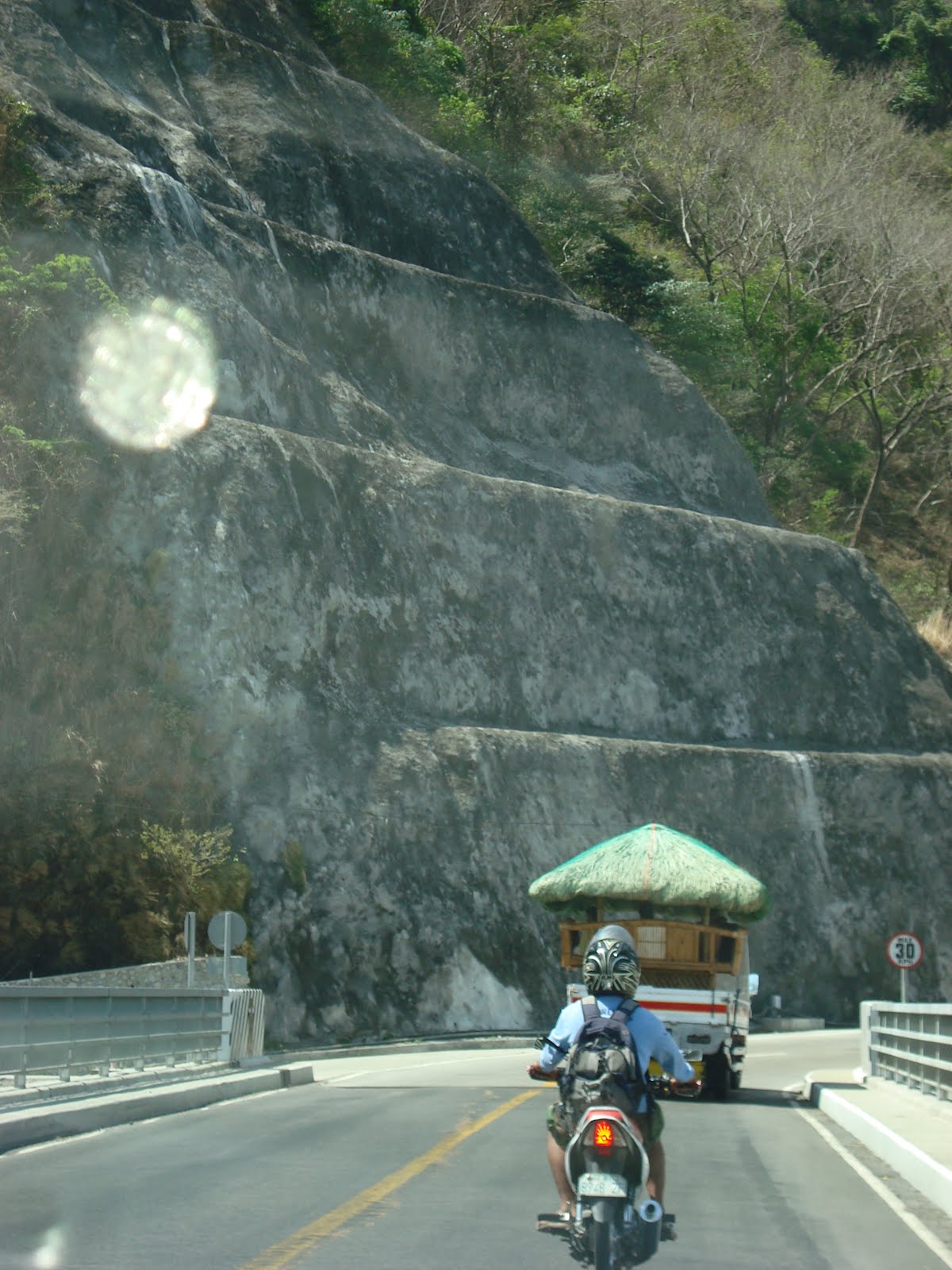
Bahay Kubo on Wheel

Abe V Rotor

I followed a bahay kubo on wheels,
along the highway though brief;
someday a bahay kubo on wings, too,
or one cruising the sea like ship.

Oddities make our light world,
for they take us to fantasy
with our feet firm on the ground,
they make us feel life easy.

Fancy lifts the spirit when it sags,
like a string tuned to a song,
or a bow and arrow fit strong,
that we rise above the throng.

We live the days of our childhood,
momentarily turning back
the hands of time in a once fairyland
in the magic of a nipa hut. ~

Bahay Kubo or Nipa Hut is a symbol of Philippine culture on the countryside, where life is simple and cozy, reminiscent of ancestral lifestyle and ethnic art.
Compact models are popular for urban residences and establishments like restaurants, like the model shown here. Photos taken by Leo Carlo Rotor along the highway crossing the fabled Banaoang Pass on a newly constructed bridge. Santa, Ilocos Sur.
 ------

Tuesday, April 10, 2012

Farming the Tridachna (Taklobo)

Abe V Rotor

The taklobo is now a threatened species.
Graduate students from the University of
Santo Tomas visit a taklobo farm in Masinloc,
Zambales, 2010
.

Taklobo shell as holy water receptacle.
Mount Carmel Church, QC


One way to spend a summer is to visit marine projects such as a Tridachna or taklobo farm. Farming the sea includes seaweeds such as

Caulerpa or lato, green seaweed, ar-arusip in Iloko
Porphyra or gamet, red seaweed, also known as nori in Japan
Codium or pokpoklo, green seaweed
Gracillaria or guraman (Ilk), brown seaweed
Eucheuma or guso, brown seaweed

Fish cage culture of grouper and mullet has become popular in many parts of the world. And now, genetically modified salmon which lost its homing and free range characteristics by crossing genetic materials of unrelated species.

The earliest attempt to farm the sea is by building fishponds, converting estuaries and swamps into fishponds. But in large and open shallow areas, fish pens and cages, became more feasible. Prawn, milkfish, catfish, tilapia are among the common species raised.

Shellfish like oysters and green mussels are grown in the estuaries, and the traditional way of using bamboo and rope on which the juvenile shellfish cling to has not changed. Perhaps the most sophisticated marine farming is pearl culture, where pearl formation is induced.

Today, farming has spilled over seas, estuaries, rivers and lakes, after conventional frontiers have been conquered, threatening ecological balance, and pitting farming and environmental conservation as strange bedfellows. Runaway population, growing affluence, advances in science and technology are all aimed at the so-called Good Life. We are wrong.

The taklobo is a natural indicator of our planet's health. It is now a threatened species . Out there in its natural habitat one could hardly find a taklobo. Soon only its fossil can be found either in the museum or in the church as receptacle of Holy Water.~

Therapy with Pets

 Therapy with Pets
Dr Abe V Rotor

Author takes time out from work with Nikko, a Doberman.

More than the pleasant company they give, and sometimes because of the risk they take in giving us security, pets share our pain. They even get sick when we do. They help us dry our tears, soothe our frayed nerves, and break the monotony of our existence.

There is an inexplicable connection between man and animals. Even when man was still a wanderer, hunting for, and gathering his food, his companions, most likely, included animals. Domestication was the key to his new life and the dawning of civilization. We often hear about the dog as being man’s best friend. Among man’s other friends are: the cat that rids his home of rodents and other vermin; the bullock that plows the field and pulls the cart; the cow that gives milk; the honeybee that produces the sweetest stuff of nature; that silkworm that weaves the finest fabric. Horses carried man to battle, and brought letters across the continent.

In our periods of anxiety, when our body and spirit sag under the weight of modern living, we seek refuge and find comfort in the meaning to life. We seek answer to many whys to the many whys and ask questions only when we are down.

Good books, television programs and music provide us recourse, all right. They teach, inspire, and challenge us. We reflect, meditate and bridge ourselves with the omnipotent being. We search for the past, exorcising the hidden guilt into catharsis, and recreating pleasant memories into a renewable resource. In the end, we are left asking for more. It is not a deliberate demand for more. It is the opposite. It is a need for nothing but silence, something that silences our probing mind, our throbbing heart, and our tense muscles.

Let us learn from pets. Their reactions are pure and simple. Their message needs no words. As a writer once exclaimed, “What words can describe the feeling of a cat purring on your lap, a puppy lapping your face, a goldfish popping bubbles of air and glistening in the prism of sunlight?”

When finally we reach home to continue rest on doctor’s advice, we soon find ourselves facing boredom. Boredom is when we cannot do the things we want to do. The inability to do things because of our poor mental and physical state drains us. While we can still plan out things, we often loom at the edge of uncertainty and fear, something we may not have experienced before. To many of us the feeling is that of retreat, and we do not know when we will ever resume our normal lives again.

No one is spared from these moments in life. The more daring we are the deeper is the wound if we fail, and the longer it takes to heal. It takes more intellectual acuity and intestinal fortitude to be aggressive, which has various forms: like being enterprising, being more risk tolerant, adventurous, pioneering, courageous. These traits take us into the horizons ordinary people dare not tread. It is said that in our moments of glory we strive for more of it. But in our instances of defeat, we find ourselves deep in shadow. “Victory has a thousand fathers, while defeat is an orphan.” A pet can help resurrect us from defeat to a victory.

Pet Therapy in Hospitals

According to Time Magazine, there are hospitals in the United States today which train dogs and other pets to help patients recuperate faster. The patients coddle these pets, in the process, develop faster recovery. One report is about a patient who could barely move his hand as a result of a stroke. But with a pet around he began to regain the use of his hand. Dogs are trained to guide the blind, while there are dogs trained to play games with patients during their recuperation.

Pets help patients conquer depression, a condition that may lead to nervous breakdown, neurosis and even suicide. There are millions of people around the world, especially those living in industrialized nations, who fall victim to this modern day disease. Many become unwilling victims of drugs. Many lives are ruined if not treated early or on time.

Pets compensate for the lack of feeling and concern in modern day living. They heal the wounds of broken relationships and help fill out the vacuum of absence. They buoy the sagging spirit, accept us when we are rejected, and give the “human touch” to the high tech world of specialized medicine. Everybody seems busy doing his thing. After a hard day’s work, a dog wagging its tail meets us at the gate, begging to be touched, revealing unashamedly how much it had missed us. A pat and some leftovers of fast food may be all we can give, but our pet soon settles down, fully contentment in its world. That is because it has found our company again.