Tuesday, May 28, 2024

A Travelogue in Art: From Paleolithic to Postmodernism

A Travelogue in Art: From Paleolithic to Postmodernism
 
Dr Abe V Rotor 
Living with Nature - School on Blog  

“We know from records how art developed and influenced man and his society throughout history, but we can only surmise today at its role in guiding us to cope up with the complexities of postmodern life.” - AVR
   
Art began at the dawn of civilization. It started in cave dwellings of early man then found its way to some fertile plains where nomadic man started to settle down, evidently in Mesopotamia and other known cradles of civilization in Asia and Africa. Since then art and culture grew together.    

Textbook on Humanities by Dr Kristine 
Molina-Doria and Dr Abercio V Rotor, 
C and E Publishing QC
                                      

Art developed with the discovery of early tools for the home and field. Symbols were drawn on rocks, animal skin and bark of trees as early records. Sounds developed into words, and melodies. Early weapons like the spear and shield were highly decorated, more so after a victorious battle. The string of a bow led early man to invent the lyre, and other early stringed instruments. The use of the bow-and-arrow led to sports other than for hunting and war, which consequently developed the art of worship and rituals, in celebrating victories, and giving respect to the dead.  

Art is to man’s credit, but his model and source of inspiration is nature. The rainbow made him wonder, the stars made him wish, thunder and lightning humbled him, creatures of all kinds made him feel important, the coming and passing of seasons marked his activities and leisure. He learned from Nature the various forms of art, in fact many fields of learning.

The pyramid is a man-made mountain, the boat a dugout piece of log, a fort came from the idea of an isolated island, a bridge from a rock promontory, the wheel from a rolling stone, temple from a cave of glittering stalactites and stalagmites. He copied the intricate architecture of the termite mound for his buildings, the unique designs of nature to express function and beauty. He studied how birds fly, build their nest, and flock together. He wondered at the mystery of living things, describing and copying them, mimicked their looks, dances and songs. Nature indeed has been man’s greatest teacher.

Beyond discovery and invention, man added aesthetics – that high sense of beauty. It is this innate desire that is expressed in his art – an expression emanating from within influenced by experience and the environment. It is a kind of longing, a pouring out of emotion, a romantic gesture, a symbol of thought or idea, a puzzle of a game or test. Often art poses a question itself, as it offers fulfillment, or therapy. But art, differentiated from science, takes the road of imagination and creativity more than reason, the dialectics of logic, and formality of philosophy. Art takes man to the road of freedom, it liberates his mind to explore, to experience and express, in the world of imagination and fantasy, distorting reality and elevating emotion, and stimulating the psyche, ascendant to aesthetic level.

If art grew with civilization, it must have its early beginning with our Stone Age ancestors. Earlier than that, art – if it is called art – is associated with instinctive ways basically in response to the needs of survival like mimicry, nesting, and cooperation shared biologically with other creatures. In reckoning the beginning of art, it is in the Paleolithic and Neolithic times dating as far back as 25,000 BC. Paintings inside caves are clearly art and history combined. These cave paintings found in many parts of the world from Lascaux in France to Montalban, Rizal, are proofs of prehistoric culture, the most prominent being those of stone tools, funerary offerings, and articles of adoration and worship. The Stonehenge in Great Britain was built ingeniously as an observatory to plot the movement and position of stars and planets, to which early man asked favor while submitting his fate through worship and festivals. Similarly the tunnels of the Pyramids of Egypt have astronomical significance, so with the ziggurats of Central America.

Imagine Stone Age art in an early version of the Greek Venus, in decorated vases, tools and weapons, or in the form of specimens from hunted animals as memorabilia or talisman. Body paintings must have imitated animals, or simply signified position and rank in the tribe. Clothing evolved from function to art. Many ethnic cultures have been preserved to this day, and in fact the modern world built on them multi-million dollar industries in fashion and tourism.

The last prehistoric phase, the Metal Age, is characterized by a proliferation of metallic crafts, from weapons to body ornaments. Discovery of burial chambers yielded rich metallic decors of gold and silver, swords and spears in advanced metallurgy in this period, shields and armors revolutionized war. And because of the precious value and malleability of metals, various objects of art were made from them and became artifacts of today, many are displayed in museums.

Art in Ancient times reached its peak with the Wonders of the Ancient World, with Greece and later Rome at the peak of power. “The glory that was Greece and the grandeur that was Rome…” became a metaphoric adage, and true to their superior achievements, the Greco-Roman model was adopted by the Renaissance, one and one-half millennia later - in the fifteen century. Unfortunately of the seven man-made wonders of the ancient world, only the Great Pyramid of Giza in Egypt survives. The rest - Temple of Artemis at Ephesus, The Hanging Gardens of Babylon, Statue of Zeus at Olympia, Mausoleum of Halicarnassus, Colossus of Rhodes and Lighthouse of Alexandria, were destroyed by earthquake or fire. The inclusion of other man-made wonders include the Coliseum of Rome, Karnak Temple of Egypt, Petra of Jordan and in other parts of the world, the Great Wall of China, Taj Mahal of India, Machu Picchu in Peru, Bali in Indonesia, Bagan Temples and Pagodas of Burma, Borobodor of Indonesia, Angkor Wat in Cambodia, Teotihuacan in Mexico, the Forbidden City of China. Last, but not the least, the Banaue Rice Terraces in the Philippines.

 
Ruins of fabulous ancient cultures: 
Borobodor of Indonesia and Machu Picchu of Peru

The Middle Ages often referred to as the Dark Ages was a long lull in arts, particularly in the western world, whereas on the side of world, art flourished in China and other parts of Asia, and in Central and South America (Aztec, Maya and Inca civilizations). The former Roman Empire disintegrated into warring fiefs or kingdoms, yet romantically yielded stories of fantasy and bed time stories handed down to us. (Children stories from the Grimm Brothers, and Hans Anderson; 1001 Arabian Nights)

It was in the 14th century that there was a stirring of man’s redemption from his woeful past - the Renaissance. The Renaissance brought new life and bridged the isolated corners of the world, so to speak. The Philippines became part of Renaissance Europe with its “discovery” by Ferdinand Magellan in 1521. For almost 400 years of Spanish rule we developed a culture greatly influenced by European civilization, except the remote ethnic communities.

Impressionistic painting with Renaissance theme by AVRotor

The paintings of Juan Luna, Felix Hidalgo, Fernando Amorsolo strongly reveal European styles. Many of our dances are distinctly Spanish. Even Biag ni Lam-ang (Life of Lam-ang, an pic) was abridged with Spanish and Christian flavor. Towns founded during the Spanish period were basically of Roman design. It is because Spain was ruled by the Romans for centuries. Even our Zarzuela and Moro-moro are Western in origin, the latter depicting the victory of Christians over the Moors in the Arab world. But the greatest expression of European Renaissance in the Philippines in church architecture. A typical example of baroque architecture is San Agustin Church in Intramuros, while San Sebastian Church is expressly of Gothic. The latter greatly influenced the Iglesia ni Cristo’s neo-gothic edifices.

Even before the era of colonization ended at the close of the 19th century, there was a movement sweeping Europe – Impressionism. This movement radically changed art. Classicism and Romanticism which were the dominant schools of art mainly with the elite bowed to the popular movement. Now people can reach a level of art related to their everyday life, their simple needs and aspirations. Even Realism took a step downward. Subjects are not viewed the way they are with details and accuracy; they are merely “impressions.” They are memories, dreams, views from the distance, and remnants of events and residues of thought. But this was but a transition to other movements at the close of the 19th century.

It was Vincent Van Gogh who opened a new meaning in art - expressionism - the freedom to bring out through art emotions and feelings, and not merely thoughts or ideas. It took years after its founder’s death that expressionism was accepted as a major movement, particularly with the birth of new nations out of the bondage of colonial rule. The trilogy of the French Revolution – Liberty, Fraternity and Equality became a universal cry, and America was the first to adapt the trilogy as pillars of its constitution. It greatly moved local leaders. Rizal wrote Noli Me Tangere and El Filibusterismo, Juan Luna painted Spolarium a mural comparing the suffering Filipinos with the gladiators of Rome. The 1889 Philippine Independence aroused nationalism, although it was short lived with America placing the Philippines under its sovereign as a Commonwealth. Here is a mélange of art with American art further diluting an already losing Filipino identity.

Nature Crucified: Ecological Paradigm of Salvation

Since the pioneers of America were mostly Europeans, American art was distinctly European. So with the art they introduced in the Philippines. Buildings during the Commonwealth were post-colonial – which is fundamentally Greco-Roman. The prominent examples are the Central Post Office, the old Congress and Senate, Agriculture, Finance, Supreme Court, Philippine General Hospital. All over the country neo-colonial architecture and design are still evident seventy years after our independence from America.
--------------------------------
Science and technology has opened new frontiers for the arts. It has unveiled many mysteries to become interesting subjects for the art. The discovery of the sunken Titanic gave us movies, songs, poetry, and the refloated ship has been converted into a museum. The deepest part of the ocean is being revealed as a mysterious landscape, and the universe is being scanned for new worlds.
--------------------------------

As industrialization stimulated economy, towns and cities grew, people travelled or migrated, and population rapidly increased. Art found a new expression - abstract art. Pablo Picasso, is perhaps the most prominent leader in this movement. His mural Guernica in the Basque territory had cleverly hidden messages that helped Spain resist the threat of Germany. Picasso’s art spanned three generations and evolved into several art movements, challenging tradition and convention, and influencing global art more than any artist did.

Scientific and technological breakthrough changed the world, so with art. Splitting of the Atom brought Armageddon and persistent fear to mankind. The invention of the microchip shrunk the world with modern communication - radio and television, and the Internet, resulting in an explosion of knowledge, while trespassing into personal life and privacy. The breaking of the Code of Life gave rise to genetic engineering which can clone life, and change natural evolution. These conditions have set a new movement in the art tied with post-modernism. If man is virtually living ahead of his time, what could be his art?

Art indeed has proliferated into theories, and each theory cannot be judged as right or wrong. So with its direction, and its multi-facet expressions. Here are developments in the art in our postmodern time.

1. Art and Modern Super Structures – The ancient wonders of the world are now dwarfed by mega structures like the Eiffel Tower (France) PHOTO, Brooklyn Bridge (USA), Panama Canal, Chunnel (tunnel linking France and Great Britain across the English Channel), and Petronas Twin Tower (Malaysia), Aswan Dam (Egypt), to name a few. 

Photographic Art – The camera and its accessories are now easily accessible. These include programs for photo editing and publication. The versatility of photography is in its advance technology, linking it with advertisement, digital art, communication and media. Photography is a “short cut to art” which makes its classification controversial. With the computer, a photograph can be converted into various forms and interpretations. But such result emanates mainly from the versatility of the machine rather than the operator. Photography has taken over the former function of art in portraiture and documentation.
Modern multi-purpose hall

3. Art and Media – Media art reaches the far ends of the globe, from print to satellite communications. With cellphones, and multi-media equipment make people participate in the arts as performers and audience. Media is everywhere every day. Music can be produced any time. TV programs through cable brings in a flood of information and entertainment. Media has revolutionized schooling through Distance Learning (Open University) and communications (e-mail, e-libing, e-commerce, e-learning, and the like)

4. Function-and-Beauty – The role of art in industry and trade is that it enhances the desirability of a product or service. It is akin to advertisement, but it is actually function and beauty combined that sells. For example, a car’s sleek design is functionally aerodynamics, tools and equipment are ergonomically designed. More and more houses, roads, bridges, parks, and the like exhibit the element of function-and-beauty.

5. Thrash Art – Art from recycled materials is practical, and it sends an ecological message, that touches people’s sensitivity and conscience amidst worsening pollution. Thrash art may be a sculptural piece made of metal scraps (art), or it could be an all-purpose bag from recycled fruit juice packages (craft). The former is an example of high level art (aesthetic, and to any extent, a philosophy), while the other product is considered as low-level art (craft, which is more of its function than mere aesthetics.)

6. Avant-garde and Graffiti art on walls, trains, buses, fences, sidewalks, and other places is often associated with vandalism, and reflects deterioration of values. To many people it would be shocking to consider it as art. It reflects radicalism, although the claim is that art – whatever art takes - is free expression and of thought in whatever style or symbols. Based on conventional criteria, avant-garde and graffiti art is simply not art at all. And yet, it flourishes, which could only mean that art evolves even outside the realms of art itself, apparently a characteristic of postmodern trends.

7. Classical and Contemporary Art – Victor Hugo’s Les Miserables, Leo Tolstoy’s War and Peace, Miguel de Cervantes’ Don Quixote topped the world’s best novels, with Jose Rizal’s Noli Me Tangere ranked closely behind. The works of Shakespeare and Browning once topped the list of classical poetry, and in music, the works of Beethoven, Mozart, Chopin, and Tchaikovsky. In painting, the names Rembrandt, Goya, Da Vinci, and Michelangelo are regarded institutions. The timelessness of classics are being overshadowed by neo-classical and contemporary works, although classics remain as undying models even with the march of time and progress, and new movements creating diverse pieces of art that go with postmodern life.


8. Art and Extremism. Going back to basics draws art to fundamental themes and techniques. But fundamentalism may turn to isolationism. Art is never subservient to either. On the other hand, radicalism could ignite controversy, such as the recent art exhibit at the Cultural Center of the Philippines lampooning Christ and desecrating holy objects. The exhibit drew ire from both religious and clergy. Art cannot be detached from morals, more so with ethics. It cannot be amoral or neutral to values.
Surrealism - pecking order of life

9. Instant Art – Those who have watched Avatar or Starwars may wonder at the versatility of these movies. The truth is, many of the scenes were studio-generated and faked. Another aspect of instant art is pirating (piracy of intellectual property), and packaging such as “canned” nature (Gubat sa Siudad, Fantasyland). There is a proliferation of amusements, and mass production of art works legal or illegal. It is a trend in our postmodern life to go for instant things like photo shoot, tarpaulin billboards, e-publishing, DVD movies, and MP3 music. Similarly there is trend in food (fast food), on the dance floor (maskipop), on the karaoke (Minus One). But there is no need to change the definition of art. It is like separating the grains from the chaff, so to speak, and know what is art and is not. The essence and purpose of art will never change.
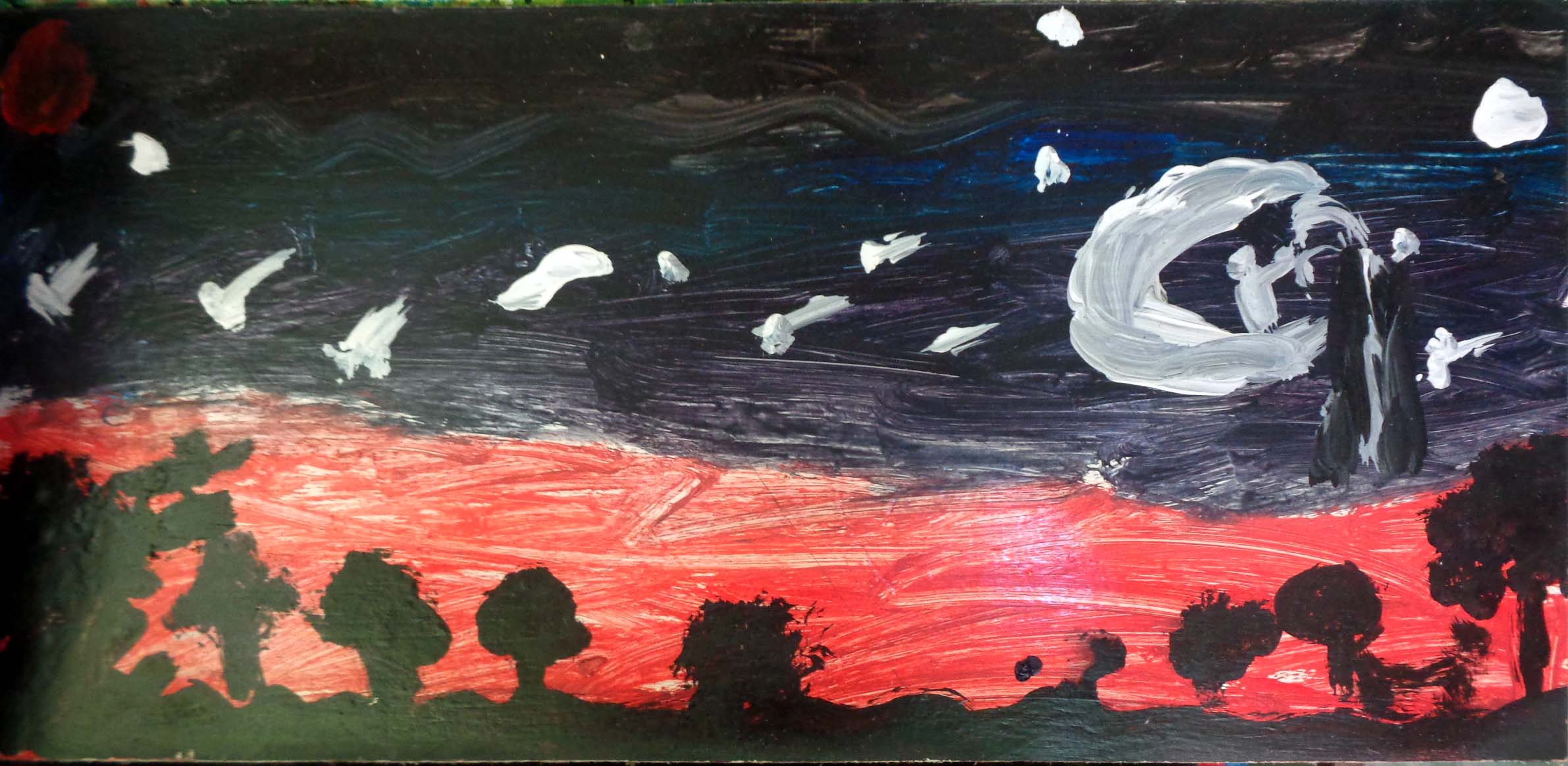
Child's interpretation of War and Peace.  (Laurence, 5 -  grandson of the author, 2022) 

No time in history has art found its widest application than it is today. Its enormous variety serve people of all ages, singly or collectively, in various occasions and events, touching their lives, tapping their talents, arousing their feelings, stimulating them to think and imagine . And to create the most wonderful things that constitute their own masterpieces. This is the challenge of art today and if these can relate to the betterment of humanity, then we say, art is humanities. ~
--------------------------
Lesson on former Paaralang Bayan sa Himpapawid with Ms Melly C Tenorio
738 KHz DZRB AM Band, 8-9 evening class, Monday to Friday

Sunday, May 26, 2024

The Garden Pond Microcosm of an Ecosystem

                                                   The Garden Pond

Microcosm of an Ecosystem

"An ecosystem is a geographic area where plants, animals, and other organisms, as well as weather and landscape, work together to form a bubble of life. Ecosystems contain biotic or living, parts, as well as abiotic factors, or nonliving parts. Biotic factors include plants, animals, and other organisms." - National Geographic Society

Dr Abe V Rotor

Garden Pond at the author's residence in  Lagro QC
with surrounding wall mural painted by the author

Are you aware that having a pond to complement your garden is beneficial to you and members of your family? This is so because a pond represents an ecosystem. As such it has the basic features of a functioning ecological unit. 

The pond is a field laboratory for microbiology. Plankton organisms (PHOTO) are revealed under the microscope. In their diversity, a whole new world unfolds - a world man did not know before Anton van Leuwenhoek introduced the science of microscopy sometime in the 17th century.


There are monerans and protists, the world’s oldest- yet simplest- organisms. It is a wonder why these organisms did not evolve and develop into complex organisms like the plants and animals we know - and why they are ensconced in a confined environment such as a pond.

The microcosm of the ocean is the pond; it is like “seeing the world in a grain of sand.” And for the eons of time and generations these organisms have passed through, it is like “holding eternity in the palm of the hand.” Thus the pond is the representation of our biological world, manifesting how little we know of God’s immense wisdom contained in a drop of water that teems with myriads of micro-organisms. 

Anyone who takes time to sit by the pond could lose his thoughts in the larger realm of nature and the countryside. Cattail (PHOTO) and umbrella plants rise among the floating water lilies, whose pink to purple flowers break the monotony of the pond scape. But the centerpiece of the pond is a community of white-flowered lotus or purple flowered Nymphaea. 

From the deep green water, one may be surprised to see a school of colorful carp and tilapia, stirring at the slightest hint of company and food. Their graceful movement creates gentle waves and soft lapping sounds against the shore line. To an observant eye, small fish like Poecilia and rainbow fish form small schools that inhabit the edges of the pond and its tiny islets and coves formed by aquatic plants and stone. These tiny fish are always mindful about staying out of the path of their large counterpart. Other than small insects that fall into the water, they subsist on the latter’s morsels.

All these illustrate how the principles of food chain, food web and food pyramid work in nature.

At the bottom of the pond lies the harmless, independent janitor fish (PHOTO) known for their role of eating crust of algae and scum. That is why they are important in keeping aquariums and ponds clean. In the process, they convert organic matter into detritus, the pond’s natural fertilizer, and are the source of sediments that accumulate and become a foothold of aquatic plants. Seldom to these helpful creatures rise to the surface, but if you want to see these shy, docile fish, peer into the water on a clear day when the sun is directly above, and you will find them lying prostrate at the bottom, like sunken ship on a sea floor.

The pond relieves tension. When you need to relax, observe the turtles basking in the morning sun, stretching their neck and appendages. Or watch those cooling off on a hot day, their nostrils and carapace protruding out of the water. Nearby, a toad might patiently sit on a leaf pad, sheepishly eyeing an unwary insect for its next meal, its long tongue coiled like spring, ready to strike like lasso.

Bees buzz from flowers to flower, while dragonflies - red, green and brown - hover prettily above the water as they search for a suitable place to lay eggs that will hatch into aquatic nymphs that feed on mosquito wrigglers and Daphnia. Strung on leaves and stalks are spider webs glistening with dewdrops. These resemble strings of diamonds that will soon turn into nearly invisible death traps for the hoppers, mosquitoes and flies that stray into them. 

Frogs are permanent residents in a small pond, singing at the onset of rain and exchange love calls throughout the breeding season. They remain quiet in summer as they aestivate and wait for the rains to come again.
Kataba or canal fish (Poecillia) PHOTO thrives without any care, as long as there is water, living on plankton and insects that fall into the pond or attracted by a nearby vigil light. Whenever there is stagnant pools around, I put a pair of these mosquito-eating fish and that solve the possibility of malaria or dengue to occur in our the place. Our pond serves as kataba nursery of sort; we give relatives, friends and students who wish to grow kataba in their own aquarium or pond.

The green water in the pond is a good hunting ground for microscopic flora and fauna. With a microscope on hand I have discovered a lot of planktons, many of which are unfamiliar. The green color is made up of millions of one-celled green algae PHOTO which constitute the pasture of zooplankton organisms. They are the autotrophs, the base of the food pyramid in a pond ecosystem.

Would a backyard fill in the vacuum created by our wanton destruction of natural resources, the rape of our forests, the draining of swamps, the conversion of mangrove to fisheries? Or the gross negligence in keeping our lakes and rivers full and clean – or at least for having nature to take care of them? I doubt. But the little Eden each one of us make in our backyards would collectively recreate little by little that bigger Paradise we lost, when and to what extent we can only surmise and struggle with will and resolve. It is our little contribution in regaining the Lost Paradise. ~


We look for nature, but nature comes to us, too. We can make the backyard a sanctuary of living things. It becomes a corner of Eden so to speak, in the inner eyes of the English poet John Milton, in the soul searching music of Beethoven, and in the quasi-spiritual reverence for life of John Muir and Aldo Leopold. ~

Acknowledgement with thanks: Internet images

Friday, May 24, 2024

Chronobiology: Take heed of your biological clock

Chronobiology: 
Take heed of your biological clock

"Living organisms take heed of their biological clock - 
except humans, in many cases." avr

Dr Abe V. Rotor

Author left, takes a break with his students at the UST Graduate School 2010

“There is a time for all things.”
- William Shakespeare

Each one of us is governed by a built-in clock within.  Everything we do is “timed;” it has a schedule. And this living clock controls our actions and behaviors.  

It is the key to survival; a tool in evolution so that it is ingrained in our genes. If that is so, are our biological clocks then synchronized?

Generally, yes. And that is why we all respond to common rules that society has set for us. We respond to the seasons of the year, each characterized by events we celebrate. We have standard working hours, and curfew. Weekends are set aside for rest and leisure. Summer means vacation. We observe three meals a day, coffee breaks, siestas, and the like.

Menstrual cycle, estrus periods, stages in growth and development – all these are controlled by inner rhythms dictated by that biological clock. So patterned are our laws and rules that we know well the best season to plant or to hunt, to plan weddings and inaugurations, to travel, to go to school, to have a date, to meditate, to be merry.

There is a saying,
“There’s time for everything.”

To every thing there is a season, and a time to
every purpose under the heaven.
A time to be born, and a time to die; a time to plant,
and a time to pluck up that which is planted;
A time to kill, and a time to heal; a time to
break down, and a time to build up;
A time to weep, and a time to laugh; a time to
mourn, and a time to dance;
A time to cast away stones, and a time to
gather stones together; a time to embrace,
and a time to refrain from embracing;
A time to get, and a time to lose; a time to keep,
and a time to cast away;
A time to rend, and a time to sew; a time to keep
silence, and time to speak;
A time to love, and a time to hate; a time of war,
and a time of peace.     
        - Ecclesiastes
Yes, we are governed by inner rhythms which are classified into the following:

Ultradian - Less than a heartbeat
Fluctuation of energy
Attention span
Brain waves

Circadian (daily) day
Blood pressure level
Sleep wake cycle
Cell division

Circaseptan (weekly ) about a week
Rejection of kidney, heart, and pancreas transplants

Circatrigintan (monthly) about a month
Menstrual Cycle
Circannual (annual) about a year
Seasonal depression
Susceptibility to some diseases
biological clock

Living organisms take heed of their biological clock - except humans, in many cases. ~

Acknowledgement with gratitude:
Internet images

Tuesday, May 21, 2024

TATAKalikasan Lesson: Laudato Si - Pope Francis speaks openly about the devastating effects of the ecological crisis on people and the planet.

Lesson on TATAKalikasan Ateneo de Manila University 
and Xavier University - Ateneo de Cagayan
87.9 FM Radyo Katipunan, 11 to 12 a,m, Thursday
Laudato Si on Ecological Crisis 
(Original Title: The Dilemma of Ecology - All in the Name of Progress)

Pope Francis' Laudato Si speaks openly about the devastating effects of the ecological crisis on people and the planet.

Dr. Abe V. Rotor
Co-Host with Fr JM Manzano SJ and Prof Emoy Rodolfo AdMU 

Death of an Ecosystem

Life Span It looks like man has been able to trace the source of the water that comes from the proverbial Pierian Spring, the secret of health and long life. For years it was believed that the spring lies up in Shangri-La atop the Himalayas, or according to the Greeks on Mt. Olympus, or the Egyptians in the Pyramids. One does not have to go there now.
The world average age of death is a few years lower at 68.9 years for men and 73.9 years for women. It will not be a surprise if one out of a hundred individuals will be a centenarian. One report claims that the life span of man can be increased to 140 years by the middle of the millennium. How long did Moses live?

Pandemic Cancer is on the rise, so with AIDS, and the spread of genetically linked defects and illness. Work-related and stress-related deaths will likewise increase with heart and severe depression as the leading diseases, followed by the traditional diseases like respiratory and diarrhea diseases. Already there are 15 million who have died of AIDS and 40 million more who are living with HIV, the viral infection. A pandemic potential with up to 1 billion people to become affected with HIV has started appearing on some crystal balls and this is not impossible if it hits populous Asia.

Cloning, the most controversial discovery in biology and medicine will continue to steal the limelight in this millennium, stirring conscience, ethics and religion. It is now sensed as the biggest threat to human society, and if Frankenstein is back and some people regard him as a hero instead of a villain, we can only imagine the imminent destruction our society faces - the emergence of sub- and ultra- human beings. On the other hand, there are those who look at cloning as an important tool of medicine to enable doctors to save lives and increase life expectancy. They also believe that cloning in situ (on site) will do away with tedious and unreliable organ transplants.

Gene therapy is in, medicinal healing is out. It means diagnosing the potential disease before it strikes by knowing its source. Actually diseases are triggered by specific genes. Reading the gene map of an individual, the doctor can “cure” the disease right at it genetic source. We call this gene therapy, the newest field in medical science. But the altered gene will be passed on to the next generation. Playing God, isn’t? Definitely it is, and it is possible to use this technology not only for the sake of treatment but for programmed genetic alteration. Another Frankenstein in the offing? But scientists are saying gene therapy can be a tool in removing permanently the genes that cause cancer, AIDS, and genetically linked diseases like diabetes, Down ’s syndrome, and probably alcoholism.

Test tube babies. There are now more than 100,000 test tube babies in the US alone since 1978, the arrival of Louise Brown, the world’s first test tube baby. The industry has just started booming with sperm and ova banks established and linked with the Internet and other commodity channels. Not only childless couples can have children, but even a sixty year old woman can - through what is coined as menopausal childbirth technology. Surrogate mothers for hire, anyone?

Population If diseases can be predicted and successfully treated, and life can be prolonged – these have indeed grave consequences to population increase. Already there are 7.5 billion people inhabiting the earth today, and we are increasing at the rate of more than 80 million a year. After 2150 we shall have reached 13 billion, the estimated maximum capacity our planet can support. Is the Malthusian theory true after all? It looks like the ghost of this English political economist and religious leaders, the founder of this theory, is back to warn us, this time more urgent than his 1789 prediction that as population grows and that food production grows only mathematically, there will come a time when population will outstrip the capacity of the earth to feed the world’s population resulting to famine.

Global Warming Our Earth is getting warmer, and this is not any kind of comfort but destruction. We have experienced seven of the ten warmest years in the past decade and we are heading toward another Noah’s episode. Low lying areas where the rich farmlands and many big cities virtually squat will be flooded. Heat is trapped by the carbon that we generate from our cars and industries creating a “greenhouse effect”. As the world’s temperature increases, the polar ice melts, and more rains and climatic disturbances ensue. Climate scientists have predicted that by year 2100 the earth’s temperature will go up from 1 to 3.5 degrees centigrade. But wait, the worst is yet to come. Global warming will plunge us ultimately – towards the middle of the millennium – into another ice age! There will be a buildup of ice at the Polar Regions as the ocean currents fail to carry warm water to the poles and back.

H
igh-tech Living  The trend of lifestyle will be toward the simple and natural, even in the midst of high-tech living. More and more people will go for natural food and natural medicine as they become conscious of their health. The media and the information highway will provide more people access to entertainment and information. Remote management and distance learning will greatly influence business and education. But people will still seek greener pastures in cities and in foreign lands.

“Save the earth!” has yet to be a denominator of cooperation and peace among nations. The failure of the Earth Summit at Rio de Janeiro, and the first summit before in Stockholm, has produced valuable lessons leaders must learn. There is only one ship in which all of us are riding. Let us all save our ship.

In the name of Progress
It is all in the name of progress that nations are pursuing. The West insists of pushing the frontiers of technology into the so-called “third wave”.

Ruins of the famed Hanging Gardens of Babylon during the time of Nebuchadnezzar 
 
The East, the Asian Pacific region, insists on industrialization in order to catch up with the progress of the West, while the Middle East has yet to undergo a major socio-cultural and political transformation while aiming at lofty economic goals.

Progress, it is generally believed, is the aim of globalization, and globalization is building of a world village. Isn’t this the key to peace and cooperation? This sounds familiar to scholars and leaders.

Maybe, but the greatest challenge lies in the preservation of a healthy Mother Earth, a common denominator of concern irrespective of political, ideological and religious boundaries. It is the saving of the environment that will be the biggest challenge to this and the coming generations.

Earth Summits Poor Rating of Earth Summits. Let us look at what happened to the promises made by leaders from 178 nations who gathered in the Earth Summit in Rio de Janeiro more than a decade ago. These are the four areas of accord: biodiversity, climate, deforestation, and population.

Biodiversity  On the biodiversity accord signed by 161 countries (except the US), ecosystems continue to be assaulted and fragmented. On arresting global warming as a result of emissions from industries and vehicles, developing countries on the path of industrialization have exacerbated the problem. Deforestation virtually knows no limits and bounds as long as there is wilderness to conquer. Every year forests are lost the size of Nepal. Asia has lost 95 percent of its woodlands.

Every year about 80 millions people are added. This is about the Philippines population. Although birth rates are going down in the West as well as in the NICS, there is a boom in babies in rural Asia Latin America and Africa.

Global Village  Rhetoric and promises can not be relied upon. It is in this area that globalization should be reviewed. Globalization should be defined in economic, cultural and environmental terms. This triad approach has yet to be addressed to all members of the global village. And there should be a new world governance, more credible than the UN, to undertake this gargantuan task. Kyoto Protocol on Greenhouse Gases. On December 10, 1997, 160 nations reached agreement in Kyoto, Japan, to limit emission of CO2 and other gases in order to arrest Greenhouse Effect threatening the whole world. But not all countries signed the treaty, among them the US and Australia. Actually the Kyoto Protocol is not new. In 1992, some 170 countries ratified a similar treaty reducing emission of gases to the level of 1990 by 2000, but this did not yield the desired result.
Malthusian Theory  “Hundreds of millions of people will starve to death,” warned Paul Ehrlich in his 1968 book, “The Population Bomb.” This is an echo of the Malthusian Theory raised 200 years ago. This means farmers, in spite of biotechnology, can not keep up indefinitely with increasing food demands. Yet there is a great disparity in food distribution. While the average adult needs 2200 calories a day, an American consumes 3603 as compared to the intake of a Kenyan which is only 1991 calories.

Ecomigration  Degradation of the land, the breaking up of ecosystems, are resulting to modern day exodus of ecomigrants who cross borders, invade cities and build marginal communities, threaten security of nations, and creates other socio-economic problems. Desertification, soil erosion, overuse of farms drive multitudes to search for greener pasture, many in the guise of overseas workers, settlers, refugees.

Megapolises The birth of mega cities is a human phenomenon in modern times. The world’s cities are bursting at the seams. Half of the world’s population live in urban areas today, and more are coming in. In developed countries 75 percent of their population lives in cities. By year 2015, 27 of the world’s 33 largest cities will be found in Asia, with Bombay and Shanghai bursting with 20 million each. Today the most populous city in the world is Tokyo with 27 million people. New York has 16.3 millions which is about the same as Sao Paolo. Metro Manila has 10 million.

Global warming  Figures show how the world fares under greenhouse effect. This phenomenon is attributed to the severity of the last three episodes of El Nino in the last three decades, and to the prevalence of deadly tornadoes, hurricane, floods and natural calamities.

Ozone Hole  A hole in the sky was caused by damaging chemicals that tear down the vital atmospheric ozone shield that keeps us from too much heat and radiation. The size of the ozone hole about the Antarctic region is estimated to be like the whole continental US – and is still expanding. CFC use is now restricted in most countries, but there are other damaging chemicals used by agriculture and industry. Methyl bromide for one is 40 times more destructive to ozone than CFC.

Antarctica: World’s Park  One of the few places on earth unexploited by humans is Antarctica. Not now, not until recently. With the Antarctic Treaty of 1991 declares that “Antarctica shall be open to all nations to conduct scientific or other peaceful activities there,” seven countries have already laid overlapping claims on the continent, which comprises one-tenth of the world’s total land area. Thousands of tourists are now visiting Antarctica every year.

Scientific research is economically motivated, such as oil exploration, with geopolitical or military objectives in mind. Earlier – in the 1970s New Zealand proposed designating an Antarctica World Park, making it an international wilderness area. On the ecological point of view, Antarctica is fragile with simple and short food chains that support few organisms such as the penguin, whales, shrimp-like krill. Any slight disturbance is likely to upset the delicate balance. We have already caused the growing hole of the ozone layer above Antarctica through unabated release of CFCs , and fossil-fuel combustion worldwide. Would humanity be better served by developing the natural resources of Antarctica than turning it into a world park and preserve its ecological balance?

We also ask the same question to areas similar to Antarctica, such as the pristine wildlife of Canada, Greenland, the Yukon Territories, the unexplored islands of the Pacific, and main Amazon Basin.

Ecology and Stock Exchange  In 2000, Earth Sanctuaries was listed on the Australian Stock Exchange, making it the world’s first conservation company to go public. We know that conservation efforts have been conventionally under foundations and government projects. But this times this intriguing approach to conserving the environment raised as lot of questions.

Habitat Preservation  Does the market place really have a role in habitat preservation? Is this approach really conserving natural ecosystem or just creating large zoos? Would we rather save and give our children good education that helps rescue an endangered animal? Indeed the conflict between maximizing profits and conservation raises ethical issues.

Ecology advertising  In the supermarket we find tags, organically grown, environment-friendly, eco-safe, environmentally safe, children-safe, ozone-friend, and so on. But are these claims true?

Consider the following:
• Look for the three-phase symbol of recycling – three interacting arrows to form a triangle.
• When buying a refrigerator or air-conditioned get the one that is Freon-free, ozone friendly. Be sure the purchase is covered by company guarantee.
• Producers of food claimed to be safe, such as organically grown, must be able to show a reliable track record. It is good to trace the source of food that we eat, from beginning with production to processing, and ultimately to the dining table.
• Even materials claimed to be biodegradable, photo-degradable, and the like, may not be readily converted into safe materials. As a general rule, save money from “over-packaged” commodities, and you save the environment as well. Don’t be misled by package advertising, how attractive it may appear.

Business versus Environment  Is it possible to have a healthy environment and a healthy economy at the same time? More and more businesses have begun adopting this concept as a business philosophy. People behind business organizations are becoming more aware of the ethical decisions they face, and their responsibility for their consequences. A multi-national corporation, responding to the provisions of GRI (Global Reporting Initiative), CERES (Coalition of Environmental Responsible Economies), UNEP (United Nations Environmental Program), came up with the following thrusts:

• Restore and preserve the environment
• Reduce waste and pollution
• Education of the public on environmental conservation
• Work with government for sound and responsible
   environmental program
• Assess impact of business on the environment and communities.

The environment and the economy need not be viewed as opposites. Or strange bedfellows.

Otherwise the dilemma of ecology which is the very foundation of our existence is progress itself.  ~

Acknowledgement with gratitude: Internet images

Sunday, May 19, 2024


Tamales keeps freshness and natural taste of fish

 Tamales keeps freshness and natural taste of fish

Make culinary art as simple, practical and healthful as possible.  Cook small fish like dulong (Ipon Ilk), and dilis (anchovies) the tamales (tamalis Ilk) way.   Let's return to indigenous cooking practices - and live happy, long and healthy like our ancestors.  

                                             Dr Abe V Rotor


Follow these steps, refer to the photos. 
      1. Wash fresh fish with a strainer.
      2. Add salt, chopped ginger and onion. 
      3. Wilt leaves with stalk
      4. Pack in small amount, good per person.   
      5. Line stainless pan (or clay pot) with banana stalk
      6. Arrange packed tamales for cooking, cover.
      7. Don't overcook, serve whole pan on dining table
      8. Best when steaming hot, save the juice
      9. Pack is ideal for baon 
      10. Eat with fresh tomato for variety. 
 
Share this lesson with your family, school and community. Let's return to indigenous cooking practices - and live happy, long and healthy like our ancestors. ~

Friday, May 17, 2024

International Museum Day May 18, 2024: Importance of People's Museum and Library in Our Times in 8 Articles

 International Museum Day, May 18, 2024

Importance of People's Museum and Library in Our Times 

Dr Abe V Rotor
Living with Nature School on Blog

 
This year's theme, “Museums for Education and Research,” underscores the pivotal role of cultural institutions in providing a holistic educational experience. This day pushes for a more conscious, sustainable and inclusive world.

Part 1 - Farmers' Museum (NFA Grains Museum)
Part 2 - "A museum will, like any living thing, change and grow.” - Smithsonian
Part 3 - The Art of Diorama: Museum of Natural History, UPLB Laguna
Part 4 - UNP Students Visit the Living with Nature Center, San Vicente, Ilocos Sur 
Part 5 -  Relevance of Community Museum and Library Today
Part 6 - The Living with Nature Library
Part 7 - Rock Collection: Study and Hobby 
ANNEX - Famous Quotations about Museums

Part 1 - Farmers' Museum (NFA Grains Museum)
Museum in honor of the Filipino Farmer re-opened after 30 Years.

The ingenuity at the grassroots cannot be underestimated. Farmers' technology developed with the birth of agriculture in the Fertile Crescent thousands of years ago, and spread throughout the world to the present time. 

National Food Authority Grains Industry Museum
NFA Regional Office, Cabanatuan, Nueva Ecija 

NFA Museum at NFA Regional Office, Cabanatuan City

Mechanical dryer for palay, corn and beans

Prototype two-stroke diesel engine, prime mover for milling.
Donated by the late Bonifacio Tambot, Binalonan, Pangasinan


DIORAMA: The flagship of the Marcos administration Masagana 99, a nationwide
 rice production program that made the Philippines a net exporter of rice in the later part of the seventies to the eighties.

The re-opening of the museum signifies the revival of the original objectives of the museum, which the author envisioned and pursued as its first curator in the early 1980s.  

Featured in the Grains, official publication of the National Food Authority, the NFA Grains Industry Museum with address at the Regional Office in Cabanatuan City (NE) is now inviting students, scholars, researchers, and ordinary folks, even while restoration is on-going. 

The feature story is quoted in part, as follows:  (December 2016 Vol. 44, No. 4), written by Ms Lina G Reyes and Ms Josephine C Bacungan), 

"Old farm tools and artifacts had been sitting quietly, gathering dust at the dilapidated museum of the Central Luzon Regional office in Cabanatuan City. National Food Authority Grains Industry Museum was a brainchild of then NFA Extension Director Abercio V Rotor with a vision to highlight the evolution of the rice industry through various images on production, post-harvest activities, processing, storage and marketing /distribution of rice and other grains .  It was intended to serve as NFA's contribution to the preservation of cultural traditions particularly in the agricultural landscape.  It operated for sometime but was closed down due to lack of funds and trained personnel to maintain it.  But thanks to he history-loving team of Director Amadeo de Guzman and Assistant Regional Director Serafin Manalili, and then Asst Director Mar Alvarez, et al ... "(the whole staff of the NFA regional and NFA provincial offices.) 

Rare Artifacts   
Operated by hand this native rice mill made of wood and bamboo separates the husk from the grain, leaving the grain intact with its bran.

Brown rice or pinawa dehusker made of bamboo and hardened earth with hardwood grinder displayed at the former Farmers' Museum of the National Food Authority in Cabanatuan City.c 1981 

The bran contains minerals, vitamins, oil, and digestible fiber which conventional rice mills removed during polishing. Polishing removes the bran leaving the grain white and polished. In the process, much of the grains is broken, particularly the defective and immature ones chalky and powdery.  It is the bran that gives the nutritious tiki-tiki which is extracted in the final boiling stage in cooking rice. Tiki-tiki was developed by a Filipino scientist, Dr. Manuel Zamora, a cheap and practical source of infant food supplement which saved thousands of babies during the second World War. It was later popularized as United Tiki-tiki. 

 Biggest wooden harrow (suyod) with a span of two meters, more than twice the size of a typical harrow for upland farming.  


The harrow is of two designs and make. One with iron pegs (left) is used on wet paddy. It serves as harrow and leveler.  The second is made of bamboo with natural and embedded pegs used as harrow for the upland.  


Author demonstrates a rare wooden planter with a sliding wooden block at the middle. The block creates a tic-tac sound to let know the worker is busy on the job, while the deep sound warns birds and rodents to keep away from the newly planted seeds. The block vibrates the stake shaking off clinging soil and dirt before it is thrust to make the next hole. Whoever put this mechanism into multiple and unified uses must be a true genius. 

At the background are naturally shaped hame* made of bamboo.  At the foreground is the mould (cross section) showing the formed hame. The process involved is simple.  The mould is placed atop an emerging shoot.  The shoot grows through the mould and grows to maturity. One or two years after, the bamboo is cut with the mould, and cured and seasoned for durability all in the natural way.  (Hame is a curved harness that fits over the nape of a draft animal like carabao and bullock. Hame for the horse is made of two wooden pieces, padded and clamped together around its neck.) 
--------------------------------------------
All over the world there are similarities, based on a general pattern, save variations for ease and comfort in usage, which we call today ergonomics, Thus primitive farmers were the founders of this new science. Pride in the farmer can be read on face on discovering these simple tools displayed in the museum.   
---------------------------------------- 
Native raincoats made of leaves of anahaw (Livistona rotundifolia), cowhide, and woven bamboo slats, with matching headgears likewise made of native materials.  Foreground: Sleds, one made of bamboo (left) and the other of wood. 

These sets of mortar and pestle in different designs came from different regions of the country, principally for dehusking palay into rice, and making rice flour. Other uses include  cracking beans such as mungo, and grinding corn into grits and bran. 


Photo below was taken just after the inauguration of the Museum (1982). The author (left) shows new collection to Dr Romualdo M del Rosario (in barong), deputy director of the National Museum, who helped in setting up the museum. 

---------------------
The ingenuity at the grassroots cannot be underestimated. Farmers' technology developed with the birth of agriculture in the Fertile Crescent thousands of years ago, and spread to many parts of the world. The commonality of inventions is more on function, rather than scientific explanation, the latter serving as basis in improvement and diversification.

Rice Industry Showcase
The Farmers' Museum of the then National Grains Authority, now National Food Authority, was put up in response to the administration's thrust in food self-sufficiency.  It was during the time the country gave emphasis on developing cultural pride as a nation and people, as evidenced by the expansion of the National Museum, the putting up of the Philippine Convention Center, and the National Art Center on Mt Makiling, among others, during the administration of the late President Ferdinand E Marcos. The Farmers' Museum occupied the right wing of the Regional NFA Building in Cabanatuan City for two decades, until it closed down.  It was once a pride of the agency, the centerpiece of visitation by foreign dignitaries, convention participants, tourists, professors and students, and most especially farmers who found the museum not only as a showcase of the agricultural industry, but as a hallmark of their being the "backbone of the nation." AVR   

There are six dioramas, four of these are shown in these old photographs. A wall mural meets the visitor on entering the museum.  Indigenous farm tools and implements are lined on the foreground.  The dioramas are grouped at the center of the cubicles.   

 Rice Industry Dioramas 


One of the six dioramas, Rice farming on the Banaue rice terraces
Rainfed (sahod ulan) farming dominates the uplands and hillsides. 
Good harvest depends on generous amount and distribution of 
rainfall during the monsoon. Since ancient times festivals implore 
providence for bountiful harvest. This practice still exists especially 
among the  minorities like the Yakans.  
World famous rice terraces in Banaue in the Cordillera have been declared World Heritage by UNESCO. Rice farming on the terraces is as old as the terraces believed to be as old as the Pyramids of Egypt, and much older than the Great Wall of China. Science is still studying the sustainability of these terraces. 

 The Encomienda System dominated agriculture during Spanish rule over the
 islands for more than three centuries. The friars and Spanish officials were the encomienderos, similar to hacienderos.   Although the system underwent land reform, it still persists to this day under corporate umbrella such as the case of Del Monte pineapple plantation. Hacienda Luisita in Tarlac still retains some features of the system.                          
                  
This mural was destroyed when the wall it was painted on had to undergo 
major repairs.
                               
How primitive are farmers' tools and implements? The animal-drawn sled predates the wheel cart, and has not changed since its invention thousands of years ago.  It is still used in the remote countryside. 
 
Brain coral for shelling corn raises eyebrow to the city bred.  Biggest iron bar scale (timbangan), probably is another item for the Book of Guinness. 

“Education is the lifeblood of museums. Museum education has the power and the responsibility to do the challenging inner work of tackling tough topics and turning them into teachable moments... If we truly believe in the power of cultural institutions to impact communities and engage authentically with social justice issues, if we believe in museums’ capacity to bring about social change, improve cultural awareness, and even transform the world, than we must also believe that our internal practices have an impact, and must act according to the changes we seek.” 
― Monica O Montgomery

“Closing a museum to save money is like holding your breath to save oxygen...” ― Nanette L. Avery 

Part 2 -  "A museum will, like any living thing, change and grow.”

“A visit to a museum is a search for beauty, truth, and meaning in our lives. Go to museums as often as you can.” – Maira Kalman

Dr Abe V Rotor 

                    “I paint flowers so they will not die.”– Frida Kahlo

Monet in Paris Museum, Brisbane Australia

Isn’t a museum something concerned with antiques and the things of the past?” A colleague once asked me.

“No, no.” I sounded defensive. Then I began scanning his thoughts. There I saw the image of past civilization and institutions. No wonder he was telling of the Egyptian museum, the Aztecs in the Mexican Museum, the American Indians in the Smithsonian, the Renaissance Gallery, and the dinosaurs in the Chinese Museum in Beijing. All these have long lost their glory and now they are remembered in glass cases and fossils. Then my thoughts turned to SPCQ. Why a museum on its 50th anniversary? My friend flashed a devilish smile.

He played the devil’s advocate; I played the student’s role. He raised the mercury, so with my enthusiasm. I did my assignment. There are museums like the giant Smithsonian Complex and the provincial Manitoba museum in Winnipeg that do not only focus on the past. The space museum projects man’s lofty dreams to conquer space. Hirshorn is a gallery that is both subjective and prospective, veering from the traditional and classic. The Tel-Aviv museum features a documentary of the Iran-Iraq war. The trend of museums today is to link the past and the present, and beat the path for the future. In no other time in history have museums tried to project the fullest breadth of human accomplishments and potentials. They exude a touch of reverence to the Creator, reflecting his faith in the institutions which he built in spite of their imperfections, and man’s glory and admittance of failure – all these point out to one thing: that he is the most special creature that ever lived.

I remember Dr. Dillon Ripley’s words. “ if it is truly active and reflective of its own time, a museum will, like any living thing, change and grow.”

Dynamism lies in keeping abreast with the times - our fast changing modern times, when man in the last two centuries alone, has discovered more things than what all his ancestors probably did.

Humble Beginning of a Museum

In the mind of Dr. Ripley, of course, is one of the magnitude and prestige of the Smithsonian in which he had long been the curator and director. Or those of the internationally known institutions like the Chicago Museum of Natural History, or the Vatican Museum. Then there is Rikj Museum of Holland and the great Louvers of France. Name a country and you will see the finest of her culture in the native land’s museums. But the entire thing has had its early beginning - most probably like how the SPCQ museum got started.

The question is that, “How can a newly born show its worth?” But who does not love a baby? The baby itself is love. He holds the key of idealism in this world of ours. The great promise of God in man is mirrored in his smile and innocence. And he has all the potential that this world would be better to live in with him, as he grows, as he lightens the flame of idealism which in many of us adults had long been extinguished. The SPCQ museum is a baby that rekindles our heart, that tells us that this world will go on despite its imperfection – because we know how to start life again, though the rebirth of faith and hope. 

Note: Excerpt from an interview with the author during the inauguration of the SPCQ Museum in 1994


Queensland Museum of Natural History, Brisbane 2023

 
Seven Sisters, sculpture by Julie Lluch Dalena, detail; Life size icons 
at Museum's entrance greet visitor. Former SPUQC Museum 

 
           Rare starfish. Spines make a fine wind chime. Porcupine, endangered                                                                         indigenous animal

 Part 3
 The Art of Diorama: Museum of Natural History,
UPLB Laguna
  
A diorama is a miniature three-dimensional scene, for example, in a museum, in which models of figures are arranged against a background.


1. a miniature three-dimensional scene, in which models of figures are seen against a background
2. a picture made up of illuminated translucent curtains, viewed through an aperture
3. a museum display, as of an animal, of a specimen in its natural setting
4. cinema - a scene produced by the rearrangement of lighting effects Collins English Dictionary

Philippine Eagle lords over the vast landscape atop Mt Apo, its home. Fewer and fewer sightings tell us the bird may soon join the list of extinct animals - if we don't protect its remaining population estimated to be less than a thousand
The idea of a diorama is likened to a showcase in a mall. It is an enclosure of glass, multi-dimensional so that the viewer enjoys a natural panoramic scenery - foreground and background, ground and ceiling, and a spacious center view for the main subject. From one side to the other, and back, the viewer finds freedom of vision to explore the whole diorama.

Natural history dioramas gain attention to naturalness. The stuff animals look real, a pond reveals the secret of its bottom. Water always looks fresh and invigorating. Trees and the whole vegetation retain their freshness. Depth of field leads the eye to the farthest point disappearing in thin air.

Emphasis is given to interaction of the living with the non-living world, the interrelationships of organisms in food chains and food webs, and by the flow of energy from one organism to another.

A diorama artist is multi-skilled: he is a sculptor, a painter and an architect. Above all, he is a scientist who understands the working of biology and ecology. He must be a naturalist, and being one, must uphold the philosophy of reverence for life that makes man the custodian of creation.

The Museum of Natural History is an educational center with a sprawling natural setting - Mt. Makiling, a tropical rainforest reached in three hours from Manila. It is a world-famous center of studies and researches in agriculture, environment and many related sciences, including humanities.

I recommend the place for a whole day educational field trip. An itinerary includes the Mt Makiling Botanical Garden, tour of UPLB campus (agriculture and forestry) and the International Rice Research Institute (IRRI). Special lectures and guided tours may be arranged. Packed lunch under the trees is a rare experience. Nature photography, is at its best - so with on-the-spot composition (drawing, musical sketch, poetry).

“If you don’t know history, then you don’t know anything. You are a leaf that doesn’t know it is part of a tree.” – Michael Crichton


The Hornbill is another endangered Philippine bird. The first and last time I saw hornbills was in the seventies at the tip of Luzon along the treacherous Patapat road joining the Ilocos Region and Cagayan Valley. They are a closely knit family moving on the forest canopy. Their call is heard far and wide. It is resonated by their big hollow bills and echoed by big trees and cliffs.


Cave bats in a simulated habitat. Being nocturnal, the bats hunt from flying insects in the dark locating their prey through echolocation, the principle of the radar.Their droppings make a huge guano deposit mined for agriculture.


A rare rodent that lives on trees in Palawan, the last bastion of rare 
animal species, among them the porcupine, mouse deer and anteater.

Nesting pigeons keep vigil for intruders and predators. Masters of camouflage they blend with the surroundings and remain extremely quiet and still at the sign of danger. But when imminent, the mother bird stealthily dashes to another place and decoys away the attention of the enemy.

Instead of a diorama, the actual skeleton, and replica, of a whale are displayed for anatomical and morphological study. In the Smithsonian the blue whale, the biggest creature that ever lived on earth spans the length of a hall the size of a typical chapel.


Tree mushroom garden


A cluster of nature dioramas, each an ecosystem pristine and unspoiled.


Centennial celebration of UPLB, pictorials at the museum's lobby.
                           Author and wife are among the countless visitors.

“The best introduction to art is to stroll through a museum.
The more art you see, the more you’ll learn to define your own taste.”
– Jeanne Frank

      Part 4 - UNP Students Visit the Living with Nature Center                  San Vicente, Ilocos Sur     


Students in fine art at the University of Northern Philippines visit 
the author's family art gallery, museum and reading center.


Representative works of the author showing conventional and modern art.


Lighter moments at the Art Gallery and Botanical Garden (arboretum and fishpond)


The Green House 
(Side Gate and Street Corner Views}

“It's a fort of green trees around,
that buffer against noise and wind,
filter dusts and glare of the sun,
residence for austere living” - avr

 
Integrated Children's Workshop at the San Vicente Botanical Garden , San Vicente, Ilocos Sur.

On-the-Spot Workshop at the Botanical Garden and Arboretum 

"Take time out from TV, computer, malling;
life's so dull, busy yet empty;
The left brain's overworked, the right idle,
growing up is a sad story." - avr

"Every man's life ends the same way. It is only the details of how he lived and how he died that distinguish one man from another. Never confuse movement with action. The best people possess a feeling for beauty, the courage to take risks, the discipline to tell the truth, the capacity for sacrifice." - Ernest Hemingway, The Old Man and the Sea

A visit to an 18th century Basi wine cellar 
San Vicente, Ilocos Sur 
 
Original basi wine cellar and jars (burnay) date back to the
 18th century across six generations of continuous operation, 
interrupted only by the Second World War for five years. 
 
The cellar attracts researchers, students and tourists for its historical 
significance with the Spanish Galleon Trade, and technology o
the old folks in making basi and its related products, principally 
vinegar (sukang Iloko).  

By now this jar of basi is 13 years old.  Unless opened, it remains longer 
in aging. The general rule is, the longer wine is aged, the more mellow it 
becomes.  It's not really so.  There are other factors to consider like 
damaged clay cap and leaching.  And there's the basic rule that "only 
good wine mellows with age" (So with man, they add.) 

Crystalline golden color and pleasant wine aroma meet the happy
connoisseur after the desired aging period is reached (at least two 
years in the case of Rotor Basi). Fresh and direct from the jar, the 
harvest is bottled, sealed and labelled (as shown below), according
 to customers' specifications intended for an occasion like
 wedding, Christmas, exhibit, and the like. 


House guest picks a fruit wine of his choice,  Fruit wine making 
follows the basic fermentation-aging process in basi making.
There are 20 kinds of fruit wine developed in this cellar from different 
fruits growing locally like macopa, aratiles, duhat and guyabano. 

Green Tunnel to the Living Room
(Floor-Wall-Ceiling Mural) 

"When life becomes unbearable living in a jungle of concrete;
when pressure of work is taking its toll and you may be the next,
don't tarry, reach out for the green tunnel." - avr 


Listen to the sea in a conch, dead the creature maybe;
Wash away your worries and anxiety.
For life is real, yet in scenes like these, is but fantasy;
It is how we live that holds the key. 

"The greatest glory in living lies not in never falling, 
but in rising every time we fall." -Nelson Mandela

 
Modern art works by the author: Relief still life in acrylic, palette knife 
and hand painting; double-surface aquarium scene in acrylic on glass. 


Experimental paintings on glass by the author. Top left, clockwise: Telescopic view of  red sun under a huge tree; school of fish (How many fish can you count?); cinders after a brush fire; red seaweeds (Porphyra or gamet Ilk) under a magnifying lens.
 
Art is not a mirror held up to reality, but a hammer with which to shape it.
— Berthold Brecht
 
  
Expressionism - gateway of Impressionism to Abstract art


Discreet Nature in four views (Left, top, clockwise: Microscopic Volvox; juvenile seaweeds; meadow comes alive after the first rain in May; fungal mycelia on hamburger 

Vincent Van Gogh was both an impressionist and an expressionist. At the time, he would have considered himself to be an impressionist. Today, however, Van Gogh is considered one of the pioneers and founders of the expressionism movement.

 
Keyhole perspective appears to viewers in natural frames.
 It has a magnifying, as well as telescopic effect.
   
 
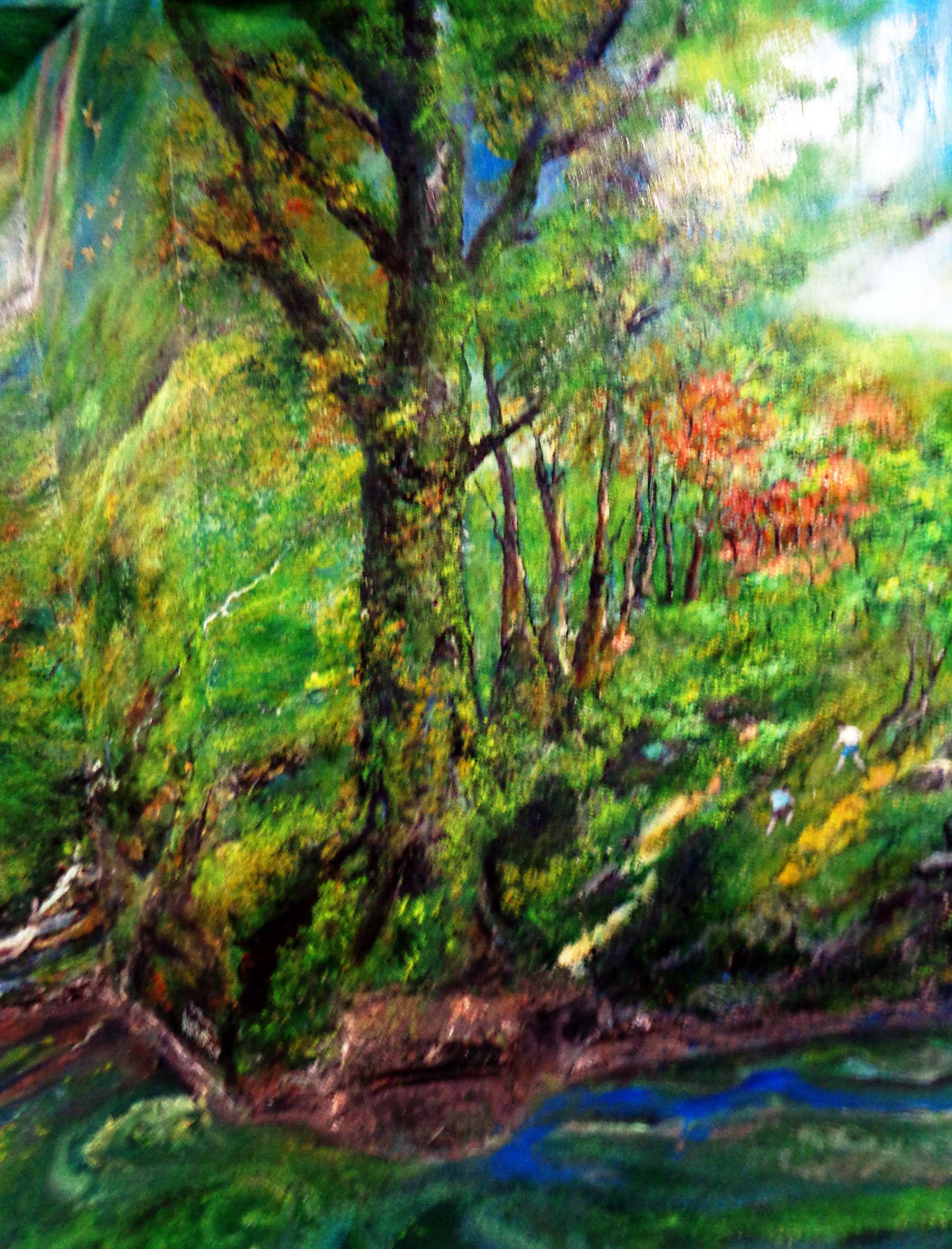
Details of wall mural painted by the author.  Left, a pair of kalaw or hornbill birds perched across a forest stream; upland landscape showing young hikers 
dwarfed by trees. 

 Conventional or traditional art gives a true picture of Nature as seen by the naked eye, viewed either as landscapes or ecosystems with details and special effects as influenced by the elements, season, and place. 

Green Tunnel 
Mural and Verse by Dr Abe V Rotor

When life becomes unbearable living in a jungle of concrete;
when pressure of work is taking its toll and you may be the next,
don't tarry, reach out for the green tunnel;

when the air is filled with smog and you hardly can breathe;
when crime grips the street, you feel you're no longer safe,
don't tarry, reach out for the green tunnel;

when you are losing your friends and you feel sad and lonely;
when you are no longer enjoying the so-called Good Life, 
don't tarry, reach out for the green tunnel;

when you ponder over the promise of afterlife as a tunnel, too; 
when there is time on earth to seek its living counterpart,
don't tarry, reach out for the green tunnel;

when you shall have found your way to this heaven on earth;
when and where man once found peace and contentment,
look back, but revere this green tunnel.

Exit door from the art gallery.
Country life mural graces the second floor of San Vicente municipal hall.  


Students in fine art at the University of Northern Philippines visit 
the author's family art gallery, museum and reading center.

“Every child is an artist. The problem is how to remain 
an artist once you we grow up.” – Pablo Picasso

 
Homage to an 18th century icon of the Resurrection.  

“It’s not a museum. It’s not a place of artifacts; it’s a place of ideas.”
– Jeanie Kahnke

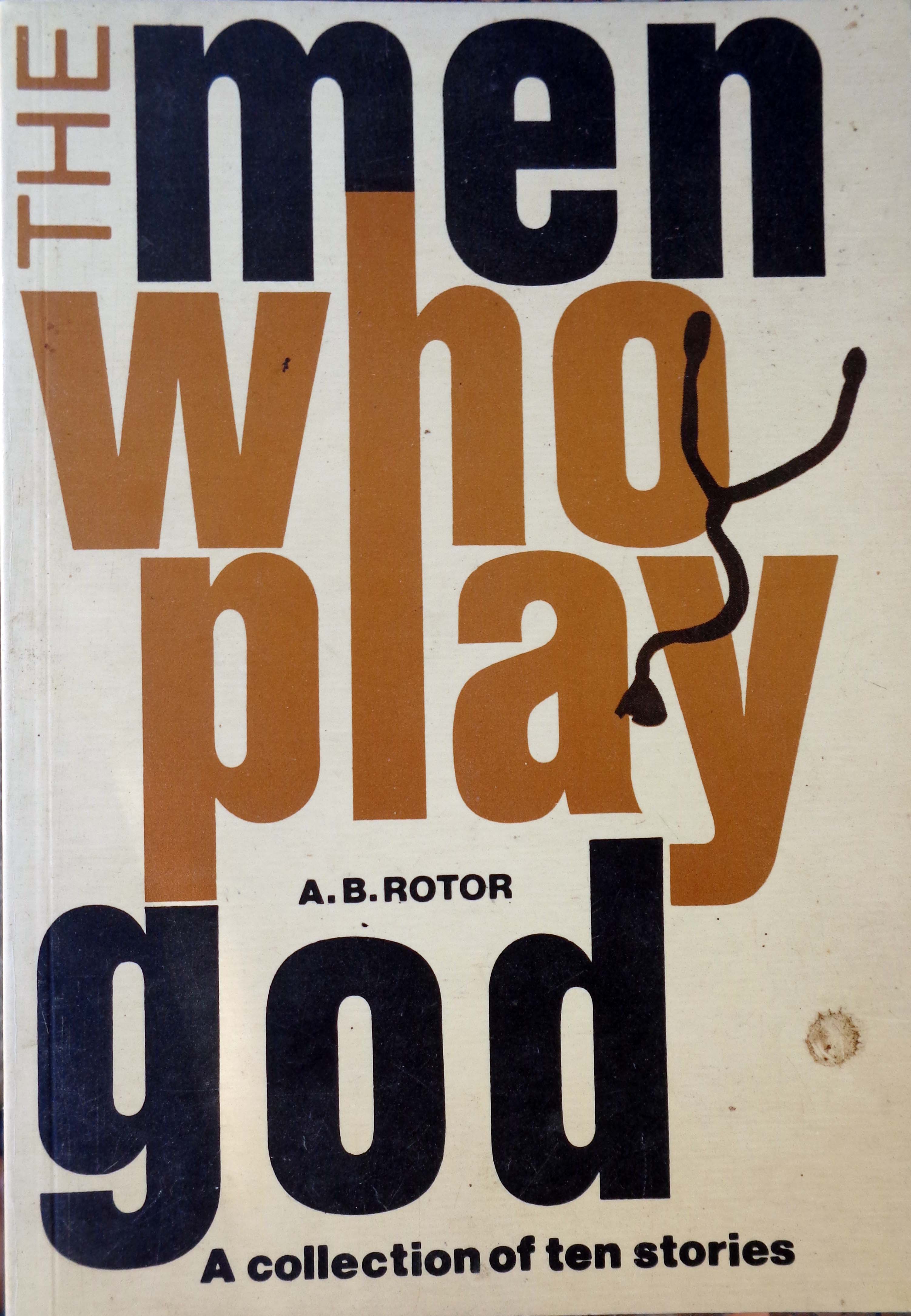
*Abercio V Rotor, Ph.D. is the award-winning author of Living with Nature Handbook (Gintong Aklat Award 203), Living with Nature in Our Times (National Book Award 2006), and radio instructor of People’s School on Air (Paaralang Bayan sa Himpapawid, Gawad Oscar Florentino Award for Development Communication on radio). He is also author of other books in essays and poetry, and textbooks in Humanities and Literature. Dr Rotor is a professor at UST, a former director of NFA and consultant of the Philippine Senate. He is married to Cecilia A Rojas, CPA, MBA, CESO3, with whom they have three children: Matthew Marlo, Anna Christina, and Leo Carlo. The family hails from San Vicente, Ilocos Sur. 

Part 5
Relevance of Community Museum 
and Library Today
Original title: Books - the Greatest Treasure of Mankind

Dr Abe V Rotor
Author inspects books for his home library in San Vicente, Ilocos Sur.
 
 
Books are  the greatest treasure of mankind; reverence the greatest in heart and mind. ~
Author's Note: Expand your home library by linking it with online libraries here and abroad. A simplified digital system would make access easier and wider, and for purposes of saving old books electronically, among other advantages. Create a conducive-to-learn  "library" ambiance with properly arranged and catalogued materials. (Internet photos) ~

B
ooks, once the privilege of a few in pre-printing machine era, each page painstakingly handwritten, each book a well-kept treasure.


Books, the authority, the final say, unquestioned, un-refuted, else any one rising contrary faces punishment, including death or damnation.

Books, the diary, the ledger, the document of conquest and discovery, of battles fought, often in favor of the writer and party.

Books, the novels that carry the greatest stories of all times are called classics, for which they are regarded timeless for their universal values.

Books, the epics of Homer, stories of the Grimm Brothers distilled from oral literature passed through generations to the present.

Books, written ahead of their time - Galileo's astronomy, Darwin's evolution, Martin Luther's Protestantism ignited dis-pleasured of the Church.

Books, bedtime stories, baby's introduction to the world, legends and fantasies that take young ones to the land of make believe.

Books, the record of ultimate scholarship, are the epitome of the greatest minds in
thesis and dissertation, theories and principles.

Books, the precursor of the Internet, the framework of the i-Pod, Tablet, Galaxy, and other gadgets that man becomes a walking encyclopedia.

Books, the progeny of the earliest forms of writing like the cuneiform, hieroglyphics, caves drawings, etchings, scrolls of the Dead Sea.

Books, that gave the idea and structure of the Wonders of the Ancient World, and the significance and belief for which they were built.

Books, that grew with knowledge, brought new schools and movements in arts and philosophy, in unending search for truth.

Books, the most widely read, the Bible; the shortest, Albert Einstein’s e=mc2, and book-to-cinema versions of Spielberg, Lucas, Cecile de Mills et al.

Books, the greatest treasure of mankind, its collective attributes as humanity, the very stimulus of man's rationality to rise above other creatures - and himself.

Books, that brought about man's disobedience to his creator, playing god, and questioning if god made man, or that man made god.

Books that enlighten man to care for the environment, guide the young and future generations to a better future, and lead man to save his own species from extinction.
-----------------
Author's Note: Herein below is one of the lists of top 100 books of the world. There is no standard for comparison, only preferences by different sources. However, there are books that consistently appear in many lists.

100 Most Influential Books Ever Written
by Martin Seymour-Smith

Note: This list is in chronological order. I've gotten e-mails from people who complain that there are too many religious books on the list. Say what you want, but you cannot deny that religion has been influential in human history. I'm sure that's what Seymour-Smith had in mind

1. The I Ching

2. The Old Testament
3. The Iliad and The Odyssey by Homer
4. The Upanishads
5. The Way and Its Power, Lao-tzu

6. The Avesta

7. Analects, Confucius
8. History of the Peloponnesian War, Thucydides
9. Works, Hippocrates
10. Works, Aristotle
11. History, Herodotus

12. The Republic, Plato
13. Elements, Euclid
14. The Dhammapada
15. Aeneid, Virgil

16. On the Nature of Reality, Lucretius

17. Allegorical Expositions of the Holy Laws, Philo of Alexandria
18. The New Testament
19. Lives, Plutarch
20. Annals, from the Death of the Divine Augustus, Cornelius Tacitus

21. The Gospel of Truth

22. Meditations, Marcus Aurelius
23. Outlines of Pyrrhonism, Sextus Empiricus
24. Enneads, Plotinus
25. Confessions, Augustine of Hippo

26. The Koran

27. Guide for the Perplexed, Moses Maimonides
28. The Kabbalah
29. Summa Theologicae, Thomas Aquinas
30. The Divine Comedy, Dante Alighieri

31. In Praise of Folly, Desiderius Erasmus

32. The Prince, Niccolò Machiavelli
33. On the Babylonian Captivity of the Church, Martin Luther
34. Gargantua and Pantagruel, François Rabelais
35. Institutes of the Christian Religion, John Calvin

36. On the Revolution of the Celestial Orbs, Nicolaus Copernicus

37. Essays, Michel Eyquem de Montaigne
38. Don Quixote, Parts I and II, Miguel de Cervantes
39. The Harmony of the World, Johannes Kepler
40. Novum Organum, Francis Bacon

41. The First Folio [Works], William Shakespeare

42. Dialogue Concerning Two New Chief World Systems, Galileo Galilei
43. Discourse on Method, René Descartes
44. Leviathan, Thomas Hobbes
45. Works, Gottfried Wilhelm Leibniz

46. Pensées, Blaise Pascal

47. Ethics, Baruch de Spinoza
48. Pilgrim's Progress, John Bunyan
49. Mathematical Principles of Natural Philosophy, Isaac Newton
50. Essay Concerning Human Understanding, John Locke

51. The Principles of Human Knowledge, George Berkeley

52. The New Science, Giambattista Vico
53. A Treatise of Human Nature, David Hume
54. The Encyclopedia, Denis Diderot, ed
55. A Dictionary of the English Language, Samuel Johnson

56. Candide, François-Marie de Voltaire

57. Common Sense, Thomas Paine
58. An Enquiry Into the Nature and Causes of the Wealth of Nations, Adam Smith
59. The History of the Decline and Fall of the Roman Empire, Edward Gibbon
60. Critique of Pure Reason, Immanuel Kant

61. Confessions, Jean-Jacques Rousseau

62. Reflections on the Revolution in France, Edmund Burke
63. Vindication of the Rights of Women, Mary Wollstonecraft
64. An Enquiry Concerning Political Justice, William Godwin
65. An Essay on the Principle of Population, Thomas Robert Malthus

66. Phenomenology of Spirit, George Wilhelm Friedrich Hegel
67. The World as Will and Idea, Arthur Schopenhauer
68. Course in the Positivist Philosophy, Auguste Comte
69. On War, Carl Marie von Clausewitz
70. Either/Or, Søren Kierkegaard

71. The Manifesto of the Communist Party, Karl Marx and Friedrich Engels

72. "Civil Disobedience," Henry David Thoreau
73. The Origin of Species by Means of Natural Selection, Charles Darwin
74. On Liberty, John Stuart Mill
75. First Principles, Herbert Spencer

76. "Experiments with Plant Hybrids," Gregor Mendel

77. War and Peace, Leo Tolstoy
78. Treatise on Electricity and Magnetism, James Clerk Maxwell
79. Thus Spake Zarathustra, Friedrich Nietzsche
80. The Interpretation of Dreams, Sigmund Freud

81. Pragmatism, William James

82. Relativity, Albert Einstein
83. The Mind and Society, Vilfredo Pareto
84. Psychological Types, Carl Gustav Jung
85. I and Thou, Martin Buber

86. The Trial, Franz Kafka

87. The Logic of Scientific Discovery, Karl Popper
88. The General Theory of Employment, Interest, and Money, John Maynard Keynes
89. Being and Nothingness, Jean-Paul Sartre
90. The Road to Serfdom, Friedrich von Hayek

91. The Second Sex, Simone de Beauvoir

92. Cybernetics, Norbert Wiener
93. Nineteen Eighty-Four, George Orwell
94. Beelzebub's Tales to His Grandson, George Ivanovitch Gurdjieff
95. Philosophical Investigations, Ludwig Wittgenstein

96. Syntactic Structures, Noam Chomsky

97. The Structure of Scientific Revolutions, T. S. Kuhn
98. The Feminine Mystique, Betty Friedan
99. Quotations from Chairman Mao Tse-tung [The Little Red Book], Mao Zedong
100. Beyond Freedom and Dignity, B. F. Skinner

Source: Seymour-Smith, Martin. 100 Most Influential Books Ever Written. Secaucus, N.J.: Citadel Press, 1998. © 1998 Martin Seymour-Smith. List from the Internet ~


Part 6 - The Living with Nature Center Library
Collection of Books and References


Part 7 - Rock Collection: Study and Hobby 

"All the lessons are in nature. You look at the way rocks are formed - the wind and the water hitting them, shaping them, making them what they are. Things take time, you know?" Diane Lane

Dr Abe V Rotor

Petrified or fossilized wood.  Carbon dating process traces
the origin, age, and habitat of the specimen. 


Resin, exudate of Pine tree undergoing metamorphism into amber

Aggregate rocks in various compositions and structures. 

Unidentified layered rock, indicating geologic
history.  

This is not a fossil, but broken glazed jar often used to store sacred 
objects and remains, like an urn in earlier times. 

Soft wood fossil broken into two to find out what is really its interior made of.

Not so perfectly round but it served as canon ball in early times.
Picked from a dry river bed, this specimen is a result of continuous
and even abrasion as it travelled downstream.

Fo
Limestone undergoing metamorphism into marble which 
may take a very long time under favorable conditions.

Rock collection of a student attracted by the diversity of the specimens.

Brain coral in its early stage of fossilization.

Operculum of a large seashell undergoing erosion by the elements.
Note the counterclockwise spiral, a unique find. 

Shades of opal and glitter often make this petrified wood look 
valuable when cut and polished, and made into fancy jewelry.

This chalky fossil looks like elephant's task.
 Did elephants roam the countryside in prehistoric times? 

Early stone age tools, crude and unpolished,
but they served the purpose of hunting.


Mt Pinatubo's pyroclastic  rock mounted for the museum.  
The rock formed while still very hot, forming a porous texture. ~

 Floral arrangement of stones gathered from Bacnotan, La Union beach. 
A collection of rock samples at author's home,  


ANNEX - Famous Quotations about Museums

“The best introduction to art is to stroll through a museum.
The more art you see, the more you’ll learn to define your own taste.”
– Jeanne Frank

“I paint flowers so they will not die.”
– Frida Kahlo

“Painter, you are not a speaker! Paint so and be silent!”
– Salvador Dali

“It’s not a museum. It’s not a place of artifacts; it’s a place of ideas.”
– Jeanie Kahnke

“The modern world thinks of art as very important:
something close to the meaning of life.”
– Alain de Botton

“Every child is an artist. The problem is how to remain an artist once you we grow up.”
– Pablo Picasso

“I saw the angel in the marble and carved until I set him free.”
– Michelangelo

“I want to make of Impressionism an art as solid as that of the museums.”
– Paul Cézanne

“If you don’t know history, then you don’t know anything.
You are a leaf that doesn’t know it is part of a tree.”
– Michael Crichton

“Immature poets imitate; mature poets steal.”
– T. S. Eliot

“Which painting in the National Gallery would I save if there was a fire? The one nearest the door of course.”
– George Bernard Shaw

“What you are doing does not matter so much as what you are learning from doing it.
It is better not to know and to know that one does not know than presumptuously to attribute some random meaning to symbols.”
– Ancient Egyptian Proverb

“Art is limitation. The essence of every picture is the frame.”
– G. K. Chesterton

(More lessons are found in avrotornaturalism.blogspot.com)