Wednesday, July 27, 2022

A Rocky Shore Comes Alive

 A Rocky Shore Comes Alive

Painting and Poem by Abe V Rotor 
Living with Nature - School on Blog (avrotor.blogspot.com)
Also open Naturalism - the Eighth Sense

Summer on a Rocky Shore, in acrylic by AVR 2012

Wish the old days could come back in old age, 
and exchange childhood from being a sage; 
wish the unspoiled field and shore remain, 
the simple life over richly domain. 

Wish the sky is deep blue as the sea before, 
the hills green and alive as the rocky shore; 
wish the lilting joy of children fill the air, 
the sweet cacophony of a country fair. 

Wish the tide to recede and walk on the reef, 
to be in the underworld for a time so brief, 
wish the waves to be as calm as your thought, 
yet wish the surf to keep coming back and forth. 

Wish the child in you shall live forevermore, 
as innocent and pure as he was before; 
wish for the ideal, the sublime, and the free, 
and the shore shall forever clap for thee. ~

 
Details of painting

Lesson on former Paaralang Bayan sa Himpapawid 738KHzAM 8-9 evening class Mon to Fri

Tuesday, July 26, 2022

Do you believe in tree spirit?

 Do you believe in tree spirit?

Dr Abe V Rotor

Living with Nature - School on Blog (avrotor.blogspot.com
Also open Naturalism -the Eighth Sense

 Children playing at the edge of a forest in acrylic by the author

Call the kapre, dwende, tikbalang
    to scare or just for fun;
call goddess Maria Makiling,
    and Helios, the sun;
Imagine the world without them
    - without them around.

Children wouldn't be home before dark;
and dogs at night wouldn't bark.

why sunflowers always face the sun,
and go to sleep when gone,

trespasser, beware, take the road instead,
else on some spirit you might tread;

over the hills and valleys thunder rolls
when angry Thor growls;

and mushroom spontaneously appear
breaking the ground like spear;

phosphorescence fascinates us, 
after the fire has gone into ash;

look up they're but one - fireflies and stars,
fireflies are the missing stars;

holiest is the altar of nature unspoiled,
where logging was foiled,

where the kapre lives in big trees,
and scares with a sudden breeze;

paddies sigh, bamboos creak and whisper,
unseen - creatures or not - slither.

The world is alive with tales and legends;
    untrue yet true, for they are a twin;
and if you pass by a tree, stop and listen
    to the spirit that throbs within. ~
 

Children Camping by a Forest Stream in acrylic by the author   

Let's Develop the Less Popular Fruits in the Philippines

Let's Develop the Less Popular Fruits
in the Philippines

The truth is that, the typical fruit stand is a poor showroom of Philippine fruits. 

Dr. Abe V. Rotor
Living with Nature School on Blog

Visit a fruit stand. There are many kinds of fruits coming from different parts of the Philippines. They have unique characteristics in taste, which can't be compared with imported fruits. They take us to a travelogue to their indigenous sources.

Lanzones from Paete, marang from South Cotabato, pomelo from Davao, manggang kalabao from Zambales, strawberry from Baguio, "Formosa" piƱa from  Bicol, durian from Maguindanao, dalangita from Cavite, pakwan from Candaba.


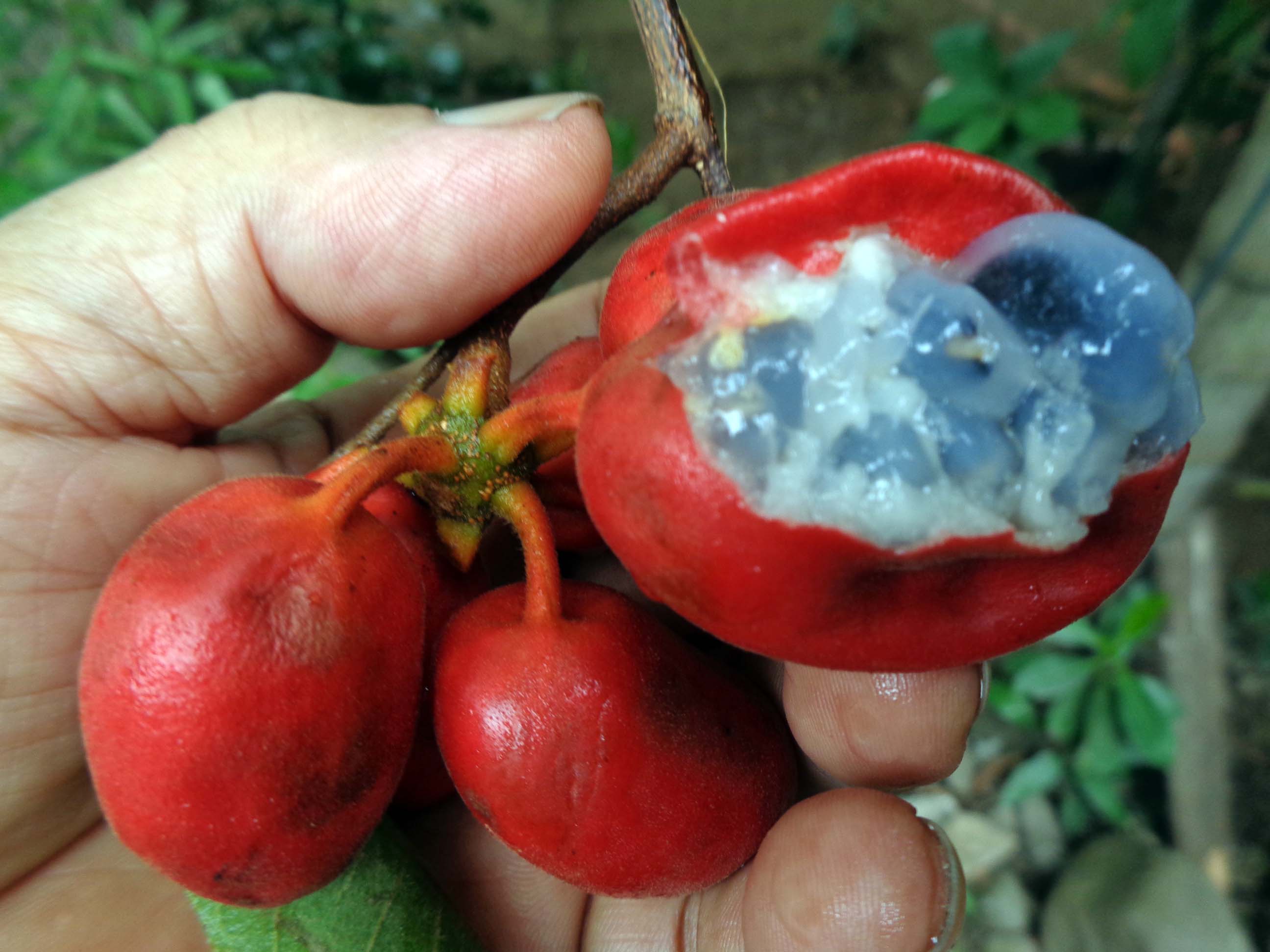
           Alagat (carabao teat fruit) - Uvaria rufa); bignay (Bugnay Ilk) - Antidesma bunius

Horticulture may have succeeded in acclimatizing several of these fruits outside of their indigenous origins, but these are inferior in taste and yield.

Today there is a proliferation of introduced fruits or fruits developed through hybridization. They have displaced many of our native varieties. But native chico is still sweeter than the ponderosa, native guava is sweeter and more aromatic than the guapple. The aroma of the apple mango is hardly traced to our carabao mango. And you can't make jams, jellies, pickles, wine and vinegar. from them. Or it would be quite expensive to do so. 

 Lubeg (Syzygium lineatum), locally known as Malubeg and Alebadu, Family Myrtaceae


The truth is that, the fruit stand is a poor showroom of Philippine fruits. There are a lot of fruits that are not so popular for certain reasons, among them their seasonal nature and "uneconomic" market value. Simply others have not been fully explored of their potential significance.

Author examines imported balimbing fruits in a supermarket in Metro Manila 

Here is a list of the minor fruits of the Philippines, often referred to as “promising fruits” because of their great potential in agriculture and industry, for both domestic and foreign markets.

1. Atis (Anona squamosa)
2. Avocado (Persia americana)
3. Balimbing (Averrhoa carambola)
4. Kamias (Averrhoa balimbi)
5. Caimito (Chrysophyllum cainito)

6. Cashew (Anacardium occidentale)
7. Chico (Manikara zapota syn., Achras zapota)
8. Duhat (Syzygium cumini)
9. Durian (Durio zibethinus)
10. Grapes (native) (Vitis vinifera)

               Macopa - Syzygium samarangense 
                                     (Family: Myrtaceae)

11. Guava (Psidium guajava)
12. Guyabano (Anona muricata)
13. Jackfruit (Artocarpus heterophyllus)
14. Lanzones (Lansium domesticum)
15. Mangosteen (Garcinia mangostana)
16. Pili (Canarium ovatum)
17. Rambutan (Nephalium appaceum)
18. Rimas (Artocarpus altilis)
19. Kamansi (A. camansi)
20. Santol (Sandoricum koetjape)

21. Sineguelas (Spondias purpurea)
22. Strawberry (Fragaria chiloensis)
23. Tamarind (Tamarindus indica)
24. Tiessa (Poteria campechiana)


Here are other noteworthy fruits to develop.

25. Bago (Gnetum gnenum)
26. Bignay (Antidesma bunuis)
27. Biriba (Rollina deliciosa syn R. orthopetala)
28. Chico-Mamey (Pouteria sapota syn., Calocarpum sapota)
29. Datiles (Muntingia calabura)
30. Kalumpit (Terminalia microcarpa)

31. Kamachili (Pithecolobium dulce)
32. Kayam (Inocarpus eduluis)
33. Mabolo (Diospyrus blancoi)
34. Makopa (Syzygium samarangense)
35. Manzanitas (Ziziphus jujuba)


Top Left clockwise: Pomegranate, passion fruit, caimito or star apple,
 mulberry, limonsito*, bignay

36. Marang (Artocarpus pdoratoissima)
37. Passion fruit (Passiflora edulis)
38. Granadilla (Punica granatum)
39. Tampoy (Syzygium jambos), relative of duhat and macopa
40. Fig (Relative of Smyrna fig)

Many native fruits await inclusion in this list. There are those known only in a particular place, likely after their dialect names. There are species in the endangered list such as sapote, anonang (a relative of the atis), karamay and batocanag. Others are growing in the wild such as paho, a wild species of mango, awaiting to be discovered.

For entrepreneurs, it is an opportunity to popularize these fruits. To the environmentalists, help save them before they finally disappear. ~

*Triphasia trifolia is a species of Triphasia in the family Rutaceae, native to tropical southeastern Asia in Malaysia, the Philippines and possibly elsewhere. Triphasias are very close relatives of citrus.

Reference: Promising Fruits of the Philippines by Dr. Roberto E. Coronel, UPLB, Laguna.

Lesson on former Paaralang Bayan sa Himpapawid (People's School-on-Air) Dr Abe V Rotor and Ms Melly C Tenorio. 738 DZRB AM Band, 8 to 9 evening class Monday to Friday

Monday, July 25, 2022

Dawn of Discovery in the Garden

Dawn of Discovery in the Garden 
"My garden is my most beautiful masterpiece." –Claude Monet

Dr Abe V Rotor

 
Croton and Philodendron compared - an introduction to Linnaeus' system 
of nomenclature.

 
Spore cases (sori) of fern, counterpart of fruits containing seeds in  
flowering plants (angiosperms).

 
A wall mural depicting wildlife enriches the garden's natural landscape.
Mural painting by the author.

School gardening as part of elementary curriculum (Internet)

Gardening in the twilight years (Internet) ~


Sunday, July 24, 2022

Wishing Well

                                                    
Wishing Well
Dr Abe V Rotor

Tagaytay, Cavite

Throw one coin too many makes a wish come true;
Lady Luck comes this way, the fortune tellers' view;
who wins loses, winning in the back of his mind
the deepest of desire where good and evil bind.

Friday, July 22, 2022

How happy are you? A self-administered test.

 How happy are you? A self-administered test.

Dr Abe V Rotor 
Living with Nature - School on Blog

Mimicking the windmill, Bangui, Ilocos Norte

We say we are happy, or a little happy. Or unhappy. Or sad. But how can we quantify happiness like in a grading system?

Paaralang Bayan sa Himpapawid (People's School-on-Air) found a good reference. It came from the works of the founding father of happiness research, Dr Happiness himself - Dr Edward Diener of the University of Illinois.* He calls this technique The Satisfaction with Life Scale.

This evening Ka Melly and I used this technique to impart a lesson about Happiness. We find that Dr Diener's test can be used in the classroom, in meetings and conferences, or just for the sake of bonding with friends and associates.

Get a piece of paper and rate yourself in each of the following items. Use a scale of 1 to 7, where 1 is not true at all, 4 is moderately true and 7 absolutely true. The scale allows you to approximate closer to your self-judgment.

Here are the criteria:

1. In most ways my life is close to my ideal.
2. The conditions of my life are excellent.
3. I am satisfied with my life.
4. So far I have gotten the important things I want in life.
5. If I could live my life over, I would change almost nothing.

Compute for the total score by adding all values from the five questions.

Here is the interpretation of your score.

If you got 31 to 35, you are extremely satisfied with your life. Kudos!

If you got 26 to 30, you are very satisfied with your life. My co-host Melly Tenorio got 28; I got 27. Three program participants got Very Satisfied scores, too.

If you scored 21 to 25, you are slightly satisfied. Two participants got scores on this level.


Those who scored 15 to 19 (slightly dissatisfied) will have to perk up and unload some reasons. Get to the neutral point which is 20, and thence move up the happiness ladder.

It's not hopeless if you got low. The idea of this exercise is to create awareness that there are avenues of happiness, and that there are basic levels of happiness that one can cling to, and say, "Oh well, that's life." And still manage to laugh. And the world laughs with you.

Here is Wilcox's masterpiece which projected her to world fame as author and poetess.


  The Way of the World

Laugh, and the world laughs with you,
Weep, and you weep alone;
For the brave old earth must borrow its mirth,
But has trouble enough of its own.

Sing and the hills will answer,
Sigh, it is lost on the air;
The echoes rebound to a joyful sound
And shrink from voicing care.

Rejoice, and men will seek you,
Grieve, and they turn to go;
They want full measure of your pleasure,
But they do not want your woe.

Be glad, and your friends are many,
Be sad, and you lose them all;
There is none to decline your nectared wine,
But alone you must drink life’s gall.

Feast, and your halls are crowded,
Fast, and the world goes by.
Forget and forgive – it helps you to live,
But no man can help you to die;

There’s room in the halls of pleasure
For a long and lordly train,
But one by one, we must all march on
Through the narrow isle of pain.

Reference: The New Science of Happiness, Claudia Wallis, Time February 28, 2005

Lesson on former Paaralang Bayan sa Himpapawid with Ms Melly C Tenorio
738 DZRB AM, 8 to 9 evening, Monday to Friday

My brother and I nearly drowned

 My brother and I nearly drowned

Dr Abe V Rotor


When we were kids, Eugene and I nearly drowned in a river. And this is the story.

Busiing River today as it was in our childhood.

There was a friendly man who would come around and dad allowed him to play with us. He knew many things like making slingshot, bird trap (taay), kites, bow and arrow - which kids love to have. People were talking he was a strange fellow, but we simply didn't mind. He was perhaps in his twenties when Eugene and I were in the early grades in San Vicente, Ilocos Sur.


One day this guy (I forgot his name) took us to Busiing river, a kilometer walk or so from the Poblacion. The water was so inviting - and what would kids like best to do? We swam and frolicked and fished, but then the water was steadily rising so we had to hold on the bamboo poles staked in the water to avoid being swept down by the current. I held on tight, and I saw Eugene doing the same on a nearby bamboo pole. the water was up to our neck. The guy must have forgotten us. He was quite far downstream and couldn't hear us shouting for help amid the rushing current and wind. Just then dad came running and saved us at the nick of time. Dad was really angry at the fellow. I never saw him like that.

We realized the extent of the psychiatric condition of this friendly fellow. There are people who are like him. They appear normal but suffer fits of madness. In Ilocano we call them agma-uyong (crazy), samsamatic (abnormal) and agkabus (lunatic, particularly during full moon). Beware of these persons. They may unwittingly put you in extreme danger, and not know you are in it. ~