Friday, May 27, 2016

Ideas that are Changing Our World (True or False) - Self-administered Test

 Dr Abe V Rotor

Living with Nature - School on Blog [avrotor.blogspot.com]
Paaralang Bayan sa Himpapawid (People's School-on-Air) with Ms Melly C Tenorio
738 DZRB AM Band, 8 to 9 evening class, Monday to Friday [www.pbs.gov.ph]


1. Take the back seat cinema, the so-called movies, save your money and ego. A 1001 homegrown producers are in the making in all countries today. In fact Bollywood India makes more than all movies made by Hollywood.

2. And gargantuan corporations that have dominated such small items like Colgate, Gillette,Palmolive, or cartelized coffee, cocoa, shoes, cars, and the like – Beware of the changing wind of change, and the triumphant of Small is Beautiful.
A sub-culture in dumpsites.

3. And to universities and schools - Put up more and larger campuses, multistory-building for classrooms and dormitories to accommodate more and more students as population continues to soar and as knowledge explodes.

4. History tells us time and again that ideas merely influence our thinking as humans, but never will they run the world and keep it spinning; it is money, politics and religion that runs our world.

5. The defining challenge of the 21st century will be to face the reality that humanity shares a common fate on a crowded planet. Nationalism, while it remains as the motivating factor in nationhood, must expand into the realm of regional and international cooperation.

Smog over cities


6. Customer service welcome. Welcome sir, thank you madam. More call centers, more HRM waiters and actresses, bank tellers, nurses. Personalized service is part of red carpet treatment.

7. The key to sustainable development is to make the right choices in our public investments and to find ways to harness, and channel, market forces. That is if we are talking to sustainable development for the whole world – for we cannot enjoy sustainable development while the rest of the world declines.

8. National interests aren’t what they used to be. Our survival requires global solutions. Thus a Filipino works in NASA, China makes good for the US, Germany supplies airplanes in Saudi, oil tankers servile any country irrespective of ideology or distance or political stability as long as the price is right. This is globalization.
HIV-AIDS on the rise globally

9. In 2005 the Kyoto Protocol mandates emission cuts by industrialized countries. Two countries remain indifferent as of today – US and Australia.

10. In 1999 - Human Surge, world pop reached 6 billion, doubling in size in 50 years. But by 2050 stabilization of world population shall then be attained at 8 billion, believed to be manageable under a sustainable development system.

11. In 2000 New resolutions (UN Millennium Development Goals address poverty and education. In 2002 – Health Aid Global Fund established to fight AIDS, tuberculosis and malaria. In 2003 – Going green, UN Sec-Gen Kofi Annan calls for Green Revolution in Africa.

12. End of Poverty comes in 2020. Income of all the world’s poorest can be increased comfortably above 1$ per day.

13. In 2030 – Fuel Economy. Plug-in hybrids and new technologies produce 42 km/li cars. By 2040 Zero Emissions. Goal for halting climate change through renewable energy and other steps.

14. The End of Customer Services. With self-serve technology, you’ll never have to see a clerk again. Started in 1902 Automat in Philadelphia – a German idea. In 1916 – A super market Piggy Wiggly, first self-serve grocery store, Memphis.
Changing of the guards and evolution of communism-capitalism ideology

15. 1n 1947 – Self pumped gas in California service stations by George Urich. 1967 Teller Goodbye. Barclays bank worlds first ATMs at London Branch. In 1995 Flying solo. Alaska airplane ticket over the internet for the first time

16. The Post-Movie-Star Era is still around. Get ready for more films in which the leading man is the center of attraction.
Rise of NONES (people who detached themselves from organized religion)
17. In 1910s Stars Charlie Chaplin and Mary Pickford sold the new medium of cinema around the world. By 1930s Stars shine. Studios ensure stability by signing their A-list actors to long-term contracts. In 1950 Shoot stars. Top talent – John Wayne, Burt Lancaster became their own producers, so with Kirk Douglas.

18. In 1970 Stars fade. All-star vehicles give way to non-star fantasies like Star Wars, ET Jurassic Park. 2000s Lights out. Old style stars rise falling into the black hole of no-name epics and stories.

19. Reverse Radicalism to terrorism? No way start talking to terrorists who stop themselves. Some 170 prisoners currently incarcerated for Jihadi crimes in Indonesia – 24 persuaded to cooperate with police, 151 released after serving time.
Decline of classical and fine arts

20. Ramon Magsaysay, then defense secretary dismantled the Hukbalahap Movement through persuasion and integrated the members into the stream of society. Rebel returnees program of the Philippines.


ANSWERS: 1t, 2t, 3f, 4f, 5t, 6f, 7t, 8t, 9f, 10t, 11t, 12f, 13t, 14t, 15t, 16f, 17t,18t, 19t, 20t

Living with Nature, AV Rotor (UST)

Thursday, May 26, 2016

Gross National Happiness (GNH) vs Gross National Product (GNP)

Gross National Happiness (GNH) vs Gross National Product (GNP)  
Are you really happy?
"How many people can you count on for help in case you get sick?"
"How often do you eat meals together as a family?"
"How restful can you be after a weekend?"


Dr Abe V Rotor
Living with Nature - School on Blog [avrotor.blogspot.com]
Paaralang Bayan sa Himpapawid (People's School-on-Air) with Ms Melly C Tenorio
738 DZRB AM Band, 8 to 9 evening class, Monday to Friday [www.pbs.gov.ph]


Have you heard of a measure of growth and development based on people's happiness?

Well, it is called Gross National Happiness (GNH) by Bhutan, the proponent of the idea. It
is more than people's welfare which is the aim of Human Development Index (HDI).  And it is a radical alternative to Gross National Product (GNP) which is a broad and unqualified gross measure of a country's economic growth.  

The illustrate, if a country's GNP is 10 percent - which is quite high - to what extent does this annual gain contribute to people's well-being in terms of health, education, income, housing, and the like which constitutes HDI?  Then we ask, in what way and to what extent does this material gain and social welfare make people happy? (GNH)  
A happy family 
Bhutan's bold attempt to quantify national well-being and achieve sustainable development (Gross National Happiness Index) is opening the eyes of the world to the paradox that rising incomes don't bring happiness (Easterlin Paradox, named for American economist Richard Easterlin).  

This is a long known fact but it was shrouded by an apparently progressive capitalistic world  in the last three decades - until recently – when economic crisis gripped the most progressive countries led by the US and members of the European Union, now affecting other countries, among them the the Philippines. 

The paradox is steadily being felt in China as it replaced Japan as the second biggest economy of the world. And the new tiger economies as well -  Singapore, Korea, Taiwan, including India which is an upcoming technology giant.  

Unhappiness has been the cause of depression, and depression often leads to self-destruction. Rising incomes, if taken as an analogy to Easterlin Paradox, increases the rate of depression and therefore suicide.  Thus the highest rate of suicide in the world has been observed in highly industrialized countries like Japan, the US and UK, with victims that include young men and women in the prime of their careers, and set to "conquer the world" but have failed to meet their aspirations.

GNH is a Eastern alternative to pressures of the materialistic Western world. The new measure aims at reducing pressure of living on the fast lane. It reduces the influx to cities and consequential buildup of urban marginal communities. It holds on to time-tested, community-based living. It is an alternative to a stressful life, and pressures of competition.  

To make GNH workable, Bhutan is adopting a program based on four pillars, namely

  • sustainable economic development
  • conservation of the environment
  • preservation of culture
  • good governance
Since 1989 after the dissolution of the USSR liberating former member-nations to self-rule,  and the termination of the Cold War that polarized the world into two ideologies - democracy and socialism, the world unfortunately has not devised a formula to equate prosperity with happiness, 

What is happiness sought for by a people, by a nation or region? It is really more than material benefit.  It is more than growth of institutions.  Of high rise buildings and wide avenues. It is something that elevates the human spirit on a higher level, albeit religiosity.  It is something that speaks of now and tomorrow, of the welfare of our children and children's children. 


Joy in receiving a award
Translated to the individual person, happiness may be gauged by his answers to these simple questions often encountered in daily living.
  • "How many people can you count on for help in case you get sick?" 
  • "How often do you eat meals together as a family?"
  • "How restful can you be after a weekend?"
  • "How comfortable are you with the level of household debt?"
  • "How satisfied are you in your present work.?"
  • "How often do to take time out with the kids?"
  • "How comfortable are you at home? In the neighborhood?"
  • "How secure are you with your income?  Savings?"
  • "How fulfilled are you your career? Livelihood?  Vocation?"  
  • "How satisfied are you with you community's governance?" 
  •  "How satisfied are you in sharing your talents and resources?  
  •  "How well preserved is your natural environment?  
Maybe we might as well ask
  • "How happy did you feel yesterday?"
  • "How satisfied are you with life today.?
These are sample questions raised in surveys conducted in Bhutan and other countries . The results differ of course, Except Bhutan, the result of the survey may be summarized as "Most people feel disconnected from the dominant economic indicators."

Which leads us to analyze the major unrest in many parts of the world, their cause and effect:
  • Arab Spring in the Middle East 
  • Occupy Wall Street in the US
  • Syrian War and migration
  • UK plan to leave EU
  • Miners' protest in South Africa
  • Oil protest in Nigeria 
  • Austerity Protest in Greece and Spain
  • Rise of Terrorism worldwide
  •  
Campus parade and class in jovial mood, UST   
Even political protests in post-Mubarak Egypt, in war-torn Iraq and continued conflict in post-Bin Ladin Afghanistan, are symptoms of people's unhappiness. So with Israel-Palestine unresolved conflict in Gaza, and short-lived people's protests in Russia, Tel-Aviv, and elsewhere in the world are traced to human's unfulfilled goal of happiness.  

Never has the issue of happiness, originally too personal and private and subjective, been brought out into a world forum likely to escalate into global referendum. And it took a new democracy with less than a million people perched on the Himalayas to herald what makes a beautiful life - happiness.   

"Gusto ko, Happy ka."  ~


There are many ways people find happiness and contentment: picking fruits, merchandising, joining parade, playing, outing, and fishing - be it a leisure or a livelihood.  List down your own ways and share with your family and friends. ~

Wednesday, May 25, 2016

Nature's Emissaries of Good News


Dr Abe V Rotor
Living with Nature School on Blog
Paaralang Bayan sa Himpapawid with Ms Melly C Tenorio
738 DZRB AM Band, 8-9 evening class, Monday to Friday  
 1. Roosters are Nature’s alarm clock.
Notice that roosters crow almost at the same time as dawn approaches. Some crow at midnight though. They are fairly accurate in telling us time, but at the height of Mt.Pinatubo’s eruption, roosters in Australia and China were behaving differently. The pyroclastic materials drifting in the atmosphere temporarily took away their sense of time. It was not unusual to hear them crow at anytime of the day or night until the drift settled months after the eruption.
Close up view of a crowing rooster- handsome fellow! The best alarm clock around!www.pinterest.com236 × 358Search by image
With our changing lifestyle, this natural rouser is likewise changing, especially the gamecock. But in the farm where I live, the roosters still crow with a message –

“Early to bed and early to rise,
Makes a person healthy and wise.”
2. Cicada sings for rain.
When you hear the shrilling song of cicada (kuliglig), it means the rains have finally arrived. From here we expect the rains to intensify throughout the southeast monsoon or habagat then tapers off in October. The cicada spends its immature or nymph stage in the ground feeding on roots of plants. 


(Right panel) Cicadas come in many species from the seasonal or one-year old cicada, to the 17-year old cicada often referred to as 17-year old locust. UPLB Museum of Natural History


There are species that complete their life cycle in one year (annual cicada which is most common), two years, and seventeen years (often called seventeen-year old locust). Whatever is the species, the emergence of cicada is at the onset of the rainy season, usually in April or May in most part of the country.

Rain softens the soil and signals the full-grown nymph to get out of its cell. It then climbs to the nearest tree and at some distance from the ground, it metamorphoses into an adult. It is the male cicada that “sings”, which is actually a continuous rapid high-pitched sound - tick-tack-tick-tack… produced by a pair of drums attached on its abdomen. Imagine the lid of a tin can pressed and released in rapid succession. On the other hand, the female cicada is totally mute and her response to a love call is to get near a Romeo whose song pleases her.

3. Cat grooming at the doorway tells of the coming of visitors.
Cats are fastidious clean creatures. Like birds at rest preening, cats lick their paws and fur clean especially after eating. But what has this to do with their alleged ability to forecast? Well, let’s look at it this way. It is customary in the province to cook something especially for our guests. And fond that we are with cats, we let them have their fill while we are cooking.

4. Emergence of the June beetle ushers the start of rainy season. Sometimes in comes out in May, hence also called May beetle.

This beetle, Leucopholis irrorata, resides under the soil for about a year as grub subsisting on roots of plants. It soon develops into pupa, and consequently adult towards the rainy season, remaining in its chamber until the first heavy rain comes. The beetle emerges and looks for food and mate. In a few days it dies, the female having laid dozens of eggs in the soil for the next generation.

What triggers metamorphosis is dictated by a biological clock pre-set by mature in the species. However, differential emergence among members of the population within the same species within a span of three months (April to June) is not fully understood.


5. Hovering dragonflies indicates a coming rain.
Old folks can tell if it’s going to rain early or late in the day just by observing the dragonflies. 
Common red dragonfly at rest
Dragonflies or tutubi' (Odonata) come in horde and hover over our heads in the meadow, farms, football field, or any place where they swoop upon their prey – small insects such as leafhoppers, gnats and midges (gamu-gamu) that escape from their abode to find shelter elsewhere. But how do they sense an oncoming rain? These insects are endowed with sensitive antennae and tactile body hairs, and can detect the changes of temperature and relative humidity that characterize an approaching rain.

The more dragonflies hovering, and the closer they get to the ground, the heavier is the coming rain, the old folks warn. By the way, it is the dragonfly’s predatory habit that has earned them a place in the heart of farmers.

6. If you see birds in the open sea, there must be land nearby.
Christopher Columbus knew there was land nearby when he saw sea birds in the sky. This convinced his disheartened crew who was at the verge of mutiny. The ship followed the birds leading to the discovery of America.
Birds migrating to the south when it is winter in the north guide seafarers. In spring and summer the birds return. It is a long route covering a distance of three thousand miles. 

Sea birds, one with a piece of plastic fishing net stuck around its neck. 20 miles off the coast of Mauritania. www.greenpeace.org800 × 532Search by image

Many of the birds fail to complete the route, and may discover new habitats and interbreed with local birds. Butterflies like the flamboyant monarch butterflies also migrate over long distances, such as the route from North America to Mexico. It is not a wonder to find butterflies not only on land but also at sea.

7. When house lizards (butiki) are noisy, there is a guest coming.
My father used to tell me when I was a child, that if house lizards make loud and crispy calls, it’s likely that a visitor is coming.

How do lizards know? Some people attribute this to the house lizard’s habit of “kissing” the ground at dusk. But this has nothing to do with predicting a guest’s arrival. But we know that when a person is anticipating a guest he is extraordinarily keen, and thus become aware of anything happening in his surroundings – including the mating calls of lizards.

House lizards take a drink on the ground and return to their dwellings on top of trees, on ceilings and roofs where water is scarce. By the way lizards are present where there is a lot of insects they feed on, such as areas around fluorescent lamps and streetlights.


Monarch butterfly migrates southward in enormous population to escape winter in the north.

Monday, May 23, 2016

The way to beat Invasive Species is to eat them

These invasive species have found their way to the dining table. Man's  gustatory delight is indeed the best way in dealing with undesirable creatures.

Dr Abe V Rotor

Living with Nature - School on Blog [avrotor.blogspot.com]
Paaralang Bayan sa Himpapawid (People's School-on-Air) with Ms Melly C Tenorio
738 DZRB AM Band, 8 to 9 evening class, Monday to Friday [www.pbs.gov.ph]


What is the best way to beat invasive species? Well, if humans managed to eat field rats, mole crickets, snails, pythons, alligators - and other "pests", why can't these undesirable organisms be part of his culinary taste and art?


1. Pets turned wild - knife fish and janitor fish.  Once fancy pets in aquarium, they found their way to Laguna Lake and Taal Lake. They can be cooked like any fish.  

2. Food to pest - Golden Kuhol (Pomacea caniculata).  Imported in the seventies as food  like the popular French escargot, it has spread to rice fields, where they have developed in a major pest of rice. Cook it with tanglad and luya, better still with gata.

Golden Kuhol (Pomacea caniculata).
3. Migratory swarms - Locust (Locusta migratoria) moves in swarms, thousands upon  thousands riding on wind current, invading fields and forests many kilometers away. They settle down as solitary grasshoppers, remaining in the place, mate and multiply, until the next migratory season. Have you tasted sauteed mole cricket  June beetle, gamu-gamu (winged termite)?  It tastes the same. 

4. Biological Warfare in peace time - Giant African Snail (Achatina fulica) introduce by the Japanese during World War II, now a common garden pests. One time a recipe was prepared on the request of a school head, and all his teachers tasted it - with delight. 


Janitor fish (Pterygoplichthys ), a fugitive from home aquarium, now a pest in Laguna Bay and other lakes

5. Fugitive to invader - Asian carp in Illinois, Missouri and Mississippi river. It is similar to our tilapia - Tilapia nilotica and T. mosambica.  American will learn to love the carp like we Asians. Just like how we first accepted it when it was introduced in the fifties by Dr Deogracia Villadolid, a prominent fisheries expert. Today tilapia is an important part of the Filipino diet,   

6. Breakout from cage - Black spiny-tailed Iguana has invaded Florida.  It eats about anything, including birds. When made into adobo, its meat tastes like that of monitor lizard.

7. Trans-oceanic invasion - Lion fish has venomous spines and dangerous to aquatic and human life alike. Origin Pacific and Indian oceans to the Caribbean. It's cooked like any marine fish.
Maverick knife fish (Apteronotus albifrons),
8. Adaptive mechanism of survival - Nutria a rodent originated in South America and has invaded the Gulf Coast, destroying valuable wetlands, and make bore tunnels through levees.  In the Philippines the Rattus rattus norvigicus was accidentally introduced and have adapted to city life. 

9. Wildlife gone wilder - Armadillo, a gentle and peaceful armored animal of Central and South America is upsetting the balance of food webs, eating just anything, even stealing eggs of threatened sea turtles.  They say it's good meat. The closest animal to the Armadillo in the Philippines is the Scaly Anteater which is a threatened species.    

10. Biological Control agent gone wild - Toad (Bufo marinus) introduced in Australia to control sugarcane pest, now overruns even homes and highways. This is poisonous, even animals have learned to avoid it.  It is for this reason, itspopulation increased rapidly in Australia.  

Except for No 10, these invasive species have found their way to the dining table. Man's  gustatory delight is indeed the best way in dealing with undesirable creatures. ~ 


Maya or red finch is a pest in the ricefield during harvest season. They invade in flocks ready-to-harvest palay.  They are caught by  nets strung along paddies and end up in the frying pan.

Arius - Batanes' Signature Plant

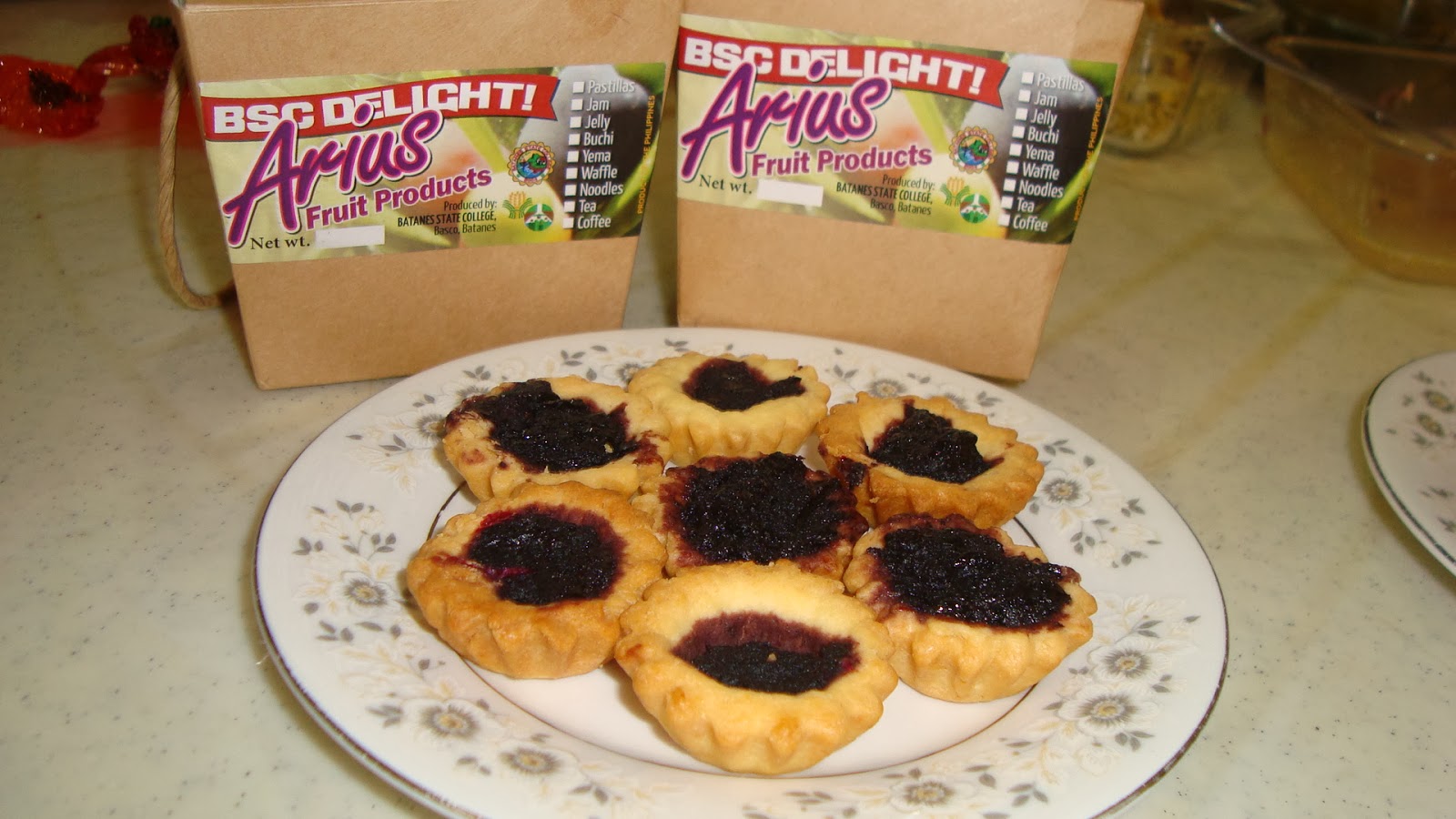
Arius Pastry - Batanes Delight 
Dr Abe V Rotor
Living with Nature - School on Blog [avrotor.blogspot.com]
Paaralang Bayan sa Himpapawid (People's School-on-Air) with Ms Melly C Tenorio
738 DZRB AM Band, 8 to 9 evening class, Monday to Friday [www.pbs.gov.ph]


Here is a classical example of a "wild food plant" rediscovered for its many uses.
1. Pastries and other bakery products
2. Jam, jelly, "raisin"
3. Fruit wine, natural vinegar
4. Fruit juice, tea
5. Health food - rich in tannin, flavonoid, anti-oxidant, anti-cancer, calories and vitamins
6. Enhancement of active long life.
7. Reforestation, watershed, windbreak, ornamental
8. Pesticide - volatile oil is a safe insect repellent.
9. Natural Christmas tree - saves cutting of trees during the Season.
10. Living fossil - helps trace evolution and phylogeny of living things. Gymnosperms are much older than angiosperms, they were the dominant plants during the time of the dinosaur (Mesozoic Period)) while the angiosperms dominated the Cenozoic Period onward to the present.


Pastry made from the mature berries of Arius 
Pastry is the name given to various kinds of baked products made from ingredients such as flour, sugar, milk, butter, shortening, baking powder, and eggs. Small tarts and other sweet baked products are called "pastries"

Arius (Podocarpus costalis) a relative of the pine and cypress is a gymnosperm, which is distinct from angiosperms or seed-bearing plants. Many gymnosperms like the redwood, bristle pine and our own Baguio pine are among the longest living organisms on earth. Although it may not live for one thousand to three thousand years like the Sequoia and Bristle Pine, Arius for one has a lifespan of 100 to 300 years for which it earned its name "century plant" in its native habitat - Formosa, now Taiwan and Batanes. To the Ivatans, it is Batanes Pine. 

One of the treasured plants at the former EcoSanctuary of St Paul University QC was a pair of Arius trees until tall buildings took over the garden.  Dr Sel Cabigan and I used to visit the plants when we were professors in the university.  Indeed the Arius is a very curious plant. 

First, it is unsuspecting as a gymnosperm. It does not have needle leaves like the pine. It produces male and female flowers, the female becoming the "berry" which ripens into dark purple, its seeds exposed at the bottom like the cashew (kasoy). 

Second, it is an evergreen.  The tree remains green throughout the year. It does not lose its leaves simultaneously or at a given time of the year, unlike the deciduous narra, talisay, and and many seed-bearing trees. Being an evergreen it protects the area from brush fire.  It is efficient as watershed cover to catch and store water, while protecting the soil from erosion and siltation. 

Third, it is photoperiodic.  It responding to specific day length that dictates certain blooming period, and maturing of the fruits or berries. It is climate specific.  Though it may grow vegetatively in the lowland, and at lower latitude, it does not produce cones - and these may not form into "berries" at all.  In Batanes and Taiwan the Arius undergoes the normal cycle, being indigenous in these places. 

Fourth, its essential oil is an insect repellant, as ointment, smudge (katol), or simply by applying fresh leaves where insects abound like in poultry houses, kitchen cabinet, and tents. Try crushed leaves mixed with water for watering garden plants.     


Sunday, May 22, 2016

Flowering talahib grass (Saccharum spontaneum) captures the dying glow of the sky

Poem and Photo by Dr Abe V Rotor
 Living with Nature - School on Blog [avrotor.blogspot.com]
Paaralang Bayan sa Himpapawid (People's School-on-Air) with Ms Melly C Tenorio
738 DZRB AM Band, 8 to 9 evening class, Monday to Friday [www.pbs.gov.ph]

Flowering talahib grass (Saccharum spontaneum) captures the dying glow of the sky before a heavy rain. Lipa, Batangas. (AVR) 

Beauty is heavy sky about to fall,
     and sprays of talahib bloom,
proud to capture the last glow of day,
     swaying to the will of the wind.

Goodbye to the feathery seeds fly,
     knowing not their destiny; 
and if freedom the prize of weaning
     it is none but fate and duty.  

Ephemeral is beauty simple and true,
     weeping not on the side of gloom;
whoever is afraid does not deserve    
     the prize of this great mystery.   

Beauty begets beauty, that we know,  
     and begets death too, at the end;
and lo! time passing and tears dry,
     rise the hills and valleys green.~  
       

Ilokano Haiku: No Mapulinganka (When dust gets into your eyes ... what will you do?)*

Dr Abe V Rotor
Living with Nature - School on Blog [avrotor.blogspot.com]
Paaralang Bayan sa Himpapawid (People's School-on-Air) with Ms Melly C Tenorio
738 DZRB AM Band, 8 to 9 evening class, Monday to Friday [www.pbs.gov.ph]
Upstream is noisy after a heavy rain. Fishing
Upstream
, p
ainting in acrylic AVR 1997?


1. Panagladingit,
Ilelennek ti init,
Tikag, sakit
Sorrow is immeasurable in times of drought and disease at sunset (metaphor). 
2. Mapulinganka,
Ipangresmo't mamindua, 
Mabang-aranka.
 Blow your nose twice to relieve you when dust gets into your eyes. 
3. Naanos unay -
Maikatallo a takiag
Ni apo lakay.

The attendant of an old man is indeed very patient.
 

4. Laud ken daya
Agsabat a maymaysa
Agkabsat ida.
 West and East meet and become brothers.

5. Panagkasangay,
Agtinnag ti bulbulong,
Aweng malmalday.
Birthdays can be lonely in old age. (Falling leaves, metaphor)

6. Pugot idiay sanga,
Agpalpalayog aya,
Ay, lawa-lawa'.
It's the spider hanging on a branch, a riddle.

7. Rupa't arigna,
Uray nakakidemka,
Panagsarita.

The way one talks shows his character (face)

- even without looking at the person.

8. Atiddag ti biag,
No dakkel ti lapayag,
Agal-allingag.

He who has large ears live long. (Being alert)
 

9. Napnuan saririt -
Kabusor, rig-rigat,
Pannaka-abak.

Wisdom grows in the face of enemy, hardship and failure.
 

10. Natagarinto,
Kalpasan ti tudo,
Waig ti ngato.
Upstream is noisy after a rain.

 ---------
* Answer: Just blow your nose hard, and the dust will be eliminated.
 
Reference: Living with Nature
, AVR (UST) 2003


A haiku in English is a very short poem in the English language, following to a greater or lesser extent the form and style of the Japanese haiku. A typical haiku is a three-line observation about a fleeting moment involving nature.