Abe V Rotor
Living with Nature - School on Blog.
Lesson: Let's do our part on Earth Day 2011 - and beyond
Countdown to Earth Day April 22, 2011. These are some things we can do to make Earth Day significant in real terms and long range effects.
Set 1 - Things to do spontaneously. Take heed and act now.
1. Keep clean and neat at all times, at home and in public
2. Have regular physical exercise through sports and work.
3. Eat fruits and vegetables, less of meat products
4. Save, save, save. Refrain from non-essential and luxury items.
5. Get rid of thrash properly. Donate materials which still have something of value like clothings.
6. Recycle bottles, old clothes to rugs.
7. Repair, don't throw away - furniture, appliances, clothes.
8. Refill: ball pen, printers, detergent dispensers.
9. Compost, convert kitchen and farm waste into valuable fertilizer. Practice organic farming.
10. Limit use of cosmetics, avoid those known to contain harmful substances like Pb, Hg and Cd.
Set 2 - Plan, Simplify and Organize. Just do it.
1. Organize a car pool in your area. Why not a carless day?
2. Check tires regularly. Underinflated tires give less mileage. Replace old tires.
3. Economize water. Check pipes and faucet for leakage. Recyle water.
4. Harvest and store rainwater in tank or pond for domestic use.
5. Build a garden pond to cool and beautify garden, raise fish - and safety in case of fire.
6. Walk the short distance, or bike. Do it regularly.
7. Plan your car route, avoid congested area, maximaize travel.
8. Be a handyman at home for simple house repair, school projects.
9. Plant backyard with vegetables, herbals, ornamentals - in this order.
10. Plant trees as personal or community project. Take care of them after.
Next set follows. Why don't you add to the list and be a resource person?
Every year, Earth Day - April 22 - marks the anniversary of the birth of modern environmental movement that started in 1970, brainchild of Senator Gaylord Nelson of Wisconsin.
Earth Day capitalizes on the emerging consciousness on environmental concerns.
Since then millions all over the world took to the streets, parks, and auditoriums to demonstrate for a healthy, sustainable environment in massive rallies. More than just talk and demonstrate, they rolled their sleeves took the rake and shovel and did the cleaning of cities, parks, rivers, the sea and air. Colleges and universities organized protests against the deterioration of the environment. Groups that had been fighting against oil spills, polluting factories and power plants, raw sewage, toxic dumps, pesticides, freeways, the loss of wilderness, and the extinction of wildlife suddenly realized they now share common values.
Earth Day was instrumental in the creation of the United States Environmental Protection Agency, and the passage of the Clean Air , Clean Water, and Endangered Species Acts. Earth Day paved the way for the 1992 United Nations Earth Summit in Rio de Janeiro, and subsequent environmental conferences.
Earth Day is just the beginning of Environmental Revolution - the revolution of this millenium. It's going to be the biggest change mankind aims to achieve, it means saving Planet Earth. ~
Wednesday, April 13, 2011
Tuesday, April 12, 2011
Dying Hill
Dying Hill, in acrylic, AVR 2010How can I sing on this hill Maria's song,
"The hills are alive with the sound of music,"
Where I now stand is not what I knew then -
the music of the young, pure and angelic?
How can I hear Maria amidst cascading
Streams and waterfalls that never stop,
Rushing, hissing against boulders and rocks,
And precious soil washed from the top?
From here I watch the consequence of my act,
The trees I cut, the farm I did abandon
Lost is the beauty I wanted to own alone.~
Living with Nature, AVR
Burning of Rome and Birth of Christendom
Dr Abe V Rotor
Burning of Rome, Mural by AVR, 1997, former St. Paul Museum QC
Nero burned Rome into ruins and ashes
Inflamed by the caprice of the Pharisees;
Christians died with their faith in sacrifice
With Paul's blood, that they may again rise -
And they did to the present Christendom,
Built by their faith and martyrdom.~
Emperor Nero is said to have torched Rome that burned for days, and insanely sang with a lyre, thrilled by the scene of the inferno. Christians were blamed for the conflagration and Paul of Tarsus, a former Roman general turned staunch disciple of Christ, was led to his execution. He is popularly known today as Saint Paul the Apostle, a revered martyr and writer - he wrote nearly a third of the Bible's new testament. ~
Inflamed by the caprice of the Pharisees;
Christians died with their faith in sacrifice
With Paul's blood, that they may again rise -
And they did to the present Christendom,
Built by their faith and martyrdom.~
Emperor Nero is said to have torched Rome that burned for days, and insanely sang with a lyre, thrilled by the scene of the inferno. Christians were blamed for the conflagration and Paul of Tarsus, a former Roman general turned staunch disciple of Christ, was led to his execution. He is popularly known today as Saint Paul the Apostle, a revered martyr and writer - he wrote nearly a third of the Bible's new testament. ~
Monday, April 11, 2011
Kaleidoscopic Seaweed
Dr Abe V Rotor
From folks who believe in the mermaid,
algae by their colors are named;
yet taxonomy's puzzle are foundin lowly plants on reefs abound.
Phaeophyta for the brown,
Chrysophyta, the golden;
Rhodophyta for the red,
Chlorophyta, the green,
And Cyanophyta, blue-green.
What with the countless without brand,
the microscopic, those in mighty strand
that make the jungle under the sea,
and the mysterious Sargasso Sea?
(Velasquez, Trono, Cordero,*
Please come, come to the rescue.) ~
* Foremost Filipino phycologists
Dr Abe V Rotor
From folks who believe in the mermaid,
algae by their colors are named;
yet taxonomy's puzzle are foundin lowly plants on reefs abound.
Phaeophyta for the brown,
Chrysophyta, the golden;
Rhodophyta for the red,
Chlorophyta, the green,
And Cyanophyta, blue-green.
What with the countless without brand,
the microscopic, those in mighty strand
that make the jungle under the sea,
and the mysterious Sargasso Sea?
(Velasquez, Trono, Cordero,*
Please come, come to the rescue.) ~
* Foremost Filipino phycologists
Dr Abe V Rotor
From folks who believe in the mermaid,
algae by their colors are named;
yet taxonomy's puzzle are foundin lowly plants on reefs abound.
Phaeophyta for the brown,
Chrysophyta, the golden;
Rhodophyta for the red,
Chlorophyta, the green,
And Cyanophyta, blue-green.
What with the countless without brand,
the microscopic, those in mighty strand
that make the jungle under the sea,
and the mysterious Sargasso Sea?
(Velasquez, Trono, Cordero,*
Please come, come to the rescue.) ~
* Foremost Filipino phycologists
Dr Abe V Rotor
From folks who believe in the mermaid,
algae by their colors are named;
yet taxonomy's puzzle are foundin lowly plants on reefs abound.
Phaeophyta for the brown,
Chrysophyta, the golden;
Rhodophyta for the red,
Chlorophyta, the green,
And Cyanophyta, blue-green.
What with the countless without brand,
the microscopic, those in mighty strand
that make the jungle under the sea,
and the mysterious Sargasso Sea?
(Velasquez, Trono, Cordero,*
Please come, come to the rescue.) ~
* Foremost Filipino phycologists
Sunday, April 10, 2011
Chimaera
Chimaera
Abe V Rotor
I saw you when I was a child on cartoon,
in youth a monster to slay;
I saw you in the hadal deep of the ocean,
armed with tools of the day.
I saw you with Jules Verne and Arthur Doyle,
with Linneaus and Darwin;
I saw you with Cousteau and Attenborough,
in every creature your twin. ~
in youth a monster to slay;
I saw you in the hadal deep of the ocean,
armed with tools of the day.
I saw you with Jules Verne and Arthur Doyle,
with Linneaus and Darwin;
I saw you with Cousteau and Attenborough,
in every creature your twin. ~
Living with Nature, AVR
Seaweeds: Vegetables of the Sea
Abe V Rotor
Welcome to Living with Nature - School on Blog
1,837th Post
To open posts/lessons, type keyword on SEARCH.
Lesson: Phycology, specifically marine algae. Add on to this list of common sea vegetables found in your area or country.
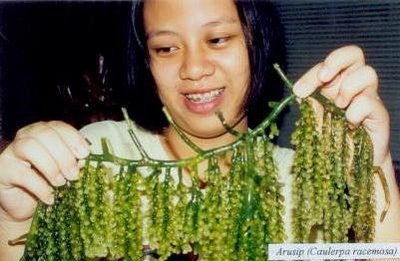
Arusip or ar-arusip, is the most popular sea vegetable in the local market. It is now widely cultivated on seaweed farms.
“Food of the gods.” This is what the ancient Greeks call a special kind of seaweed which the Chinese and Japanese call “food of the emperor.” And only members of the royalty have the exclusive right to partake of this food. It is Porphyra – nori to the Japanese, laver to the Europeans, and gamet to Ilocanos. Thus elevating the status of some 30 species of edible seaweeds to a premium class of food - sea vegetables.
The fact is seaweeds have a wide range of importance from food and medicine, to the manufacture of many industrial products. In nature, seaweeds together with corals and sea grasses, constitute the pasture and forest of the sea, a vast ecosystem, unique in its kind because it is the sanctuary of both marine and terrestrial life, and in the estuaries.
Lately however, we have intruded into this horizon, pushing agriculture beyond land towards the sea. We build fishponds, fish pens and cages, resorts, and we introduce poison from our wasteful living.
And yet we have barely discovered the many uses of seaweeds. Ironically we are indiscriminately and unwittingly destroying the very production base of this valuable resource before we have discovered its full potential – in the same way we are destroying the forest even if we have studied barely 10 percent of the potential value of its composition.
A happy note however, may be found in our success in cultivating seaweeds even before naturally occurring species and stands become exhausted. Seaweed farming has been established in coves and sheltered coral reefs such as in Danajon Reef between Cebu and Bohol, on flat coral beds in Calatagan in Batangas, Zamboanga and Tawi-tawi, to mention the most important plantations. Eucheuma, the source of carageenan is the main crop, followed by Gracillaria, Gellidiella and other species as source of algin and agar.
These seaweeds built a multi-million dollar industry locally. Their extracts have revolutionized the food industry, mainly as conditioners in food manufacture. More and more products are derived from them for our everyday use, which other than in food, are used in the manufacture of medicine and drugs, cosmetics, fabrics, paints, films, to mention a few.
-----------------------------------------------------------------------------------------------------
Unlike land plants, no seaweed has been found to be poisonous or pathologic. On the contrary seaweeds are rich in minerals and vitamins, which make them elixir of health. Only one species so far is known to cause dizziness when taken in excess - lato or Caulerpa. A substance responsible to this effect is caulerpin, which may be explored of its potential value in medicine as natural tranquilizer.
------------------------------------------------------------------------------------------------------
Seaweeds, botanically speaking, are not true plants, but rather algae – giants among their counterpart in the micro-world such as the Chlorella and Spirogyra. Biologists have assigned seaweeds into classes based on their color or dominant pigment, hence green (Chlorophyta), brown (Phaeophyta) and red (Rhodophyta). In terms of niche, these three groupings grow naturally at varying depths - in increasing depth in this order. This is ecologically advantageous and definitely a tool in their evolutionary success.
Food Value of Seaweeds
Fishes that feed on seaweeds contain high levels of Vitamins A and D in their liver, apparently absorbed from the seaweeds. Algae also synthesize appreciable amounts of Vitamins B12, C and K. Another advantage they have over land plants is their rich content of iodine, bromine, potassium, and other chemicals that have been discovered recently, many of which have potential value to medicine and industry.
It is no wonder why people who take seaweeds as regular part of their diet are sturdier and healthier and seldom get sick of anemia, goiter and scurvy. It is an observation that the Ilocanos who are the country’s top consumers of seaweeds generally enjoy good health and long life.
The cultivation of other edible seaweeds now include Enteromorpha, Monostroma, Laminaria, Porphyra and Undaria. The importance of seaweed culture is fast expanding this century, principally for food. This is to show the food value of seaweeds using kelp as a model.
Kelp (Laminaria japonica) contains the following nutrients based on a 100-gram sample: Carotene, 0.57 mg; Thiamine, 0.09 mg; Riboflavin, 0.36 mg; Niacin, 1.60 mg; Protein 8.20 g; Fats, 0.10 g; Carbohydrates, 57 g; Coarse fiber (roughage), 9.80 g; Inorganic salts, 12.90 g; Calcium, 1.18 g; Iron, 0.15 g; and Phosphorus, 0.22g.
Philippine seaweeds which approximate the food value of Laminaria are Eucheuma, Gracillaria and Gellidiella. On the other hand, gamet or Porphyra has the following food value. Based on a 100-gram sample, gamet contains protein, 35.6 g; fat, 0.7 g; carbohydrates, 44.3 g; provitamin, 44,500 IU; Vitamin C, 20 mg; Vitamin B1, 0.25 mg; Vitamin B2, 1.24 mg; and Niacin, 10 mg.
Seaweeds Sold in the Market
These seaweeds are commercially sold in Metro Manila, mainly in public markets and in talipapa.
1. Lato or Arusip [Caulerpa racemosa)(Forsk)L Agard], Chlorophyta
2. Guso (Eucheuma sp.), Rhodophyta
3. Gulaman (Gracillaria verrucosa), Rhodophyta
4. Kelp (Laminaria sp.), Phaeophyta
5. Gamet (Porphyra crispata Kjellman ), Rhodophyta
6. Kulot [Gelidiella acerosa (Forsk) Feldman ]
Lato or Caulerpa is of two commercial species, C. racemosa which is cultured in estuaries and fishponds and and C. lentillifera which is usually found growing in the wild. It is the racemosa type that predominates the market. Because of frequent harvesting of this species by local residents lentillifera it is no longer popular in the market. Besides, the cultured Caulerpa is cleaner and more uniform. It has lesser damage and is less pungent than its wild counterpart.
Guso or Eucheuma cotonii is cartilaginous and firm as compared with Caulerpa and because it is very much branched air can circulate better in between the fronds, which explains why its self life may extend up to 3 days. Guso is eaten in fresh state mixed with vegetables or cooked in water and sugar to make into sweets.
Gracillaria verrucosa and G. coronipifolia are the two common species of gulaman. The thallus is bushy with a firm fleshy texture. It is cylindrical and repeatedly divided into subdichotomous branches with numerous lateral proliferation. Gulaman grows up to 25 cm long and has a disclike base. It is found growing in protected, shallow waters.
Gamet or Pophyra crispata Kjellman has a deep red thallus which is flat and membranous with soft gelatinous fronds. Three to nine blades usually form clusters which grow from a very small adhesive disc which has tiny rhizoids attached to the rocky substratum. Gamet grows on rock promontories and rocks exposed directly to the action of waves and wind. This can be observed along the coast of Burgos, Ilocos Norte, which is the major producer of gamet. To date we have not succeeded in culturing gamet in spite of our knowledge on how nori, a species of Porphyra similar to our own gamet, is raised on marine farms in Japan and other parts of the world. The most authentic reason is because the natural habitat of Porphyra is temperate.
Why gamet grows along the northern most tip of Luzon is because the cold Kuroshu Current coming down from Japan reaches this point during the months of December to February. The current probably carries also the reproductive parts of the organisms, which explains the similarity of the Japanese and Philippine species.
Gamet is sold in dried form, compressed in mat, either circular with a diater of 20 to 30 cm, or rectangular in shape measuring some 50cm x 100 cm. Gamet is blanched with boiling water and allowed to cool before salad garnishings are added. It is also added to soup or diningding.
Kulot or Gelidiella acerosa (Forsk) Feldmann and Hamel has tough and wiry thalli, greenish black to dull purple in color. They lie low and creeping on rocks and corals along the intertidal zone. It is very much branched when mature with secondary branches cylindrical at the base and flattened towards the tip and beset on both sides with irregular, pinnately short branches. The fertile branchlets have conspicuous swollen tips.
Kelp or Laminaria is also found in the market. This is popular seaweed growing only in temperate seas. The main supplier is China. Kelp grows to several feet long and is usually thick and broad. It is sold in dried form or cut into strips and soaked in water and rehydrated.
As a source of nutrition and natural medicine, seaweeds are important in commerce and industry and as direct source of food of the people. On the point of ecology, protection of seaweeds in the wild, as well as their cultivation on reefs, farms and estuaries should be integrated under a sound management program of our coastal areas. Thus preserving God’s Eden under the Sea. ~
Reference: Rotor AV, Living with Nature in Our Times
Welcome to Living with Nature - School on Blog
1,837th Post
To open posts/lessons, type keyword on SEARCH.
Lesson: Phycology, specifically marine algae. Add on to this list of common sea vegetables found in your area or country.
Arusip or ar-arusip, is the most popular sea vegetable in the local market. It is now widely cultivated on seaweed farms. “Food of the gods.” This is what the ancient Greeks call a special kind of seaweed which the Chinese and Japanese call “food of the emperor.” And only members of the royalty have the exclusive right to partake of this food. It is Porphyra – nori to the Japanese, laver to the Europeans, and gamet to Ilocanos. Thus elevating the status of some 30 species of edible seaweeds to a premium class of food - sea vegetables.
The fact is seaweeds have a wide range of importance from food and medicine, to the manufacture of many industrial products. In nature, seaweeds together with corals and sea grasses, constitute the pasture and forest of the sea, a vast ecosystem, unique in its kind because it is the sanctuary of both marine and terrestrial life, and in the estuaries.
Lately however, we have intruded into this horizon, pushing agriculture beyond land towards the sea. We build fishponds, fish pens and cages, resorts, and we introduce poison from our wasteful living.
And yet we have barely discovered the many uses of seaweeds. Ironically we are indiscriminately and unwittingly destroying the very production base of this valuable resource before we have discovered its full potential – in the same way we are destroying the forest even if we have studied barely 10 percent of the potential value of its composition.
A happy note however, may be found in our success in cultivating seaweeds even before naturally occurring species and stands become exhausted. Seaweed farming has been established in coves and sheltered coral reefs such as in Danajon Reef between Cebu and Bohol, on flat coral beds in Calatagan in Batangas, Zamboanga and Tawi-tawi, to mention the most important plantations. Eucheuma, the source of carageenan is the main crop, followed by Gracillaria, Gellidiella and other species as source of algin and agar.
These seaweeds built a multi-million dollar industry locally. Their extracts have revolutionized the food industry, mainly as conditioners in food manufacture. More and more products are derived from them for our everyday use, which other than in food, are used in the manufacture of medicine and drugs, cosmetics, fabrics, paints, films, to mention a few.
-----------------------------------------------------------------------------------------------------
Unlike land plants, no seaweed has been found to be poisonous or pathologic. On the contrary seaweeds are rich in minerals and vitamins, which make them elixir of health. Only one species so far is known to cause dizziness when taken in excess - lato or Caulerpa. A substance responsible to this effect is caulerpin, which may be explored of its potential value in medicine as natural tranquilizer.
------------------------------------------------------------------------------------------------------
Seaweeds, botanically speaking, are not true plants, but rather algae – giants among their counterpart in the micro-world such as the Chlorella and Spirogyra. Biologists have assigned seaweeds into classes based on their color or dominant pigment, hence green (Chlorophyta), brown (Phaeophyta) and red (Rhodophyta). In terms of niche, these three groupings grow naturally at varying depths - in increasing depth in this order. This is ecologically advantageous and definitely a tool in their evolutionary success.
Food Value of Seaweeds
Fishes that feed on seaweeds contain high levels of Vitamins A and D in their liver, apparently absorbed from the seaweeds. Algae also synthesize appreciable amounts of Vitamins B12, C and K. Another advantage they have over land plants is their rich content of iodine, bromine, potassium, and other chemicals that have been discovered recently, many of which have potential value to medicine and industry.
It is no wonder why people who take seaweeds as regular part of their diet are sturdier and healthier and seldom get sick of anemia, goiter and scurvy. It is an observation that the Ilocanos who are the country’s top consumers of seaweeds generally enjoy good health and long life.
The cultivation of other edible seaweeds now include Enteromorpha, Monostroma, Laminaria, Porphyra and Undaria. The importance of seaweed culture is fast expanding this century, principally for food. This is to show the food value of seaweeds using kelp as a model.
Kelp (Laminaria japonica) contains the following nutrients based on a 100-gram sample: Carotene, 0.57 mg; Thiamine, 0.09 mg; Riboflavin, 0.36 mg; Niacin, 1.60 mg; Protein 8.20 g; Fats, 0.10 g; Carbohydrates, 57 g; Coarse fiber (roughage), 9.80 g; Inorganic salts, 12.90 g; Calcium, 1.18 g; Iron, 0.15 g; and Phosphorus, 0.22g.
Philippine seaweeds which approximate the food value of Laminaria are Eucheuma, Gracillaria and Gellidiella. On the other hand, gamet or Porphyra has the following food value. Based on a 100-gram sample, gamet contains protein, 35.6 g; fat, 0.7 g; carbohydrates, 44.3 g; provitamin, 44,500 IU; Vitamin C, 20 mg; Vitamin B1, 0.25 mg; Vitamin B2, 1.24 mg; and Niacin, 10 mg.
Seaweeds Sold in the Market
These seaweeds are commercially sold in Metro Manila, mainly in public markets and in talipapa.
1. Lato or Arusip [Caulerpa racemosa)(Forsk)L Agard], Chlorophyta
2. Guso (Eucheuma sp.), Rhodophyta
3. Gulaman (Gracillaria verrucosa), Rhodophyta
4. Kelp (Laminaria sp.), Phaeophyta
5. Gamet (Porphyra crispata Kjellman ), Rhodophyta
6. Kulot [Gelidiella acerosa (Forsk) Feldman ]
Lato or Caulerpa is of two commercial species, C. racemosa which is cultured in estuaries and fishponds and and C. lentillifera which is usually found growing in the wild. It is the racemosa type that predominates the market. Because of frequent harvesting of this species by local residents lentillifera it is no longer popular in the market. Besides, the cultured Caulerpa is cleaner and more uniform. It has lesser damage and is less pungent than its wild counterpart.
Guso or Eucheuma cotonii is cartilaginous and firm as compared with Caulerpa and because it is very much branched air can circulate better in between the fronds, which explains why its self life may extend up to 3 days. Guso is eaten in fresh state mixed with vegetables or cooked in water and sugar to make into sweets.
Gracillaria verrucosa and G. coronipifolia are the two common species of gulaman. The thallus is bushy with a firm fleshy texture. It is cylindrical and repeatedly divided into subdichotomous branches with numerous lateral proliferation. Gulaman grows up to 25 cm long and has a disclike base. It is found growing in protected, shallow waters.
Gamet or Pophyra crispata Kjellman has a deep red thallus which is flat and membranous with soft gelatinous fronds. Three to nine blades usually form clusters which grow from a very small adhesive disc which has tiny rhizoids attached to the rocky substratum. Gamet grows on rock promontories and rocks exposed directly to the action of waves and wind. This can be observed along the coast of Burgos, Ilocos Norte, which is the major producer of gamet. To date we have not succeeded in culturing gamet in spite of our knowledge on how nori, a species of Porphyra similar to our own gamet, is raised on marine farms in Japan and other parts of the world. The most authentic reason is because the natural habitat of Porphyra is temperate.
Why gamet grows along the northern most tip of Luzon is because the cold Kuroshu Current coming down from Japan reaches this point during the months of December to February. The current probably carries also the reproductive parts of the organisms, which explains the similarity of the Japanese and Philippine species.
Gamet is sold in dried form, compressed in mat, either circular with a diater of 20 to 30 cm, or rectangular in shape measuring some 50cm x 100 cm. Gamet is blanched with boiling water and allowed to cool before salad garnishings are added. It is also added to soup or diningding.
Kulot or Gelidiella acerosa (Forsk) Feldmann and Hamel has tough and wiry thalli, greenish black to dull purple in color. They lie low and creeping on rocks and corals along the intertidal zone. It is very much branched when mature with secondary branches cylindrical at the base and flattened towards the tip and beset on both sides with irregular, pinnately short branches. The fertile branchlets have conspicuous swollen tips.
Kelp or Laminaria is also found in the market. This is popular seaweed growing only in temperate seas. The main supplier is China. Kelp grows to several feet long and is usually thick and broad. It is sold in dried form or cut into strips and soaked in water and rehydrated.
As a source of nutrition and natural medicine, seaweeds are important in commerce and industry and as direct source of food of the people. On the point of ecology, protection of seaweeds in the wild, as well as their cultivation on reefs, farms and estuaries should be integrated under a sound management program of our coastal areas. Thus preserving God’s Eden under the Sea. ~
Reference: Rotor AV, Living with Nature in Our Times
Old Folks' Wisdom: Science or Superstition? Test, 50 items
Abe V Rotor
Living with Nature - School on Blog
Lesson: Test. Now and then we encounter events or situations we are not sure if real or just unfounded beliefs. Take the test, individually or in group. You will find the answers at the end, with the corresponding rating. I invite old folks to take this test as well. For their convenience the font is made large and bold.
(Photo unedited), Sacred Heart Novitiate, Novaliches QC. The party was already over when this photo was taken, showing an image of dancers under a huge balete tree, relative of the banyan.
Which is which? Find out the answer at the end of this test.
1. Raining while the sun is out breeds insects.
2. Nangka may bear fruit from its roots underground.
3. You know how big ube tuber is by its mound.
4.Karurayan na dumalaga (all white female fryer) is best food for a recuperating patient.
5. Swarming of winged termites and ants predicts siyam-siyam (18 days of uninterrupted rainfall)
6. Red sky in the west means coming of a typhoon.
7. When you break a glass, take another and break it too, to break the omen.
8. Kapre (ogre) lives on old trees; dwende (dwarf) lives among mushrooms.
9.When a spoon is accidentally dropped, a female guest is coming. If fork, a male guest.
10. When buying watermelon, choose that which has wide spaces between the “ribs.” It is more fleshy and sweet.
11. Actually you can hear the earth breath on a quiet summer night.
12. Predominance of cogon grass means the land is not worth farming.
13. Snake means good luck; monitor lizard bad luck.
14. Oranges with indented bottom are sweeter.
15. Powdered rhino horn is medicine and aphrodisiac.
16. Worms improve the taste of bagoong or patis. (fish sauce)
17. Just wipe kitchen with mild vinegar to drive ants away.
18. Large and round macopa contains seeds, so with lanzones.
19. Prune standing corn stalk to get fuller cobs.
20. There are people who cook ampalaya (bitter gourd) which tastes more bitter.
21. A brooding animal, like snake, is ferocious.
22. Guava seeds may cause appendicitis
23. Ginseng increase human virility or has aphrodisiac property.
24. Cut the leaves (pruning) of rice seedlings before transplanting in the field to make them grow faster and bigger.
25. When you eat twin bananas you will bear also twins.
26. During full moon crabs are lean.
27. Phases of the moons influence behavior (lunatic effect).
28. Gate must not face directly the dead-end of a road.
29. Planting cassava stem upturned will produce poisonous tuber.
30. Ring around the moon means a storm coming.
Mushrooms are often associated with superstition. It is perhaps because of their sudden appearance in most unlikely places. (UST campus Manila)
31. When you have a fishbone stuck, get the cat and gently rub its paws on the affected area of your throat.
32. When a spoon is accidentally dropped, a female guest is coming. If fork, a male guest.
33. A brooding animal, like snake, is ferocious.
34. Food offering at the family altar during festivals is homage to the spirits
35. Say tabi-tabi (or bari-bari Ilk) when entering a thicket.
36. Put sugar as fertilizer to a tree to get sweeter fruits.
37. Some people suffer body aches before a typhoon brews near.
38. When walking through a forest, wear a face mask backward to ward of tiger or lion attack.
39. When harvesting the first fruits, get an oversize basket and pretend that the harvest is heavy.
40. Expect rain if hordes of dragonflies hover low.
41. Size and shape of lips of a woman reflects her private organ.
42. Get male flower and introduce it into the female flower, like the squash, to enhance the fruit to develop.
43. Crickets are noisiest in summer.
44. When transplanting banana tiller take out the eyes (young tiller buds) arising on the corm.
45. Wet your navel with the first raindrops in summer, for good heath.
46. Noisy hen layers are not productive layers.
47. Roosters do sometimes lay eggs which are very small and sterile.
48. Throw sand into the axils of coconut leaves to prevent beetle attack.
49. A black cat brings bad luck when you meet it on the corridor or street.
50. A kingfisher's (salaksak) sonorous call means someone is going to die. ~
Tabon Cave (Palawan), home of our early ancestors for thousands of years. How they lived and passed on their generations to the present is a great blessing.
ANSWERS: Most likely supertitious belief to Nos. 7,8,9,11,13,16,22,25,28,29,31,32,34, 35,36,39, 41,45 and 47. The rest have scientific bases.
RATING: 46-50 Outstanding. You must be one of the old folks.
41-45 Very Good . You must be living with old folks.
36-40 Good. You have a good grasp of tradition
31-34 Fair. You have not moved away from tradition.
30 and below. Read more about old folks' wisdom - scientific and superstitious beliefs.
Reference: Living with Folk Wisdom by AV Rotor, UST Publishing House España, Manila. Book available at National Book Store, and UST Publishing House.
Living with Nature - School on Blog
Lesson: Test. Now and then we encounter events or situations we are not sure if real or just unfounded beliefs. Take the test, individually or in group. You will find the answers at the end, with the corresponding rating. I invite old folks to take this test as well. For their convenience the font is made large and bold.
(Photo unedited), Sacred Heart Novitiate, Novaliches QC. The party was already over when this photo was taken, showing an image of dancers under a huge balete tree, relative of the banyan.
Which is which? Find out the answer at the end of this test.
1. Raining while the sun is out breeds insects.
2. Nangka may bear fruit from its roots underground.
3. You know how big ube tuber is by its mound.
4.Karurayan na dumalaga (all white female fryer) is best food for a recuperating patient.
5. Swarming of winged termites and ants predicts siyam-siyam (18 days of uninterrupted rainfall)
6. Red sky in the west means coming of a typhoon.
7. When you break a glass, take another and break it too, to break the omen.
8. Kapre (ogre) lives on old trees; dwende (dwarf) lives among mushrooms.
9.When a spoon is accidentally dropped, a female guest is coming. If fork, a male guest.
10. When buying watermelon, choose that which has wide spaces between the “ribs.” It is more fleshy and sweet.
11. Actually you can hear the earth breath on a quiet summer night.
12. Predominance of cogon grass means the land is not worth farming.
13. Snake means good luck; monitor lizard bad luck.
14. Oranges with indented bottom are sweeter.
15. Powdered rhino horn is medicine and aphrodisiac.
16. Worms improve the taste of bagoong or patis. (fish sauce)
17. Just wipe kitchen with mild vinegar to drive ants away.
18. Large and round macopa contains seeds, so with lanzones.
19. Prune standing corn stalk to get fuller cobs.
20. There are people who cook ampalaya (bitter gourd) which tastes more bitter.
21. A brooding animal, like snake, is ferocious.
22. Guava seeds may cause appendicitis
23. Ginseng increase human virility or has aphrodisiac property.
24. Cut the leaves (pruning) of rice seedlings before transplanting in the field to make them grow faster and bigger.
25. When you eat twin bananas you will bear also twins.
26. During full moon crabs are lean.
27. Phases of the moons influence behavior (lunatic effect).
28. Gate must not face directly the dead-end of a road.
29. Planting cassava stem upturned will produce poisonous tuber.
30. Ring around the moon means a storm coming.
Mushrooms are often associated with superstition. It is perhaps because of their sudden appearance in most unlikely places. (UST campus Manila)31. When you have a fishbone stuck, get the cat and gently rub its paws on the affected area of your throat.
32. When a spoon is accidentally dropped, a female guest is coming. If fork, a male guest.
33. A brooding animal, like snake, is ferocious.
34. Food offering at the family altar during festivals is homage to the spirits
35. Say tabi-tabi (or bari-bari Ilk) when entering a thicket.
36. Put sugar as fertilizer to a tree to get sweeter fruits.
37. Some people suffer body aches before a typhoon brews near.
38. When walking through a forest, wear a face mask backward to ward of tiger or lion attack.
39. When harvesting the first fruits, get an oversize basket and pretend that the harvest is heavy.
40. Expect rain if hordes of dragonflies hover low.
41. Size and shape of lips of a woman reflects her private organ.
42. Get male flower and introduce it into the female flower, like the squash, to enhance the fruit to develop.
43. Crickets are noisiest in summer.
44. When transplanting banana tiller take out the eyes (young tiller buds) arising on the corm.
45. Wet your navel with the first raindrops in summer, for good heath.
46. Noisy hen layers are not productive layers.
47. Roosters do sometimes lay eggs which are very small and sterile.
48. Throw sand into the axils of coconut leaves to prevent beetle attack.
49. A black cat brings bad luck when you meet it on the corridor or street.
50. A kingfisher's (salaksak) sonorous call means someone is going to die. ~
Tabon Cave (Palawan), home of our early ancestors for thousands of years. How they lived and passed on their generations to the present is a great blessing. ANSWERS: Most likely supertitious belief to Nos. 7,8,9,11,13,16,22,25,28,29,31,32,34, 35,36,39, 41,45 and 47. The rest have scientific bases.
RATING: 46-50 Outstanding. You must be one of the old folks.
41-45 Very Good . You must be living with old folks.
36-40 Good. You have a good grasp of tradition
31-34 Fair. You have not moved away from tradition.
30 and below. Read more about old folks' wisdom - scientific and superstitious beliefs.
Reference: Living with Folk Wisdom by AV Rotor, UST Publishing House España, Manila. Book available at National Book Store, and UST Publishing House.
Subscribe to:
Posts (Atom)