Saturday, May 12, 2012

Chimaera

Dr Abe V Rotor
Chimaera, acrylic AVR 2005

I saw you when I was a child on cartoon,
     in youth a monster to slay;
I saw you in the hadal depth of the ocean,
     armed with tools of the day.

I saw you with Jules Verne and Arthur Doyle,
     with Linnaeus and Darwin;
I saw you with Cousteau and Attenborough,
     in every creature your twin. ~


Assignment: 
  1. What is the beast. Chimaera, in Greek mythology? 
  2. How does this biological phenomenon apply to other animals? to Plants? 
  3. Explain the scientific cause of chimaera? Its genetic basis?

Thursday, May 3, 2012

When does selfishness end and selflessness begin?

Abe V Rotor

 
Ipil-ipil plant lice (Psylla sp) form colonies in sheer number causing defoliation oif the host plant. When starved, the nymphs may produce youngs (virgin birth), a rare phenomenon in nature called paedogenesis.

All organisms, simple or complex, plant or animal – and human – are governed by genes, which through the long process of evolution, are the very tools for survival in Darwin’s treatise on Survival of the Fittest through Natural Selection.

The acquisition of successful genes is key to the survival of present day species, and the explanation on the failure of those which did not. Two words are important: adaptation and competition. This dual attributes are directed to self-preservation through the process of acquiring the basic necessities of life either by adjusting to it passively or actively. Definitely it is not one that is easy to share to the extent of losing its benefit in favor of another.

But if we analyze it, this is true to each individual. Now organisms do not live as individuals; they live as a community, as a society. Which leads us to the logical inference that if the individual organism, in order to survive must be selfish, then how can it be able to establish a community in which it ultimately become a part?

This is very important because the community is the key to resource sharing from food to space; it is the key to collective bargaining in times of peace or war. The community is like a bundle of individuals behaving singularly. It is collective planting time when the monsoon arrives, harvesting when it ends. The rituals that go with such activities enhance the success of bonding, and enshrine it into an institution.

Institutions were born from socio-economic needs which spontaneously developed into cultural and political rolled into one complex society. To answer where selfness starts is easier to answer than where selflessness begins.

If the premise is biological what proofs can we show that it is so?

• Social insects – ants, bees and termites – bind themselves as a colony. Any attack on the colony sends soldiers to fight the enemy. Paper wasps sting as intruders. The honeybee does not consume the nectar and pollen it gathers, but brings the harvest into the granary from which it get its share later. An ant clings to death at an enemy. When a bee sting, its abdomen is ripped away and is surely to die.

• Starve an aphid or a mealybug, and it will produce young prematurely – even without first becoming an adult. This is called paedogenesis. Or an adult may produce young without the benefit of mating and fertilization. This is parthenogenesis.

• A plant stressed by drought will cut its life cycle short in order to use the remaining energy to produce offspring. This is true to grasshoppers or caterpillars – they skip one or two moulting and metamorphose so that they can mate and reproduce.

• The spacing of plants is determined not only of soil and climatic conditions that control the growth and development, but by a biological mechanism known as allelopathy. A date palm will kill its own offspring around its trunk and under its crown. Those that grow outside its shadow becomes a part of the oasis’ vegetation.

• Bacteria, yeasts, and other microorganisms go into luxury feeding where there is plenty, and nature seems not to mind, until they consume the food, and worse until their waste accumulates and becomes toxic. This is called autotoxicity. Thus in fermentation, it is the toxic material - alcohol - that eventually kills the yeasts themselves, and another process follows until the organic forms of compounds are transformed and ultimately returned as inorganic ready for use by succeeding organisms.

• The dalag or mudfish and many other species of fish eat their young leaving only those that can escape. Here the advantage of controlled population and survival of the fittest are shown.

• Vultures seldom attack a living prey; they wait to its last breath. A male lion will kill a cub which it did not sire. But we know too, that there are surrogate mothers in the wild like the cuckoo, and among domestic animals.

Because of the complexity of social behavior, Dr E O Wilson of Harvard University, attempted to explain many of the observed behavior into a field of biology he called sociobiology. In a simple illustration, if your child is about to be hit by a fast oncoming vehicle, a mother would risk her life to save him. Dr. Wilson would then asks a third party if he or she would do the same thing to a child who is not his own – much less without any relations.


This leads us back to our previous question: When does selfishness end and selflessness begin?~

Tuesday, May 1, 2012

Drawing Exercise: Make your pet dogs happy


Dr Abe V Rotor

“Make these dogs happy,” I told a group of schoolchildren who were taking art lessons from me. I gave each of them a copy of a trace drawing of a pair of dogs. The dogs looked sad, docile and there is something pathetic about them.

With pastel colors they took the challenge. In their young mind I saw their pets at home. As I studied the expressions of their faces and actions they were not only re-creating their pets physically - they we virtually “caring for their pets.”

And what do you think they did with these animals? How kind are these children to them? How good are they as masters – or friends to their pets?

If you would like to try this workshop exercise yourself, stop reading this article. Draw a pair of dogs on a whole bond or Oslo paper and proceed without reading the criteria below. The instruction is simply, Make your pet dogs happy.

These are the criteria in grading your drawing. Use the Likert Scale of 1 to 10, where 1 is poorest, 5 average and 10 outstanding. Each criterion is equivalent to 10 points, so that the perfect score is 100 percent.

1. Unchain the dogs – A young participant made a drawing of a chain being sawed off in order to free the dogs. Truly there is nothing more important than freedom. This is also true with animals. Aren’t zoos today moved to bigger spaces where the habitats of the animals are simulated? In Safari Africa tourists are taken to see the animals in the wild, and not vice versa.

2. Build a doghouse – Keep them from heat and cold. Give them a sense of security and comfort. Give the doghouse some art and a bit of aesthetic sense. The house is a status symbol but its functional features are foremost.

3. Provide a shade – A tree beside the doghouse is a magnificent scene:
a bird’s nest atop, birdlings and parents singing at feeding time, ripe fruits hang, a kite is stuck up on a branch, a boy climbs to retrieve it, leaves fall and form a litter on which the dogs lay. These and many more, which the children drew, revive the childhood to every viewer of their art works.

4. Give them bone – If there is anything a dog is associated with, it is a big bone. Aesop saw it fitting for a fable, a lesson about greed. For the dog however, it is security and plaything. Be sure you give your pets food, fresh water and proper nutrition. Just do not overfeed them.

5. Play with them, give a plaything – I found out that many of my pupils drew themselves beside or playing with their pets. Others drew cats and mice playing with their dogs. Playing is universal among animals, tame or in the wild. Others raced with them on the meadow.

6. Groom them - Give them bath and comb them. Several drawings showed the dogs in attire, one in a circus, the others in casual wear, one eating on China ware. This is not rare because we often think of animal as human beings. Read “Animal Farm” by George Orwell. Or see the movie, “Babe.” Aesop’s fables are about animals who think like human beings – or it could be the other way around as Aesop wanted to drive a point, quite often a painful lesson. Aesop was silenced because he was unwittingly hurting people with his fable.

7. Teach them tricks and discipline – A ball, a stick, an electronic gadget to open or close the doghouse, are among the things the young participants included in their drawings. Why there’s a saying, “Old dogs learn no trick.” But the children saw their pets as young as they are. This means they are growing up together.

8. Vaccinate your dog – A participant drew a veterinarian administering an anti-rabies shot on his young pet. Precaution is always important, rabies is dangerous.

9. Artistic quality of your drawing

10. No wasteland or vacant space on your drawing paper.

Compute for the total score.
91 to 100 outstanding. You are a superb master. Indeed you a great caretaker of pets.
81 to 90 very good. You know how to take care of your pets properly.
71 to 80 good. It's all right. Give more care and attention to your pets.
60 to 70 average. You got to learn many things about taking care of pets. Find interest in pets.
59 and below. Listen to Paaralang Bayan sa Himpapawid lessons. Attend a dog training school for pet owners.

Who are these children mirrored by their drawings? And who will they be through the keyhole of their imagination? How we regard our pets is what we are and will become.

“A starving dog at his master’s gate predicts the ruin of the state,” thus William Blake in “Auguries of Innocence” tells us.

I, for one, would gladly meet with confidence and ease the master of a contented and happy dog.

The art workshop for children in which I used the dog as an exercise to demonstrate love for animals may be a simple way of changing attitudes and developing values. But children are known to be very effective in carrying out the multiplier effect of a lesson such as this one.

“Make these dogs happy,” could mean a thousand dogs in the future, and a thousand enlightened children who follow the footsteps of those who unchained the dog, build a doghouse, gave a bone - and made the world a kinder one. ~

------
Sunken Pier


Three views of the Sunken Pier in Puerto, Sto. Domingo, Ilocos Sur
Built by the Americans before WW II, it was one of the biggest piers in Asia.  
However, it was heavily damaged by the elements of nature and was never put to use.  What remain today are the remnants of its massive walls and a detached bulk of its terminal.

Abe V Rotor

No, it was not the big gun
that brought you down;
it was old Lamarckian
who brought in the clown.

When not in use, a thing 
degenerates into nothing; 
once a rudiment, 
it is a useless instrument.

The limb of a reptile,
the coccyx of the tail,
Intramuros or Great Wall
are no use at all.

Idleness and uselessness
are a duo in the art of waste;
great indeed is loss in disuse, 
the grey matter's no excuse. ~

Saturday, April 28, 2012

Fisherman's Delight


Abe V Rotor


I envy you my good friend, yours is freedom,
And there's no urgency even in the twilight;
I envy you like Hemingway's old fisherman,
Though his prize catch had never been known;
For I haven't caught a big one or known freedom. ~

Home. Sweet Home with Nature, AVR

Wednesday, April 25, 2012

Sweet Memories of Childhood with Nature

Paintings and Verses by Abe V Rotor

 Waterfalls

How many falls do you tumble all the time?
And songs you sing in rhythm and rhyme?
Oh, you are simply filled with awe and joy.
And I, I wish I were forever a boy -

I ride on your crest, plunge into your floor,
Inside your womb I’m a child once more,
Together we flow, and I’m weaned out to sea
To tell the world of a beautiful story. ~  

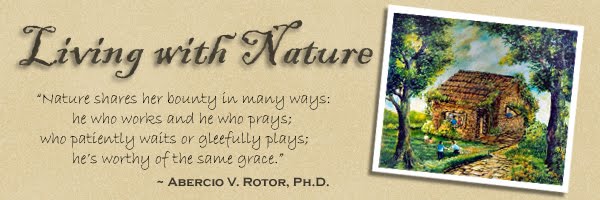
Brick Hut 

Small is my home but wide is its lawn;
Its walls solid, its tiles of the earth;
Its windows open to the yard and path
That leads all feet to the hearth.

Vines and herbs they grow wild and free,
They cool my head, they hide the crack,
And the trees call the birds to build their nest,
They shield the sun and the cold gray rock.

Small is my home but wide is its lawn,
Where quaintness reigns and fresh is the air,
Fence there is none, with neither road nor gate;
This patch of Eden, my little lair.

 Bare Trees


Detail of mural (5ft x 12 ft) by AVR 2010
In my dreams I saw a forest fire,
black, red and blue, amber and ash
all that was left by a tragedy,
by lightning or man’s folly.

The sky mourned as clouds came by,
dowsing the old warrior's wound,
and the kin dressed in autumn mood,
to tell a story untold.
 
Days passed, the memory fades away;
the seed breaks the ground,
rises into a canopy of forest.
It’s time for all to rest. ~