Abe V Rotor
The practice includes offering a plate of food and drink the host has prepared for the occasion. It is placed on the family altar, or any place the souls and spirits are deemed to be around. Respect (pag-galang) is true Filipino and Oriental tradition to the living, the dead and the unseen. It strengthens camaraderie, keeps memories of loved ones alive, and adds quaintness to village life.
It’s customary to first spill a little of your wine in deference to the spirits.
And say a little prayer, too, to appease the souls and spirits. It is a sign of peace and respect not only to the memory of the departed souls and spirits of the place, but also a gesture to the host and company. But please do it discreetly and with finesse. ~ ~ ~
Living with Folk Wisdom, UST Manila

Sunday, September 13, 2009

Thursday, September 10, 2009
Photography: Self-Administered Test in Photography (True or False, 50 items)
___1. For best results there is no substitute to having a manual camera with semi-automatic system for photographic art – kahit digital camera pa.
__ 2 . When taking pictures, the rule is that the source of light must be at the back of the photographer.
___3. The lens of a camera is like the pupil of the human eye.
___4. Single lens reflex (SLR) means you are looking at the subject through the lens of the camera.
__ 5. Satellite imaging can detect weather disturbances, pollution; it can predict crop yield levels, and in fact even hideouts of terrorists.
__6. Satellite imaging is used in cartography, that is, the science of mapping the features of the earth.
__ 7. Deeper interpretation of contrast is in the subject of the photo, rather than interplay of light and shadow, colors and lines.
__ 8. The larger the lens opening the better is the depth of field.
__ 9. If the background is bright and your subjects are posed against it, what you can do to counteract glare is to use flash.
__10. Filters emphasize outlines, increases contrast of light and shadow, warm and cool and colors. It is also used in silhouette photography.
__11. The opening of a flower bud step by step is recorded by means of time lapse photography, a technique that compresses time to enable the eye to witness the event in a short time frame. (T)
__12. Buildings appear in concentric circle converging at the top if you use fisheye lens.
__13.When using a wide angle lens for a group photo, those on the sides appear to be very thin while those at the center are fat.
__14. Telezoom lenses extend the view, compressing distance, thus they are used in war zones.
__15.Allow the pupil of the eye to narrow down by sending a series of faint flashes before the real flash is made. This is to prevent redeye in the photograph.
_ 16. With the state-of-the-art digital photography, a poorly taken photo can be edited anyway - so, why worry?
__17. Black and white photos are simpler to process and print than color photographs.
__18. The computer is equipped with a software to correct blurred, burned, incomplete and misaligned photos to appear normal.
__ 19. As a rule do not retouch a historical documentary photos; they are more authentic in their original state.
__ 20. It is easier to photograph emotions rather than features, because they come naturally, while you have to do a lot of script in the latter.
__21. A famous photograph – a naked young girl, her body burned by napalm (Orange Agent) running along a highway with other children, while soldiers simply didn’t mind, was taken during the recent Iraq war.
__22. A lone man standing in front of a column of tanks was taken during the Vietnam war. The photo freezes the action as if the man succeeded in his suicidal act.
__23. Today, photography – from shooting to printing - can be done in a home studio, and therefore offers a good business opportunity. In fact documentaries and short movies can be done.
__24. Composition is the key to telling a story, be it a painting, a poem, a novel – or a photograph.
__25. The elements of art – are also the elements of photography.
__26. Foreshortened effect is shown on traffic signs written on the highway.
__27. 400 ASA/ISO/DIN film is more sensitive than 100 ASA/ISO/DIN film, in the same way as 4 megapixels is more sensitive than say, 2 megapixels.
__28. As the number increases - 30, 60, 100, 250, 500, 1000 – it means the shutter mechanism proportionately slows down or decreases speed.
__29. Here are three ways to improve your photo when lighting is poor: use tripod, use flash, increase ASA or DIN – in any combination, or all of them at the same time.
__30. You can get multiple exposures in a single shot of fireworks even without a tripod.
__31. Adjust shutter to B and mount camera on tripod when shooting night scenes – a busy street, Christmas lights, stars, constellation, etc.
__32. Today’s digital camera is more versatile, relatively cheaper, easier to operate – but not necessarily superior in quality - to film camera.
__33. Some digital cameras can used the lenses of film cameras, particularly SLRs.
__34. The most advanced digital cameras are made by Kodak.
__35.When a close up of flower is blurred, the subject is too close.
__36. Basketball player in air totally blurred – shutter speed is too slow.
__37. Sunny outdoor view is rough, with dot matrix like in “pointillism.” – ASA value too high.
__38. Photo is too light all over, no accent, clarity poor – insufficient light, lens opening too small, or both
__39. When having your picture taken, relax your shoulder and your face muscles will also relax.
__40. “Honey I Shrunk the Kids” and “Micro Safari” have one in common – microphotography.
__41. Light microscope reveals the world of microorganisms – countless of them in a single drop of water.
__42. Electron microscopy produces photographs of extremely small objects up to 50,000 times in a myriad of colors like a rainbow.
__43. Radiotelescope enables the human eye to see very far objects like stars using the same principle of lens telescope.
__44. One area of photography that enables us to see fast moving objects normally invisible to the eye is through slow motion photography.
__45. The aura emitted by our body is visible through photography.
__46. Photography brings to the eyes of the world good things to appreciate, and evil things to correct.
__47. Photojournalism is a risky profession, like other media men, they risk their lives. In fact the Philippines has the most number of fatalities among media men, second to Iraq.
__48. War is the arena of photography – war against poverty, graft and corruption, environmental degradation, diseases, ignorance, terrorism, and the like.
__49. Yet photography offers the newest, most modern, technologically advanced, now popularized to be enjoyed by millions of people everyday.
__50. Photography is the extension of our eyes and other senses, in fact our intellect, our feeling and our soul.
ANSWERS: False - 1,3,8,13,18,19,20,21,22,30,34 & 42.
Paaralang Bayan sa Himpapawid, DZRB 738 AM with AVRotor and Melly Tenorio
Wednesday, September 9, 2009
Evolution of Faith
Abe V Rotor

Move over Baroque, once bastion of the ancient
world, evolved from the underground and grassy hut,
into mighty fort for war and worship - a kingdom,
until Gothic took its place - ah, freedom!
Soaring into Heaven, scaled not by walls or stairs
but by spire rising like sword piercing the blue sky -until smog hid its view, and took away its purity,
no longer a rod to fear, no longer pointing at eternity.
High rise buried Baroque and Gothic, with billboards
all around; Gregorian chant sang in rock and pop,
in time passing, not by the clock but by flashy car,
and space a catacomb of concrete and steel bar.
Make way for the Messiah, make haste, we are told;
but who would he or she be? Of what race and tongue?
manger and star we no longer find even by Google chart;
does faith make any difference through in science and art?
The world did not really change, but we - we did.
Creation, we're but a part - never the Creator, forbid. ~ ~
Living with Nature, Volume 3. All Rights Reserved.
Squatters on the Slopes
By Abe V Rotor


 Painting in acrylic by AV Rotor, showing details 2009
Get the gold, tear the mountains,
Dry the basin to the bones,
Dam the river at your doorsteps,
Wishing Midas to touch the stones.
Throw some seeds on the terrace,
Catch fish with a strange sound or trap,
Hunt the surviving animals and fowls,
Here in this unmarked place in the map.
A fugitive you are to country and Nature
Raping her, the helpless young ones dying;
A valley of death your wastes doth make,
By your senseless, careless living.
x x x
Living with Nature, Volume 3. All Rights Reserved.
Get the Best from Your Favorite Fruits
Get the Best from Your Favorite Fruits
Dr Abe V Rotor
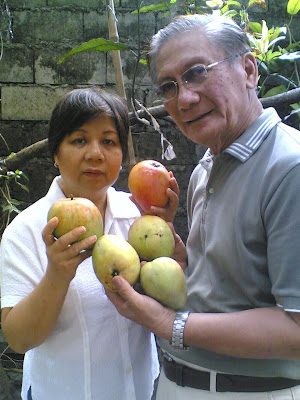 Guapple, a recent cultivar of mango.
 Buko, young coconut - most popular nut
for fruit, juice and salad
 Atis (Anona squamosa)
 Caimito (Chrysophyllum cainito)
My dad used leaves of kakawate or madre de cacao (Gliricida sepium) to ripen bananas inside earthen jars. He lined the inside of the jar with fresh of leaves kakawate, placed the green latundan or lakatan bananas, then covered them with more leaves before turning the jar down or covering its mouth with wilted banana leaves and jute sack. In two or three days the bananas are bright yellow, evenly ripe, and without blemish – and does not have the residual odor of carburo (calcium carbide) which is now a common practice today to force the ripening of fruits.
He cautioned me as a farmhand that only when the fruits have reached maturity that they should be harvested. He gave me these tips that I have kept in mind every time my sister sends green fruits to Manila where my family now resides, or whenever we buy fruits from the market.
1. Be keen with the appearance, smell, feel – and even sound – of the fruit before harvesting or buying it. For example, jackfruit or nangka when fully mature is yellowish green, and its spikes are well spread. The rind gives way to slight pressure and you smell the faint characteristic sweet odor. When tapped with the forefinger the sound is dull and deep.
2. Many fruits are tested this way. You must have a clinical eye, ear, nose, and finger (EENF). And if the vendor allows you, sample the fruit. There’s no substitute to Taste Test. Develop your skills on these fruits: mango, musk melon, soursop or guyabano and its relative, sugar apple or atis. Also try on caimito, chico, siniguelas, and such rare fruit as sapote.
3. You cannot always use all senses though for all fruits. Take the case of watermelon. This is perhaps the most difficult fruit to know when to harvest it, or which one to pick from a fruit stand. Study the rind. The alternate rows of green and yellowish green shades are wide spread, making the fruit appear round, plumb, and shiny. The attached stem (peduncle) should be green, at least green at the attachment; otherwise the fruit had long been picked. Be keen with the sound as you tap at different parts with the nail of your forefinger. Resounding and vibrating sound indicates the fruit is not fully ripe. Deep and dull sound on the other hand, means it is over ripe, especially if the rind yields to pressure. Sixth sense and luck often accompany good choice.
4. When buying young coconut or buko, the vendor usually asks you want it for salad or just for the water. Then he taps the nut with the back of his bolo twice or thrice. It’s sixth sense, I suppose because there is no rule to follow. It is just like picking a nut of macapuno (coconut sport). At Los Banos I tried to learn how to differentiate macapuno from a normal nut just by its sound upon hitting the ground. Ask the coconut harvester and he will tell you how. But there are things you simply cannot learn. Could this be a part of the gift of “green thumb”?
5. In the city you use the rice dispenser to ripen chico, caimito, avocado, tomato, and the like. Wrap the fruits loosely with two or three layers of newspaper before placing them inside the dispenser – or simply bury the bundle in a sack of rice. In the province palay is preferred. The principle is that, as the fruit ripens it exudes ethylene gas that is then trapped. It builds up and induces ripening and all the fruits ripen almost at the same time.
6. To ripen fruits that do not readily get ripe, specially those which lack maturity, put table salt on the cut stem (peduncle) soon after it has been picked. For fruits bought from the market, clean the base of the stem before putting salt. Salt does not only facilitate ripening, it also protects the fruit from fungi and bacteria that cause it to rot. Try this technique on mango, nangka, chico, caimito, guyabano, and papaya.
7. Look for unusual marks. Freckles and warts are signs of fungal and viral diseases affecting banana, especially latundan. Black spots on mango is sign of anthracnose fungus. Black ridges on atis are sign of an insect that bores into the flesh. Pinpricks on depressed and uneven skin of cucumber are entry points of fruit flies. Most likely the insect’s larvae are still inside. Holes lead to spoilage of the whole frui in santol, macopa and guava. These holes are made by the same fruit fly that are of two species. Dacus dorsalis is the worse pest that attacks the mango fruit. The reason mango importing countries have strict quarantine regulation is not only to assure the quality of the commodity but because this insect lives on apple, orange and other fruits as alternate hosts. While these insects and pathogens are generally harmless to humans, it is the byproducts of putrefaction that may cause ailments including allergy.
8. This is myth. The presence of black ants on lanzones, many believe - and it is a good selling point, means that the fruit is sweet. Black powdery fungus and aphids on the stem and fruits may be the reason why the ants are there. They live in symbiosis with the aphids. The black fungus grows on the sugar secretion of the aphids, which also serves as food for the ants.
9. This is another myth. Oranges with deep bottom is sweeter than those with even bottom. Purple caimito is sweeter than the green skinned. Well, both are green but one variety turns red violet when ripe. Purple avocado is also green when unripe, just like the green variety. Like caimito it is not in anyway better in taste and texture. Perhaps it is psychological. Papaya is ripe when it turns yellow or orange yellow. There are papaya varieties that retain much of their green coloration even when fully ripe, and they are as sweet as the yellow ones.
10. The bigger the better. Not always. Native chico is sweeter and more aromatic than the ponderosa chico. It is firmer, less susceptible to fruit fly, and has longer shelf life. This is also true with the native guava. Large duhat is preferred because it is fleshy, but the native duhat is much sweeter. Big lanzones has large seeds. Bicol (Formosa variety) pineapple, although not juicier, is sweeter than the Hawaiian variety. Extra large banana must have been grown on very rich soil, so that it is less sweet and firm than the smaller banana of the same variety. Large cucumber is seldom preferred. Commercial pickling cucumber is thumb size.
11. For citrus, the main criterion is sweetness and fleshiness. Pinkish color is preferred. For rambutan, it is the bright red color that attracts most. Taste test should prove it is really sweet and the pulp can be easily dislodged from the rind. For mangosteen, the color should be deep purple and shiny, and the sepals are still intact and green. When buying, examine the bunch for some hidden over ripe fruits. Again, Taste Test is the best tool.
12. Of course we always pick up the biggest mango, nangka, caimito, watermelon, cantaloupe, honeydew, avocado, atis, guyabano, and the like. It depends though on your budget and if there is an special occasion. The jackfruit is the biggest fruit on earth. It can weigh up to 35 kilos, and it is very expensive. A kilo may cost as much as 100 pesos.
13. There are vegetables that are eaten as fruit or prepared into juice. Examples are carrot, tomato, green corn, and sweet green pea. Vegetables made into fruit juices are tomato and carrot. When preparing these juices, pick the best kind. It was in China where I tasted asparagus juice. Now hear this. Have you tasted bamboo juice?
How to enjoy your favorite fruit after you have sufficiently chosen and ripened it is how it is served. It is a general rule that the best fruits are eaten fresh, and the inferior ones are made into preserves such as jelly, jam, and pickles. They can be made into candies. A common way to prepare fruit juices is by first making puree from the pulp using as osterizer or fruit juicer. You can keep this in the refrigerator as mother stock. Now and then the children prepare their own mix from it adding sugar and milk. Try papaya puree and purees made from guyabano, guava, ripe or green mango, and pineapple.
Try some varieties. Frozen caimito. Nangka ice cream. Dried mango. Pineapple boat with fruit cocktail. Candied papaya. Avocado cubes. Fruit toppings on ice cream. Durian candies. Now hear this. Have you tasted Chico wine? Guava wine? Many fruits make excellent table wine. And we have the technology and skill.
To enjoy the abundance of your favorite fruits consult the fruit season calendar. Bananas, jackfruit, papayas abound all year round. In the city even seasonal fruits are available but the price is high. Off-season lanzones comes from Camiguin, mango from June to December comes from Mindanao. But caimito, siniguelas and guyabano are strictly seasonal and are not always readily available in the market. Durian and Marang are not only seasonal, they are exclusively grown in the south, and they must be eaten directly when ripe. So with strawberry which is grown only on semi-temperate climate.
Enjoy thus your favorite fruits. Wouldn’t it be more complete given the ambiance of the song “Guavas are Ripe” and the painting of Amorsolo of a rustic scene of a fruit-laden mango tree?
X X X
Living with Nature, by AVR, UST Manila
Tuesday, September 8, 2009
Part 2: Devolution - Threat to Biodiversity
 Diversity of fruits is decreasing.
Dr Abe V Rotor
What is the implication of narrowing down the choice of varieties to be planted commercially?
First, it will result in indirect elimination of varieties in the bottom of the list, by displacement by the preferred ones and by neglect on the [art of the farmer in maintaining them.
Second, fewer varieties planted is food security risk. Severe damage to even only one major variety is likely to result in economic disaster.
Third, the narrowing down of genetic diversity disturbs the ecosystem, laying much on man’s care the survival not only of the cultivated crops but other living things in the area as well, thus leading to the further decrease in diversity and population. The loss of diversity in cereal lands applies as well in other areas as evidenced by the following:
• Vegetables sold in the market are limited to those that are salable, leaving out those that are not, and the so-called “wild vegetables” represented by such vegetables as bagbagkong, papait, sabawil, sword bean, and alukong or himbaba-o.
• The kinds of fruits may be counted by the fingers, and like vegetables, only those that are acceptable dominate the fruit stands. Today it is rare to find such indigenous fruits as tampoy, sapote, batocanag, anonang and the native counterparts of guapple and ponderosa.
• Industrial crops are also suffering of the same fate. Take the following:
1. Dipterocarp species of forest trees (narra family) are now endangered. These include apitong , yakal, tanguili, and guijo.
2. Fiber plants such as maguey (Agave family), ramie, kenaf, jute, abaca, have bee vastly neglected since the introduction of synthetics fibers.
3. Today bamboo groves occupy the fringes of wastelands and certain watershed areas. Traditional bamboo areas, like the Dipterocarp forests, are vanishing, so with many of the species and variety of this so-called giant grass.
4. The increasing demand for firewood has decimated many indigenous sources, what with the open exploitation for day-to-day gathering of firewood in marginal communities. These include madre de cacao, ipil-ipil, acacia, and aroma.
5. Even plants of medicinal value are being exploited severely such as quinine for malaria, banaba for kidney trouble, derris for insect control.
6. Seaweeds suffer the same fate as more resorts are put up, aquaculture selective only to those species of major importance are raised, deleterious effects of pollution, notwithstanding.
Monday, September 7, 2009
Cassava grown from inverted stalk (cutting) is poisonous.
Abe V Rotor
This is not true. But let us take it this way. Cassava cuttings if planted upside down will take a much longer time to grow, if at all. Those that survive become stunted (bansot), thus at harvest time they are left behind in the field. Come next planting season, and they are rouged, their tubers by now are about a year old. Tubers accumulate poisonous cyanic substances as they mature, and the longer they stay in the field the higher is the poison level in their tubers.
A one-year old cassava tuber has twice the amount of cyanide than regularly harvested ones do (4 to 5 months in the field). Thus cassava poisoning is not uncommon. Beware of cassava tubers harvested from borders or along fences. These must be very old indeed. By the way, when preparing cassava, choose the freshly harvested tubers. It is in the bark where the poison is concentrated so that it should be completely peeled off. While boiling, take off the pot cover in order to allow the poison to escape as gas - cyanogas , which is similar to the poisonous gas used in executing convicts in the US.
Living with Folk Wisdom, AVR
Subscribe to:
Posts (Atom)