Thursday, May 29, 2025

"Art enables us to find ourselves and lose ourselves at the same time."

                           STI Rotaract club Vigan City Integrated Art Workshop 

"Art enables us to find ourselves and lose ourselves at the same time." Thomas Merton**

Dr Abe V Rotor
                                                               Art Instructor
Living with Nature Center, San Vicente Ilocos Sur

A pool of  colors
 
 Painting with the hand beside the brush freely releases
 these ardent young painters the expressions of their thoughts, 
emotions, and imaginations happily and courageously.

The Hand

The hand speaks of the mind and the heart,
 actions good and evil, and deed, 
mirrors the spirit, cast the rainbow of life; 
 imprint of one's life indeed. 


Workshop on Integrated Art attended by officers and members of Rotaract Club of STI College, Metro Vigan Ilocos Sur, at the author's residence.  August 11, 2019 

The Way

Wonder to where the road leads,
 the stream of life flows, 
the stars in time and space,
as a man or woman grows.  

Red Sky

Rage, rage, rage! 
when the Being is gone
and life an empty stage.

 
Protolife

Living but for a moment like passing breeze,
haploids of heredity searching their other halves - - 
the wholeness of procreation - omnipotent,
singular, mysterious,  beyond man's grasp. 

  
Crossing the Bar*

For though from out our bourne of Time and Place
The flood may bear me far,
I hope to see my Pilot face to face
When I have crossed the bar.

*Last stanza of Crossing the Bar is an 1889 poem by Alfred, Lord Tennyson. It is considered that Tennyson wrote it in elegy; the narrator uses an extended metaphor to compare death with crossing the "sandbar" between river of life, with its outgoing "flood," and the ocean that lies beyond [death], the "boundless deep", to which we return. (en.wikipedia.org) 
AUTHOR's NOTE: The original title given by the painter is "Prison in the Sky"

Home, Sweet Home - The Bahay Kubo
 
Above the doves of peace and unity,
the glow of burning light of the city;
endlessly rages the sea down below,
belies this bastion of long ago,


Workshop participants take pride in showing their works 
and in interpreting them individually.


 Workshop participant shows demo work of author which he won in 
a raffle among his fellow participants at the end of the session.


 Participant stands before a mural painted by the author.  His work is
 reminiscent of  the Impressionism movement in France at the end of 
the 18th century. Dynamic movements of arts can be traced invariably
 and often unconsciously in the works of young artists and enthusiasts.  

August 11, 2019 - Rotaract clubs bring together people ages 18-30 to exchange ideas with leaders in the community, develop leadership and professional skills, and have fun.‎ Rotaract originally began as a Rotary International youth program in 1968 at Charlotte North Rotary Club in Charlotte, North Carolina, United States, and has grown into a major Rotary-sponsored organization of over 10,904 clubs spread around the world and 250,792 members in 184 countries. Motto: Self Development - Fellowship Through Service

** Thomas Merton (1915-1968) was a writer and Trappist monk at Our Lady of Gethsemani Abbey in Kentucky. His writings include such classics as The Seven Storey Mountain, New Seeds of Contemplation, and Zen and the Birds of Appetite. Merton is the author of more than seventy books that include poetry, personal journals, collections of letters, social criticism, and writings on peace, justice, and ecumenism. ~

Fossil Hunting - Study and Hobby

             Fossil Hunting - Study and Hobby  

Explore our Earth's history and learn more about life 
forms in past.

Dr Abe V Rotor


Legends are rich in stories of the supernatural when gods do the impossible to the awe and fear of mortals, such as turning man into rock. Or wood into rock. For who would deny the markings of every tissue of the demised tree - its xylem vessels, phloem which carry manufactured food from the leaves, the pith or dead center of the wood? In fact one can count the age of the tree when it died by counting the annular rings. And how long had the tree died. The circumstances of its death, and the events like drought, flood, fire that it had undergone.

Top: Teachers view the Fossil Collection of the Museum of Natural History, UPLB, Laguna; author (left) studies fossil of a Nautilus. Right: fossils of Ammonites, and ancient fish fossils.  

Next time you visit a quarry, or landscape supplier, or simply walking along a river bed, or rocky cliff, be keen at the possible presence of petrified wood. If there are more clues to the fossil you can even tell what tree it was. Is it already extinct? Is it the ancestor of modern species? What if the tree has not changed, evidenced by its similarity with its living progeny?

Indeed fossils are nature's geologic timepieces; they take us thousands, if not millions of years back. Didn't Charles Darwin gauge the stages of evolution of plants and animals through paleontology - the science of the study of fossils?

"Through the study of fossils I had already been initiated into the mysteries of prehistoric creations." - Pierre Loti
At first I didn't see it, until the tides left it in shallow water. It is a fossil of a very big staghorn coral, its base cut like the anther of a deer after the mating season. So clean did it appear I can count the number of years the coral lived. But that is deceiving because corals grow very slow. It takes fifty long years to grow to the size of a man's head. Each ring therefore, is compounded with other rings, making it difficult to tell the exact age of the fossil. A clear break may be an indication of an extreme condition of the environment that left such mark.

Around the fossil are many fossils of small organisms, other corals and shells. Fossils are known by their total age by combining the age of the fossil itself and the age of the surrounding rock.

How do fossils retain their form and structure even to the detail? Well, calcium carbonate seeps into the cells, and tissues, and in this particular case, into the fine structures like pores of the coral skeleton where the compound solidifies hard - harder than the mold itself. It's a skeleton in a skeleton, so to speak. Through hundreds or thousand of years the mold disintegrates leaving behind the hardened calcium compound. The process is also the same in wood turning into rock - petrified rock.
Here is a fossil of a bivalve - a big Tridachna, as large as the shell of its progeny shown in the lower photo. This shell is a receptacle of holy water at the entrance of Mt. Carmel Church QC. Shells survive adverse conditions of the environment, and as such also retain their original shape and form. Sand and silt become sedimentary rock entombing the shell until it is discovered through erosion and other means.
  
Fossils are made in a different way such as a hairy caterpillar stuck in oozing latex of rubber tree. The latex solidifies and hardens into rock, the same way an insect is engulfed in oozing resinous substance of pine tree. The resin hardens into a clear transparent material with the doomed insect or any other creature clearly visible. Resin turns into amber. Remember Jurassic Park movie? A mosquito after feeding on blood of a dinosaur was trapped in amber. The DNA of the extinct monster was reconstructed from the mosquito's food blood. Of course this is fiction. But Flash Gordon and Jules Verne proved beyond being just fiction writers.

Fossil of a bivalve shell

 Petrified wood is actually rock which bears the exact likeness of the original wood. The species can be traced to present specimens.  
 
"Why are the bones of great fishes, and oysters and corals and various other shells and sea-snails, found on the high tops of mountains that border the sea, in the same way in which they are found in the depths of the sea?"- Leonardo da Vinci

Everyday we encounter fossils and pseudo fossils we simply call skeletons, or artifacts if they did not directly come from living things. Fossils are always in the making. There is no ceasing since the appearance of life on earth, and ever expanding with increasing biodiversity of the living world. 
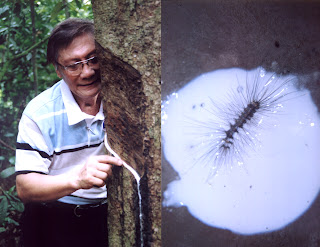
They are the remains of living things that survive time and circumstances, and of luck or fate as people put it. The older and better preserved fossils are, the more significant is the discovery - and the more we realize the secrets they reveal.

Making of a fossil.  Hairy caterpillar trapped in latex becomes a fossil thousands, 
or millions of years from now. Ho Chi Minh City, Vietnam  

Scientists reconstruct fossils close to their original form and virtual reality, complete with the organism's movements, sounds, habitat, special effects included. Thanks to advanced technology and fine arts.

Toys are then patterned after these reconstructed fossils. I know of children who grew up with collections of dinosaurs, birds, mammals, fish- all reconstructions from fossils. Many of these children grew into scientists and naturalists. I know of other children who were more interested with toy cartoon characters. They took a different career path, less meaningful and fulfilling than that of the latter children.

Geologic time is not constant though it may be contiguum. There are intervening factors we may not and never know. And if this were the case, we say, we have yet to discover the "missing link." Such was the predicament of Darwin in his theory of evolution, the bewilderment of Wallace before him, and the deceiving simplicity of Lamarck theory to decipher correctly the path of evolution. Fossils reveal the web of life as a labyrinth. We can only appreciate the early works of other paleontologists that Cuvier and Huxley who could only make inferences about life in the past and the present. In spite of all these, the world looks at all these men as pioneers and greatest fossil hunters.

Do you like to be a fossil hunter, too? ~

Part 2 - Fossil - Chronicler of Nature
Dr Abe V Rotor


Fossil in acrylic on canvas by AVRotor 2011

You’re the Creator’s emissary,
blueprint of phylogeny;
what enshrined you in a rock,
is more than fate or luck;
but a testimony of creation,
by design or evolution.

You’re a chronicler of nature,
the rise and fall of every creature;
more than a fossil but monument
of God’s supreme moment;
revealing through natural history,
the world's greatest mystery. ~

Sometime in the first billion years, life appeared on the earth's surface. Slowly, the fossil record indicates, living organisms climbed the ladder from simple to more advanced forms. - Robert Jastrow
Monday, May 26, 2025

Rediscovering Lost Culture and Art - Pride of a People and Nation

Rediscovering Lost Culture and Art
- Pride of a People and Nation

"My dad taught me from my youngest childhood memories through these connections with aboriginal and tribal people that you must always protect people's sacred status, regardless of the past." - Steve Irwin

Dr Abe V Rotor
Living with Nature
School on Blog
 
Revival of Pottery: art and livelihood, environment friendly. Sudipen, La Union

Homogenization, like a giant pool, mirrors a phenomenon which is a consequence of progress - globalization.

Globalization is irreversible. But is it really progression. If it is trend of progress where will it lead us to? To what extent, and for how long? The believers of this thesis are disciples of science and technology, and therefore are not afraid to open new horizons. They seldom look behind.

Bamboo and rattan handicraft 
 
The traditionalists look at things differently. They have deeper roots in history and culture, they find time to ponder and analyze, and ask others and themselves, “Quo vadis?” But don’t get me wrong as anti progressive, anti technology.

Globalization is like a cauldron in which diversities of culture are thrown into. They dissolve in our very eyes. Either they disappear or lose their identity.

Clearly there is homogenization of races, creeds, ideologies - technology. For example there is only one kind of car in the world – they all work of the principle of Internal Combustion. Formal education has generally of one pattern worldwide, from preparatory to post graduate; so with the various courses offered.

Ethnic wooden art in the Cordillera

Ethnicity encompasses many aspects of life and culture; other the humanities are the natural sciences, ethnobotany among them (the study of the relationship of people and plants in a natural setting.).

From here evolved the knowledge of man in pharmacology, and while such knowledge has vastly grown into a major industry dominated by multinational companies, a great deal of herbal healing still abound in rural communities.

Native cloth pattern 

Folk wisdom akin to traditional knowledge is carried onto the present by elder members of the community has lost much significance in general perception, but a great number of them are enshrined by our culture and writings. They are natural leaders whose words are listened to with respect. Why village elders have also the role of an herbolario, matchmakers in marriages, teachers in their own right based on rich experiences and long practice!

Confucian teachings permeate in the family. Christian values are reinforced by age-long heritage, and vice versa. So with the teachings of Buddha and Mohammad, and other great religious leaders. Mythology, too, has deep rooted influence in our lives. It lives in our superstitious belief, folklore and customs. But many of these are being threatened, if not endangered, in our march toward progress and affluence, along with the current of postmodernism which is sweeping the world today.

On the other hand, there is growing consciousness for moderation in living. More and more people are looking for alternatives of the so-called Good Life.

One alternative is the revival of tradition, a rediscovery of lost
 culture and art can be enshrined in our present life.

1. Revival of ethno-medicinal healing has suddenly found relevance where the dangers of modern medicine are perceived. Lagundi, Oregano, Sambong are now DOH-approved How about the bulk of herbal medicine?

2. It’s the cold wind from the north that came too soon that caused poor rice harvest. Old folks would tell us. And scientists confirm that pollination-fertilization is indeed adversely affected by cold weather.

Home child delivery assisted by a village "kumadrona" 

3. Pet therapy is gaining popularity even in modern hospitals. Victims of stroke who lost coordination of their hands surprisingly recover with a pet around.

4. Honeybee sting sends arthritic people back on the road.

Headgear is ethnic art and status symbol 
among the Igorots.

5. Return to cotton, ramie, abaca, flax, and other natural fibers for clothing and other wears is indicative of people's awareness on the comfort and health benefits of these natural fibers, not to mention their being environment friendly.

5. Ethnic art is gaining popularity in galleries and studios. Native arts are found on murals and in halls. The revival of ethnic art is very visible among the aborigines of Australia, the American Indians, the Incas and Aztecs.So with other indigenous cultures.

"We need to help students and parents cherish and preserve the ethnic and cultural diversity that nourishes and strengthens this community - and this nation." - Cesar Chavez ~

Folk Wisdom - Keeper of Tradition (10 lessons)

 Folk Wisdom - Keeper of Tradition (10 lessons)

Dr Abe V Rotor

1. Thunder and lightning spawn mushroom.

In the province, it is a tradition to go hunting for mushrooms in bamboo groves, on anthills, under rice hay and banana stalks during the monsoon season, specifically after a period of heavy thunder and lightning. And what do we know? Old folks are right as they show you the prize - baskets full of Volvariella (rice hay or banana mushroom), Pleurotus (abalone mushroom), Auricularia (tainga ng daga), and a host of other wild species. 
Where did the mushroom come from? When lightning strikes, nitrogen, which comprise 78 percent of the air is combined with oxygen (21 percent of the air) forming nitrate (NO3). 

Scientists call this process, nitrogen fixation or nitrification. Nitrate, which is soluble in water, is washed down by rain. Lightning occurs every second in any place of the earth, keeping the earth sufficient with this life-giving compound. Not only green plants are benefited from this natural fertilizer, but also phytoplankton (microscopic one-celled plants) - and the lowly mushroom whose vegetative stage is but a cottony mass of mycelia enmeshed in decomposing media such as plant residues. With nitrate now available, rain softening the culture medium, and other conditions favorable, the saprophyte transforms into its reproductive phase. This is distinctly the mushroom we commonly see – one with an umbrella atop a single stalk. In all its luxuriance and plenty, one may discover clusters and hills of mushrooms in just a single spot. 

2. Kapok laden with pods means there’s going to be a poor harvest.
Ceiba pentandra, or cotton tree, has large secondary roots to compensate for its lack of primary root that can penetrate the deeper source of water. Nature endowed this plant with fleshy trunk and branches to store large amount of water for the dry season. Insufficient rains or early onset of summer triggers flowering, as it is the case in many species under stress. Thus it is one of the indicators of poor harvest farmers rely on. It has been observed that a bumper crop of kapok fiber occurs during El Niño, a climatic phenomenon characterized by extreme drought.

3. Ethnic music makes a wholesome life; it is therapy.

Have you ever noticed village folks singing or humming as they attend to their chores? They have songs when rowing the boat, songs when planting, songs of praise at sunrise, songs while walking up and down the trail, etc. Seldom is there an activity without music. Even the sounds of nature to them are music.

According to researcher Leonora Nacorda Collantes, of the UST graduate school, music influences the limbic system, called the “seat of emotions” and causes emotional response and mood change. Musical rhythms synchronize body rhythms, mediate within the sphere of the autonomous nervous and endocrine systems, and change the heart and respiratory rate.  Music reduces anxiety and pain, induces relaxation, thus promoting the overall sense of well being of the individual.

Music is closely associated with everyday life among village folks more than it is to us living in the city. The natives find content and relaxation beside a waterfall, on the riverbank, under the trees, in fact there is to them music in silence under the stars, on the meadow, at sunset, at dawn. Breeze, crickets, running water, make a repetitious melody that induces sleep. Humming indicates that one likes his or her work., and can go on for hours without getting tired at it. Boat songs make rowing synchronized. Planting songs make the deities of the field happy, so they believe; and songs at harvest is thanksgiving. The natives are indeed a happy lot.

4. When earthworms crawl out of their holes, a flood is coming.


This subterranean annelid has built-in sensors, a biblical Noah’s sense of a coming flood, so to speak. Its small brain is connected to clusters of nerve cells, called ganglia, running down the whole body length. These in turn are connected to numerous hair-like protrusions on the cuticle, which serve as receptor. When rain saturates the soil, ground water rises and before it reaches their burrows, they crawl out to higher grounds where they seek refuge until the flood or the rainy season is over. The more earthworms abandoning their burrows, the more we should take precaution.

5. To control rhinoceros beetles from destroying coconuts throw some sand into the base of the leaves. 


Male rhino beetle

This insect, Oryctes rhinoceros, is a scourge of coconut, the larva and adult burrow into the bud and destroy the whole top or crown of the tree. There is scientific explanation to this practice of throwing sand into the axis of the leaves. Sand, the raw material in making glass, penetrates into the conjunctiva - the soft skin adjoining the hard body plates, in effect injuring the insect. As the insect moves, the more it gets hurt. As a result the insect dies from wound infection, or by dehydration. Thus we observe that coconut trees growing along the seashore are seldom attacked by this beetle.

6. Don’t play with toads. Toads cause warts.

Old folks may be referring to the Bufo marinus, a poisonous toad that secretes white pasty poison from a pair of glands behind its eyes. Even snakes have learned to avoid this creature described as ugly in children’s fairy tales.

But what do we know! The toad’s defensive fluids have antibiotic properties. Chinese folk healers treat wounds such as sores and dog bites with toad secretions, sometimes obtained by surrounding the toads with mirrors to scare them in order to secrete more fluids.

Similarly certain frogs secrete antibiotic substances. A certain Dr. Michael Zasloff, physician and biochemist, discovered an antibiotic from the skin of frogs he called magainins, derived from the Hebrew word for shield, a previously unknown antibiotic. It all started when researchers performed surgery on frogs and after returning them to murky bacteria-filled water, found out that the frogs almost never got any infection.

What are then the warts the old folks claim? They must be scars of ugly wounds healed by the toad’s secretion.

7. Animals become uneasy before an earthquake occurs. 
It is because they are sensitive to the vibrations preceding an earthquake. They perceive the small numerous crackling of the earth before the final break (tectonic), which is the earthquake. 

Fantail or pandangera bird is usually restless at the onset of bad weather.


As a means of self-preservation they try to escape from stables and pens, seek shelter, run to higher grounds, or simply escape to areas far from the impending earthquake. Snakes come out of their abode, reptiles move away from the water, horses neigh and kick around, elephants seem to defy the command of their masters (like in the case of the 2004 tsunami in Sri Lanka). We humans can only detect such minute movements on our inventions such as the Richter Scale.

8. Don’t gather all the eggs. Leave some otherwise the laying hen will not return to its nest. 
True. The layer is likely to abandon its nest when it finds it empty. Leave a decoy of say, three eggs. But there are layers that know simple arithmetic, and therefore, cannot be deceived, and so they abandon their nest and find a new one.

9. Raining while the sun is out breeds insects.
Now and then we experience simultaneous rain and sunshine, and may find ourselves walking under an arch of rainbow, a romantic scene reminiscent of the movie and song, Singing in the Rain. Old folks would rather grim with a kind of sadness on their faces, for they believe that such condition breeds caterpillars and other vermin that destroy their crops.

What could be the explanation to this belief? Thunderstorm is likely the kind of rain old folks are referring to. Warmth plus moisture is vital to egg incubation, and activation of aestivating insects, fungi, bacteria and the like. In a few days, they come out in search of food and hosts. Armyworms and cutworms (Spodoptera and Prodina), named after their huge numbers and voracious eating habit, are among these uninvited guests

10. Garlic drives the aswang away.

If aswang (ghost) being referred to are pests and diseases, then there is scientific explanation to offer, because garlic contains a dozen substances that have pesticidal, antimicrobial and antiviral properties such as allicin, from which its generic name of the plant is derived – Allium sativum. Garlic is placed on doorways, in the kitchen and some corners of the house where vermin usually hide, which is also practiced in other countries. It exudes a repellant odor found effective against insects and rodents – and to many people, also to evil spirits, such as the manananggal (half-bodied vampire). ~

Reference

* Lesson on former Paaralang Bayan sa Himpapawid with Ms Melly C Tenorio 738 DZRB AM Band, 8-9 evening class, Monday to Friday

Sunday, May 25, 2025

A message on Fathers' Day June 15 2025: Let us instill in our children the habit of reading.

Let us instill in our children the habit of reading*

“Today a reader, tomorrow a leader.” - Margaret Fuller, American journalist and philosopher

Dr Abe V Rotor
Living with Nature School on Blog avrotor.blogspot.com

Based on a research of Claudine R. Bananal
on Development Communication, UST
Faculty of Arts and Letters

National Book Award Winners, 2008, with Senator Edgardo Angara (extreme
right); author is second from left. Some of the works of these winners were
displayed during the awarding ceremonies at the Yuchenco Museum, Makati

A child's reading skills are important to their success in school and work. Children who learn to read from an early age are generally more successful in academic areas. Many children enroll in school, only 63 per cent complete primary school, and the quality of education remains poor in many areas of the country. In addition, reading can be a fun and imaginative activity for children, which opens doors to all kinds of new worlds for them. Reading and writing are important ways we use to communicate.(Source: UNICEF Philippines)

The test is an oral test given to a pupil to measure reading ability. Five test questions are administered constituting the entire test:

Independent reading level – Pupil can read with ease and without the help or guidance of a teacher. In the Phil-IRI test, they can answer four or five correct answers (out of five test questions) and can read with rhythm, with a conversational tone, and can interpret punctuation correctly.

Instructional reading level – Pupil can profit from instruction. In the Phil-IRI test, they answer three out of five test questions correctly.

Frustrated reading level – Pupil gets two or below in the Phil-IRI test (out of five test questions). They show symptoms or behavior of withdrawing from reading situations and commit multiple types of errors in oral reading.(Phil-IRI (Philippine-Informal Reading Inventory)

Reading Levels of Children in the City (%)
Grade 1
Frustrated Reader 64.41
Instructional Reader 20.17
Independent Reader 15.42
Total 23,114
Grade 2
Frustrated Reader 49.98
Instructional Reader 31.45
Independent Reader 19.07
Total 28,170
Grade 3
Frustrated Reader 47.59
Instructional Reader 32.47
Independent Reader 19.94
Total 26,843
Grade 4
Frustrated Reader 44.82
Instructional Reader 32.17
Independent Reader 23.01
Total 25,493
Grade 5
Frustrated Reader 50.78
Instructional Reader 28.48
Independent Reader  20.74
Total 30,288
Grade 6
Frustrated Reader36.50
Instructional Reader34.67
Independent Reader28.83
Total 27,199

Source: Philippine-Informal Reading Inventory Test (Phil-IRI), Schools Division of Manila, SY 2003-04


PROGRAMS, PROJECTS AND ACTIVITIES TO IMPROVE READING SKILLS
  • Build more public libraries especially in remote areas.
  • Encourage the community via reading campaigns to frequently visit these public libraries to borrow books and read.
  • Share the joy of reading to the illiterate by reading books, magazines and newspapers to them and teaching them in the process.
  • In this campaign, the public libraries will hold daily reading/storytelling sessions to the poor and illiterate, adults and children alike. It will be conducted by volunteers from the community.
  • Parents must play a critical role in helping their children develop not only the ability to read, but also an enjoyment of reading.
  1. Turn off the TV. Start by limiting your children’s viewing time.
  2. Teach by example. There must be books, newspapers and magazines around the house and children must actually see their parents reading so they will learn that reading is of great value.

  3. Read together. Reading with children is a great activity. It not only teaches them its importance but it also offers a chance to talk about the book, and often other issues will come up. Books can really open the lines of communication between parents and their children and broaden their minds. 
Adages on Reading
  • “To acquire the habit of reading is to construct for yourself a refuge from almost all of the miseries of life.” -W. Somerset Maugham
  • “Reading is to the mind what exercise is to the body.” -Sir Richard Steele
  • “He who destroys a good book kills reason itself.” - John Milton
  • “No entertainment is so cheap as reading, nor any pleasure so lasting.” - Lady Mary Wortley Montague ~
Living with Nature Book Series by Dr Abe V Rotor

Award-winning books (Gintong Aklat and National Book Awards) 
published by UST Publishing House Manila
 
* Lesson on former Paaralang Bayan sa Himpapawid (People's School-on-Air) with Ms Melly C Tenorio 738 DZRB AM Band, 8 to 9 evening class Monday to Friday

A Tribute and Reminder of Fathers' Role in these Critical Times

 A Tribute and Reminder of Fathers' Role in these Critical Times

Father's Day is a celebration honoring fathers and celebrating fatherhood, paternal bonds, and the influence of fathers in society

Excerpt of TV interview of Dr Abercio V Rotor Ph.D.
In celebration of International Fathers Day
June 16, 2019 , Manila Hotel

Ulirang Ama Awardees: PM GENERAL GUILLERMO ELEAZAR 

and DR ABERCIO V ROTOR 


Hi! This was taken during the Ulirang Ama Awarding last June 16 2019 held at The Manila Hotel. My grandpa, Dr. Abercio Rotor, was one of the awardees together with another ulirang ama. I always pretend to play as a super-agent, that is why, when I met NCRPO PM General Guillermo Eleazar, i was so happy! Someday, I want to be like him! And I was also happy because I got to play and spend some time with my grandpa, grandma (photo), tita ann  and tito mac, tito carlo, and my cousins; mackie (photo) and markus. It was a very happy Father’s Day. HAVE A GREAT DAY! Mateo Laurencio Vicente M Rotor, 8

 
                                 AVR - Ulirang Ama Awardee for Education 2019

 
29 Ulirang Ama awardees 2019 in 11 sectoral categories pose with Ulirang Ama/Ina Foundation officers after the awarding ceremonies at the Manila Hotel.  (Dr Rotor is shown standing, extreme right)

I am honored to receive this prestigious award Ulirang Ama for Education 2019.
While I am an individual named by your Foundation, I must insist of sharing this award with all fathers.

Father's Day brings back sweet memories of the man in particular who was father to me. The inspiration he provided and the moral values he instilled are very much alive in me - in my children and hopefully with their children, ad infinitum. To my late father, “To the world you are a dad; to our family you are the world."

Father's Day bespeaks the unity and continuity of the Filipino in particular that the Family is the central element in our national life. The role of the father carries responsibilities as well as the joys and rewards of fatherhood. 

“If the father's responsibility and authority break down, the family is in trouble. If the family is in trouble, the Nation is in trouble.” Said United States VP Gerald Ford 1974 Father of the Year Awardee)

I congratulate the organizers of this yearly event in keeping this beautiful bond of love blooming with kindness and love. This is one of the most important bonds a person can share. It affirms the greatest gift of the Omnipotent Being the sacredness of man-woman union in matrimony and procreation and in establishing the nucleus of society. 

Robert Browning has very rightly stated that “Take away love and our earth is a tomb”. God had sent to us love in various forms and one of them is your Father. He is a person who stands by our side no matter what. He loves his children unconditionally and the beauty of the relationship is that he does it all without demanding anything in return.

Before I get carried away with my role of the father and recipient of this award, let me point out that my wife Cecille deserves the same if not, greater recognition, because  a father cannot be a father without a mother for their children.

The concept of Father's Day is one that celebrates human relationships built on love and family unity while inspired by the love of country and humanity with the moral values instilled by the Supreme Creator.

Again, I thank you for selecting me for this cherished award. I wish all the fathers Happy Fathers' Day. But let us not forget the mothers, the uncles, the aunts, the grandparents, and the children themselves who make it all possible.  
---------------------
"We never know the love of a parent till we become parents ourselves."
—Henry Ward Beecher 


Dr Abercio V Rotor Family
Front, seated: Dr Abe V Rotor, Sister Venie Valdez Rotor (religious), spouse Cecilia Rojas Rotor.  Standing L-R, Daughter Anna Christina Rotor-Sta Maria (with grandson Markus Andrei), neice Jules Rojas; son Leo Carlo Rotor (with granddaughter Michaela Adrianna);  Dr Charisse Mendoza Rotor (MD); Matthew Marlo R Rotor. (Not in the picture is son-in-law Mac Sta Maria who took this photo)