Thursday, August 13, 2020

A tree fell and took with it its tenants and symbionts.


A tree fell and took with it its tenants
and symbionts.
Everything was quiet, then came a gust of wind from nowhere.  It sent a ten-year old samat tree crashing across the street.   
Dr Abe V Rotor


Workers in the neighborhood in Lagro QC clear the blockage to restore traffic flow and electricity. Samat or binunga (Macaranga tenarius) though sturdy is no contest to the power of wind. But where did the cyclone-strong wind come from in a fine weather?

I felt obliged to do my own research having been the one who planted the tree in 2003 from a seedling I got from our home in San Vicente, Ilocos Sur. I needed the mature and yellow leaves in brewing wine and making vinegar.  Marlo, my son needed the fruits in his thesis in the graduate school.  The leaves are rich in tannin and other medicinal compounds. Its bark produces latex and resin.

Because of its thick crown the year round, the tree is a good shade and buffer against noise and dust.  It was in this tree that birds that were not seen for many years suddenly appeared, among them the  kikiaw (kiaw Ilk) or yellow and black oriole thought to have become extinct locally. Migratory birds would find the samat tree a lodging place in their long migration at the onset of winter in the North which marks our Amihan season when cold winds from Siberia sweeps across Asia down to the Pacific. 

Then there were house sparrows that found shelter in the tree's thick crown. And not to be outsmarted was the pandangera or fantail bird. It would complain when disturbed sitting in her nest. And when a cat would get near the tree, the pandagera together with her mate would swoop down and drive the intruder away.   

One time I released a gecko lizard on the tree. It did not stay long, when our parrot started imitating its mating call. Perhaps on discovering the hoax it left for the real call from its own kind in some trees in the La Mesa watershed which is very near us. 

The green tree ants regularly built a nest or two in the tree.  It was good because they controlled other insects, and they are good janitors.  They glean on any food leftovers, and kept the surroundings clean, especially around the doghouse. Houseflies generally don’t thrive on clean environment.  

When the tree fell it took with it the lianas, orchids, ferns clinging of its limbs. So with the lichens and mosses that are natural indicators of good air by their abundance.

You see, the tree is not just a tree.  It is a host.  A host of many organisms depending on it in various categories.  Call it parasitism for feeding caterpillars, symbiosis for epiphytic bromeliads and orchids, commensalism for mosses and  lichens.  Free board and lodging for the seasonal perperoka. Fungi growing on the tree’s dead branch are saprophytes, bees and beetles and butterflies as pollinators.

When new leaves form, photosynthesis gets a boost.  So the tree produces more food, and more oxygen that replenishes the carbon dioxide that we in the animal kingdom expel. And what happens to the “food” accumulated in the tree?  It is further made into complex organic substances – cellulose and lignin in wood which we harvest for construction, crafts and fuels. Tannin for cure of diabetes. Xanthophyll and carotene for vitamins and natural dye, and many more. 

All these attest to the tree’s role more than just a passive standing host.  It is a system in itself, an ecological system or ecosystem in short.

The meaning of this is that when the tree dies the whole system also dies. And the sad thing is that the loss is irreversible.

I mourn for the felled samat tree on behalf of the creatures that benefited from it that have too died, and luckily for others, they have migrated and may have found another benevolent host.          

But the puzzle remains.  Everything was quiet, then came a gust of wind from nowhere.  It sent this ten-year old samat tree crashing across our street.  
Theories are not rare to explain the incident. The most plausible is poor foothold. The tree was virtually sitting on adobe bedrock characteristic of the geology of QC, so that its root system had no other way of spread but sideways instead of downward with a tap root as principal anchor. 
Author displays cured samat leaves used in brewing basi wine and making vinegar.
There is a nearby drainage through which  various wastes flowed - oil, detergents, alkali and acid rain, ultimately finding their way into the root zone and destroying much of the roots. The tree however held on without apparent sign of weakness.  
On the meteorological aspect, thunderstorms have become more frequent, as a consequence of global warming, a phenomenon that is not yet well understood. But global warming is spawning more - and stronger - typhoons, hurricanes, and tornadoes all over the world. Extreme weather is now felt more often. Too much rainfall in one place causes flood, while too little rainfall causes drought in another place. Freak weather disturbances are not unusual, among them was a sudden thunderstorm on that fine day that toppled my favorite samat tree. ~   

Tuesday, August 11, 2020


Once-in-a-lifetime photos sealed in memory (Part 1)

(Part 1)
Once-in-a-lifetime photos sealed in memory
"Now I'm too old to revisit the place,
yet fresh still and full of praises." - avr


Dr Abe V Rotor
School on Blog

Traveller's palm, Ravenala madagascariensis, is a living fountain. It stores rain and dewdrops in its stalk. UST Botanical Garden. c. 2011

It's springtime in a desert when lost,
a traveler's palm in a oasis rises;
now I'm too old to revisit the place,
yet fresh still and full of praises.


Introducing a camia flower (Hedychium coronarium) to baby Mackie, author's residence QC. Camia is also called white ginger, garland flower, butterfly lily or butterfly ginger.

Fragrance and beauty make a flower,
which comes first, we grownups know;
Pavlov says a child would later remember
but not as fresh as it was though.


Graduate students of UST conduct a field research in Marine Biology at Palauig, Zambales headed by the author as their professor. c.2010

The world is a stage, it is also a school,
Nature's the greatest teacher of all.
Her ways are lessons, mysterious yet full,
fuller still as we grow older.


Balibago flower (Hibiscus tiliaceus Linn) is white in the morning, turning red at the end of the day. Thus it is called balibago as explained by Dr Anselmo Set Cabigan, former director for research of NFA, and professor SPU-QC.

The essence of true beauty is brevity,
elusive, save a glance, a tear, a smile;
behold a flower leaving some memory
like cold wind passing with a sigh.


Markus - baby artist lends a helping hand to his lolo, the author and muralist. At home QC ,

New schools of art many artists missed,
Picasso too advanced in his art;
here's a child a paint brush he seized,
eager at heart at the very start. ~

Wednesday, August 5, 2020

Science as Critique of Society

Science as Critique of Society           
Can man lead a life that allows him to see and appreciate the true beauty of living? 
Dr Abe V Rotor
Living with Nature School on Blog
-----------------------------------------------------
“The ultimate test of any civilization is not in its inventions and deed, but the endurance of Mother Nature in keeping up with man’s number and his ever increasing needs.” –AVR, Light from the Old Arch
-----------------------------------------------------
First, I wish to point out three keywords from the title and theme of this article - society, critique, and science – in the order my reaction is presented. Human society today is a global village.  We expect the boundaries – scientific, cultural, language, political, and the like - to continue to dissolve towards 
Author examines marine fossil in Santa, Ilocos Sur

a homogeneous pool even at a faster rate with the rapid development of transportation, communication, trade and technology.  I believe this is the society that is the focus in this forum, or for that matter, any other forum about our human society.

The other keyword is critique. To critique is to relate things with standards. The here question is, “How prepared are we in facing the consequences of development in the light of being a Filipino and Christian? What and how much shall we give up in becoming a “citizen of the world?” What can we do, other than what we think and believe? Let us consider these parameters. 

o   Family solidarity
o   Values and Tradition
o   Peace and Unity
o   Environmental Preservation
o   Integrity of the Human Species
  
The third keyword is science. We talk of a kind of science today that was futuristic yesterday. We progressed through leaps and bounds with science and technology, but “Quo vadis?” This is the essence of science critiquing society. 

Here are scenarios no one is spared to see and think about seriously in a fast changing world we live in.

o   Genetic diversity is shrinking. This is not only true to plants and animals; it is also true to humans.

o   West-meets-East, now on its third episode or “marriage” is creating a homogenous human genetic pool. What is the consequence of this biologically and socially? Having more genes shared could mean better understanding and cooperation among the members of the species, according to sociobiology (E.O Wilson, Harvard). Sharing of genes could be the key to world peace. Is communication carried out at the gene level? What helped in the dissolution of colonial rule as in the merging of warring tribes, was apparently in part, if this is the case, a natural blood compact.
o   Biologically, with the human genome project (mapping of the 46 chromosomes and their component genes), and through genetic engineering, we have broken the code of heredity (the DNA). This means we can now look into what kind of stuff the human being is made of. Pretty soon we will be carrying a diskette in our pocket that tells us of our intelligence (for job placement), of our well-being (for the doctor and insurance), even of our potentials and dispositions, including addiction, fidelity, and the like.  Virtual loss of privacy is coming of age.   

"The world is in man's hands. Man may alter life, 
but ultimately his own species will be destroyed. 

West-meets-East intensifies and the scenarios of our society, apparently simple as they seem, are actually complex and the consequences are many and far-reaching.

o   Mixed blood, a result of multi-lateral and accelerating intermarriages (human hybridization), is dissolving the racial lines, so with political, cultural and apartheid boundaries. To illustrate this many entertainment idols of Asia are mixed bloods, and the movies the play are East-West hybrids. Does this strike us in the malls, advertisement boards, hotels?
----------------------------------------------------------------------------------------------------
The most effective factor of homogenization of races eversince prehistoric times is human migration.  - Dr. AS Cabigan
----------------------------------------------------------------------------------------------------
Human Society and Mankind: An Auto-Evolution

Given this premise, as a teacher and father, I seek for answers to many questions raised about the future of our society, and that of mankind.  The essence of critiquing through introspection other than historical and empirical basis is to be challenged, particularly in the academe. Will the trend of homogenization necessarily follow in the field of politics and government, religion, education, humanities, science and technology, culture, trade and industry.

The list of developments are useful in enriching scenarios of the topic. They provide the rationale and background of a very serious topic. To critique is not only difficult; it carries a responsibility, particularly because we critique at something which directly involves our work as scientists and as respectable members of society.

o   The Gains – Progress through science  
o   Science and Technology for Poverty Alleviation
o   Millennium Development Goals
o   The Need for Partnership

But these do not tell us of the looming modern Frankenstein of science and technology - Frankenstein disguised in progress and fraternity. The recitation of facts and events may not necessarily enlighten us on many issues.  Let us look at science-and- technology-at-large.

o   Frankenfood, genetically engineered plants and animals we call GMO (Genetically Modified Organisms) has reached our table. All may be quiet on the Western Front, so to speak, but even among the progenitors of this technology are cautioning us of its revolutionary nature and the unknown consequences of tinkering with the genes. Yet GMOs continue to invade the market and homes of both rich and poor nations. What is our position as a developing country? The Golden Rice was developed in Switzerland by a relatively unknown scientist, Dr. Inggo Potrykus who brought his GMO rice to IRRI. The idea is to make Golden Rice available for the world, particularly for rice-eating Asia. Certainly this makes the Philippines a center of GMO research.)    

o   Through Genetic Engineering man is creating new forms of life, and soon new species of organisms, God forbids. Today there are 80 man-made amino acids. There are only 20 natural amino acids that are the building blocks of protein, and that of life.  These 20 units have been more than enough in making highly complex and diversified life forms in the geologic past and today. (We have identified so far a measly 10 percent of all living organisms to date.) Imagine how chaotic could be the result of 80 amino acids in virtually endless combinations! And all these are done on the Seventh Day.

o   Now we have Human Cloning, following the success with Dolly, the sheep. (Dolly, the first cloned animal, died recently of pre-mature aging.)  It seems that a cloned human will live only biologically. And like Dolly, there will be only three stages of his life – birth-growth-senility – all packed in so short a chronological period.  I am sure no human being would like to be cloned because his clone or clones will never have the joys of childhood, discovery in adolescence, adventure in youth, responsibility in maturity, and fulfillment in age?  He will have only a body – and in spite how perfectly it may be made – it will not possess a soul.  He will be a monster, never a human.

o   Loss of natural relationships like the monster in Frankenstein novel. He wanted a wife, a family, friends.  He wanted acceptance. He wanted to belong to society.  But the doctor-creator failed him. In short he failed in creating Love.  And without love the monster turned his back on him and ultimately man. In a cloned society who is father, mother, sister, cousin, etc? And where is that love Frankenstein failed to give?

Environment – Today’s Revolution
I think environment should be emphasized in this forum. Population, agriculture, economics, industry – science and technology, for that matter, are interlinked with environment. Population-food-environment is one controversial issue today. The frontiers of these three areas are looked upon differently, depending on who is talking. But the issue must be taken holistically.

o   To illustrate, I mentioned tragedy of the commons, citing over- fishing the oceans, an activity man still retains his nomadic-hunter culture. Another example is communal pasture.  A herdsman added “one more head” to his herd for economic advantage (return on investment).  Another herdsman did the same, and another.  Now whole herds are added!  The land suffers of overgrazing, soil erosion and nutrient depletion, and ultimately the community plunges into poverty.

o   Here science and technology comes to the fore revitalizing the carrying capacity of the pasture. But increased production triggers increase in human population.  There is, and must be, a limit to growth, because it is nature that ultimately subsidizes man’s growing needs. And contrary to what many people believe, the resources of the earth in general are finite, meaning they are non-renewable and are therefore subject to depletion. 

o   The rate of doubling of our population, now six billion, is alarming. Every year we need a space as large as Great Britain to accommodate the yearly addition.   

 What I am inquiring about is for what purpose should man live on the racetrack?  Do we have to and why?  What is this race we seem to be locked up at always racing?  Can man return to a life that allows him to see and appreciate the true beauty of living?

Where is the soul of science?  If we cannot find it, can we give it one? Then we must look deep into the good nature of man – as sapiens, faber and jugens, above all, God-fearing.

If we can do this, I believe it is man and his society that should be the critique of science.~

Environmental Revolution - Quest for Quality of Life

Environmental Revolution - Quest for Quality of Life 
Dr Abe V Rotor
School on Blog

1. Man has emboldened the causative agents of human diseases – both old and new - into epidemic and pandemic proportions, which include HIV-AIDS, SARS, Ebola, and today’s threats of pandemic diseases, the Avian flu (caused by a new virus H5N1, a hybrid of the human flu virus and the bird fly virus) and obesity (caused by Ad36 virus)

A corner of Eden mural in acrylic, AVRotor

2. Through biological specialization or mutation – natural and man-induced – causative agents have crossed natural barriers of transmission across species, such as bird to man (bird flu), civet cat to man (SARS), and primate to man (HIV-AIDS, and Ebola). Man has built bridges between the non-living to the living as well. We have paved the way for the Prion, an infectious protein, the causative agent of mad cow disease or BSE (Bovine Spongiosform Encephalopathy ) to cross from cattle to man and cause a similar disease affecting humans, the Creutzfeldt-Jakob Disease (CJD). Viruses have acquired new ability to infect and spread not only among humans but also in animals and plants. Viral diseases of plants have been responsible for the decrease in agricultural production in many parts of the world.

3. In the midst of enjoying the good life in a postmodern world more and more people are victims of accidents, heart attacks and strokes, anxiety and depression – and various forms of psychosomatic disorder - that often lead to ruined lives and suicides. Cancer, diabetes, and the deleterious consequences of vices (tobacco and alcohol), are on the rise among other modern diseases. Surprisingly, the number of years a person is healthy in proportion to his life span is not significantly longer than that of his predecessors, and that a person’s life span has not significantly increased at all. It is the average longevity of a population that has increased, not the individual’s. The fact is that modern medicine has increased survival of infants and young people, most of them are now in their past fifties, thus gross longevity appears to have increased, up to 78 years in some countries. On the contrary, more and more young people are getting sick and dying.

4. Modern society and science and technology no longer fit into the Darwinian theory of natural selection. There is a growing burden placed on the shoulders of the able and fit in our society who, without choice, is responsible in taking care of the growing number of dependents – many are the infirm and the aged.

---------------------------------------------------------------------------------------------------
There are few frontiers of production left today. We have virtually pushed back the sea and leveled off the mountain. Prime lands have all been taken, swamps have been drained, and even deserts are being reclaimed. But as we continue to explore the marginal edges of these frontiers the more we are confronted with high cost of production that is levied on the consumer, and more importantly, the danger of destroying the fragile environment. AVR
---------------------------------------------------------------------------------------------------
All these lead us to re-examine our values. It challenges us to look deeper into a paradigm of salvation through our concern for the environment. The prolificacy of the human species sans war and pestilence, plus growing affluence of our society has led to a population explosion which had doubled in less than fifty years. We are now over six billion. Under this paradigm, there is no master and subject. All must join hands to prevent the exploitation of the earth’s finite resources. Today’s economists must also be good housekeepers of Nature, so with those in the other professions. While man’s aim is directed at the Good Life, he has unwittingly reduced the very foundation of that good life – the productivity and beauty of Mother Earth.

Ecological paradigm endorses an ecocentric approach where all forms of life and non-life are important to human life. Spirituality points out to a unitive force: the sacredness of everything. God’s divinity flows in everything. There is integration in the universe. And we are part of that integration, exceedingly small as we are, notwithstanding. Under ecological paradigm of salvation, the one responsible in the destruction of the environment leading to loss of lives and properties should be held accountable for it to God, nature and fellowmen.

The environment and the economy need not be viewed as opposites. It is possible to have a healthy environment and a healthy economy at the same time. More and more businesses have begun adopting this concept as a business philosophy. People behind business organizations are becoming more aware of the ethical decisions they face, and their responsibility for their consequences.
----------------------------------------------------------------------------------------------------
Industrialization and urbanization are akin to each other. Industrial growth spurred the building of cities all over the world. Today there are as many people living in cities as those living the rural places. A mega-city like Tokyo has a population of 15 million people. We are 10 million in Metro Manila. Cities are fragile environments. Cities are more prone to epidemics such as the bubonic plague that killed one-third of the population of Europe in the 13th century. Now we are confronted with COVID-19 pandemic, HIV-AID, SARs, Meningo cochcimia – and the dreaded Avian flu which hovers as the next human pandemic disease. AVR

There are organizations that have set some rules of governance of the environment, among them, GRI (Global Reporting Initiative), CERES (Coalition of Environmental Responsible Economies), and UNEP (United Nations Environmental Program). In line with these a multi- national corporation came up with the following thrusts:
• Restore and preserve the environment
• Reduce waste and pollution
• Education of the public on environmental conservation
• Work with government for sound and responsible environmental program
• Assess impact of business on the environment and communities.
This approach is gaining respect and more and more businesses are looking at this model with favor.

The Question of Governance

Environment scientist Dr. Tai cited three themes in order that man can live in harmony with nature. Man is part of the ecosystem, Man is steward of the earth, and Man is finite. Dr. Tai cited models with which man can change his views about the environment and change his style of living. We have also models in the business world, in the church, and in the government, in fact all sectors of society. 

There are models everywhere in this or that part of the world, whether developed or underdeveloped. There are as many models in less developed countries as in highly industrialized countries. It could be that the less developed are closer to tradition, and still have strong ethnic roots, like the old civilizations mentioned in the paper – the native cultures of America and Africa.

But the world has never been one. It has become more diverse in views and interests though in many respects share the same aspirations towards progress and development. And this is the problem. Man is always in a race. In that race awaits at the end not a prize mankind is proud of and honorable. It is tragedy, which Garett Hardin calls, the tragedy of the commons. It is a greedy competition for a finite resource, each his own, until it is gone. The forests are disappearing today, the lake are dying, the fields are getting marginal, the pastures are overgrazed, the air is loaded with destructive gases, the sea is over fished. All these point out to the syndrome - tragedy of the commons. And because time is of the essence, many believe that the world needs a new revolution now? Is revolution the only way to solve global problems of the environment today?

Definitely, while we need to reform to save our environment, any means that is contrary to peace and unity, is definitely unacceptable. And we would not adhere to the rule of force or violence just to be able to succeed. It is said, that revolution starts in a small corner. It starts in this congress.

Ethics is the foundation of aesthetics; it is something very difficult to explain that makes beautiful more beautiful, rising to the highest level of philosophy where man find hope, inspiration, and peace. It is a beacon. While ethics sets the direction, aesthetics is its beautiful goal.

In closing I would like to thank Dr. Tai, for his scholarly and incisive paper from which I was not only able to prepare myself as a member of the panel of reactors, but found an opportunity to review and expand my current research works in ecology as well. Lastly, I would like to recite this short prayer I made for this International Congress on Bioethics, and dedicate it through the little child who visited the two workshops in the village and exclaimed. “But there are no neighbors! But there are no trees, birds, fields and mountains!”


Ecology Prayer

When my days are over,
Let me lie down to sleep
on sweet breeze and earth,
in the shade of trees
I planted in my youth;
since I had not done enough,
make, make my kind live
to carry on the torch,
while my dusts fall
to where new life begins –
even only an atom I shall be,
let me be with you,
dear Mother Earth.

-----------------------------------------------------------------------------------------
There was once a town in the heart of America where all life seemed to live in harmony with its surroundings…Then a strange blight crept over the area and everything began to change …Mysterious maladies swept the flocks of chickens, the cattle and chicken sickened and died …There was a strange stillness… The Few birds seen anywhere were moribund, they trembled violently and could not fly. It is a spring without voices.
Rachel Carson, Silent Spring
-----------------------------------------------------------------------------------------

Monday, August 3, 2020

Nature's Trophy 1: Shelf Mushroom on Deadwood

Nature's Trophy 1 
Shelf Mushroom on Deadwood
Life to death, and back to life - the Creator's protocol of 
primera causa - beyond human measure and comprehension. 

Dr Abe V Rotor 
 Shelf Mushrooms on Deadwood trophy and mural background 
by the author 2020. On display at San Vicente (IS) Botanical Garden,
Living with Nature Center

Call it Nature's crucifix of death and resurrection;
deadwood back to Nature its destiny,
organic compounds transformed into elements,
 in cycle returning to life in diversity.

Life to death, and back to life in unending cycle,

 a process in the fifth kingdom Mycophyta,
 world of afterlife and back, ever richer, grander -
the Creator's protocol of primera causa. ~

Nature's Trophy 3: Rainforest's Tower of Babel

Nature's Trophy 3: Rainforest's Tower of Babel 
 An artist's interpretation of irreversible ecological destruction of the Tropical Rainforest, richest biome and seat of biodiversity

Dr Abe V Rotor 
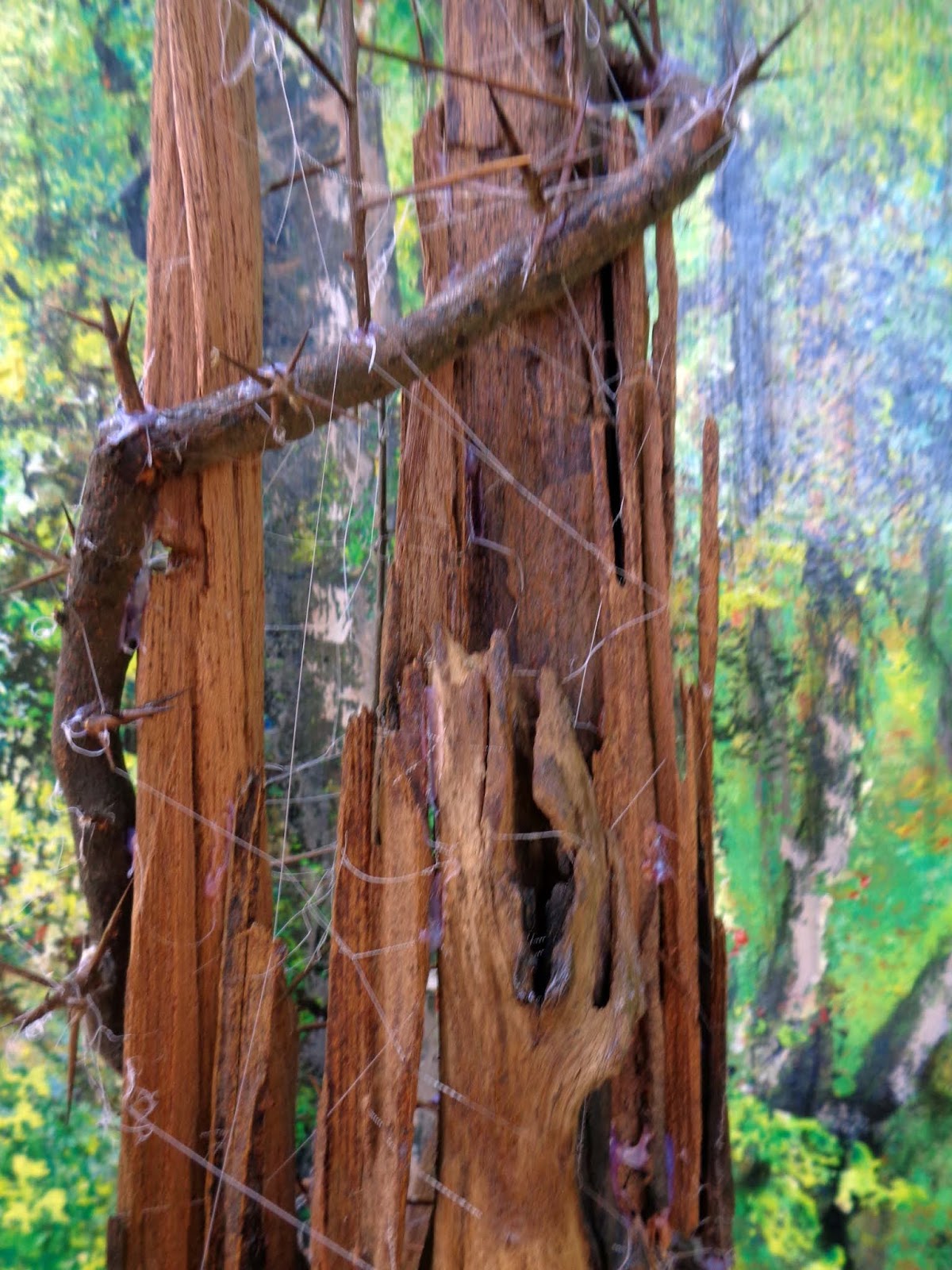
 Rainforest's Tower of Babel model (24") and mural background by the author, 2020. On display at the San Vicente Botanical Garden, Living with Nature Center
San Vicente, Ilocos Sur.

Three dimensions of the model
The model and its shadow showing  details.  (Photos below)

Model made of termite wood remnant, and liana spiked with thorns 
of cherry tree.  Thorny liana symbolizes human greed and destructive 
nature. Cobwebs symbolize negligence in both time and action. ~