Wednesday, February 17, 2021

The Power of STILLNESS

The Power of STILLNESS
Calm is the sea but a sleeping volcano,
the sky is blue, the river meandering to the sea,
a child of creation I'm from the stillness of the womb,
to the stillness of hereafter.


Dr Abe V Rotor

Angelus by Jean Francois Millet

1. Stillness and Meditation

Silence, oh elusive silence,.
take me to your realm divine
where good and evil part,
that I may find a new start,
that begins in the heart.

2. Stillness and the Loving Heart
Throb oh heart, throb the magic of love,
lest desire may turn into lust,
blinding the senses in Freudian ido;
Browning, Ben Jonson, come
with your art of love on hand.

3. Stillness and the Arts

Soar into the heavens for peace and quiet,
let imagination rule over reason,
creativity reigns supreme in stillness,
spawning the great masterpieces.

4. Stillness and Scholarship
Fishing not for fish but ideas,
the rod bends, the line quivers -
a big fish bites, pulls, rages,
oh stillness, tool of the sages.

5. Stillness and the Longing Heart
When the heart throbs for someone far away,
of a place you can't go for the moment or nevermore,
of things lost and can no longer be found,
or wishing the good old days were here,
stillness, stillness must reign,
in fullness and profound.

6. Stillness and the Weary Heart
When doubt clouds the mind and shrouds the view,
which road to take of the two,
take the less trodden, more so the fresh path;
stillness – but never the heart to a halt.

7. Stillness and the Grieving Heart

In the dark hours of life the night is long,
the dawn comes late or seems it never comes,
grief and pain they are inseparable:
the mind, body and spirit;
stillness brings back the joy and wit.

8. Stillness and the Raging Heart

When rages the heart cascading wild,
chartless in a sea of tempest,
seeing the shore no more,
stillness shall give you rest.

9. Stillness and Nature

Calm is the sea but a sleeping volcano,
the sky is blue, the river meandering to the sea,
a child of creation I'm from the stillness of the womb,
to the stillness of hereafter.

10. Stillness and Angelus

The sun sets with the Angelus,
as creatures go to their lair,
stillness reigns in the night
until the return of light. ~

Sunday, February 14, 2021

Food Crisis 18: Poisonous Plants: The most poisonous, driving millions to slow death, is nicotine from tobacco.

Food Crisis 18
Poisonous Plants
The most poisonous, driving millions to slow death,
is nicotine from tobacco.

Dr Abe V Rotor
Living with Nature School on Blog
.
Standing crop of tobacco: illustrated warning on the harmful effects of smoking.
Facts about Smoking & Using Tobacco (See article below)

There are plants that have naturally developed defences against animals and other enemies. Through evolution plants developed thorns, and other structures, but the most successful means is chemical protection. Tannin emerged earlier than complex molecules like polyacetylenes. Plant poisons range from mild irritation to instant death. The most poisonous is ricin from castor bean. Hemlock is associated with history - Socrates, father of Philosophy was condemned to die by drinking hemlock. But the most poisonous of all, driving millions to slow death, is nicotine from tobacco. Poisons in plants are also used in many pharmacological preparation - including addict forming drugs. Plants that are unknown should be treated with utmost caution and children must be properly warned.

Lipang Aso (Lipang-aso (Fleurya interrupta Linn) Don't touch the plant. It is covered with tiny trichomes that impart an itchy substance. Wash affected skin immediately with soap. First aid is to apply vinegar or lemon. Right, Lipang Kalabaw (Dendrocnide meyeniana) has also similar poisonous effects.

Yellow Bell PHOTO below: Don't allow children to play with the plant. Its milky sap may cause paralysis of the pharynx muscles resulting to asphyxiation. Adelfa has a similar property.
  
Be careful with wild mushroom. Consult the local folks. If you are not sure, don't eat it. There is no antidote to mushroom poisoning. (Author gathers edible wild mushrooms guaranteed by old folks in the area.)

There are hundreds – probably thousands of plants that are injurious to health of humans and animals. The most classical is hemlock, the poison that killed the great Greek philosopher, Socrates. We do not have hemlock in the Philippines but there are species that are as poisonous. Here is a list of the most common poisonous plants found in gardens, parks, fields, and even wastelands.

• Tubang bakod (Jatropha curcas) – the seeds look and taste like peanut. They are extremely poisonous. It causes drastic diarrhea.

• Castor bean or tangan-tangan (Ricinus communis) – Seeds contain one of the most poisonous substances in nature – ricinin. This is the reason castor oil purgative is no longer recommended. Purified ricinin is reportedly used in the manufacture of lethal weapons.
• Periwinkle or chichirica (Catharanthus roseus) PHOTO – While it is refuted for its curative power for cancer and diabetes, it causes abortion, and reportedly the cause of death of grazing cattle.

• Oleander or Adelfa (Nerium oleander) – The bark and leaves are poisonous. The poison consists of glucosides allied to digitalin sometimes referred to as oleandrin, rosaginin, neriin, oleander-digitalein, which act on the heart and even in quite small amounts may cause death. There are cases children choke after putting into their mouth the stem or any part of the plant. The poison causes muscle paralysis.

• Kamagsa-tagalis (Rourea erecta), also known as palo santo (Spanish) or gikos-gikos – The wood of the root is pounded, boiled, and mixed with the food of dogs in order to kill them. The fruit contain an active poison, a glucoside. It cannot be explained why the poison does not affect herbivores like guinea pig, but is effective on carnivores.

• Derris (Derris eliptica) – The roots contain an active principle known as rotenone, with a formula C23 H22 O6, a potent insecticide, which also kills fish and animals, including grazing cattle. According to Dr. W.H. Brown, Derris roots have been long associated with suicidal and murder cases.

• Cassava (Manihot esculenta) – Hydrocyanic acid resides in the bark of the tuber or enlarged root, so that it is important to remove the bark before cooking. And when cooking, remove the pot cover to allow the poison to escape as cyanogas.

• Lima Bean or Patani (Phaseolus lunatus) PHOTO – When I was a farmhand I witnessed a case of goat poisoning after the stray animal had ingested leaves of this legume whose seed is rich in carbohydrate and protein. The belly was greatly distended, and while the animal was agonizing, the owner had it slaughtered. In my research I did not encounter any poisonous substance in Phaseolus. Could it be a case of overeating or allergic reaction?

The seed of botong, and also that of bitaog or palomaria (Callophylum inophylum) is poisonous. There are plants that are used as herbal medicine but have dangerous overdose effect. That's why caution should be undertaken when using seeds of mahogany, bark of bignay, and leaves of neem tree. .
--------------------------------------------
There is no seaweed known to be poisonous, but Caulerpa (lato or arusip) PHOTO, contains caulerpin which can cause dizziness when taken too much. It has also sedative effect. By the way, there is a species of wild Caulerpa introduced into the Mediterranean and has vastly spread out on the ocean floor killing fish and other marine organisms.It is listed among the renegade organisms - introduced organisms that went out of control. It is likewise true with animal organisms such as the golden kuhol. Introduced as food in the sixties it is now a major pest of rice crop.
 
Palomaria (Callophylum innophylum) - Seed has high oil content, poisonous
---------------------------------------------------
Plumeria (commonly known as frangipani). Contact with the milky latex may irritate eyes and skin. Mango tree – Mango peel and sap contains urushiol, the chemical in poison ivy and poison sumac that can cause urushiol-induced contact dermatitis in susceptible people. Solanum nigrum (commonly known as black nightshade). All parts of the plant except the ripe fruit contain the toxic glycoalkaloid solanine.

---------------------------------------------------
Can you recall the ending of the movie, Blue Lagoon, after the couple and their son had eaten a kind of poisonous berries? Here is then the rule when you are not sure of the plant - or anything that appeals to you as food. Do not eat it. This is especially true with mushrooms. There is no known antidote of poisonous Amanita. ~

LESSON on former Paaralang Bayan sa Himpapawid Dr Abe V Rotor and  Ms Melly C Tenorio 738 DZRB AM Band, 8 to 9 evening class, Monday to Friday

----------------
Facts about Smoking & Using Tobacco

Today we know a lot about the dangers of smoking thanks to decades years of research about tobacco addiction. Here we’ve listed some of the major statistics about the effects of smoking and using tobacco. Read them and then judge for yourself.
10 Tobacco and Addiction Facts
  • On average, the life expectancy of a smoker is 10 years less than a nonsmoker
  • Cigarette smoke contains more than 7,000 chemicals, 70 of which are known to cause cancer.
  • Nearly 9 out of 10 smokers start before the age of 18 and almost all start smoking by age 26.
  • Every day, more than 3,200 children and teens under 18 years old smoke their first cigarette. (There are also 2,100 young adults who turn into daily smokers each day.)
  • For every person who dies from a smoking-related disease, 20 more people suffer from a smoking-related illness.
  • Smoking and tobacco use causes more than 5 million deaths per year worldwide. Current trends show that this will increase to more than 8 million deaths annually by 2030.
  • Smoking is responsible for about 1 in 5 deaths annually in the United States. (That means tobacco causes about 480,000 deaths per year—and 41,000 of those deaths are because of exposure to secondhand smoke).
  • Smoking causes cancer, heart disease, stroke, diabetes and lung diseases (including emphysema, bronchitis and chronic airway obstruction).
  • Smokers typically inhale about 1 milligram (mg) of nicotine in a single cigarette.4 For some, that’s all it takes to become addicted.
  • Tobacco is the leading cause of preventable death in the world.
Acknowledgement: Thanks to Tobacco Facts (Internet) ~~

Friday, February 12, 2021

Food Crisis Series 27: Remembering the late Administrator Jesus T Tanchanco - Father of the National Grains Authority (now NFA)

Food Crisis Series 27:

Remembering the late Administrator Jesus T Tanchanco
Father of the National Grains Authority (now NFA)

Re-print  for the 48th Anniversary of National Food Authority (former National Grains Authority*) September 26, 2020 Theme: "Mas sigurado ang bukas 'pag may sapat na bigas."

NGA Pioneers' Reunion: Reunite, Reminisce, and Rejoice
Theme of NGA 70s Pioneer Employees’ Reunion, January 25-26, 2019 
A  Message of  Dr Abe V Rotor
Former Regional Director, Ilocos Region and Cagayan Valley (1976-78)

Dr and Mrs Abe V Rotor exchange pleasantries with former NFA administrator Jesus T Tanchanco (right) during the last homecoming of former NGA-NFA employees in 2012.  It was the last meeting of the group with this great man, the father of the National Food Authority, then National Grains Authority.    

The theme of this occasion, a triad of 3 Rs speaks well of your laudable objectives which I happily enjoin, to Reunite, to Reminisce, and to Rejoice, after all the years since the 70’s when we were young ones. Or when we were once young, a phenomenon of life we cannot escape. Can we still recognize one another?  Of course, just a whisper of a name and the past comes back in blissful memories.    

Please add another R .  Thus, Reunite, Reminisce, Rejoice, Rotate (Rotor), in this order. Repeat and have more occasions like this. I hope to join you, so with our other colleagues. Well, the fourth R – Rotate makes the world go round. Life is a cycle.  Everything does.  While we are able to trace the beginning and end of a cycle, its continuity is indefinite, like the number 8.  Ideally man’s aspiration is like that. So with his hopes and dreams.

You have captured the essence of this gathering. Congratulations to the organizers. As a member of NFA and its predecessor, NGA, I have always remained a part of the organization.  I am proud of it, and I’ll treasure it as long as I live.

To me the most important organization is one that guarantees the basic needs of a people. There is no country without an NFA, or its equivalence - even the most advanced nations like Japan and the US have, so with city states like Singapore and Hongkong.

Our organization has been built on a philosophy that no leader or organization can destroy. Several attempts failed.  It is in upholding this philosophy that matters most to us, keeping its integrity virtually at all cost. We were not only pioneers; we have been sentinels to this day.  I say we have been good soldiers, and good soldiers never die.  They say pioneers are themselves heroes.  Where and when no one had dared, we did. We have been pathfinders. The grain industry grew not only with us but by us.  

We may have earned laurels around our heads.  But we cannot and should not  rest on honors and praises. We cannot remain comfortable in retirement.  Retirement does not end our responsibilities. Rather we find ourselves moved up to the challenges of the times.

In the 70s we were instrumental in filling up a huge breadbasket that augmented the lean rice supply of Manila and major urban centers thus saving them from imminent famine during that period. And what was more astonishing an accomplishment was when the Philippines became a rice-exporting country for almost eight long years.  Yes, we were part of that incredible accomplishments, too.  

Whenever I am asked of my greatest achievement in government service for twenty long years I would proudly relate my role in this economic miracle.  I believe you would answer the same and perhaps tell more about it – the dangers and sacrifices you faced, and the triumph and fulfillment that followed.  Yet, like the Unknown Soldier you have kept low and humble.      

But this time we cannot remain silent. We are in a new battlefield. But we  must act with prudence and wisdom.  Wisdom they say, is distilled knowledge gained from experiences, time, loyalty - and of course, courage and unity.  We must stand as we did before, for the sake of the organization we served in the  best years of our lives, in lieu of personal comfort and security. Here is a list of issues confronting NFA and the Grains industry.

Maybe we can take up these issues in a conference-workshop, perhaps in another  homecoming. This could be our most important contribution – sharing that wisdom as pioneers. It is providing the connection of the old and new. Retired and young employees.  Foreign and local programs.  Greater participation at the grassroots in policy making and program setting. Please go over these issues.  You may not agree with all of them, but it is equally valuable in coming up with solutions. You may annotate each item.

1.    Yes to programs to reduce rice consumption, expand other food sources
2.    Yes to programs to reduce wastage of food from field to the dining table
3.    Yes to agribusiness for value added to the advantage of farmers
4.    Yes to Corporate Farming revival, corporations must produce the rice requirement of their employees   
5.    Yes to a new Package of Technology, Masagana 99 Part 2
6.    Yes to Government to Government (G to G) importation through NFA. 
7.    Yes to full utilization of NFA resources, and expansion as needed
8.    Yes to full financial support, yes to “social cost concept of buffer stock”
9.    Yes to encouraging young people to go into agriculture.
10. Yes to technology innovation with less dependence on high tech and input
11. No to abolition of NFA.  No to privatization.
12. No to rice land conversion into non-agricultural.
13. No to huge and unnecessary importation, disincentive to local production.
14. No to graft and corruption in the industry involving many sectors
15. No to genetically modified rice (GMO); it pollutes the natural gene pool
16. No to high tech in rice farming, it is unaffordable to ordinary farmers
17. No to delinquent farmers, irresponsible, unwilling to innovate
18. No to pesticides harmful to health and environment
19. No to kaingin or swiden farming, it irreversibly destroys the land
20. No to pollution, erosion, siltation as a result of poor management

There are many other concerns which you may know having stayed with the agency longer than I did. I had one advantage though. After my early retirement in 1989 I went to the academe to teach, had a stint as consultant of the Senate committee on food and agriculture. And having visited other countries I realized how intricate and complex is the grain industry. We must continue learning.

“Let us not go gentle into the night.”**

By the way, thanks to the present administration for paving the way in re-opening the Grains Museum at NFA Cabanatuan.  It is a unique museum, it offers the other side of technology – culture and the quaintness of indigenous and community living, which to me is the more important aspect of the grain industry.     

I believe that another reason for this gathering is Renewal of our commitment to the agency and the industry, to that cause for which we gave the best years of our lives. It is also an occasion to Remember (5th R) our departed colleagues and friends. It is remembering the man behind our NGA and NFA - our beloved Jesus T Tanchanco.  JT as we fondly called him must be smiling up there.  We also remember in prayers all our departed colleagues. 

Again, Congratulations!


Dr Rotor served as consultant of the Senate's Committee on Food and Agriculture with the late Senator Butz Aquino as chairman (1989-1993). The committee stood vigorous against the abolition and privatization of NFA. 

“Yesterday’s memories, today’s challenges, tomorrow’s dreams - the greatest cycle and never ending journey of life.” (avrotor)

*The National Food Authority was created through Presidential Decree No. 4 dated September 26, 1972, under the name National Grains Authority (NGA) with the mission of promoting the integrated growth and development of the grains industry covering rice, corn, feed grains and other grains like sorghum, including wheat which we had substantive success on the farm level.
**Dylan Thomas – Do Not Go Gentle Into That Good Night

Wednesday, February 10, 2021

Bioethics and Environment - Two Basic Lessons in Life

 Bioethics and Environment - Two Basic Lessons in Life

Dr Abe V Rotor
---------------------------------------------------------------------------------------------
This world, which appears to be a great workshop in which knowledge is developed by man – which appears as progress and civilization, as a modern system of communication, as a structure of democratic freedom without any limitations – this world is not capable of making man happy.

- Pope John Paul II, Crossing the Threshold of Hope
---------------------------------------------------------------------------------------------

Pristine water of Abra River passing through Banaoang Pass, Santa, Ilocos Sur

I thank the International Congress on Bioethics for inviting me through Fr. Tamerlane Lana, to make a commentary on Bioethics and the Environment. Distinguished lecturers, fellow reactors, participants, guests, friends, good morning.

Our resource person, Dr. Michael Cheng-tek Tai, said, “… not only human life is influenced by biological factors but also by social, psychological and even environmental factors.” He asked, “Is our environment in a good condition to fortify a good life for mankind?”

First allow me to me to relate a story before I proceed with my reaction.

But there are no neighbors!

Once there was a workshop for adult leaders somewhere in Asia. The teacher asked the participants to draw on the blackboard a beautiful house, a dream house ideal to live in and raise a family. It was of course, an exercise, which in the minds of the participants was as easy as copying a model from experience and memory. Besides it is a universal dream to own such a house, which allows free interplay of both reason and imagination, using the left and the right brain. The participants formed a queue to allow everyone to contribute his own idea on the blackboard.

The first in the queue drew the posts of the house, on which the succeeding members made the roof and floor. The rest proceeded in making the walls and windows. On the second round the participants added garage, porch, veranda, gate, staircase, fence, swimming pool, TV antennae, and other amenities. Finally their dream house was completed and they returned to their seats. A lively “sharing session” followed and everyone was happy with the outcome of the exercise, including the teacher. Just then a little child happened to be passing by and saw the drawing of the house on the blackboard. He stopped and entered the classroom. He stood there for a long time looking at the drawing and the teacher approached him. The child exclaimed, “But there are no neighbors!”

Human relations is very important. Sociology has become a major field in education. There is a field of biology known as Human Ecology. Economics is rooted into the theory of equitable wealth distribution, where everyone gets a fair share of the pie. Most religions, including ancient religions, are anthropocentric. The Good Samaritan, The Prodigal Son, Matthew 25, Sermon on the Mount, the meaning of Messiah – all these and many more speak of man to be good to his fellowmen. Salvation is not aimed at oneself, but should be one that is collective, which means, “No one goes to heaven alone.” Very little mention is made on the role of the environment, or nature for that matter, in leading man to heaven.

But there are no trees, rivers...

In a another village near the first one I told you, there was a similar workshop. This time the participants were asked to draw a community. So they made a queue for the blackboard and after working together, came up with a beautiful drawing of a community. There are houses - many houses; a church, a school, village hall, plaza. Roads and bridges make a network in the village showing many people. The market is very busy. Anything that makes a typical village is there. The participants discussed, “What constitute a community?” and everyone was so eager and delighted at the result. Just then a little child was passing by, and when he saw the drawing on the backboard, stopped and entered the classroom. The teacher approached him. The child exclaimed, “But there are no trees, no birds; there are no mountains, no fields, no river!”

As no man is an island, so is a village without a natural environment. What good is man living on top of a hill while being surrounded by people in abject poverty? What good is progress – megacities, science and technology, internet, - when progress itself is responsible for the destruction of the land, the seas, and the atmosphere, in short, the Planet Earth.

Many days had passed since the two workshops. Virtually no one ever thought of looking for the little child - who he was or where he lived. Then the whole village suddenly realized, and so they began to search for him, but they never found him – not in the village, not in the neighboring village, not in the town, not in any known place.

Who was the little child? Everyone who saw him never forgot his kindly beautiful and innocent face, and they pondered on his words which remained a puzzle to them for a long, long time.

Environmental Philosophy

What is wrong with our relationship with nature? There are those who believe that nature shall serve humanity. On the other hand there are those who believe that humanity shall serve nature. And there are those who say, it is “something in between”.

We speak about environmental ethics, environmental philosophy, eco-philosophy, and so on, but what do we put into these concepts, and how? Understanding these terms may not solve environmental problems, but on the other hand it is questionable whether we can solve these problems without discussing them on a philosophical level.

There are different views about change. Scientific knowledge and government policies for example, often disagree and run into conflict at each other. Economics and ecology, though they share a common root word and foundation, are strange bedfellows, so to speak. Yet they support common goals geared toward change. But change has to be viewed more than the measures of GNP, currency, balance of trade, and the like, and should not only be confined to Human Development Indices, such as literacy rate, mortality and population. While these are parameters of growth and development, certain questions on sustainability and environmental preservation are left unanswered. How do we ensure future generations? We ask ourselves what is “progress without conscience?” And whose development? What is the relationship between progress and posterity?

Which leads us to Dr. Tai’s paper, Who is man on earth? Is he Master? He proceeded in saying that man is a steward – one who must treat nature with overwhelming respect. Man has responsibility to God, to nature, to his fellowmen, other creatures and the Earth.

It is on this concept that we measure the obedience of man. It is also on this concept that man’s greatest achievement is made, his martyrdom, his heroism. The hero concept revolutionizes traditional and conventional definition of a hero. He is more than a nationalist, an economist, or an ideologist, as we generally know, but a hero for Mother Earth. The late Dr. Dioscorro Umali, national scientist, addressed a graduating class at the University of the Philippines with this statement, “Be the heroes we never were.” The essence of his speech is that his generation left so little of the earth’s resources for the next generations to inherit and enjoy. “We have not only abused the bounties of Nature,” he said, “We have destroyed her as well.” Which leads us to the topic, environmental movement.

----------------------------------------------------------------------------------------------
Today, rather than defending himself against nature, man realized, he needed to defend nature against himself.

- AV Rotor, Light from the Old Arch
-----------------------------------------------------------------------------------------------

Environmental Movement

Environmental movement has roots in ancient cultures as gleamed from such old structures as the Banawe Rice Terraces. Throughout history as civilizations grew and spread the environment became a sacrificial lamb. Such phrases “all roads lead to Rome,” “the glory that was Greece, the grandeur that was Rome,” “the sun never sets on English soil,” and the eight wonders of the ancient world may reflect man’s ultimate achievements, yet all these were ephemeral in the mist of time in man’s dreams. In the end, it is nature that takes them away from the hands of man. The loss of natural environments has led to the decline of civilizations and their subsequent demise.

Revival of environmental awareness came at the heels of the Renaissance. In the 12th century St. Francis of Assisi brought a new concept of devotion. Brother Sun, Sister Moon, and all the creatures on Earth our friends, laid down the foundation of naturalism in the Christian church reviving much of the Aristotelian naturalism, and those in ancient cultures.

It is but fitting that St. Francis of Assisi is regarded as the patron saint of ecology. Time Magazine came up with a list of heroes for Planet Earth, among them are naturalist philosophers or conservationist philosophers are Ralph Waldo Emerson, Henry David Thoreau, John Muir, Aldo Leopold, and Rachel Carson. Here is a glimpse at their contributions

• Emerson claimed that “behind nature, throughout nature, spirit is present.”

• Thoreau spoke of the side of “truth in nature and wilderness over the deceits of civilization.”

• Muir believed that “wilderness mirrors divinity, nourishes humanity, and vivifies the spirit.”

• Leopold was behind the policies in wilderness and game management. “Wilderness is the raw material out of which man has hammered the artifact called civilization.”

• Carson published Silent Spring, which dramatized the potential dangers of pesticides to food, wildlife, and humans causing wide spread damage to the ecosystem.

• Chico Mendes was a front liner in environmental conservation. He lost his life defending the concept of “extractive reserves” to conserve the Brazilian Rainforest that provided livelihood of the people against the conversion of the forest into ranches and plantations.

Other heroes of planet Earth cited include Barbara Ward, author of Only One Earth which shaped the UN environmental conference; Ernest Schumacher who did not believe in endless growth, mega-companies and endless consumption, an advocated for Small is Beautiful, a best seller; Jacques-Yves Cousteau, oceanographer who espoused the need to arrest the declining health of the oceans. There many more whom we can compare with the Unknown Soldier, but a soldier in defense of nature. ~

Monday, February 1, 2021

Food Crisis Series 2: Revive and Promote Home Biotechnology - People’s Green Revolution

 Food Crisis Series 2
Home Biotechnology -
People’s Green Revolution
Dr Abe V Rotor

We wake up to the fresh aroma of coffee, chocolate, vanilla, the cured taste of dried tapa, tinapa, ham and bacon – all these are products of a mysterious process we generally call fermentation.

Aged wine is mellower, cured tobacco is more aromatic, naturally ripened fruits are sweeter, dried prunes, raisin and dates have higher sugar content and have longer shelf life. Seasoned toyo, bagoong and patis make fine cuisine, so with vanilla, chili, laurel, banana blossom, and annatto.
Why many foods taste better after allowing them to stand for sometime! Take suman, tupig, puto, bibingka, and the like. The real taste of pinakbet comes out an hour or two after it has been cooked. So with the Ilocos dinuguan.

Thanks to the myriads of beneficial microorganisms, and the complex chemistry working in our favor even while we are asleep. Indeed Nature works silently through her invisible agents and processes.

The vast potential uses of microorganisms - bacteria, algae, fungi and the like - in providing food, medicine and better environment to supply the requirements of our fast growing population and standard of living are being tapped by biotechnology. Biotechnology hand in hand with genetic engineering dominate the Green Revolution of this century – the fourth since Neolithic time.

Let me cite particular areas of biotechnology in which small entrepreneurs play a vital role and which they have proven themselves successful in one way or the other. The first group involves the production of alcoholic drinks and vinegar through fermentation. These products are

§ Tapoy (rice wine of the Cordillera equivalent to the Japanese kampei)
§ Basi (sugarcane)
§ Lambanog (distilled coconut wine)
§ Tuba (young wine from coconut)
§ Layaw (nipa)
§ Bahalina (coconut and tangal)
§ Fruit wine (kasoy, bignay, strawberry, pineapple, etc.)
§ Root crop wine (potato, kamote, cassava, yakon)
§ Beer (malted corn, rice, sorghum, barley, wheat, rye)
§ Vinegar (nipa, sugarcane, coconut, various fruits)

 
Basi and fruit wine, pride of the Ilocos Region.

With readily available raw materials and simple tools used, brewing is a practical industry. More so, with the simplicity of fermentation itself - which is the conversion of sugar into ethanol through fermentation with yeast, as shown in this general formula?

C6H12O6 ------- 2C2H5OH + 2CO2
Sugar to Wine

This equation applies to all kinds of wine and beer in the world, varying only in the source of materials and technical aspects, cultural uniqueness notwithstanding. This is why wine making is universal. It is engrained in culture and history, and in all human activities. No ceremony is without wine. It is symbolic of religious faith and belief. And while there are popular brands in the market, still the best wine is found in the farmer’s cellar in Europe and Asia, or elsewhere.

The brewed product is either consumed immediately or allowed to age. Aging improves quality and lengthens the shelf life of the product. Wine making is an art, and a personalized enterprise, with each vintage or cellar having a distinctive quality trademark. Bordeaux in France for example, is famous for brandy, while the Scotch Whiskey remains a top grade liquor made from grains. Similarly we have basi in Ilocos, bahalina in the Visayas and lambanog in Southern Tagalog.

Wine does not go to waste if it fails to meet standards. And even if the brew is left unattended. Nature makes wine to vinegar. Vin-egar means sour wine. In chemistry it is oxidized ethyl alcohol, the product of which is acetic acid, as shown in this formula, similarly a universal one.

C2H5OH + O2 ---------------- CH3COOH + H2O
Wine or Ethyl Alcohol to Acetic Acid

Vinegar is perhaps the most common food preservative and additive. It is often associated with the local source such as Sukang Iloko and Sukang Paombong. Or material – sasa from nipa, pineapple vinegar, apple cider vinegar, etc.

Vinegar has many uses outside of the kitchen. Weed killer, bleaching agent, pesticide, drainage declogger, odor remover, etc. Many industries rely on this organic substance from food to textile to metallurgy.

The second group of products of village biotechnology are beverages, food condiments, tobacco and betel for chewing. Tea, coffee, fruit juice and chocolate, in this order, make up the world’s top beverages, thus pointing out the vast opportunities of biotechnology in this area.

§ Kapeng barako (Batangas and Cavite)
§ Cacao (Batangas, Mindanao)
§ Vanilla (Mindanao)
§ Tsaa (Batangas)
§ Fruit puree (mango, guyabano, pineapple, etc.,
Southern Tagalog, Mindanao)
§ Bagoong and patis (Navotas, Balayan, Dagupan)
§ Kesong Puti (Laguna)
§ Betel (Cordillera, Laguna, Ilocos)
§ Ketsup (banana, tomato)
§ Rolled tobacco (Cagayan Valley, Ilocos)Toyo (Southern Tagalog, Mindanao)

Like in the first group, these products are area-specific which point out to their indigenous production and processing, so with their patronage. Rolled tobacco or pinadis, for example, has a special market for old people who are used to the product – and not to the younger generation. This is also true with betel or nganga.

On the other hand, bagoong and patis, which used to be a specialty among Ilocanos, are now marketed abroad. So with kapeng barako a local coffee which is mainly grown in the highlands of Batangas and Tagaytay?

Fruit puree and fruit preserve, though relatively new, are amazingly growing fast, as people are shunning away from carbonated drinks. Because of high demand, these products became a boom to small growers, who recently are becoming mere conduits or raw products suppliers of big companies, instead of making and marketing the finished products themselves.

The third and largest group of village biotechnology products is in processed food.

§ Puto or rice cake, very popular among Filipinos
§ Bibingka (rice)
§ Maja (corn starch)
§ Burong manggang paho, mustasa (pickled mango, mustard)
§ Burong Isda (dalag and rice)
§ Hamon (manok, baboy, pato) ham
§ Tocino, longganisa
§ Itlog na pula and century egg
§ Balot and Penoy (incubated duck egg)
§ Tokwa (bean curd)
§ Taosi (fermented black bean)
§ Talangka (crab paste)
§ Pickles (papaya, carrot, amargoso, onion, cucumber, etc.)
§ Toge (mungo sprout)
§ Cakes (banana, cassava)
§ Ripening of fruits (with madre de cacao leaves)

Food processing constitutes the bulk of village biotechnology in developing countries, on both domestic and commercial scales. Like in the other groups, these undertakings are seldom organized as formal establishments; rather they fall under the category of informal economics which is life line of the people especially in these critical times.

The pioneering group, are the so-called “One-Celled Protein” food, a new term in food production by algae, fungi and bacteria. Actually many of these have long been known even in primitive societies because they grow in the wild.

· Spirulina (blue-green alga or BGA)
· Chlorella (green alga)
· Nostoc (BGA as food and fertilizer)
· Anabaena (BGA in symbiosis with Azolla a floating fern, for fertilizer and food)
· Nata - nata de coco, nata de piña (Leuconostoc mesenteroides, a capsule bacterium)
· Mushrooms –Pleurotus (abalone mushroom), Shitaki (black mushroom), Volvariella  
   (banana mushrrom), Agaricus (rice hay mushroom), Auricularia or “tainga ng daga,” 
   and many other edible mushrooms, cultivated or wild.

Let’s strive to make village biotechnology truly a Green Revolution of, for and by the people. ~

LESSON: Make a list of home and village biotechnologies in your area, and explain their salient features in helping curb the current food crisis during these pandemic times.

Recreating Nature in Murals on the Wall

Recreating Nature in Murals on the Wall

"Take me from this world a moment
to be with You in this holy event;
From your seat to down below I see
my friends, my enemies - and me." - avr

Dr Abe V Rotor

Under the Sea Cavern. Simulating stalactites and stalagmites in caves, the artist simulated the same conditions on some coral reef ledges where the sun could hardly penetrate. Mystery lies inside the cavern which only the imagination can fathom. A predator waits for its prey, small fishes group together for safety, shell fish cling lazily on rocks, while seaweeds sway freely like a curtain. It is a stage of sort where drama of life in the deep takes place everyday. (Wall mural, SPUQC, AVR).

I have wondered many times if fish ever sleep
or they just lie down very still
in some quiet deep, like flocks of sheep
after their fill lay on a grassy hill.
Other creatures gain this way their ease
and man by the power of his will
takes the long and winding road to peace
searching for that quiet pool or hill.

Tropical Rainforest. A composite painting of a running stream through the woods, apparently near human habitation as shown by the presence of promenades and fishing enthusiasts enjoying themselves as in a park. Also, the stream empties into a pond of Nymphaea and lotus on the foreground giving the impression that the scene is at the edge of a clearing. Nonetheless the whole scene speaks of an undisturbed ecosystem. The presence of wildlife shows that this is their natural habitat. SPUQC, AVR

Gather the clouds into fog and mist,
rain and stream;
Gather the fish, the birds and the beasts
to a peaceful reign.

Light in the Woods. Are there images on the painting? How many trees are there. Can you see a face? Whose face is it? The inverted "V" perspective creates a panoramic effect leading the eye toward the center and background. SPUQC AVR

It inspired a soul to write a book*
that touches the eye and heart;
This little light in a nook shines
where good and evil part.

* Light the the Woods, by AVR, Megabooks 1995


Ruins of Colonialism. Keenness in history leads the hand to re-create events in composite order. The sky and landscape blend well and create a peaceful ambiance in contrast with that of the ruins on the foreground. Infinity can be felt towards the background where boundaries of land and sky dissolve in mist and cloud. SPUQC AVR

Ruins, your silence disturbs at this time of tempest,
When dawn breaks like any dawn sans rays of noble past;
The day shall come to put people again to the test,
Like spring, rise again from their state of outcast.

Composite Landscape. There are three scenic parts arranged vertically to suit the design of the sala of a private residence. Upon entering one is led to look up and down the painting. Thus the elongated design has a foreshortening effect. There was originally a rainbow, but it was toned down so as not to steal the show, so to speak. It's suggestiveness however, has a strong effect from the balcony eye level. (Dasmariñas Village, Makati MM)

Where man makes a living, a garden by his hands he makes,
At the foot of a hill, on the tip of a pen, on rivers and lakes,
He contends - even only a piece of that Paradise lost -, he regains;
From knowledge and disobedience, the whole world gains.

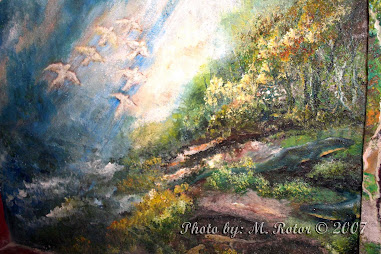
Doves Flying at Dawn. There is a feeling of ascendancy in this painting. The diagonal perspective enhances such movement, while splashes of light heightens daybreak. The rough sea and dark foreground give contrast to the painting. The hideous presence of large reptiles creates enigma as to what the artist wanted to imply. Mystery in art is an important element. (Wall Mural SPU-QC)

Take me from this world a moment
to be with You in this holy event;
From your seat to down below I see
my friends, my enemies - and me.

Watershed. Unlike the first painting the perspective is normal "V" which explains the title - a funnel shaped valley to catch and store rainfall and in the process make a natural garden with the colors of spring, summer and autumn, thus exuding a fairyland effect. The landscape speaks clearly of a pristine environment far and free from humans. (Wall mural SPU-QC)Ask Ceres or the mightiest God of all -

if Nature keeps herself better if we depart;
With her housekeeping and her art -
was Paradise redeemed after the Fall? ~