Abe V Rotor Sailing in acrylic AVR
Like a bird gliding free;
For nothing is more fearful
Than doldrums in the sea.
Sail on, sail on, don’t delay,
Leave while there’s still time,
The doldrums will lull you,
To pass away your prime.~
Anecdotes about Lincoln
Dr Abe V Rotor
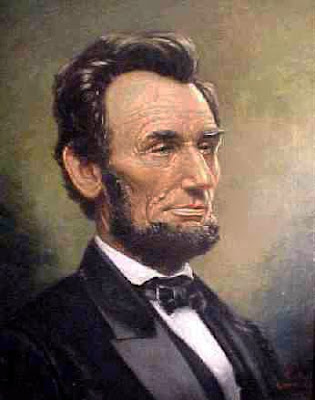 Abraham Lincoln, 16th US President (1861-1865)
Brief Gettysburg Address
Perhaps Edward Everett talked a bit too long at Gettysburg, but he was an old man then, by the standards of his day – within a few months of his seventieth birthday. And this was the culminating glory of a long career. But Everett was among those who perfected the classic qualities of the Lincoln address. In a note to the President the following day he said: “I should be glad if I could flatter myself that I came as near to the central idea of the occasion in two hours as you did in two minutes.”
With his customary graciousness President Lincoln replied: “In our respective parts yesterday, you could not have been excused to make a short address, or I a long one.” (Quote Magazine)
Presidential Polish
During the Civil War days a foreign minister to the United States was shocked when, on a call to the White House, he found President Lincoln shining his own shoes. He told the President that in his country it was not the custom of gentlemen to polish their own shoes.
With his customary resourcefulness and nimble wit, President Lincoln replied, “Then whose shoes do they polish?” (The Red Barrel)
Lincoln’s Enemy
Abraham Lincoln was questioned by one of his advisers as follows: “Mr. President, I cannot understand you. You treat your enemies with such kindness. It would seem to me that you should want to destroy them.”
“My dear fellow,” said the President. “I do destroy my enemy when I make him into a friend.” (Annonymous)
Musical President
Throughout his life, music was a solace to Lincoln. “His musical tastes,” says a biographer, “were simple and uncultivated, his choice being old airs, songs and ballads.”
On one of his walks through Washington during the war, Lincoln passed a schoolhouse where children were singing. He took off his beaver hat and heard the song through, his face brightening the while. Then he straightened up and walked off with a more elastic step. (Sunday Magazine)
Using Words Carefully
If the story of the Creation can be told in 400 words, if the Ten Commandments contain 297 words, if Lincoln’s immortal Gettysburg Address was only 266 words, if an entire concept of freedom was set in the Declaration of Independence in about 1,300 words – it is up to some of us to use fewer words, and thus save the time energy, vitality, and nerves of those who must read or listen (Jerome P Fleishman)
 A Life in Brief
When Abraham Lincoln was elected President in 1860, seven slave states left the Union to form the Confederate States of America, and four more joined when hostilities began between the North and South. A bloody civil war then engulfed the nation as Lincoln vowed to preserve the Union, enforce the laws of the United States, and end the secession.
"With malice toward none; with charity for all; with firmness in the right, as God gives us to see the right, let us strive on to finish the work we are in; to bind up the nation’s wounds; to care for him who shall have borne the battle, and for his widow, and his orphan..."
Abraham Lincoln, March 4, 1865
Abe V Rotor Craggy Sea, painting in acrylic by AVRotor 2002Yield, cold rock, yield
to the hunting protolife and sun
that shall carpet your shoulders
before I, too, shall come.
Or exfoliate into dusts
and ride on the wind,
whistling the requiem of time
on endless, lifeless sand.
Yield, cold rock, yield
to a thousand raging waves
until you topple from shore
into the hadal deep unknown.
Yield to the lichen and the vine,
the way to the bread and wine,
for you are the rock of life
of symbiosis divine. Living with Nature, AVRotor
Abe V Rotor
 Dita, Alstonia scholaris, soars to a height surpassing the main building and reaching out to the level of the tower cross of the University of Santo Tomas, Manila. The tree has a pair similarly as tall, also growing in the Botanical Garden, formerly the Pharmacy Garden of the university, the oldest of its kind in the country.
Dita grows very tall with storeyed crown, tapering at the top. The leaves are in whorls of 4 to 7, oblong -obovate in shape. The bark, stems and leaves produce abundant milky sap. The flowers are white, crowded and numerous. The fruits are pendulous, slender, and cylindrical, 20 to 40 cm long. The seeds are about 3 mm long with brown ciliate hairs on the ends that enable the seed to "float in air" and to be carried to new and far places. This is the principal means of dissiminating the species.
Dita is very common in northern Luzon from Cagayan to the Bicol region, to Palawan and Mindanao; in most islands and provinces, in primary ans secondary forests at low and medium altitude. It is generally found in tropical Asia and Africa, through the Malayan region to tropical Australia.
Locally the tree is known as alipauen, dalipauen, dirita, lipauen in Ilokano; andarayan, dilupaon, iplai in Ibanag; bita in Panay Visaya, ditaa in Bikul and Sulu; tanitan, tangitang (Bisaya); pasuit, polai in Pangasinan; and dita in Tagalog.
Dita has many pharmacological uses. Technically the decoction of the bark is used as "tonic and febrifuge and is said to be an emmenagogue, anticholeric, and vulnerary." (Guerrero, as cited by WH Brown, Useful Plants of the Philippines.)
What are then the active principles found in the plant? In the same reference, dita is rich in alkaloids which are specified as ditamine, echitamine, echitenine; alstonine, porphyrine, porphyrosine, and alstonidine. It is no wonder that dita has many uses as remedty of common ailments as stomachic, fever, diabetes and vermifuge, bath preparation after childbirth, and cough. It is also used in an enema for hemorrhoids.
The Malays use the latex for curing toothache by placing it inside the cavity of the tooth. It is an an antidote for food poisoning. It is used in Java for ripening abcesses and boils. The tender leaves are used as poultice in India, and a decoction of the same is drunk in eastern Malaysia for beriberi, and an infusion in vinegar is prescibed for congestion of the liver.
I stand beside a living colossus,
its top buried in fog and smog;
I take the air our breaths infuse,
and catch the cool wind in its shade,
this living tower that God made.
I prick her skin and it bleeds freely
of milky potion for health and groom;
I pick her leaves and grind into tea,
docoction and poultice I make
for a hundred and one ailment.
She dwarfs all things save the high
rise, she survives flood and acid rain,
everyday trampling and heavy sigh,
endless traffic, noise and vermin;
under her wings it's a lovely scene.
Lovers in her shade her fragrance
guiding Cupid's aim, her flowers
in confetti honor the passersby;
her silky seeds float each with a wish
that rises up, up with the breeze.
What makes this tree tall and great,
by measure, it is indeed a fact;
it is how so little man can make
of her innate power and grace
that have served the human race. ~
Living with Nature, AVRotor
Brook
Dr Abe V Rotor
 Brook of my Childhood, Mural detail AVR
The brook of my childhood
meandered in dreams,
where lazy hours flowed
through the valley;
when in youth I drifted
on her water and shoulders
to where the world opens;
when with age I found her
dying as she filled the ocean.~
Abe V Rotor Sunset view at Fairview, QC
you shrink in a sudden act
from the transfixed holy sight,
wondering if dream or fact.
Visions are sometimes deceiving
to the unwary beholder,
yet stir the senses into believing
in some mystery yonder.~
 Sailing in acrylic AVR
 Abraham Lincoln, 16th US President (1861-1865)
 A Life in Brief
 Craggy Sea, painting in acrylic by AVRotor 2002
 Brook of my Childhood, Mural detail AVR
 Sunset view at Fairview, QC