Monday, March 5, 2018

Enigma of the Animal World

Dr. Abe V Rotor
Lecture on Zoology

 Orangutan (right)

Who came first, with mind closed and eyes blind,
We know who emerged at the dawn
of knowledge and consciousness, leaving behind
an ancestor long humans disown. 
Tukak Ba-ug (puffer frog)

Bellied frog, all but air resounding,
booming, and croaking;
Threatened, it lodges between rocks,
or floats dead feigning.   
Mouse deer

With the likes of the man from Transylvania transformed,
This creature maligned, two kinds combined and deformed.  
Barn Owl

This owl is dead, it's just a specimen,
 so with the wisdom in it and in men. 
Fruit bat

It's a fruit bat clumsy with its load, 
that drops on a roof at night,
scaring children in their bed believing
in a vampire with utmost fright
Sea urchin, spines hang for wind chime

Do you also play the tune in the deep
to wake the mermaids in their sleep? 
 Arupama, biggest freshwater fish

 A giant you are in the Amazon River
Famed of beauty more than terror;
If I were to believe in your being gentle
where have been your friends before?  
 Water iguana

Harmless though frightening you are,  
from the wild now behind bar;
Ugly and ancient people see you  
in their mind millions of years ago. 
 
Starting termite mound, architecture of a house sparrow's nest.
 Aestivating toad; snap turtle hatchlings
 A pair of yellow luna moth. SPU-QC.
 Black dots on their wings like eyes,
would-be predators are surprised.
  Red heart pigeons; red parrots.  Photos by the author

Your heart is bleeding I can see it through,
Need not tell you your love is true;
unreciprocated, you are in sorrow,
'til you met your kind - a happy duo    
 Kapis shell from which a province is named - Capiz.
 Lanky tree frog (atop a shower head) 
watching me took a shower one summer day 
in a retreat center in Lipa City;
Where have you been hiding these years? 
Here is retreat center, indeed, 
 White heron are migratory, arriving in time of rice planting
 Janitor fish comb the pond's bottom for algae and detritus. 
Author's residence in QC
Queen termite, with king (top) surrounded by members of the colony - 
soldiers (big head) and workers. Berkshire swine breed. (Note characteristic white band.)
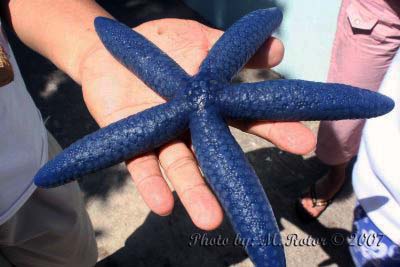
Giant blue starfish pick on the coral reef of Calatagan, Batangas.
Spiny puffer fish. 


Black birds (martines) nesting on tree fern atop an acacia; 
photo taken by author's son Marlo with a 200mm telephoto lens. ~

Let's Promote Nature Field Trip

"There is pleasure in the pathless woods, there is rapture in the lonely shore, there is society where none intrudes, by the deep sea, and music in its roar; I love not Man the less, but Nature more." Lord Byron

Dr Abe V Rotor
Living with Nature School on Blog [ avrotor.blogspot.com ]
The clearest way into the Universe is through a forest wilderness.
John Muir

The woods are lovely, dark and deep.
    But I have promises to keep,
And miles to go before I sleep,
    And miles to go before I sleep.
                                   . Robert Frost

Nature Field Trip, Mt Makiling Botanical Garden, UPLB Laguna

Forget not that the earth delights to feel your bare feet
and the winds long to play with your hair. Khalil Gibran


The butterfly counts not months but moments,
and has time enough. Rabindranath Tagore

Look deep into nature, and then you will understand
everything better. Albert Einstein

Teachers visit the Museum of Natural History, UPLB

Nature holds the key to our aesthetic, intellectual,
cognitive and even spiritual satisfaction. E. O. Wilson


Biology teachers in MM visit Mt Makiling Botanical Garden, UPLB Laguna

The world is a book, and those who do not travel
read only a page. Saint Augustine

Learn Science in your Garden

Learn Science in your Garden
Dr Abe V Rotor 
Living with Nature School on Blog 

Plants lose water by transpiration (through stomates) and gutation through special "valves." Here gutation is shown in Rhoeo discolor.  Droplets line the leaf edges mistaken as dewdrops in early morning. Excess water in the plant is released through special valves to protect the cells from plasmoptysis or excess pressure, the opposite of plasmolysis (shrinking of cells for lack of water). This is a physiological phenomenon existing in the plant world.  

Bagworm (Cryptothelea fuscescens) is the turtle in the insect world with the larva enclosed by a silk bag it builds which grows with the larva itself in four or five moltings becoming bigger in each instar (larval stage).  It spends its pupal phase outside, hanging at the posterior end, then emerges into a moth.  But in the case of the female, it spends its pupal and adult stages inside the bag. Because it is wingless mating is done through the posterior opening of the bag with the male attracted by pheromone (chemical scent).  After fertilization, it lays her eggs inside, squeezes out and dies on the ground.  
Lantana camara, a sturdy shrub exudes obnoxious odor from its flower and body, specially when disturbed.  Its leaves and young stems are covered with tough hairs that easily break when touched, thus emitting the characteristic odor that earned his name bang-bangsit, which means odorous in Ilocano.  This odor however makes the plant a repellant against a host of destructive insects, except for certain butterflies and other insects that pollinate the flowers.  With natural farming gaining popularity, Lantana is welcomed in garden as biological agent against pests. 
Lichens are indicators of good environment. They are plentiful when the environment is pristine, and the air is not polluted.  The three kinds of lichens indicate the degree of pollution. Fruticose (above, right) indicate very clean environment, foliose (leaf-like) indicates declining condition, and crustose (crust-like, left) tolerable level.  The less the lichens are found, the more the environment is deteriorating.  Thus the lichens are practical biological indicators. 

Preying mantis (Mantis religiosa), the executioner in the insect world, spares no insect - not even its own kind.  The female mantis kills her mate while in the act, devour it after for nutrition. But farmers and gardener like them for protecting their plants, and while they are villains in their world, they are harmless to humans.  Sometimes they are regarded as pets.  

Colony of aphids (Aphis sp) at the leaf axils of variegated fortune plant.  Black mass of fungus  grows on the sugary exudate of the aphids. It is this natural sugar made from the plant sap the insect sips that attract red ants.  these ants protect the aphids from predators like ladybugs. Note self regenerating capacity of the plant (right) that shows the plant's ability to survive the pest. 
Bumble bees have become rare in gardens, so with butterflies and honeybees. This is because the air is becoming more polluted, and there are less and less free spaces to build gardens specially in cities. Radiation emanating from transmission towers creates disorientation of pollinators, particularly honeybees as they search for nectar and pollen over long distances and returning to their hive. No wonder the cost of honey has gone up,  so with insect pollination-dependent fruits,vegetables and seeds - these apparently is a  result of our deteriorating environment.
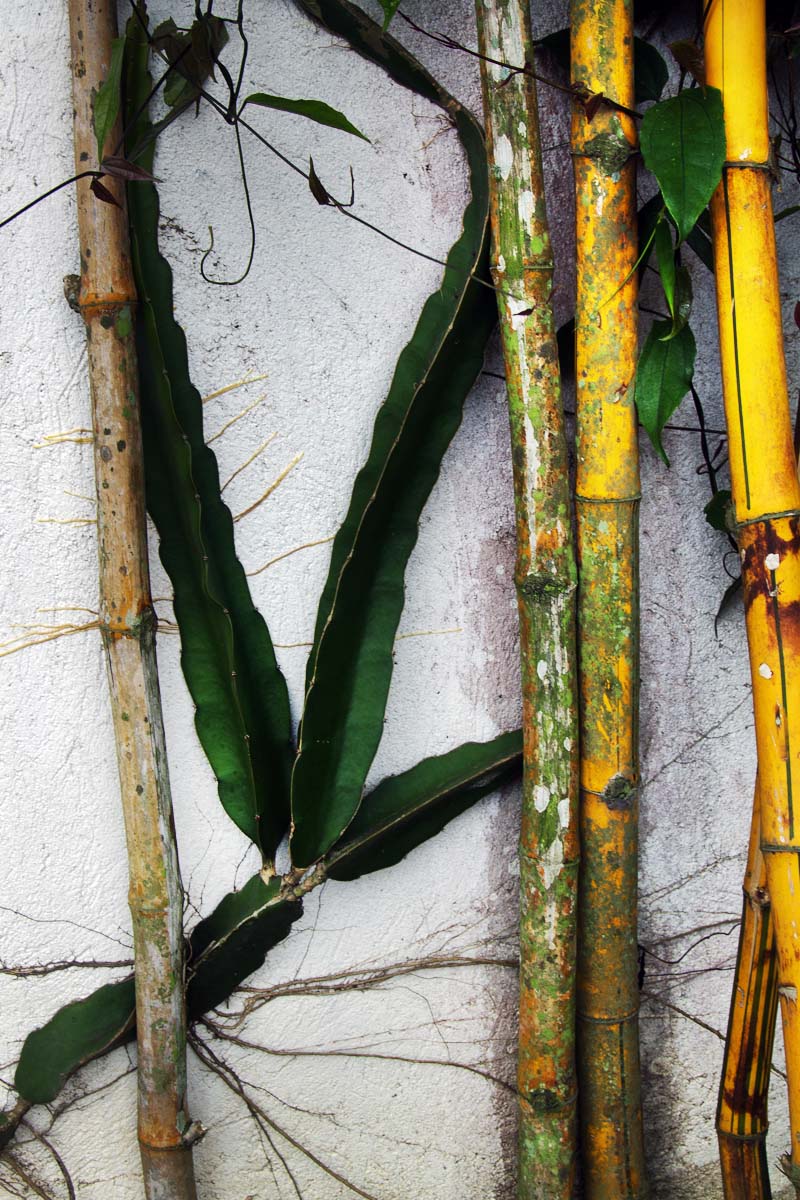
Plant physiology. Apparently there are no common characteristics between bamboo and cactus in this photo. In the first place the bamboo can support itself, while the cactus has to depend on a support - a wall to cling on. Photosynthesis takes place in the green stem of the cactus which is not possible in the bamboo and its kind. The one thing they share, other than water and basic nutrients, is phototropism - both rise to reach for sunlight, and for space. But nature provided each one certain adaptive mechanisms to compete as well as to live under one niche. It is this principle that enables plants to live together naturally like in a forest.  
Poke marks caused by insects create a subject for abstract art.  Viewed against the bright sky the leaf shows netted venation, like veins and capillaries, which supply water and materials for photosynthesis, and it products mainly sugar, to other parts of the plant. Deep green coloration shows richness in chlorophyll.  The leaf structure is an engineering marvel that continues to inspire architecture and engineering.  In the field of medicine, the network of vascular and leaf tissues may provide the key to understanding tissue transplant and stem cell culture.  
 Makahiya (Mimosa pudica) makes a plaything for children and adults trying to steal a leaf without drooping, wishing almost anything in the world from love to fortune - if  they succeed. And no one will ever succeed in altering nature's gift to this shy plant. Special cells called pulvini control the drooping of the leaflets and the whole compound leaf, and restoring them fresh and erect once these cells are filled again with water.  The powder puff flowers attract bees and other pollinators without alarming the plant, thus insuring fertilization and production of seeds.  

Sunday, March 4, 2018

A Checklist: Poor Self-image Behavior

"Mirror. mirror on the wall,
who is the fairest of them all?"

                     (From Cinderella)  

Dr Abe V Rotor
Our self-image may not be the same as our public image. Rightly so, we are being criticized for our behavior we project and perceived by people.


It is a constant struggle actually. It's not only putting our best foot forward; it is also stepping back to clear our doubts and to amend for our wrongdoings.  And re-set the stage we play our role. Building self-image requires planning, and the principal determinant is our behavior.  

The following behavior traits are evidence that there is room for improvement in our self-image:
  • Negative talk about ourselves 
  • Experiencing guilt.
  • Failure to give compliments
  • Non- acceptance of compliments
  • Not asking for what we want.
  • Starving ourselves of luxuries unnecessarily.
  • Failure to give affection.
  • Inability to receive and enjoy affection 
  • Criticism of others. 
  • Comparison of ourselves with others. 
  • Constant poor health. 
There are no hard rules in this checklist. Post this list in your bedroom next to a mirror as a daily reminder. Remember, "Your beliefs don't make you a better person. Your behavior does." (Anonymous) ~

Reference: ll you wanted to know about happiness, by Vikas Malcani, New Dawn; acknowledgement: Internet image.