Tuesday, October 13, 2026

Images of Nature on a Wall Mural

Images of Nature on a Wall Mural

"Little did I realize that the order of Nature is not merely determined by natural laws applied as ecological tenets, but as a divine law which determines its arrangement, the subordination of the means to the end, and the assimilation of the parts to the whole." - avr

Dr Abe V Rotor

Wall mural (8 ft x 16 ft) St Paul University Quezon City by the author, 2000

Nature represents the idea of the entire universe in a state of perfection. Nature is one: it unites heaven and earth, connecting human beings with the stars and bringing them all together into a single family. Nature is beautiful; it is ordered. A divine law determines its arrangement, namely the subordination of the means to the end, and the parts to the whole.

After putting down my brush, I took a view of the mural from a distance. The scene – unspoiled nature – one spared from the hands of man and typified by the tropical rainforest, flowed out from a wall that was previously white and empty.

In the course of painting the mural, which took all of seven days and in the days following its unveiling, I took notice of the reactions of viewers. It must be the stillness of the scene, freshness of its atmosphere, and its apparent eccentricity that attract passersby as if in search of something therapeutic. It seems to slow down busy feet, soothing tired nerves. There is something I thought was mysterious beyond the levels of aesthetics. For the huge scene is a drama of life completely different from city living. It is respite. It is transformation from concrete to greenery, from cityscape to landscape.

Yet, I found it difficult to give it a title and an explanation that captures both its essence and message. This time many ideas crowded my mind. At the start of my painting labors, the challenge was how and where to start painting. Now that it is completed, what else is there to say after one has “said” it all in colors and lines, hues and shadows, perspective and design? What more is there to declare for after the last page of a book? For a painting, it is the same.

Relaxation did not come easy for me after many hours of concentrating on my subject, dealing with a fast-drying medium of acrylic. What made it more challenging was the unending attempt to capture those fleeting impressions and recollections that pervaded my mind as I painted. I then took a pen and slowly wrote my thoughts. From the mural, I saw the scenery of my childhood on the farm, views of my travels here and abroad, imagery from my readings, and views drawn out like a thread from the mass of a golf ball. It was imagery and memory working jointly.

Tropical Rainforest Model


I chose the tropical rainforest scenery since it is the richest of all ecosystems in the world. The Philippines, being one of the countries endowed with this natural wealth is a treasure, indeed. For this reason, I believe that, the tropical rainforest closely resembles the description of the biblical paradise. It is not only a living bank of biological diversity; it is the most important sanctuary of living matters on earth.

To paint such a big wall is no easy task. It is not unusual to face a blank wall, literally speaking, and not knowing what to do first even with all the colors and tools on hand – and a predetermined topic in mind. Shall I start at the center and move outward, or from both sides slowly progressing inward? Or do I divide the wall into parts, working on them one by one, then unifying them at the end?

…and Heaven and Nature Sing

Christmas was already in the air and the Siberian winds were bringing in the chills. Carol music was now being played in malls, schools and homes. I was engrossed in my work when some students, watching me paint, sang a familiar song. On this particular occasion, something about the song chimed inside me, directing me towards the central theme of my mural.

“…and heaven and nature sing,
and heaven and nature sing,
and heaven, and heaven and nature sing.”
- Joy to the World

What does this mean? Is it the idea of nature representing the entire universe in a state of perfection? Or is it nature as one? Does it unite heaven and earth? Does it connect human beings and the galaxies as one family?

Little did I know of my ecology. As a subject I teach in college and in the graduate school I depend much on formulas and equations, principles and case studies. My knowledge about the environment is structured and formal. I use module maps or course syllabi based on accepted teaching techniques and references. My approach was comparative analysis. I was a judge of the beautiful and ugly, the do’s and don’ts. At times I am a Utopian; at others, conformist.

Little did I realize that the order of Nature is not merely determined by natural laws applied as ecological tenets, but as a divine law which determines its arrangement, the subordination of the means to the end, and the assimilation of the parts to the whole. Many of us are ignorant of this law, or if we know it, seem to forget or disregard it as we relentlessly work to exploit the earth.

In our apparent failure to preserve nature, perhaps it is time to look at ecology with the essence of this popular Christmas song – a song that makes everyday of the year, Christmas. Ecology is “heaven and nature singing together.” Only then can we truly understand the term, balance of nature – a kind of dynamic equilibrium that leads to homeostasis where there is stability among interdependent groups that characterize natural processes, and the period in which they take place. The ultimate conclusion is always a balanced system. We have to look beyond books to understand biological diversity, and its application in nature, to find the common phrase: In diversity there is unity. The general rule is that the wider the diversity is in terms of number of living species, and in terms of the number of natural species and their habitats, the more closely knit the biosphere becomes, resulting in a richer, more stable environment. Undoubtedly, all this is part of a grand design inspired divinely.

A Hole in the Sky


Looking at the mural from a distance one notices a darkened part of the sky, apparently a hole (though this is not the ozone layer pierced by CFC pollution). It gives one a feeling that it is a tunnel to infinity as if to link both earth and heaven. Through this hole, one envisions a Higher Principle. From the foreground, which is the placid stream of a downward meandering river, its tributaries and banks lined with trees and thickets, the eye soon reaches the forested hills and mountains shrouded by clouds.

But it does not end there. Here the cloud is a curtain laden with the radiance of the sun, and the life-giving provenance of rain, useless each without the other for life on earth to exist. This is the crossroad. The cloud opens with a backdrop of infinity. The universe, whose limit is unknown, bursts open a foreground that reveals a whole drama of life on earth. After that, the eye repeats the journey. In the process, the viewer becomes sensitive to the details of the painting. He searches for things familiar, or situations that later become a new experience.

Creatures in the Forest

Creatures in general are not as visible as they appear in books and on the screen. They blend with their surroundings mainly for predatory anticipation and protective camouflage. But there are other reasons too, that are not well understood. Take the case of the butterflies. Their beauty is extravagant for their basic function as pollinators. Fish jump for mere pleasure, dragonflies have wings that split light into prisms. Birds stay in the sky longer for the sheer joy of flying, and not just to cruise in search of a prey.

Among the animals suggested to me while painting the mural are flying lemur, Philippine monkey, heron, monitor lizard, boa constrictor and hornbill. I painted these - and many more, the way I imagined them in their natural habitat. I put a touch of Noah’s Ark, painting them in pairs. For the rodents, ducks and doves I made them in amiable groupings that exude a familial atmosphere.

Whenever I see viewers seriously searching for these creatures with walking fingers, I am tempted to add to the collection of creatures, making them even more difficult to find. But that might change the ambiance to fun and puzzle solving, rather than of meditation and recollection.

People in the Mural


The trees and the massiveness of the scenery dwarf the characters in the mural. They appear mindless of events and time. They care not for the chores of the day. Those who are engrossed fishing with a simple hook-and-line do not show excitement even as they land their catch. Others patiently wait for a bite. There is a sense of tranquility and peace to all characters, whether they are promenading or just passing the time away. Their faces show only the slightest hint of anger or sadness.

I noticed viewers trying to identify themselves with the characters of the mural. Some construction workers envision themselves fishing. High school students are drawn by the promenades. But there are those who simply imagine themselves part of the scene. “This place is familiar to me,” one would say, apparently recalling provincial life. “We have flying lemurs in Davao,” says another.

Where does the water flow, and what does the mural mean to us? Water is everywhere. It is free to flow. Tributaries abound as if there were no limit. Trees are everywhere and far into the backdrop is a vast virgin forest. There is no sign of man’s destructive hand. At the foreground is a placid pond where Nymphaea and lotus grow. It is in contrast to the lively pulse of the river. This is a corner where life is peaceful and serene. It is here that we draw strength in facing the river and beyond.

What really is the message of the mural?


Quite often, images of nature enrapture us. These are reminiscences of childhood, a re-creation of a favorite spot we may have visited or seen, or products of the imagination greatly influenced by the society we live in.

These images reflect a deep-seated biological longing to be part of nature. Putting it in the biblical sense, it is a natural searching for the lost paradise. They are a refuge from city living, a respite, and an escape from the daily grind.

But these images do not only tell us of what we are missing. Rather, it reminds us what we are going to miss, perhaps forever, if we do not heed nature’s signal towards a fast declining ecosystem. If we do not change our way of life from too much dependence on consumerism, to one more closely linked to conservation of nature, we may end up building memories and future archives of a lost world.

The warning is clear. The painting challenges everyone to do his part to save Mother Earth so that her beauty is not only kept in the form of images, but a scenery of real life enjoyed by us and future generations. ~

Monday, October 12, 2026

Rediscovering Lost Culture and Art - Pride of a People and Nation

Rediscovering Lost Culture and Art
- Pride of a People and Nation

"My dad taught me from my youngest childhood memories through these connections with Aboriginal and tribal people that you must always protect people's sacred status, regardless of the past." (Steve Irwin)

Dr Abe V Rotor

Revival of Pottery: art and livelihood, environment friendly. 
Sudipen, La Union

Homogenization, like a giant pool, mirrors a phenomenon which is a consequence of progress - globalization.

Globalization is irreversible. But is it really progression. If it is trend of progress where will it lead us to? To what extent, and for how long? The believers of this thesis are disciples of science and technology, and therefore are not afraid to open new horizons. They seldom look behind.

The traditionalists look at things differently. They have deeper roots in history and culture, they find time to ponder and analyze, and ask others and themselves, “Quo vadis?” But don’t get me wrong as anti progressive, anti technology.

Globalization is like a cauldron in which diversities of culture are thrown into. They dissolve in our very eyes. Either they disappear or lose their identity.

Clearly there is homogenization of races, creeds, ideologies - technology. For example there is only one kind of car in the world – they all work of the principle of Internal Combustion. Formal education has generally of one pattern worldwide, from preparatory to post graduate; so with the various courses offered.

Ethnicity encompasses many aspects of life and culture; other the humanities are the natural sciences, ethnobotany among them (the study of the relationship of people and plants in a natural setting.) Ethnic wooden art in the Cordillera

From here evolved the knowledge of man in pharmacology, and while such knowledge has vastly grown into a major industry dominated by multinational companies, a great deal of herbal healing still abound in rural communities.

Folk wisdom akin to traditional knowledge is carried onto the present by elder members of the community has lost much significance in general perception, but a great number of them are enshrined by our culture and writings. They are natural leaders whose words are listened to with respect. Why village elders have also the role of an herbolario, matchmakers in marriages, teachers in their own right based on rich experiences and long practice!

Confucian teachings permeate in the family. Christian values are reinforced by age-long heritage, and vice versa. So with the teachings of Buddha and Mohammad, and other great religious leaders. Mythology, too, has deep rooted influence in our lives. It lives in our superstitious belief, folklore and customs. But many of these are being threatened, if not endangered, in our march toward progress and affluence, along with the current of postmodernism which is sweeping the world today.

On the other hand, there is growing consciousness for moderation in living. More and more people are looking for alternatives of the so-called Good Life.

One alternative is the revival of tradition, a rediscovery of lost culture and art can be 
enshrined in our present life.

1. Revival of ethno-medicinal healing has suddenly found relevance where the dangers of modern medicine are perceived. Lagundi, Oregano, Sambong are now DOH-approved How about the bulk of herbal medicine?

2. It’s the cold wind from the north that came too soon that caused poor rice harvest. Old folks would tell us. And scientists confirm that pollination-fertilization is indeed adversely affected by cold weather. Home child delivery assisted by a village "kumadrona" 

3. Pet therapy is gaining popularity even in modern hospitals. Victims of stroke who lost coordination of their hands surprisingly recover with a pet around.


4. Honeybee sting sends arthritic people back on the road.

5. Return to cotton, ramie, abaca, flax, and other natural fibers for clothing and other wears is indicative of people's awareness on the comfort and health benefits of these natural fibers, not to mention their being environment friendly. Headgear is ethnic art and status symbol among the Igorots.

5. Ethnic art is gaining popularity in galleries and studios. Native arts are found on murals and in halls. The revival of ethnic art is very visible among the aborigines of Australia, the American Indians, the Incas and Aztecs.So with other indigenous cultures.
-------------------
"We need to help students and parents cherish and preserve the ethnic and cultural diversity that nourishes and strengthens this community - and this nation." - Cesar Chavez ~

Self Administered Test on Humanities (True or False, 50 Items)

Self Administered Test on Humanities
(True or False, 50 Items)

Nicanor Abelardo is to music as Fernando Amorsolo is to painting. Their masterpieces are considered as classics today. True or False?

Dr Abe V Rotor
 Living with Nature - School on Blog (avrotor.blogspot.com)

1. The most dominant color of the earth as seen outer space is green.

2. There are six colors of the rainbow that follow a standard sequence whether the rainbow is in the tropics or in the temperate zone, in summer or in winter.

3. It is rare to see a twin rainbow, but if there is one and you are lucky to witness it, the lower rainbow is wider than the one on top of it. 

4. Humanities comes from the old English word humanus which speaks of fine of human culture.

5. Victor Hugo wrote Les Miserables and The Hunchback of Notre Dame, both classic socio-political novels.

6. The Happy Prince by Oscar Wilde is a example of a tragedy because the happy prince died at a very young age, and therefore missed the opportunity to serve his constituents.

7. One of the standards of a classical work of art is that it is timeliness.

8. Alexander Dumas, Miguel Cervantes, Leo Tolstoy, Victor Hugo and Jose Rizal have one thing in common: they are writers of powerful novels that move the world so to speak, and changed the course of history.

9. Robert Frost by mistake repeated the last lines of his famous poem On a Snowy Night,
“And miles to go before I sleep
And miles to go before I sleep.”

10. A drawing exercise of fruits like apple, pear, grapes, chestnut, and orange arranged on a table is an example of "still life."

11. Don’t go gentle into the night is a poem which tells us to be vigilant, and that our work is never done; don’t settle for comfort when in trouble and even when there is apparent peace.

12. Shakespearean drama is akin to tragedy; and if it were not for the literary genius of this world’s greatest dramatist, many of his works like Romeo and Juliet won’t pass the Board of Censors today.

13. Biag ni Lam-ang is a local counterpart of Iliad.

14. Juan Luna’s work, particularly Spolarium is a typical example of Impressionism.

15. Vincent van Gogh is considered the Father of Expressionism, an art movement that preceded Impressionism.

16. Impressionism is an art movement that started in France in the later part of the 18th century, among the pioneers are Paul Cezanne, Pizarro, Monet, Degas.

17. In the poem Fisherboy, the boy being referred to has something in common with Mark Twain’s boys, Tom Sawyer and Huckleberry Finn, who did not want to go to school.

18. Jose Garcia Villa is a one of the greatest Filipino poet, awarded the honor of National Artist.

19. Nicanor Abelardo is to music as Fernando Amorsolo is to painting. Their masterpieces are classics today.

20. Nature takes shape was the basis of a drawing exercise on Landscape. The three basic shapes are circle, square and triangle.

21. When blue and yellow are mixed the color produced in green; blue and red will produce violet.

22. When the primary colors – red, blue and yellow - are mixed in equal proportion the resulting color is black.

23. These are contemporary Filipino compositions: Saan ka man naroon, La Deportacion, Dahil sa isang bulaklak, Pamulinawen, Manang Biday, Matudnila

24. Maestro Mamerto Villaba, tenor; Ryan Cayabyab, composer; and Prof. Paulino Capitulo violinist, are Filipino musicians belonging to the same generation and school.

25. Dr. Jose Rizal’s novel, Noli Me Tangere, has been recently launched in NY in a new English translation published by Penguin Books.

26. Mahatma Gandhi is ranked among the world’s greatest leaders. His weapon: asceticism, love, compassion - a favorite model for biography, cinematography, and political documentary.

27. To become great you must be able to a book for the sake of posterity, like Rizal.

28. The Old man and the Sea by Ernest Hemingway which won the Nobel Prize for Literature, ended with the old man, worn out from his battle to land a big fish, and the world rejoiced for his victory.

29. Florante at Laura, masterpiece of poet laureate Francisco Balagtas is an epic.

30. A good work of Art must rise with the elements of spirituality and the universal criteria of intellectual values.

31. Style is unique; it's like finding no two snowflakes exactly the same.

32. Rhythm is found in music, as well as in poetry.

33. Even a free verse has musical qualities, in spite of the fact that it does not follow a definite pattern of rhyme and rhythm and meter.

34. Joyce Kilmer who wrote the famous poem Trees, is a man, not woman.

35. In Trees the figure of speech used in personification.

36. Where have all the flowers gone is a song and a poem that condemns war.

37. The Lord is my Shepherd I shall not want is the opening line of Psalm 23 by King David.

38. Melodrama is like soapbox opera, and telenovela in many respects.

39. Gettysberg Address was originally intended as an oration.

40. The editorial of a newspaper, is considered a formal essay.

41. Soliloquy and monologue are basically similar – a kind of dramatic poetry.

42. The classical model of dance is Ballet, and the greatest ballet music composer is Tchaikovsky. He composed the Dying Swan.

43. Ideally there are 100 players in a full orchestra, with string instruments comprising the biggest group of instruments.

44. Drink to me with only thine eyes and I will not look for wine is the first line of Song to Celia.

45. Our old Spanish churches are a good example of Gothic architecture.

46. The Parthenon of Greece is the greatest architectural work of the classical period.

47. Mona Lisa is considered the greatest of all paintings in the classical period.

48. Renaissance means rebirth or renewal which took place as early as the 15th h century – the model used is Greco Roman.

49. The Philippines was once a part of Renaissance Europe.

50. Calligraphy is the art of writing beautifully while graphology is hand writing analysis.
 ......................................
ANSWERS: 1F (blue), 2t, 3t, 4t, 5t, 6T (it has a tragic beginning and triumphal ending), 7F (timelessness), 8t, 9f (Frost did it for emphasis of theme, and to impart musical quality to the poem), 10t, 11t, 12t, 13t, 14f (romanticism), 15t, 16t, 17t, 18t (posthumous), 19t, 20t, 21t, 22t, 23f (all Filipino, combination of kundiman, native Ilocano and Visayan songs), 24t (although each one has a distinct style, Cayabyab is more recent and versatile), 25t, 26t, 27f (Christ, Buddha did not write any book - others wrote for and about them), 28t, 29f (Balagtasan in romantic and lyrical style - local Shakespearean), 30t, 31t, 32t, 33t, 34t, 35t, 36t, 37t, 37t, 38t, 39f, 40f, 41t, 42t 43t. 44t. 45f (Baroque), 46t, 47t, 48t, 49t, 50t.

RATING
46- 50 Outstanding
41-45 Very Good
36-40 Good
31-35 Fair
25–30 Passed
Below 25 – listen regularly to Paaralang Bayan

Lesson on former Paaralang Bayan sa Himpapawid (People's School-on-Air) with Ms Melly C Tenorio
738 DZRB AM, [www.pbs.gov.ph] 8-9 evening class Monday to Friday ~

A Dead Tree Arises Heavenward

A Dead Tree Arises Heavenward

"Trees do not preach learning and precepts. They preach, undeterred by particulars, the ancient law of life." 
― Herman Hesse (German-Swiss poet and novelist, 
and winner of the 1946 Nobel Prize in Literature.)

                                                 Dr Abe V Rotor 
Living with Nature - School on Blog
avrotor.blogspot.com 

Skeleton of Agoho (Casuarina equisetifolia) of the Pine Family, QC, 2017 

Half a century I lived, my master is now gone, his generation remnant
of tradition, imprimatur of the old school, the values of old, outstripped
by today's postmodern living.


My death is also the death of my friends: lichens and mosses on my
bark, ferns and lianas on my limbs, mycorrhiza and rhizobia in my 
roots, and others in symbiosis with me.

My demise is also a great loss to countless dependents: insects 
feeding on my leaves, bats feeding on my cones, bagworms housed in  
my needle leaves, earthworms thriving on my litter.

My crown was once a huge umbrella for tired passersby, stopover 
of  birds in their migratory route; it buffered strong wind, and filtered
dusts and carbon in the air, cooled the surroundings. 

I stood tall to reach out for the sun and through photosynthesis 
converted its energy into food and other materials, while releasing
oxygen to balance the level of carbon dioxide in the atmosphere. 

Like my relative, the pine, I did not shed my leaves all at once unlike 
the deciduous trees; instead I shed my leaves as they grew old, thus
I kept the landscape evergreen all year round. 

My life was a struggle like my kin in the wild abiding with the laws 
of nature; unlike them however, I lived on the whims and dictates of 
the human community in which I was introduced.

I did not have a family of my own, my children were weaned early 
and carried to places I never knew; nonetheless I learned to live well 
in a man-made community of plants humans called park or garden.   

I played with children in my shade and on my limbs, lulled them in 
their cradle, the old in their hammock, the bold in their swing, 
whispering, humming, creaking in nostalgic pain and laughter.

Many times I joined their celebrations, tasted their beer, held up their 
flag and banner, joined in their singing, kept secrets of lovers who 
marked my trunk their initials and vows leaving traces of memories. 

I grew up with kids until they left home, rejoiced at their return, 
welcomed and showered confetti to friends and guests, prayed for the
sick, grieved for the dead, expressed my own way of compassion.  

I was pruned many times to give way to electric lines and cables, 
road widening, for necessity of  firewood and materials for various 
crafts, or simply for aesthetic reason whatever that means.  

Progress, I had my share too, but I got mostly the harmful consequences:  
pollution, congestion, global warming, acid rain, ailments that 
accompany the Good Life, which progressively led to my demise.   
   
I have been standing dead for some time now and no one seemed to 
care, save the termites and fungi gnawing on my skeleton, and some 
black birds that sit awhile on my bare crown.

I rise up and peep into the hole in the sky beneath me, and if this is
a gate to an afterlife told by man to be so beautiful, I ask my Creator 
if I too, deserve the gift of eternal life and happiness only a place 
called Heaven can give.  ~ 
----------------------------------
 "Nature holds the key to our aesthetic, intellectual, cognitive and even spiritual satisfaction.” – E. O. Wilson

“I believe in God, only I spell it Nature.” – Frank Lloyd Wright ~     

Early Sunset on a Landscape

Early Sunset on a Landscape
Dr Abe V Rotor


View from a hill in Antipolo, Rizal, June 1, 2013

Afternoon and it's already sunset,
behind gray clouds the sun's shining,
wearing a red veil over the horizon,
with dust stirred into the air floating.

Beauty in birth and death - and life,
in between - clinging to final fate
in man's hand - and oh! how lonely,
how sad, nil of hope and losing faith.

Landscape - but whose landscape?
robbed from people, robbed from nature,
from beauty sublime, to one's design
for gain and power, not for the future. 

And he speaks on behalf of progress,
measured by concrete and steel,
by the amenities of the Good Life,
                             in unending want, incessant fill. ~ 

Sunday, October 11, 2026

WATER MANAGEMENT in 6 Articles: "Water, water everywhere, but not a drop to drink."

 Water Management 
"Water, water everywhere, but not a drop to drink." - From Ancient Mariner, by Samuel Taylor Coleridge 
Brace for "Very Strong” El Niño Until the First Half of 2027, PAGASA Warns

Dr Abe V Rotor
Living with Nature - School on Blog 
 
Part 1 - The 12 Principles in Water Management in Outline
Part 2 - Water Crisis: The La Mesa Dam - Heart of the Angat-Ipo-
              La Mesa Water System
Part 3 - We are in the Midst of El Niño Phenomenon
Part 4 - Harvesting Rainwater: The Art and Practice
Part 5 - A Shade of Noah’s Flood.
Part 6 - Legacy of Old Faithful Bubon' (Open Well)
                 
Part 1:  Twelve (12) Principles of Water Conservation 
             and Utilization

This article is very timely as a guide to water management with the current dry season. Habagat (rainy season) had long ended, we are now in midst of amihan (dry season), and aftermath of the COVID-19 pandemic.  
 
Left, Angat Dam in Bulacan; La Mesa Dam in Novaliches QC
 
Bantaoay River, San Vicente, Ilocos Sur. (Site of the Basi Revolt in 1807)
Amadeo Waterfalls, Cavite

1. Monsoon rains generally come in June to October- Habagat. The rest of the year is considered dry. Amihan season occurs during the cool months of October to February. The driest months are March and April, and recently May. Let us conserve water particularly during the dry season.

Rainfall pattern
N D J F M A    M J J A S O
Dry Season / Wet Season

2. A region or a particular geographic area may possess a micro-climate of its own, and therefore, a distinct rainfall pattern. Let's be guided by this sub-type of climate in the conservation and utilization of water.

Factors Creating a Sub-type of Climate

• Elevation – The higher the elevation, the cooler is the environment. There is more rainfall and thicker vegetation. Examples: Benguet, Mt. Apo, Kanlaon, Bulusan

• Presence of natural barriers – The Cordillera mountain range separates the Ilocos provinces and the Cagayan Valley into two sub-types of climate. The Sierra Madre mountain range has a similar effect.

• Position and closeness to large bodies of water – Samar and Leyte Islands have three micro-climates owing to the varied conditions brought by the surrounding sea as well as the presence of mountains and a large swamp – the Sab- A Basin.

• Forest cover – The thicker and more extensive the primary forest cover, the higher is the precipitation or rainfall falling in and around the area. Examples: Mt. Makiling, parts of Mindanao, Isabela and Palawan still covered by original forests.

3. In the Philippines our main supply of freshwater comes from lakes, swamps and ponds; rivers and streams; and springs and ground water.

Let's take care of these sources and use them wisely following these guidelines.
A. Lakes (e.g. Laguna de Bay, Paoay Lake, Taal Lake), and swamps (e.g. Liguasan Marsh, Sab-A Basin) are made up of a complex system network of watershed, tributaries and distributaries. Watershed supplies water and maintains stability of a lake or swamp. Management should be holistic, treating the system on the basis of inter-relationships among its parts.

A pond has similar basic structures although it is generally shallow and intermittent, its system very much simpler and reduced. A swamp, compared to a lake, is a water-logged area, usually a basin, thickly vegetated, rich in organic matter deposits such as muck and peat. Natural reservoirs maintain a desirable amount of ground water for agriculture and domestic use.)

 
Integrity of the watershed is the key to full ponds and rivers and abundance of groundwater.. 
Paintings by AV Rotor

B. Rivers and streams conduct runoff/surface water. Their load can be tapped for future use through impounding, especially those which directly run to the sea and dry up after the rainy season. Great potentials for large supply of freshwater await in our major rivers like the Agno River, Tagum River, Aparri River, Mindanao River, Pampanga River, and Agusan River.

4. An efficient watershed maintains the stability of a water reservoir whether it is natural or man made by
  • Providing protection against erosion and siltation,
  • Increasing the rate of water absorption and impounding,
  • Inducing rainfall, and
  • Keeping the surroundings cool and reducing evaporation.
A. Erosion and siltation work in tandem. Silt is carried down by water from eroded areas. Deposition causes clogging of waterways, and the silting of farms. It exacerbates flooding, reducing the life of dams, decreases crop yield.

B. Water absorption and conservation of ground water are enhanced by well-maintained watersheds.

C. A micro-climate is created within efficient watershed areas which is conducive to cloud formation and consequent precipitation. This is mainly the result of increased relative humidity and reduced evaporation.

5. Water supply is enhanced by forests and woodlands (man-made forests) through
  • Higher rate of rainfall (tropical rain forest is so-called because rain occurs frequently, if not daily, in and around tropical forests, such as Mt. Makiling.
  • Fuller rivers, streams and natural springs,
  • Abundant amount of ground water and fuller aquifers.
A pristine landscape provides an ideal ground for camping, now 
an endangered hobby in postmodern times. Painting in acrylic by AV Rotor. 

A. A forest has a multi-storey structure that is very efficient in water conservation, and solar and space utilization. Organic matter built on the forest floor helps conserve water like sponge.
  • Emergent tree
  • Canopy layers
  • Lianas & epiphytes
  • Bushes; shrubs
  • Ground plants
B. The forest cover conserves water and keeps it underground for future use. It slows down water flow thereby increasing the rate of water absorption. The roots of trees help maintain s desirable water level in the ground and fuller aquifers (underground rivers). All these enhance the life of rivers, streams and natural springs.

6. Water impounding in the tropics is a common practice in agriculture, fisheries, power generation, recreation, industry (e.g water coolant), and for domestic use. Commonly adopted designs are based on these models:
  • Dam (e.g. Ambuklao, Binga, Angat, Lamesa, Pantabangan, Chico)
  • Pond (e.g. farm pond, communal water impounding projects)
  • Terrace (e.g. Banaue rice terraces gravity irrigation) and
  • Series of catchments (China’s model)
A. Large water reservoirs are very expensive and require extensive areas. They are characterized by high technology and maintenance requirements. Our major dams are suffering from heavy siltation which have drastically reduced their capacity and life.

B. Ponds are mainly for individual use in small and medium farms. Small communal reservoirs projects are popular in Iloilo and in many parts of the country but many of them are not properly managed. Such projects are designed for cooperative farming. One project in Iloilo has 5-ha reservoir, 100-ha watershed, and a service area of 50 hectares, cultivated by some 30 farmers.

C. Water Impounding on the Banaue rice terraces is a classical example of a very efficient water management system. Rainwater is trapped in each of the hundreds of terraced ricefields which then act as a reservoir until the crop is harvested. Through gravity irrigation system paddy water is regulated. Excess water is conducted to the lower paddies and ultimately to the gorge which serves as the main drain.
  • Precipitation
  • Forest Cover
  • Upper terraces
  • Lower terraces
  • Gorge/River
D. A series of small catchments built along the length of a river conserves virtually all the water that would otherwise go to waste. This system of water impounding is built on intermittent rivers and streams of certain parts of the People’s Republic of China where the rainy season is short leaving the place dry the rest of the year.

7. Where irrigation water is limited, the principle of comparative advantage should be applied. Considering other things equal, choose the crop that gives the highest level of water utilization and returns on investment.

Economics of water utilization during the dry season:
20,000 cubic meters - water requirement of
  • 1 ha of Rice
  • 3 ha of Corn
  • 5 to 6 ha of Bean
8. In recycling water for farm, industry and domestic use follow the principles governing Nature’s Water Cycle, namely

• Water is transformed into three states of matter – solid, liquid and gas. In the process of transformation, water is separated from other substances and impurities.
Examples: In distilling water, the impurities are left behind. Much of the rain which falls on land comes from clouds formed at sea. The process of desalination follows this principle.

• While water cleans, it has also the inherent power of “cleansing itself”.
Examples: Organic matter settles at the bottom of lakes, leaving the water clear and clean. Similarly after heavy downpour, silt and clay settle down leaving the water clear. Natural springs rarely need the attention of man.

• There are certain biological and physical, including geologic and chemical processes that enhance water recycling.
Examples: Aquatic plants maintain a desirable supply of oxygen in water. In sewage treatment, water passes through a series of tanks/pools until it goes out safe and functional again.

* Aquifers are natural underground reservoirs and filters.

9. Water pollution exacerbates water shortage. Let's minimize, if not prevent, the pollution of our water supply by using biodegradable materials.

Forest Fire in acrylic by AV Rotor

There are now biodegradable plastics. Coconut oil-based detergents are preferred. So with organic fertilizer over chemical fertilizer. Botanical pesticides leave little or no toxic residue.

• Reducing pollutants
Reduced emission of gases which combine with atmospheric water to form “acid rain”. Clear watershed and waterways from all forms of garbage. Prevent clogging and water-logging as these favor accumulation of wastes and increase the effects of pollution. More strict laws on oil spill.

• Practicing cleanliness and sanitation
Proper garbage disposal. Keep industrial wastes away from water sources. Implement a shanty-free estero program. Impose strict sanitation in public markets, and “talipapa”/ flea markets. Strictly implement anti-pollution laws in factories, homes and motor vehicles.

• Banning dangerous pollutants
Let's uphold the anti-nuclear constitutional provision to prevent radioactive fallout incident. Radioactive wastes must be disposed following international safety standards. Permanently ban the “Dirty Dozen” pesticides. Use only unleaded gasoline. Regulate use and disposal of mercury compounds.

• Planning our community
Residential and industrial zoning. Strictly implement building and housing policies of the National Housing Authority, DPWH, local governments, etc, Ecology village concept, Decongest urban centers and promote rural living.

• Educating the public
National Geographic and Nature-Life TV series, DENR media programs on environment, Kalikasan publications, DA and DOST programs on agro-ecology. Include ecology in the school curriculum on all levels. Ban ads of products which contribute to environmental degradation.

10. The flow of our rivers gets less, our lakes subside, and ground water sinks deeper, saltwater intrusion increase spoiling our farms, springs and wells, rivers, streams and ponds. Let us ward off saltwater intrusion by

• Preserving the mangrove forests
Mangroves are frontlines against tides and sea currents. They are natural riprap builders and they moderate the rate of flow and mixing of seawater and freshwater at the estuaries.

• Reforestation of mountains and watersheds
Flash floods are frequent where trees have been cut. Runoff water cuts river banks, makes waterways shallow and at the mouth of rivers mudflats are formed. With reduced flown of rivers, seawater intrudes island and underground. In many parts of the country, intrusion is noted in farms as far as 10 km inland.

• Preventing siltation and pirating of rivers
River banks must be protected with trees. Residential areas must kept away from river banks. Farming along rivers and around bodies of water must be controlled, specially if it contributes to erosion and siltation. Farm chemicals drain into rivers and lakes specially if it rains. Reclaiming and pirating beaches, estuaries, rivers and streams should be strictly prohibited. Major obstructions are illegally constructed fishponds, rest houses and shanties.

• Dredging waterways
Many of the rivers are heavily silted and dredging is necessary. This is specially true in and around big urban centers. Illegal dikes and structures must be removed and strict garbage disposal enforced.

• Regulating the drawing of underground water and the damming of rivers
Water rights regulate the rate of drawing water from the ground and rivers. However, this is not being implemented strictly. Too much withdrawal predisposes saltwater intrusion. Many wells and rivers in summer turn saline.

11. Modern technology has developed new ways of tapping and recycling freshwater by means of

• Towing icebergs,
Icebergs are towed hundreds of miles to countries in need of freshwater.

• Desalination of seawater,
Freshwater is produced from seawater through the principle of distillation. To reduce cost, solar energy has replaced conventional fuel. Israel adopts desalination for its agriculture.

• Cloud seeding and inducing rainfall
Rain-inducing compounds are used by airplanes to seed rain clouds. Technology has increased the efficiency of cloud seeding.

• Bottling spring and mineral water
Due to dwindling natural supply of safe freshwater, bottling spring and mineral water has become in the last twenty years a booming industry in large urban centers. A chilled 250-ml spring water sells at 15.oo php on university campuses in Manila.

• Re-processing used water.
Unlike the conventional filtration-aeration-chlorination process, used water is recycled for domestic use through a complex purification process in big cities.

12. Everybody should share in the common responsibility to use and conserve water wisely by means of

• Avoiding wasteful use of water
List down ways to save water. These include such simple means as repairing leaky faucets and pipes, to adopting a systematic program in household management.

• Impounding rain and surface water
Residents in small islands depend largely on rain. Their houses are equipped with special gutters and storage jars to trap and store rainwater.

• Maintaining ecological balance
List down all the ways to help preserve the environment to enhance the adequacy of freshwater supply from wells, rivers, springs, etc. Refer to the foregoing principles.~

El Niño indeed gives each and everyone of us ways by which we can minimize its impact on our lives and on our community. Above all it has a humbling effect on our technology - and our wasteful living. It is the great moderator. It is also the great reminder for us to be always prepared to face the vagaries of our climate, more so natural calamities. ~
Composite mural paintings of a tropical forest in acrylic by AV Rotor.  
Courtesy of San Vicente Pasalubong Center, San Vicente Ilocos Sur

*Briefing outline before the Senate Committee on Food and Agriculture 2009 
** Lesson on former Paaralang Bayan sa Himpapawid (People's School-on-Air)
with Ms Melly C Tenorio 738 DZRB AM Band, 8 to 9 Evening Class, Monday to Friday


 *WORLD WATER DAY, March 22, 2023:The theme of World Water Day 2023 is about "accelerating change to solve the water and sanitation crisis. Dysfunction throughout the water cycle undermines progress on all major global issues, from health to hunger, gender equality to jobs, education to industry, and disasters to peace." Internet

Part  2
Water Crisis  
The La Mesa Dam -  Heart of the Angat-Ipo-La Mesa
Water System 
    Out of 101 million Filipinos, nine million rely on unimproved, unsafe and unsustainable water sources and 19 million lack access to improved sanitation. (Water.Org Internet)
Dr Abe V Rotor
Living with Nature - School on Blog [avrotor.blogspot.com]

From the Sierra Madre mountains a series of water reservoirs - Angat, Ipo, La Mesa - makes a picturesque from the air of a living artery of Nature's wondrous water cycle. Clouds form and condense into rain, funneled by their vast watersheds, and stored in man-made dams for the use of millions of residents in Metro Manila.
  
Profile of the Angat-Ipo-Lamesa water system. Angat Dam completed in 1967 is situated in Norzagaray, Bulacan. It has a total water storage capacity of 850 million cubic meters and supplies 81.4 percent of the total output of the system. Downstream 7.5 kilometers away is Ipo Dam completed in 1984 has a share of 12 percent. It diverts the water to La Mesa Dam, which contributes 3.4 percent.. It is here where water undergoes a series of treatment to make it potable before it is released to thousands of households in Metro Manila. La Mesa is the heart of this complex water system. 

Call it an engineering feat, an ideal profile of ecology, seat of rich biodiversity, source of inspiration of lovers and artists, an attraction to tourists. It's all of the above answer to queries about the complex because water, other than being basic to life, makes the living world awesome and beautiful. It is water that connects the land, air and sea, into a biosphere, the only known living planet in the whole universe.

The La Mesa dam complex gives respite from urban living, a feeling of freedom from skyscrapers and congested traffic, a change from cacophony of sounds to nature's music in the trees and on the lake shore.  Take a deep breath of the clean air, relax and believe in the power of silence and meditation. Take your family to the La Mesa Eco Park on a weekend. It's perfect for biking, hiking, rappelling, hook-and-line fishing, boating, and games of many kinds. There are scheduled educational and cultural shows. It provides in situ and hands-on study of Nature. It is a wildlife sanctuary, the only kind in Metro Manila and suburbs.

As practicum, I would take my students to the La Mesa Eco Park for a whole day field lecture and demonstration. There we would identify the best we can  plants, animals and other organisms of their common and scientific names and their taxonomic classification. We would bring along a microscope and study the plankton and other microorganisms that comprise the living minutiae of the lake and ponds, then photograph them magnified, a technique called photomicrography. 

There's another field of photography La Mesa Dam offers - Nature Photography. It is not only recording the things and events occurring in nature but capturing the ephemeral wonders of creation like a honeybee pollinating flowers,  Mimosa or makahiya drooping at the slightest touch, a skink darting across a footpath, a big carp suddenly appearing, and many happenings beyond our expectation.  Then there are things of human interests as we commune with nature.  Fishing with bamboo pole, kite flying, picking fruits, napping under a tree, watching birds in the trees and sky, camping under the stars, and many things we don't usually experience in city living. 

To the artist the park is a perfect place for on-the-spot painting, writing poetry and essays, composing songs and prayers. It offers a natural stage for drama with backdrop of trees, water, sky, in dynamic fashion and design which no stage or screen can truly copy. La Mesa is indeed  the heart and soul of a Paradise Lost and Paradise Regained," the essence of the genius John Milton's masterpieces of the same epic titles. 

  La Mesa Dam is a 700-hectare water reservoir built to supply water to Metro Manila and its suburbs. It is part of a 2,000-hectare watershed located in Fairview, Quezon City, San Jose del Monte City in Bulacan and Rodriguez in Rizal. The reservoir is elevated at 100 meters above sea level.The La Mesa reservoir occupies 27 square kilometers and can hold up to 50.5 million cubic meters of water. Greater Lagro and adjoining Fairview, both middle class hug the lower limits of the reservoir proper. The La Mesa Eco Park is situated along the spillway of the dam as indicated in this map.

But aerial view and imagery may be deceiving even on a clear day. The water system complex is facing serious problems today, some perilous at that. Authorities and scientists, in spite of protective measures and rehabilitation programs of the government, private sector and citizens, are not comfortable with the condition of the system, raising vital questions and expressing sentiments as to the sustainability of the system to keep up with the ever increasing demand of water, considering the following developments:

First, the watersheds of the three reservoirs are shrinking and thinning as a result of encroachment by illegal loggers and settlers, with kaingin or slash-and-burn planting rampant in certain places, in fact in the heart of the watersheds. The carrying capacity and longevity of the reservoir depends mainly on the integrity of its watershed. A controversial subdivision has been built inside La Mesa Dam.  The issue has not been resolved in spite of its clear violation to law.

Second, pollution coming from land, air and feeder streams is destroying the system and the health of people. Take the case of the Payatas Dumpsite, QC's version of Manila's Smokey Mountain. Because of the closeness of the open dump site, tons and tons of carbon and ash, poisonous and obnoxious gases, and leachate find their way into the reservoirs. A petition initiated by the QC government and residents has been filled with the Supreme Court to close Payatas landfill permanently. (PDI March 2015)

Third, Global Warming has reduced rainfall over the watershed complex in the last two decades or so, necessitating cloud seeding to augment receding water level. Other than depriving the needed rainfall, dry air sucks moisture from both reservoirs and watersheds predisposing the watershed to forest fire, more so during an El Niño year. . 

Fourth, the cyclical El Niño which now occurs on closer interval since industrial times, is causing the water level to plunge to critical level. Unfortunately Metro Manila is virtually dependent wholly on the Angat-Ipo-La Mesa system. Even underground water also falls to critical level during El Niño. By the way 2015 was a mild El Nino year.  We are in the midst of a major El Niño,  which is expected to extend  nationwide throughout 2020..

Fifth, The price of water in the Philippines is one of the highest in the world. Internet research showed that the minimum consumption per family of 6 in MM is 10 cubic meters per month. At P56.48 per cubic meter, monthly bill is P568.80. This is not all; there are other charges added amounting to P200, which then total to P768.80. Over and above this figure are proposed price adjustments. (Increased rates since 2015 are not included in this computation.) .

Historically from P4.97 in 1997 to P56.48 per cubic meter lately, the increase in charges is an exorbitant 1,036.69 percent. Water prices rose by 45 percent to 61 percent per year for 17 years. In addition, the government extended the water contracts to Maynilad and Manila Water by another 15 years. What went wrong?

Water privatization in Metro Manila began when President Fidel Ramos instructed the government in 1994 to solve what he called the water crisis in Manila by engaging with the private sector.
-----------------------------------
How did Metro Manila water prices become so expensive and prohibitive? The answer: Monopoly pricing. Consumers have no choice but accept the rates. The other answer: Failure of governance. MWSS abetted and encouraged atrociously high water prices. Tony Lopez, Virtual Reality
----------------------------------
Sixth, Angat dam which supplies 81.4 percent of the total output of the system is structurally in danger (Angat Dam: Another tragedy in waiting - Boo Chanco, The Philippine Star, September 10, 2014)

Philvocs warned of a catastrophic disaster unless we move fast to reinforce the structural integrity of Angat Dam. To quote Dr Renato Solidum, Philvocs Executive Director, "Angat dam is an old dam and must be fortified as soon as possible. It is old and still sitting along the West Valley fault line.... A magnitude of 7.2 or an intensity 8 earthquake could spell disaster of unimaginable proportions."

As a background two super typhoons Emma (Welming1867) and Rita (Kading 1978) took the lives of several people and destroyed millions of pesos worth of properties as a result of sudden and uncoordinated release of flood water from the dam. We can imagine a worse scenario, as Philvocs warned, had the dam given way to the tremendous force. It reminds us of the movie Evan Almighty, a modern day Noah who was commanded by God to save the people from flood caused by the collapse of a poorly constructed dam. Unlike the bible which had a tragic ending the movie exposed corruption of some politicians.

La Mesa Dam has grown old through the years of faithful service. It is like a heart that is already tired and weak, exacerbated by the poor condition of the very system it is a part of and which it serves. Which too, has passed its prime. Time, incessant use. misuse and abuse have altogether taken their toll, and will be taking more to the brink of disaster. The system has long been diagnosed and the finding is clear with a stern warning.

In physiology the heart is forced to work harder as the system declines. while the body becomes idle, overweight, and indulgent to the Good Life characteristic of our postmodern times where affluence has virtually no end. Its demand far exceeds supply violating reciprocity which is governed by a simple rule: what is taken must be returned - the basis of the principle of sustainability. The bounty and beauty of nature must be preserved and conserved. This is the greatest heritage we can bequeath to our children and children's children.~   
-------------------------------------------
The price of water in the Philippines is one of the highest in the world. 
So with electricity. "Gising, Pilipinas!"

Overlooking the La Mesa Lake
La Mesa Water Treatment  Plant
Located in Novaliches, Quezon City, La Mesa Dam was built in 1929. Water from the Novaliches Portal is conveyed through three open channels, namely La Mesa Treatment Plants 1 and 2, as well as the Balara Treatment Plant. Photos show normal water level, and excess water spilling over the dam and flows down the Tullahan River. 

The La Mesa Ecopark is famous for its natural beauty and terrain, a favorite spot for family picnic, educational and entertainment programs, hiking and and biking.  

La Mesa is home of this rare osprey (Pandion haliaetus). Now and then you may see this regal bird patrolling the lake. I have seen it a number of times closely flying over Lagro. In my research it is a large raptor, reaching more than 60 cm (24 in) in length and 180 cm (71 in) across its wings. It is brown on the upper parts and predominantly greyish on the head and underparts. It is also called fish eagle, sea hawk, river hawk, or fish hawk, a diurnal, fish-eating bird of prey.
Note: Also referred to as Philippine hawk-eagle or north Philippine hawk-eagle), Nisaetus philippensis.

 
A tranquil pond below the spillway is an excellent fishing ground
 for enthusiasts. A biker negotiates a wooden bridge.

Only with the heart that one can see rightly.*
       On-the-spot Composition at the La Mesa Eco Park
                              by Dr Abe V Rotor 2012

How fleeting time through the generations passed,
The lake once full, Narcissus idly on its shore,
Waits the nymph Echo passionately in vain ‘til cast,
Hushing the trees, crying for Narcissus no more.

If love is blind and lovers cannot see, so with beauty;
In Song to Celia’s drink to me only with thine eyes
Makes one sober and blind, bathed in prodigious plenty;
The heart no longer spoken of the soul soon dies.

Tragedies from wastefulness and indifference tell us
Often late when the wrath of our own making
Strikes in our sleep and the young innocents. Aghast!
Listen, listen to the Four Horsemen thundering.

* “It is only with the heart that one can see rightly; what is essential is invisible to the eye.” – Antoine de Saint-Exupery, The Little Prince

-------------------------------------
Advocacy and Citizens' Action
  • Use water wisely, limit consumption.
  • Plant trees, support the Greening Movement.
  • Report illegal activities in the reservoir and watershed such as kaingin.
  • Support the move to close permanently the Payatas landfill.
  • Strongly recommend reduction of water bill through Congress, local government leaders, civic and church organizations.
  • Reduce pollution, do not burn plastic. Plastic emits DIOXIN, the most poisonous man-made substance that can be carried by wind and rain.which may find its way to our water supply.
  • For those near and around the watersheds of the system, make your backyard an "extension of the watershed," and a wildlife sanctuary, too.
  • Strongly support the "Save the Angat Dam" before anything catastrophic happens.
  • Love Nature, take time out from office school and work. Develop Reverence for life a personal philosophy.
  • Enjoin the family, church, and community in ensuring every citizen the right for clean, available and affordable water, as embodied in the Declaration of Human Rights by the United Nations.~ 

    *This article is a reprint of the same title from this Blog, published in observance of the UN World Water Day March 22, 2016, This is an urgent call to conserve water as the levels of our dams are now at critical levels.
    La Mesa Dam - Heart of the Angat-Ipo-La Mesa Water System was published in Greater Lagro Gazette 2016. by AV Rotor
    Presented as lesson on the former Paaralang Bayan sa Himpapawid 738 DZRB AM, 8 to 9 evening class, Monday to Friday with Ms Melly C Tenorio and Miss Grace Velasco. Visit avrotor.blogspot.com Living with Nature - School on Blog.

         Part 3 - We are in the Midst of El Niño Phenomenon
                                                                Dr Abe V Rotor

This is the longest El Niño episode, and it is getting worse. Amazon river through which 18 percent of the world's freshwater flows has the lowest water level the last 120 years. River dolphins are dying due to increased salinity and water temperature. Between July 2011 and mid-2012, severe drought affected the entire East African region. Said to be "the worst in 60 years", the drought caused a severe food crisis across Somalia, Djibouti, Ethiopia and Kenya that threatened the livelihood of 9.5 million people.

Key Historical El Niño Timeline AI Overview
Major / Super Events: 1876–78, 1925–26, 1972–73, 1982–83, 1997–98, 2014–16, 
2023–24, and 2026–27.
Recent 21st-Century Episodes: 2002–03, 2004–05, 2006–07, 2009–10, 2014–16, 2018–19, 2023–24, and 2026–27.

El Niño Triggers Flowering of Plants  
Observe this indicator in your area
  
Profuse flowering of kapok (Ceiba pentandra) predicts extreme drought condition. Flowering of bamboo is another indication of El Niño, which comes in a cycle of 7 years, hence the biblical dream of the Pharaoh of Egypt which Joseph interpreted as 7 years of plenty, followed by 7 years of famine. For prediction the Pharaoh appointed Joseph governor of Egypt. He introduced the concept and practice of maintaining buffer stock, the mainstay of food security today.

"The chestnut has a flower!” My friend Dr. Sel Cabigan called, his words breaking out into the dry and warm morning air.

There I saw a single bud, the size and shape of a pencil, off-white, shy, peeping from under the tree’s palm shaped leaves, and bearing a glistening dewdrop. Frankly, it was the first time I had seen a chestnut, and flowering at that, on Philippine soil - and blooming at a very early age. Dr. Cabigan and I, who are both agriculturists, just stood beside the breast-high tree, silent as we pondered.

That year was an El Niño year,* El Niño starts on the equator west of Peru when warm water accumulates on the surface and sets the current to move down south along the edge of Peru, only to be blocked by the El Niño current moving up from the south pole. The standstill exacerbates warming, causing heavy precipitation in the region, depriving the other half of the globe of sufficient rainfall, and setting aberrations in climatic patterns in different parts of the world. This phenomenon - together its counterpart, La Niña (opposite pattern)- arises from geographic patterns of land masses. The Atlantic and Pacific oceans are blocked by the Isthmus of Panama down the tip of South America. It is only near the Antarctic where they exchange warm and cool water before flowing back to the equator. But for other reasons heretofore unknown, this "bridge" is blocked. This phenomenon occurs in cycle and each time it does, it is on Christmas eve, for which it got its name, Child Jesus.

This climatic phenomenon was approaching its main stage which spans two to three years, then comes back after seven years normal years. That’s why some people call it the seven-year itch, and science summed up the cycle into a ten-year period, with sub-cycles in between. 

El Niño is characterized by extreme dry and hot weather conditions, the rains coming late and very little, thus farmers fail to plant on time or harvest so little, sending the economy to its knees. It precipitated the declaration of Martial Law in the country in 1971 plagued by acute food shortage and widespread unrest. El Niño had another episode in the early eighties which caused a loss of billions of dollars worldwide. The nineties were equally bad, and now came the twenties which caused the highest deficit in rice production forcing the country to import rice, ten percent of its annual consumption, translated into one million metric tons.

El Niño triggers a number of botanical phenomena. The red Passiflora (Passiflora edulis) vine carpeting the Grotto in a garden at St. Paul University QC bore a full-grown fruit. Although it is a relative of the edible passion fruit, this species has sterile flowers, but stress must have stimulated the plant to produce fruit and ultimately seeds, a way of preserving the species. There was a rare species of Pandanus (Pandanus tinctorius)that produced curious fruits resembling breadfruit. I suppose that in the wild, the fruits split open upon maturity in order to disseminate the seeds. Animals feed on them and scatter the seeds in the process.

The climbing Derris (Derris elliptica) does not normally flower, but here it displayed a bouquet of bright pink flowers arranged like a huge lei. In many respects, the flowers resemble those of legume including madre de cacao (Gliricida sepium)  and katuray (Sesbania grandiflora). Derris is a legume that contains a toxic principle, rotenone, which makes it useful to farmers as natural insecticide.

One of the five rambutan seedlings now three years ago suddenly bloomed, indeed too young to reproduce. Just like any maiden flower, it did not develop into fruit. Neither did the flowers of the lone pili standing near the pond and the Chico. In the case of the two, being monoecious plants, their flowers settle only in the presence of a male counterpart. “But who knows, some busy bees can bring in the pollen from a far place?”  Sel said, short of betting for his hypothesis. There’s no doubt pollinators cross kilometers to deliver their goods, riding of wind and water, the nocturnal ones like moths and skippers navigate accurately in the night to reach their destination by dawn, and by morning the receptive female flowers get their prize.

To an observant eye and sensitive olfactory sense, the garden had a cinnamon whose flowers exude the characteristic condiment odor. Alagao, lagundi, dita, molave – and of course, ilang-ilang, make the morning air naturally scented. The only date palm then in this garden flowered for the first time, mocked by a much taller and older neighboring fishtail palm in having profuse flowers, littering the surrounding grounds. Mature nuts that fell to the ground germinated into numerous seedlings.

 Kalumpang blooms full in extreme dry summer, QC

Gardens at the onset of El Niño seemingly are in their best looking form, brandishing varied colors, not only of their flowers but leaves, young and old, and other parts. Let me cite the red palm (bright red leaf sheaths), bunga de Jolo (bright red ripe nuts in clusters), croton or San Francisco (variegated and multicolored leaves), bougainvillea (false flowers, actually specialized leaves, are white, red, pink, and shades of different combination). The talisay or umbrella tree demonstrates a classical example of deciduousness, its leaves turning to yellow, orange, red and purple before dropping to the ground.

Even the champagne palm, betel nut, McArthur palm respond to the dry spell with forced inflorescences. The shingle tree, relative of nangka and other relatives – the figs (Ficus spp) are abloom.

Pond plants respond to El Niño, especially on shallow area, dried mudflats and along the banks. Cattails (Typha) and papyrus bend to the weight of their flowers. Waterlilies – Nynmphaea and Eichhornia may appear to have more flowers than leaves. So with the lotus. There are many annual plants that are also full of flowers.

But the most classical of the El Niño phenomenon is the flowering of the bamboo. Yes, bamboos do bear flowers. Since it is a grass its inflorescence is similar to that of rice, corn and grass weeds. According to the old folks, and validated by science, a bamboo flowers only in hard times. Extreme drought triggers the plants to save its own species. As predicted by its flowering, surely the economic crisis is with us.

During the peak of El Niño in China, panda bears faced food shortage because the bamboos either remain dormant or die, so that supplemental feed coming from areas not affected by drought becomes necessary, otherwise, the bears starve and die, or migrate to other areas where they become vulnerable to various danger.

These are mainly indigenous, but how about the exotic ones which have yet to adjust to their new environment? Dr. Cabigan and I could not agree on what a tree was, claimed to have been brought from Rome by a religious sister. I said it is similar to that of a locquat, which I had seen in China. Some say it is fig, others, nut – like chestnut.

One morning, Dr. Cabigan called me again, this time to tell me that the mystery tree had flowered. Every morning we visited the buds to see if they had opened. One by one the buds shrank and fell to the ground, leaving a mystery to us. By its buds, we concluded it is neither Smyrna nor locquat. Both of us just told any inquirer it is a St. Agnes tree, the name of the religious sister who inrtroduced the plant.

Indeed, El Niño holds many mysteries, the botanical garden the arena of awe and respect to the One who make all these possible. More than anything in difficult times, the preparation for death is also a preparation for rebirth and resurrection. And this is what makes the garden truly beautiful.~
-----------------
*The definition of a strong El Niño. While an El Niño event occurs every three years on average, strong El Niño events typically occur every 6-10 years. The five strongest El Niño events since 1950 were in the winters of 1957-58, 1965-66, 1972-73, 1982-83 and 1997-98. ~

Annex: 
Brace for "Very Strong” El Niño Until the First Half of 2027, PAGASA Warns
Extreme heat could persist, even through the ber months.
by Zoe Andin
Published on Sep 25, 2026 Internet

(SPOT.ph) The year of unpredictable weather conditions is far from over, with even the ber months offering little relief from the heat. PAGASA warned that the current El Niño could intensify to “very strong” levels between September and December 2026. It is expected to persist into the first half of 2027.

The Philippines has experienced several El Niño events in recent years, but the last very strong one was in 2015. This time, authorities warn that this coming El Niño will be worse than before, thanks to already-high global temperatures.

“Unprecedented yung warming niya. Sinasabi po namin, [on a scale of] sinat, lagnat, trangkaso, kombulsyon, yung nararanasan po na init ng temperatura natin is konbulsyon,” PAGASA’s Climate Monitoring and Prediction Section chief Ana Liza Solis illustrated during a press conference.

El Niño stems from abnormally warm sea surface temperatures in the Central and Eastern Equatorial Pacific and cooler-than-average ocean temperatures over the Philippine Sea.

PAGASA warns of a high likelihood of dry spells and drought, with nearly the whole country receiving less than 40% of normal rainfall by March 2027, as per the Meteorological Drought Monitor. By the end of October, dry spells are forecast across much of Northern Luzon, plus Bataan and Zambales, with at least 44 provinces potentially affected by the end of November. Still, western parts of the country could see short periods of above-normal rain due to the ongoing habagat and other tropical cyclones.

Still, western parts of the country could see short periods of above-normal rain due to the ongoing habagat and other tropical cyclones.

Part 4 - Harvesting Rainwater: The Art and Practice 
Dr Abe V Rotor
Water rationing has started in Metro Manila and nearby provinces.  Angat Dam which supplies more than 80 percent of Metro Manila is appropriating its supply to last through summer next year. Limited supply is exacerbated by the ongoing El Nino phenomenon. Let us save rainwater, it's a valuable resource which should not go to waste.    
 
A bountiful harvest of rainwater cuts down water bill; it is environment-friendly and a source of enjoyment.  At home, Lagro QC.
  1. Join downspouts together to maximize harvest of rainwater in one place.
  2. Keep roof, gutter and downspout regularly cleaned and declogged of any debris.   
  3. Avoid using red lead paint, use epoxy paint instead, to avoid lead contaminant.  
  4. Filter rainwater with fine screen or cloth before transferring to container.
  5. Plastic containers are convenient but they serve only as temporary storage.
  6. Wide mouth containers may cause accident. They are not designed as bath tubs.
  7. Use water within five days, otherwise it breeds mosquitoes and other vermin. 
  8. Clean and expose containers under the sun for an hour or two to disinfect. 
  9. Invert and be ready for the next rain to come. Store only clean rainwater.      
  10. Final storage is ideally a garden pond. It is multipurpose: fish culture, water for cleaning, watering and for use in case of fire. 
        
               Catfish and pako fish are raised in a garden pond.  It also 
                   serves as a standby source of water in case of fire.  

      A garden pond adds aesthetic beauty to the place, adds coolness and tranquility, cum a gentle sound of a fountain and running stream.
Part 5
A Shade of Noah’s Flood.
A Reminder of the havoc a flood may bring. 

Dr Abe V Rotor
Living with Nature School on Blog
Flash flood as I recalled it in this painting, acrylic in 2009 and again 
in late July of 2023. Down the slopes of the Cordillera mountain, flood
water cascades through the Banaoang Pass, and dovetails over the 
plains which included our town of San Vicente, near Vigan. The water kept 
on rising and Dad made another notch on the post of our stair.

It is the season of siyam-siyam we call in Ilocano nepnep, the phenomenal – or is it proverbial? – “nine-plus-nine days of continuous rainfall” which occurs usually in August, the rainiest month in the country and peak of the monsoon in the Asian region. But it had been raining much longer than that, and dad said it would last for forty days, citing the story in the bible about Noah’s Flood.

I was in the elementary but I was then strong enough to wade and retrieve our empty basi jars or burnay being swept away by the flood. Since there was no dry ground left I pulled the jars from the rushing current. It was not easy to restrain a jar partly filled with water so that you have to empty it as much as you can before you could pull it to safety. Dad and I barely understood each other at the top of our voices in the downpour and rumbling flood, but I knew he was telling me to let the jars go because of the extreme danger, pointing at the main current just across the house.

But I simply ignored him not realizing the danger until he pulled me, letting off the jars to roll with the current sometimes banging at one another. We never gave up though with whatever we could under the extreme situation. My brother Eugene was even more daring, overtaking the jars before they were swept to the street. Manang Veny kept a watchful eye on the jars in the cellar and under the sagumbi (kichen-granary).

When we were nearly exhausted Dad examined the water level he marked earlier. It was down two marks which meant the water was receding. Only then did we realize we had been working in danger, cold and hungry, for the whole morning. In the afternoon the jars came to a halt in the muddy sediment. The flood was over. I thought I saw a white dove flying above.

Where did the floodwater come from? Towards the east is the edge of the Cordillera range running parallel with the coast of South China Sea. Dad used to tell me that when he was like me then, it was verdant green, bluish in the morning mist and before dusk.

I realized how different it was on that day the floodwater came down. It is worse today. When the day is clear you can see the scars of erosion in roan and orange and ochre, breaking the monotony and giving it a somewhat romantic touch. But these are not good signs. In fact they are signs of destruction of the forest cover, the watershed of the narrow strip of flat land spreading out northward and spilling westward to the South China Sea. Along it is a chain of villages around towns wedged by the mountain and the sea. One can imagine the movement of water when it rains, and how ground water is trapped and stored to irrigate tobacco, vegetables and other summer crops.

But without trees, runoff water simply rushes down into flood, scouring on its way riverbanks, farms and houses. There is not enough time and foothold for rain to seep into the ground and feed the spring and aquifers. And there is not enough ground water to be drawn out from wells. Because water is scarce and too deep trees succumb in summer and brushfire often sweeps and consumes the dying vegetation.

Many years has passed since the Noah’s Flood of my childhood. I trained my tired aging eyes over the Cordillera of my childhood. It too, is now old, tired and worn.~

Lesson of former Paaralang Bayan sa Himpapawid (People's School-on-Air) with Ms Melly C Tenorio 738 DZRB AM Band, 8 to 9 evening class Monday to Friday (www.pbs.gov.ph)

Part 6
Legacy of Old Faithful Bubon'
Dr Abe V Rotor

 
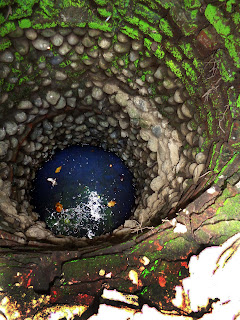
Composite views of an 18th century well at the Living with Nature Center
San Vicente, Ilocos Sur 

Old Faithful Bubon' now a ruin, intermittently flooded in monsoon, damp and dry in summer, speaks of old days in Spanish time, Commonwealth era, World War II, fledging Republic - and now faces postmodernism's abandon and neglect;

Old Faithful Bubon', abode of toads and frogs, trapped in their search for water or mate, or simply fell in, croak in unison or alternate calls, inside and outside of the well, fill the night air with scary tales of old folks, or children's bedtime stories;

Old Faithful Bubon, abode of the silvery bulan-bulan fish, glistening in the sun and moonlight for which it got its name, feeding on algae and morsels that accidentally fall, a pet and indicator of freshness and safety of the water for potable use.

Old Faithful Bubon', source of water for drinking, for the kitchen and garden through generations, was once fitted with a bamboo lever-on-fulcrum (babatwagan Ilk), an indigenous version of the pulley-and-wheel, later replaced by bucket tied to a rope.

Old Faithful Bubon', a greenery of algae and mosses, epiphytes and annual plants, makes a unique garden, representing the phylogeny of the plant kingdom on the lower scale, offers a unique study of plant diversity and evolution in an isolated environment;

Old Faithful Bubon', seat of Darwinian evolution in microcosm; trapped organisms like shrimps, fish and protists, evolve independently, detached from their populations in the open, to become ultimately through time new species, a process called speciation.

Old Faithful Bubon', indicator of underground water volume and quality by its water level, clarity, smell and taste - fresh, clean and sweet as old folks would guarantee its potable use, even without undergoing water treatment we do today;

Old Faithful Bubon', setting of movies and stories, of hideouts and "bahay-bahayan" (housing game), fascinates old and young alike, in tales and fiction, like A Journey to the Center of the Earth, by Jules Verne, and prospective treasure-hunting stories;

Old Faithful Bubon', once its crystal-clear water reflected the blue sky, flying birds, and nearby tree tops, in a perfect scenery of a pristine landscape, with a young boy seated on its rim, looking downward, his face reflecting lofty dreams and thoughts deep and far beyond.

Old Faithful Bubon', three generations later, fell into obsolescence, losing aesthetics and function, replaced by modern water system; its water no longer potable due to pollution generated by industrialization, and affluent living;

Old Faithful Bubon', now a ruin, repository of fragments of history and technology, anecdotes and legends, ancestral socio-economics, now an attraction to tourists, among them an old pilgrim who once sat at its rim dreaming of the world on its water. ~