In Celebration of National Art Month February 2026*
Ecological Art Evolution in Our Times

2. A Little Corner of Eden
3. A Search for Meaning in Nature
4. Rocks for Study, Art and Hobby
5. Bioethics and Environment
6. Metamorphosis Expressed through Paintings
17. Four-Seasons-in-One
18. Twenty Art Scenes of Our Changing Environment
19. Cryptobiology: The Study of Nature Spirits
20. Love the Children through Art


The best home is one where we live in a friendly relationship with Nature. Why don't you share with us your version of Home, Sweet Home?
 Idyllic rural life, mural painting by AV Rotor, circa 1976.
 To the returnees or balikbayan, home is a retirement in the place of their birth, most of them on the countryside where they spent their happy childhood that tempered their homing instinct.
Many city dwellers are seeking liberation from the “concrete jungle.” Home is more than walls, high rise apartments, canned entertainment, neon lights and fast lanes.
 And all over the world, there is a general trend to get closer to the concept of “at home” by going natural – the way people dress, the food they eat, the medicine they take, and the many articles they use everyday.
Brick house on the farm, painting by the author
More and more homes do not allow smoking, other vices notwithstanding, following the footsteps of school campuses, government offices and commercial centers. People are going back to cooking at home, shunning away from artificial food like coffeeless coffee (decaf), sugarless sugar (Aspartame et al), fatless fat (Olestra). And the so-called “Frankenfood” made from genetically modified organisms (GMO).
Like many schools and establishments, a home that advocates going natural, has started banning carbonated drinks, Monosodium Glutamate (MSG) or Vetsin, “magic sugar,” and even multivitamins in capsules, being mostly artificial.
The simplicity of homes today goes with the trend of “simple living,” relying less and less on cosmetics and fancy designs. People prefer leather, paper and cotton over synthetics, fresh food rather than processed, baon over fast food. Homestead over condominium. The original bungalow home is back. It is simple and practical designed in such as way that one step leads into the House, and the other to the Garden.
We can imagine with awe and appreciation the homes of people whose lifestyle is friendly to the environment, homes that provide a healthy ambiance to the residents, the neighborhood, and ultimately the whole community. This is a new movement that is gaining worldwide attention – home revolution.
I found a musical piece arranged for the violin and piano in an old wooden chest (baol) containing the personal belongings of my mother who died during WWII. I was told by my father that it was her favorite piano piece. I can only surmise the reason. Many homes were destroyed and families separated during the war. Dad managed to rebuild our old home and farm. This is the place where my sister, brother and I spent our childhood and adolescence. It is the same home we found retirement after a long absence.

Home Sweet HomeBy John Howard PayneMusic by Henry Rowley Bishop (1786-1855)(Arranged for the violin and piano by Henry Farmer)‘Mid pleasures and palaces though we may roam,Be it ever so humble, there’s no place like home;A charm from the sky seems to hallow us there,Which seek through the world, is ne’er met with elsewhere.Home, Home, sweet, sweet Home!
An exile from home, splendor dazzles in vain;O, give me my lowly thatched cottage again!The birds singingly gaily, that came to my call –Give me them – and the peace of mind, dearer than all.Home, Home sweet, sweet Home.There’s no place like Home!There’s no place like Home!


"Birds sing not only for their own kind,but to the world that shares their joy,in melodies notes may not capture,but the heart and spirit they buoy." -avr
“To see a world in a grain of sand,And heaven in a wild flower;Hold infinity in the palm of your hand,And Eternity in an hour.”- William Blake, Auguries of Innocence


higher than the flight of butterfly;aimlessly below many a passerbyjust let the world go with a sigh.


Orchids:white, delicate, immaculate, pure;red, flaming, romantic, demure;Orchids:flowing, silky, translucent, queenly;fiery, ascendant, stout, kingly.

Richest in flora and fauna of all biomes,Big and small, in a common union,Arranged in niches, divided by storeys,In competition and cooperation.Heritage trees rise through the canopy,Living towers of the forest;Divine columns of Nature's Parthenon,Cradle of harmony and rest.Stories about the forest, queer but true,Seat of evolution, of biodiversity,Ultimate of adventure, science laboratory,Man's first home, Genesis' final view.
But the painting reflects a deep-seated biological longing to be part of nature. Putting it in the biblical sense, it is a natural searching for the lost paradise. The scenery represents a refuge from city living, a respite, and an escape from the daily grind.
But the scenery does not only tell us of what we are missing. Rather, it reminds us of what we are going to miss, perhaps forever, if we do not heed nature's signal towards a fast declining ecosystem. If we do not change our way of life from too much dependence on consumerism, to one more closely linked to conservation of nature, we may end up building memories and future archives of a lost world. " - AV Rotor
If I were to return after the FallTo where my forebears once lived;If I were to trace back their footstepsTo their world of make believe.What would I tell to my dear CreatorWhose open arms have waited so longFor man to return, to repent for his Sin -And I, having also failed all along?I would tell Him there is also a place,A little green corner of grass and trees,Of bees and flowers, rainbow and butterflies,Where birds come and sing with the breeze.An emerald river gently flowing,Meandering between hills and on the plain,Palms and trees bowing at its levees,Its waters soothing the day's pain.I would tell Him of this place also forgotten,Abandoned by a bandwagon,By those who nurture the Utopian dream,Now orphaned and virtually alone.Is forgetfulness also Your tool of creationWhere man shall be gone from here on?Paradise is redeemed and once more born?No wonder Nature triumphs when left alone.~


 |


Coral reefs are often called "the rain forests of the "oceans" because they are among the richest marine ecosystems in species, productivity, biomass, and distribution.
similar in many ways with the ones we know on land - the tropical rainforest, the so-called jungle of Africa, and the coniferous temperate forest called taiga.
And sadly do we know too, that the coral reef, the foundation of the richest marine ecosystem both in vastness and biodiversity, is also dying due to deforestation in like manner our forests are destroyed by exploitation and pollution.


 |
4. Rocks for Study, Art and Hobby


2. Through biological specialization or mutation – natural and man-induced – causative agents have crossed natural barriers of transmission across species, such as bird to man (bird flu), civet cat to man (SARS), and primate to man (HIV-AIDS, and Ebola), wild animals like bat to man (COVID-19). Man has built bridges between the non-living to the living as well. We have paved the way for the Prion, an infectious protein, the causative agent of Mad Cow Disease or BSE (Bovine Spongiosform Encephalopathy) to cross from cattle to man and cause a similar disease affecting humans, the Creutzfeldt-Jakob Disease (CJD). Viruses have acquired new ability to infect and spread not only among humans but also in animals and plants. Viral diseases of plants have been responsible for the decrease in agricultural production in many parts of the world.

4. Modern society and science and technology no longer fit into the Darwinian theory of natural selection. There is a growing burden placed on the shoulders of the able and fit in our society who, without choice, is responsible in taking care of the growing number of dependents – many are the infirmed and the aged.
All these lead us to re-examine our values. It challenges us to look deeper into a paradigm of salvation through our concern for the environment. The prolificacy of the human species sans war and pestilence, plus growing affluence of our society has led to a population explosion which had doubled in less than fifty years. We are now more than 7.5 billion. Under this paradigm, there is no master and subject. All must join hands to prevent the exploitation of the earth’s finite resources. Today’s economists must also be good housekeepers of Nature, so with those in the other professions. While man’s aim is directed at the Good Life, he has unwittingly reduced the very foundation of that good life – the productivity and beauty of Mother Earth.
 There are few frontiers of production left today. We have virtually pushed back the sea and leveled off the mountain. Prime lands have all been taken, swamps have been drained, and even deserts are being reclaimed. But as we continue to explore the marginal edges of these frontiers the more we are confronted with high cost of production that is levied on the consumer, and more importantly, the danger of destroying the fragile environment. AVR
The environment and the economy need not be viewed as opposites. It is possible to have a healthy environment and a healthy economy at the same time. More and more businesses have begun adopting this concept as a business philosophy. People behind business organizations are becoming more aware of the ethical decisions they face, and their responsibility for their consequences.
Industrialization and urbanization are akin to each other. Industrial growth spurred the building of cities all over the world. Today there are as many people living in cities as those living the rural places. A mega-city like Tokyo has a population of 15 million people. We are 10 million in Metro Manila. Cities are fragile environments. Cities are more prone to epidemics such as the bubonic plague that killed one-third of the population of Europe in the 13th century. Now we are confronted with HIV-AID, SARs, Meningo cochcimia, Avian flu, and now the dreaded CORID-15 which is gripping the world today as the worst human pandemic disease in recent history. AVR
 There are organizations that have set some rules of governance of the environment, among them, GRI (Global Reporting Initiative), CERES (Coalition of Environmental Responsible Economies), and UNEP (United Nations Environmental Program). In line with these a multi- national corporation came up with the following thrusts:
Nature defiled by genetic engineering, painting by the author
This approach is gaining respect and more and more businesses are looking at this model with great interest and favor.
The Question of Governance
One of the resource speakers of the 2010 International Congress on Bioethics,
Dr. Tai cited three themes in order that man can live in harmony with nature. Man is part of the ecosystem, Man is steward of the earth, and Man is finite. Dr. Tai cited models with which man can change his views about the environment and change his style of living. We have also models in the business world, in the church, and in the government, in fact all sectors of society. There are models everywhere in this or that part of the world, whether developed or underdeveloped. There are as many models in less developed countries as in highly industrialized countries. It could be that the less developed are closer to tradition, and still have strong ethnic roots, like the old civilizations mentioned in the paper – the native cultures of America and Africa.
But the world has never been one. It has become more diverse in views and interests though in many respects share the same aspirations towards progress and development. And this is the problem. Man is always in a race. In that race awaits at the end not a prize mankind is proud of and honorable. It is tragedy, which Garett Hardin calls, the tragedy of the commons. It is a greedy competition for a finite resource, each his own, until it is gone. The forests are disappearing today, the lake are dying, the fields are getting marginal, the pastures are overgrazed, the air is loaded with destructive gases, the sea is over fished. All these point out to the syndrome - tragedy of the commons. And because time is of the essence, many believe that the world needs a new revolution now? Is revolution the only way to solve global problems of the environment today?
Definitely, while we need to reform to save our environment, any means that is contrary to peace and unity, is definitely unacceptable. And we would not adhere to the rule of force or violence just to be able to succeed. It is said, that revolution starts in a small corner. It starts in this congress.
In closing I would like to thank Dr. Tai, for his scholarly and incisive paper from which I was not only able to prepare myself as a member of the panel of reactors, but found an opportunity to review and expand my current research works in ecology as well.
Lastly, I would like to recite this short prayer I made for this International Congress on Bioethics, and dedicate it through the little child who visited the two workshops in the village and exclaimed. “But there are no neighbors! But there are no trees, birds, fields and mountains!”


It's a biological phenomenon in a variety of ways,caterpillar into butterfly, dragonfly from naiad,frog from tadpole - life cycles before our eyes;to humans, a transformation outside and inside,body and soul as one, the essence of rationality,magnificent is Creation's grand design and guide.

Biodiversity means much more in the living world,in a game of competition and cooperation,in the phylogeny of organisms in five sub-kingdoms;metamorphosis, Nature's tool of evolution.

Dichotomous is art today,in schools and movements,aesthetics and utility,indigenous and foreign,fantasy and reality,conventional and abstract.Art and craft, if I may say.


As old as in biblical times, or earlier,crafts made from this fruit were sacred,grains vessel, jug for wine and water,link of man's faith with his Creator.

Imagine this scene before the Fall,nature in unity and harmony;Or is it an aftermath of man's exile,redeeming the Lost Eden's beauty?

Light in the air, swaying with the wind;heavy in the air dull, still;Pristine, natural in the absence of man,defiled, dead, can't humans feel?


Pearl! How beautiful a pearl could be!but its kind today in the laboratoryholds no longer the secret of the sea.

I am a remnant of a felled tree in a forest long ago,drifting down the river to the sea;braving the elements and patient with time, too;free but knowing not my destiny.For how long I drifted far and wide I do not know,my world was aimless and carefreeamong creatures I met, that would come and go.but to whom can I tell this long story?Until the tides took me one day into another view,to where trees stood happy once like me,where people brought back old memories anew;but I am now but a waste of the sea.Until a curious lass took me for something new,something for the arts, not for money;but some kind of beauty in my ugliness to showNature's hidden artistic quality. ~


"The artist sees what others only catch a glimpse of.” - Leonardo da Vinci. ~

The walls I painted hills and valleys and forests,towering to the roof I painted blue, clouds rising,birds flying in flock to meet the rising sun, as freshas the morning air, chirping sweet songs, circling;
And below a dozen pako fish wake in the goldenreflection of morning, eager for food and company;I wonder if ever they feel the confines of a den,for I have faithfully copied Rousseau's scenery.
Dream no more I said to myself, of Paradise Regained -It is here, in the very core of being next to the heartand soul, this Phrygian landscape with touch of vane,the essence of contrition and amendment for my part.
For nothing is unforgivable, that Sin inherited by usfrom our ancestors - we're doomed, deprived of heavenon earth. No! the gifts the Creator have been passedonward, and here I created a piece of that lost Eden.
Here I see God across the wall, and above my head,His harmonious creation over land, across the sea,I am part of the cycle of life everyday, even in bed,as seasons come and go, here I feel always free.
When lakes and rivers dry, and the sky no longer blue;as cities grow, land fills with waste, air no longer fresh;I pick my brush, say a prayer in color, shade and hue,Inviting my Creator, "Please come, and I'll give Thee rest." ~


 A third world war was averted during the 45-year Cold War. As hindsight, an arms race revealed from both sides USA and USSR and their respective allies built a stockpile of nuclear weapons potentially capable of annihilating mankind three times, and irreversibly destroying the earth’s biological and ecological balance.
3. A third world war was averted. As hindsight, an arms race revealed from both sides a stockpile of nuclear weapons potentially capable of annihilating mankind three times, and irreversibly destroying the earth’s biological and ecological balance, with radiation and other poisons that can persist for hundreds, if not thousands of years.

6. But what really tore down the boundaries of nations zealously guarded by politics and economics have been the breakthroughs in science and technology, particularly in communication and transportation, disseminating information through multimedia and bringing people together. This ushered the beginning of “globalization.”


The kind of person we truly are is reflected by our relationship with Mother Earth, how we comply under her treaties. Clearly, biocide is the greatest sin man commits in this period. Long live, Ceres! And Albert Schweitzer and King Solomon must be smiling up there. So with St. Francis of Assisi, patron saint of ecology. “Reverence for life,” is the key to this paradigm.


Imagine the world of the "lost" - professionals and students, ordinary people notwithstanding. It is a world where
- Thoughts refuse to close down, even only for respite.
- Energy drains the whole being, even before starting to work.
- Sleep never comes on time and is never enough.
- Relationships are strained, if not alienated.
- Family bond is breaking up.
- Self worth and respect are falling to a point of depression, or suicide.


This lesson is dedicated to the students who made them, and to many visitors who appreciated the value of these masterpieces.
A diorama is a “view window” reproduced from an actual or imagined event or scene made by artists who have a background of painting, architecture and sculpture combined, and of course, history. In this particular case, the diorama artists must have a working knowledge of ecology and biology.
 The earth once wore a broad green belt on her midriff – the rainforest – that covered much of her above and below the equator. Today this cover has been reduced - and is still shrinking at a fast rate. The nakedness of the earth can be felt everywhere.
 One place where we can witness this is right here in the Philippines where only 10 percent of our original forest remains.
Even the great Amazon Basin is threatened. As man moves into new areas, puts up dwellings, plants crops, becomes affluent, increases in number, the more the tropical rainforest shrinks. Our thinking that the forest as a source of natural resources is finite is wrong.
Like any ecosystem, a forest once destroyed cannot be replaced. It can not regenerate because by then the soil has eroded, and the climate around has changed. It is everyone’s duty to protect the tropical rainforest, the bastion of thousands of species of organisms. In fact it is the richest of all the biomes on earth.
Artists and scientists re-create scenarios of Jules Verne’s, “Twenty Thousand Leagues Under the Sea,” such as this diorama, imagining man’s futuristic exploration in the deep led by Captain Nemo, the idealistic but ruthless scientist. Such scenarios are no longer fantasy today – they are scenes captured by the camera and other modern tools of research.
And the subject is not one of exploration alone, but conservation, for the sea, limitless as it may seem, is facing the same threats of pollution and other abuses man on land, in water, and air. The sea is man’s last frontier. Let us give it a chance.

Originally these islands were the tips of volcanoes, at first fierce and unsettled, but later became tame to the elements that fashioned them through time into lagoons, and other land forms of varied geographic features. As seen in this diorama, this island typical of Boracay is rich in vegetation, coconut trees grow far into the water and on the white sand that cover the shores.
The coral reef teems with many kinds of marine life, from rare shellfish to aquarium fishes. In fact the whole island is a sanctuary of wildlife. It is a natural gene bank, a natural museum of biological diversity.
Within this zone grow many kinds of seaweeds, some reaching lengths of several feet long as in the case of kelp (Laminaria), and Sargassum, the most common tropical seaweed. As a sanctuary it cradles the early life stages of marine life until they have grown to be able to survive the dangers and rigors of the open sea. Coral reefs are formed layer upon layer through long years of deposition of calcareous skeletons of Coelenterates which is then cemented with sand, silt, clay and gravel to form into rock.
Limestone is a huge deposit resulting from this process Scientists believe that without coral reefs islands would disappear and continents shrink. Above all we would not have the fishes and other marine organisms we know today.
 Isolated from the lower slopes and adjoining valley, this ecological area has earned a distinction of having plants and animals different from those in the surrounding area.
 Because of the unique climate characterized by an intense but short summer and extreme cold the rest of the year, the organisms in this biome have acquired through evolution certain characteristics that made them fit to live in such an environment.
Alpine vegetation is dramatic owing to its ephemeral nature. Here annual plants bloom with a precise calendar, attracting hordes of butterflies and other organisms. The trees are gnarled as they stand against the howling wind, mosses and liverworts carpet the ground, streams are always alive, and migrating animals have their fill before the cold sets in. We do not have this biome in the Philippines, but atop Mt. Apo in Davao and Mt. Pulog in Benguet, the country’s highest mountains, lies a unique ecosystem – a combination of grassland and alpine.
This could be yet another biome heretofore unrecorded in the textbook.
The diorama depicts the shrub-grass landscape, a stream runs into a waterhole where, during summer, attracts animals from the lowly turtle to the ferocious lion which stakes on preys like zebra and gazelle. Beyond lies Mt. Kimanjaro, Hemingway’s favorite locale of his novel of the same title (Snows of Kilimanjaro). It is said that the beginning of the Nile River, the longest river in the world, starts with the melting of snow atop Kilimanjaro, right at the heart of the Savannah.
 Scenes of the Sahara flash in our mind the moment the word “desert” is brought about to both young and old, in fantasy or reality. Here lies a wasteland, so vast that it dwarfs the imagination.
 Deserts are found at the very core of continents like Australia and North America, or extend to high altitude (Atacama Desert) or way up north (Siberian Desert) where temperature plunges below zero Celsius.
In the desert rain seldom comes and when it does, the desert suddenly blooms into multi-faceted patterns and colors of short-growing plants. Sooner the desert is peacefully dry and eerie once again, except the persistent cacti and their boarders (birds, insects and reptiles), shrubs and bushes that break the monotony of sand and sand dunes. But somewhere the “desert is hiding a well,” so sang the lost pilot and the Little Prince in Antoine de St. Exupery’s novelette, “The Little Prince.” I am referring to the oasis, waterhole in the desert. It is here where travelers mark their route, animals congregate, nations put claims on political borders.
Ecologically this is the nerve center of life, spiritually the bastion of hope, a new beginning, and source of eternal joy particularly to those who have seen and suffered in the desert. The desert is not a desert after all.~
Other biomes:
- Tundra - type of biome where the tree growth is hindered by low temperatures and short growing seasons. It is the coldest of all the biomes.
Taiga - The Russian word for forest and is the largest biome in the world. It stretches over Eurasia and North America
Temperate Deciduous Forest - dominated by temperate broad-leaf trees that lose their leaves each year. The four seasons are distinct. The trees lose their leaves in colorful display characteristic in autumn; they lay bare often in snow in winter, resume growth in spring, and are most luxuriant in summer which is also the time of flowering and seed formation.
Grassland - characterized as lands dominated by grasses rather than large shrubs or trees. The largest grasslands are the prairies of North America, and pampas in South America
Chaparral - a shrubland or heathland plant community found primarily in the U.S. state of California and in the northern portion of the Baja California peninsula.
Lake - Examples: Sea of Gallilee, Aral Sea, Laguna Bay, Victoria
River - Mekong, Danube, Rhine, Nile, Mississippi, Yangzhe River, Brahmaputra,

Nature shares her bounty in many ways:He who works or he who prays,Who patiently waits or gleefully plays;He's worthy of the same grace
- AV Rotor, Living with Nature in Our Times UST 2007 ~
15. Logotherapy* with Nature


16. Ecology: Reflection of the Good Life

All of us are endowed with a wide range of intelligence which is divided into eight realms, namely:
- Interpersonal (social intelligence)
- Intrapersonal (meditational, spirituality)
- Kinesthetic (athletics, dance, body language)
- Languages or linguistic
- Logic (dialectics, mathematics)
- Music (Auditory art)
- Spatial intelligence (drawing and painting, sculpture, architecture, photography)
- Naturalism (green thumb, relationship with the Natural World)
Why don’t you make your own assessment? Rate yourself in each realm. Analyze your top three. Are you not proud of them? Look at the other realms. You may not have tapped them well. Do you realize that there is a big room of improvement, and that there are latecomers in this world?
Lastly, let me emphasize another component of peace, that of sharing. I can not find a shorter way to explain it more clearly than to present this excerpt from “How to Live With Life,” published by Reader’s Digest. To wit:
“Every human being on this earth faces a constant problem: how to make the most of life. There is no simple solution; the art of living is the most difficult of all the arts. But fortunately for all of us, experience can be shared. Insights can be learned. Wisdom can be taught. Experiences, insights and wisdom of men and women – from teachers to clergymen, housewives to scientists, ordinary citizens to statesmen - who have lived deeply, thought profoundly and cared enormously about sharing with others what they learned have found some fragment of truth that cushions the harsh impact of reality or brightens the marvelous tapestry of living. From them we find some answers to the most fundamental of all questions: how to live with life.”
Final Reflections
Let us
- Reflect on re-creating Nature with the image of the lost Eden
- Reflect on bringing the dead tree back to life.
- Reflect that everything in this world is interconnected. Reflect on the lost lamb, the prodigal son.
- Reflect on the new concept of heroes, hope of a tired Planet Earth
- Reflect that our lives can not be ruled by the faceless side of
- science and technology
- Reflect on long life but one lived with noble cause
- Reflect on that sailboat riding on the wave and wind towards a destination.
- Reflect on the multiple intelligence which God endowed singularly to man and how we make use of it in gratitude to the Giver.

- And if we think we are too little in this wide, wide world to make any difference, let this verse permeate in our thoughts and heart.

fill the lakes, make the fields green;
the trees a curtain to hide the sun
a moment of your ephemeral beauty
of changing faces and a myriad figures;
delight many a child to draw,
to dream and grow;
and if one day the water of the sea is not enough,
drink, drink deep
from my little cup.

I love the seasons, I want them all at the same time:spring, summer, autumn, winter - rolled into one;for I can't wait each coming, or the trouble to find;one sitting before the canvas and everything's done.
So in my life, seasons crowd in, knowing not which onecomes in the morning or evening, at work or play;I lost track of Vivaldi's Four Seasons, and the bondof creation that brings all together to pray.
The artist in me called, there's order in every thing -the seasons come and go, never growing old;each with rhyme, rhythm, and the meter of living,renewing hope, keeping faith, humbling the bold.~

Fantasy or reality - how can we tellOne from the other without a third eye?Ah, but epics live on through the ages,As classics live through their spell,And Gulliver as told by the sages.The third eye tells of a coming storm,No less than the vagaries of the mind;But what the future holds remains lockedIn God's will until the time has come,Beyond fantasy or reality or luck. ~
18. Twenty Art Scenes of Our Changing Environment


“The ultimate test of a man's conscience may be his willingness to sacrifice something today for future generations whose words of thanks will not be heard.” — Gaylord Nelson


19. Cryptobiology: The Study of Nature Spirits


Art has many expressions,in different sessions;shy and cautious at first,'til released like a burst.

"A great acacia, with its slender trunkAnd over poise of multitudinous leaves.(In which a hundred fields might spill their dewAnd intense verdure, yet find room enough)Stood reconciling all the place with green."- Elizabeth Barrett Browning Internet


Take time out from TV, computer, malling;life's so dull, busy yet empty;The left brain's overworked, the right idle,growing up is a sad story.
Take time out in summer away from school,put down your books and depart;give imagination a chance over knowledgethrough creativity in the art.
Take time out to be close to Mother Nature,draw and paint under the trees,recreate the world you wish it should be,let your worries go with the breeze.
Take time out to be your real self, discoverbeyond the world of reality,with myriad colors and the paintbrush,the boundless realm of fantasy. ~

School projects students must submit,easiest to buy than make their own;unfair to those who labor to make one,but a teacher knows which is genuine.


Multi-facet projects challenge creativity;aim at function, beauty and posterity.


among the corals watching.
conscience of the sea,
over Homo sapiens fishing.
It never winks, it's alive,
guarding against man's folly,
whose eye, not of man,
disgraced guardian of the sea. ~


Living columns, Parthenon of the forest,
your fate in the hands of man,
what time did to a temple of the gods -
ruins of beauty now gone.
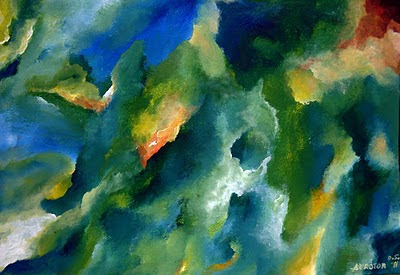
Primordium Universe in acrylic (38" x 26"), AVR 2011
I wonder at infinity in its very beginning,
of a primeval universe devoid of stars;
I wonder at the prima causa of time and space,
of energy and matter becoming living mass.
I wonder at the blueprint of a Supreme Design,
if found the Big Bang and the Black Hole;
I wonder if there was a kinder universe before,
where Heaven and Earth were one and whole. ~


Why thorns on a ball or globe,plaything - or is it our world?Like hanging Damocles' sword,over man, both young and old.

All alone after the Fall, abandoned;regained somewhere, we believe;in our world, cyberspace, searchingfor this Tree of Adam and Eve.

Mural Paintings by Dr Abe V Rotor

Bring nature home to the living room,in make-believe unspoiled landscape;do away with those fixtures and decors -for good health and happiness' sake.

Natural - a cry today to be happy and free,away from the burgeoning life in the city;it's a school without walls, a true story,take the backseat affluence, luxury.

In their mind, it's outdoor with nature,with amenities through art, they are;away from the cellphone, from the mall,as they while away time, worry and chore.

A dead wall resurrects across the street,a waterfall whispers, douses the heat,slows down pulse, heart, and busy feet;wonder why we are always on the beat.

History in its darkest hour, a work of art,captured from memorabilia long gone,keeps afresh across memory lane and time,in the cycle of life, likened to the sun.

Mural of nature and life by the sea as one,creates music with the wind and sun;oido (by-the-ear), natural, spontaneous,expressed by the artist's own opus!


Refresh your tired hands with spring water,relax after a whole day of teaching;don't reach or even go beyond your limit;Mother Nature is just around waiting.

Teachers and students often come for field study,while away time from school, even only for a day.


Never say, "I've reached dead end."It's not the end of life about;why not get some paint and brush,and clear your way out?

.jpg)
Where the busy street settles down on a wall mural,
of an apartment-hotel hallway, away from the city;
take a deep breath of freedom from stress and tension,
commune with make-believe nature, short it may be.


Once site of garbage and shanties for years,beside a historic ruins of añil* vats preserved;I took the reign as owner-and-artist as one,to rebuild the site back anew with cheers.

Imaginary butterflies - white, blue and redattract these kids, more than flowers do;a game of the right and left brain compared;
imagination reigns, letting reason go.


Relaxation slows down our busy world;it's indeed a most precious word.

"Come to the woods," this mural seems to say,and find rest in its living shroud,bastion of love, freedom and harmony,away from the maddening crowd.
10 Paintings & Verses
1. TOO SOON THE BUD OPENS
Painting in acrylic (12" x 17")

too eager a bud ahead of your time;
what promise of life awaits tomorrow
from where you've broken through?
Whichever path you take from now,
you'll miss the adventure of youth
in summer, and stillness of winter,
Oh, how could you live to the full?
"For having lost but once your prime,
you'll always tarry," so says a poet;
"It's now or never," so sings a bard,
and I, I've neither a poem nor a song.
2. A HEART ON THE WALL
Painting in acrylic (16.5" x 18")

do you still feel?
Do you still throb -
the throb of love?
Ivy, ivy on the wall,
don't hide
a living heart.
3. GRASS
Painting in acrylic (18" x 21")

Sway with the breeze,
dance with the wind;
Greet the sun with dewdrops
clinging;
In summer turn golden,
and bow,
And die sweetly to feed
the world.
4. A LOVELY PAIR IN A BOWER
Painting in acrylic (11.5" X 16")

Let the world go by in their bower,
lovers blind to the busy world,
away from the maddening crowd;
fleeting moment is forever,
to this pair in their lair.
Wonder in our midst who we are,
blind to each other, but the world,
strange this crowd we are in;
where's this lovely pair,
where's their bower?
5. SYMBIOSIS
Pisces and Echinoderms
Painting in acrylic (8" X 10")

Distant in phylogeny, yet live they together
in one community we call ecology,
ever since the beginning of our living world,
millions of years ago before man was born
to rule, to reign supreme over all creation;
wonder what Homo sapiens means
to true peace and harmony
beyond his rationality.
6. SEA URCHIN
Painting in acrylic ( 11" x 13.5")

You're all made of spikes,
I can't see the real you;
in your invincible armor
in any view.
Wonder how many of us
live like the urchin
in silent, unknown ways
and never seen.
7. SECRET OF THE HEART
Painting in Acrylic (13.5" x 13.5")

Hidden, the heart throbs
in deep silence;
two nails embedded,
unseen in pretence
of living, loving, caring,
the highest art,
filling the five chambers
of the heart.
8. INNOCENCE IN NATURE
Painting in acrylic (17.5" x 21.75")

Abstract over realism can you paint innocence,
move over classics, you are too pure
to be true, and impressionism too assuming,
with apologies to Monet's azure sky.
Oh! abstract indeed is a child's innocence,
buds in early spring, grains ripening;
heart of a true friend, pledge of real love,
growing in the passing of time.
Colors are mere symbols, wanting to behold,
the magnificence of mind and heart,
triumph of the human spirit over our frailty,
the most challenging of all art.~
9. ART OF THE CATERPILLAR
Painting in acrylic (11” x 14”)

Caterpillar, when you are gone
two things come to mind:
the butterfly you have become,
and the damage you have done
and left behind.
Art, art, whatever way defined,
the subject on the wall,
or dripping on the floor,
art, art you aren't hard to find
after all. ~

I’ve seen jellyfish swarming,
Plankton in coral reefs glowing;
a myriad fireflies mingling
with the stars, linking us all
to a Supreme Being. ~


Vincent Van Gogh
--------------------
"I found a new meaning of life to share,as a guardian children will never forget." - avr

That was 35 years ago by the sea,I was then 50 - half a century old,retired and spent, forlorn and lonely,the sunset of life in its firm hold.
With paint and brush I faced the world,with a canvas, white and empty;with the sun peeping, spying on me;of what to paint of my life's story.
Blue - but the sky was turning gray,and the sea was losing its peace,silvery clouds had tinge of bronze,the wind no longer a gentle breeze.
I sought for comfort like in a trough,amidst nature's magnificent view,with a sense of peace and surrender,but is life worthy with this duo?
Life begins at 40 or 50, they say,compliments of action anew;half-way finished, half-way to go,I took a leap to enshrine the view.


Reflection gets deeper and farther with age,looking back, and looking into the future,if I have more years to live, page by page,I'd write an epilogue for more adventure.
At the crossroad of life, where prudence reigns,only then I saw the golden glow of sunset,and found a new meaning of life to share,as a guardian children will never forget.
Not fate at all this proverbial valley of life,as we continue with our lifetime journey;a singular gift indeed our Creator bestowson us - happiness through life's beauty. ~


Worries of the day, to the back seat,away from the left, to the right brain;in creativity we lovingly seeklove and devotion that truly reign.


Through the trees, rays descend,in a tapestry of shadow and light;guide the young artists at work,to capture art beyond their sight.


Art is theory, you can't be wrong;neither compare it with another,nor leave it freely to the throng;only the artist knows and no other.


Love, compassion, care , devotion -lifewords are not enough but action;not even prayer, lengthy that it may;live life, and live it well, every day.


Teachers, parents, church leaders, all,guardians of children true to their call,beyond their homes and their school,art unites all - mind, body and soul.


“Childhood memories are the sweetest memories of the past.” — Anonymous


"I catch the clouds in the wind blowingon my face and hair, cool and soothing.I wonder where have all the birds gone,from the blue sky before the day is done."- avr


30. Pangarap Art World: Twenty (20) Drawing and Painting Exercises

This manual provides the needs of a summer workshop which is conducted for at least ten sessions, with three hours per session. Ideally one exercise is done in the classroom, and one is given as home assignment. An on-the-spot session can also make use of a number of exercises from this manual, such as Flying Kites, Inside a Gym, and Market Day. Each exercise will be graded and at the end of the workshop, the participants will be rated and ranked accordingly. The top three graduates shall be awarded gold, silver and bonze medals, respectively.
Computation of grades is based on the Likert Scale, where 1 is very poor, 2 poor, 3 fair, 4 good, and 5 very good. The general criteria are composition, interpretation, expression, artistic quality and impact. The details of these shall be discussed by the instructor at the onset of each exercise.
Like the other two manuals, the author offers this volume a respite from cartoons, advertisements, entertainment characters, programs filled with
violence and sex, computer games, and the like, which many children are overexposed via media and computers. It is his aim to help create a more wholesome culture where certain values of a growing child and adolescent are developed and nurtured. Art through this means becomes principally a vehicle for development, notwithstanding the gains in skill acquired.
For each exercise, the instructor shall explain the requirements and procedure with the use of visuals and through demonstration. If there is need for group interaction he shall also serve as facilitator-moderator. He shall choose the appropriate music background for each exercise to enhance the ambiance of the workshop.
With brush and colors one can go places and create scenarios as vivid as what a pen can do. It reminds us of the masterpieces of Jules Verne which he wrote many, many years ago, notably “Around the World in Eighty Days”. More than fiction we embark on a trip for life, real and inevitable. The pleasures await us, so with difficulties and hardships. The journey takes us closer to Nature and appreciate her beauty , it leads us to meet people and learn how to be a part of society. Here we plan our lives, make things for ourselves, enjoy success, face failure, and at the end we return to reality once again. Our journey takes us back to our loved ones, and with an Angelus prayer on our lips we draw a deep breathe of gratitude.
Thus one can glimpse from the outline of our itinerary that Part 1 introduces us to the natural world, while Part 2 integrates us into society. The last part provides a window through which a growing child and an adolescent see the other side of their present world, the real world in which they will spend the rest of their lives.
All aboard!
Exercises
1. Views from an Airplane
2. Sunflower Field
3. Riceland
4. Rainforest
5. Hut by a Pond on a Mountain
6. Waterfalls
7. Inside a Cave
8. Fairy Garden .
9. Lighthouse at the Edge of the Sea
10. Sailing
11. Camping
12. Flying Kites
13. Inside a Gym
14. Market Day
15. Shanties and Buildings
16. Building a House
17. Making an Aquarium
18. Typhoon
19. Building a Bridge
20. Angelus
Exercise 1- Views from an Airplane
Leaving our world down below and seeing it as a miniature. How small it is! Rather, how small we are!
As the airplane we are riding on soars to the sky we lose our sense of familiarity of the places below us. Then our world which we left behind appears as a miniature. And we are detached from it.
What really is the feeling of one flying on an airplane? Nervous and afraid? Excited and happy? Most probably it is a mixed feeling. Now let us imagine ourselves cruising in the sky one thousand feet up. We get a clear view below. The most prominent are the landscapes. See those mountains, rivers and lakes, the seashore. See the infrastructures – roads, bridges, towers, parks, and the like. Next, buildings, schools, the church, houses, etc. Imagine yourself to be above your hometown or barangay..
This is an individual work. Use Pastel colors and Oslo paper. You have thirty minutes to finish your drawing. Let us play “Leaving on a Jet Plane” and “Up, Up and Away”.
Exercise 2 - Sunflower Field
Lessons in radial symmetry, uniformity, and unity; farm life and scenery.
The sunflower has a central disc, surrounded by a ring of bright yellow petals which resemble the rays of the sun. But the most unique characteristic of the sunflower is that it faces the sun as it moves from sunrise to sunset. Because of its “obedience” to the sun, botanists gave the plant a genus name, Helianthes, after the Greek sun god, Helios.

Sunflowers painting by Vincent van Gogh
Draw a field of sunflowers. Central Luzon State University in Munoz, Nueva Ecija, is the pioneer in sunflower farming. Imagine yourself to be at the center of sunflower farm. It is a bright day. Walk through the field among the plants as tall as you. Examine their long and straight stem and large leaves. Touch the large flowers, smell their sweet and fresh scent. Observe the bees and butterflies visiting one flower after another. Make the flowers prominent in your drawing. Remember they are uniform in size, height and color, and they are all facing the sun. Make the sky blue with some cloud to break the monotony.
You are given thirty minutes to complete your work. Use pastel colors on Oslo or drawing paper. Fill up the entire paper as if it were the whole field and sky. You may draw butterflies and bees. And you may draw yourself as you imagine yourself in a sunflower field. Here are suggested musical compositions for music background. “Humoreque”, “Minuet in G”, “Serenata”, “Traumerei”, “On the meadow”, “Spring Song”, “Ang Maya”.
Exercise 3 - Riceland
Lessons on the Central Plains, birthplace of agriculture and seat of early human settlement, rice granary of the country, where typical farm life is observed.
Rice, rice everywhere with few trees, no mountains, except Mt. Arayat. The wind sweeps over the plains and make waves and soothing sound. Suddenly a flock of herons and maya birds rise into the air. Herds of cattle lazily graze. Their calves are playful and oftentimes get lost. You hear both parents and calves calling one another. There are carabaos which like best areas where there is water and mud to wallow in..
Because we are in the Philippines we do not have zebras, lions, tigers and leopards. These animals live in Africa and on the vast plains of North America. We are going to draw a Philippine scene instead. We have our Central Plains where we grow rice. Here the farmer plants when the rains come and harvests towards the end of the monsoon. His hut in the middle of his field is made of nipa and bamboo. It is small. Beside it are haystacks that look like giant mushrooms. Children help on the farm, they mature and learn to live with life earlier than city kids.
Draw a typical ricefield scene in Central Luzon. It is like Fernando Amorsolo’s sceneries of rural life where there are people planting or harvesting rice. A carabao pulls a plow or cart, a nipa hut is surrounded by vegetables, haystacks or mandala dwarf the huts and people around. It is indeed a typical scene that gives an excellent background for our native songs and dances like Tinikling. Ang Kabukiran song fits well as a background music for this exercise. Let us play Nicanor Abelardo’s Compositions. Filipino composers like Padilla de Leon, Verlarde, Canseco, and Umali excel in this field.
Exercise 4 - Rainforest
A lesson on different kinds of plants and animals living together in a forest, the richest ecosystem in the world, their organization, adaptation and relationships.

We walk through the forest by first clearing our way with a bolo. Be careful, the ground is slippery. In the rainforest, rain falls everyday, in fact anytime, from drizzle to downpour. That is why it is called rainforest. Be careful with wild animals and thorny plants. Do not disturb them, just observe them. Look for reptiles like lizards and snakes, amphibian like frogs and toads, fish swimming in a stream, birds singing up in the trees, insects of all kinds, animals like deer and monkeys.
Draw a cross section of a forest showing the different creatures. Show their interrelationships. For example a snake eats frogs, frogs eat insects, insects feed on plants. Observe the trees are of three levels. We appear very small standing on the ground floor of a seven-storey natural building that is the forest. Joey Ayala’s compositions on nature fit best as background music in this exercise. Why don’t we try some songs of Pilita Corales and Kuh Ledesma which are appropriate for this topic? “Sierra Madre”, for example.
Exercise 5 - A Hut by the Pond on a Mountain
Lessons of peace, tranquility, and of unspoiled landscape; feeling of being on top of the world.
The title alone tells a story. It is picturesque. Here one imagines himself to be in a simple hut made of wood and stone and grass which shelters a woodsman or a hunter on Mt. Pulag in Benguet which is the second highest mountain in the Philippines after Mt. Apo.
There are no houses, buildings; no road, except a trail. The trees are gnarled and stunted. They are covered with ferns, epiphytes and mosses which make them look haunted. Feel the great comfort the hut gives you after a long day hike, and how soothing is the cool and clear water of a pond nearby. There are water lilies growing on the pond. Their flowers are red, orange, white and yellow. Sometimes a breeze come along, followed by drizzle, then everything is quiet. Enjoy stillness. It is a rare experience to one who has been living in the city.
 Draw first the mountain top where a pond and a hut are found. There is an faint trail which is the only way. The trees are dwarf and sturdy. They are bearded with mosses. Mist will soon clear as the sun penetrates through the trees, and makes a prism on the mist and dewdrops. Selections from the sound track of “Sound of Music” provide an ideal musical background.
Exercise 6 - Waterfall
This exercise makes us reflect at where a river abruptly ends. The energy and scenery of a waterfalls stir our imagination and make us think about life. (Painting by the author)
Here we follow the river. It meanders, then at a certain point it stops. But it does not actually end here. As water seeks its own level the river drops into a waterfalls and continues its journey toward the sea. We think of Pagsanjan Falls in Laguna or Maria Cristina Falls in Mindanao.
As we stand witness to this natural phenomenon, we are awed by its strength, it roars as it falls, sending spray and mist that make a prism or small rainbow. It pounds the rocks, plunges to a deep bottom before it becomes placid as if it has been tamed, then resumes to flow, seeking a new course toward its destiny.
Look around. Trees abound everywhere and make a perfect curtain and prop of a great drama. The background music is a deafening sound. And it is just appropriate. Be part of the drama. Be still and capture the scene. You have thirty minutes to do it on Oslo and pastel colors. Let us play heavy music from Beethoven, and Ryan Cayabyab. Toward the end of the exercise let us have a Rachmaninov or a Listz composition.
Exercise 7 - Inside a Cave
Looking back at the past, the home of our primitive ancestors, window of early civilization, and study of a Nature’s architectural work.
Have you ever been inside a cave? Jules Verne wrote a fancinating novel, “Journey to the Center of the Earth”. Look for the book or tape, or find somebody who had read it. It is a story of three daring men who traveled down a dormant volcano and explored a huge cavern, a world in itself inhabited by strange creatures of the past.
This exercise leads us to a cave in Callao, Cagayan, or Tabon in Palawan. On the face of a cliff are openings. We enter the biggest one. It is dark and scary. We hear bats, dripping water, and the wind making its ways through the cave. We see tiny lights like hundreds of distant stars. These are crystalline calcium deposits, phosphorescent materials, and glow worms. They cling on the stalactites which are giant teethlike structures hanging from the roof of the cave. The stalagmites are their counterpart rising from the cave floor. When both meet, they form pillars of many shapes and sizes. See that beam of light coming through the roof? It is a window to the sky.
Now draw the view from here and show the main entrance which frame the stalactites and stalagmites, and the seeping beam of light coming from the opening at the sky roof. You have thirty minutes to do it. Play a tape of Johann Sebastian Bach as background music. Robert Schumann’s symphony fits as well.
Exercise 8 - Fairy Garden
Introduction to fantasy, richness of imagination, and familiarity of make-believe stories.
This exercise relies principally on fantasy. We are in fairyland. What kind of garden is this? It is a garden made by our imagination and dreams. It is a garden in the world of Jonathan Swift’s second book, “Gulliver in Brodningnad”, where Gulliver was a dwarf in a land of giants where everything is big.
Imagine yourself a dwarf among mushrooms, mosses, grass, and insects. But here everyone is friendly, you imagine you can even ride on an ant like in “Honey, I Shrunk the Kids!”, if you have seen the movie.
Here harmony of nature and creatures is at its best. There are no cars, buildings, highways and skyways. The amenities in life are very simple. Nature is left alone in her pure state.
Use Oslo paper and pastel colors. Draw a part or section of that garden in your imagination. Do not draw the whole panoramic view. Include the things that make that garden in your imagination, one that belongs to fantasy land. “The Last Rose of Summer’” by Flotow fits well in this exercise. How about Schubert compositions? Ballet music like, “The Dying Swan”? Let us try these for background music.
Exercise 9 - Lighthouse at the Edge of the Sea

Lessons in the wild, where Nature can be at times angry and cruel to those who do not take heed of her warning.
Here we are at the end of the land, and the beginning of the vast ocean. We stand on the coral reef and stones where we are safe from the angry waves. Above our head is a tall structure, strong, painted white, and on top of it is a strong light which guides seafarers at night, keeping away from dangerous rocks and shoals. This is an old lighthouse in Calatagan, Batangas.
Draw the waves breaking on the rock at the foot of the lighthouse. Give life to the sky. Put some moving clouds, some sunset colors. This is a sign of bad weather. There are sailboats leaning with the wind, their sails distended. They burst in different colors and designs, breaking the gloom. Other boats lay in anchor, their sails lowered, while others have been carried to higher ground. The shore is deserted now, except a few fishermen securing their paraphernalia in their anchored boats. Let us play Antonin Dvorak Jean Sibelius and other Scandinavian compositions. They have a special touch that creates the ambiance for this topic.
Exercise 10 - Sailing
Pure joy of adventure at sea, freedom riding on the wind and waves, a test of courage and endurance
Have you ever gone to sea? Have you ever ridden a sailboat or banca? I am sure all of us have. For those who may have forgotten it, or were very young at that time, here is a way to relive the experience. Let us have a rowing song as background., “Like Volga Boat Song”, or music about rivers and sea, like “Over the Waves”, “On the Blue Danube”.
Let us go sailing in Manila Bay. Sailing is both pleasure and competition. Get your boat, and organize yourselves into a crew. Be sure you are ready when the race starts. Other sailboats are also preparing for the race. You can not afford to be left behind. The wind is building now. Is your sail set? Do you have enough provisions? Water, food, first aid kit, fuel, tools, map, flashlight, and others things. Review your checklist.
Group yourselves into 5. Assume that you are in your boat moving with other boats. This is the perspective of your composite drawing. Draw on illustration board using pastel or acrylic colors. You have the whole session to finish it. Ready, set, go!
Exercise 11 - Camping
A test of survival, a life without parents and home, gathering around a bonfire, and counting stars.
Let us go camping like boy scouts and girl scouts. Let us go to a summer camp. Check the things you bring. Do not bring a lot of things, only those which are essential will do. You do not want to carry a heavy load, do you? Besides camping has its rules. Read more about camping. Let us play “Moon River”, “You Light up my Life”, Tosselli’s “Serenade”, and Antonio Molina’s “Hating Gabi”.
After this we play “Nature Sounds” which are recorded sounds of frogs, birds, waterfalls, and insect. To fully appreciate these sounds we will observe complete silence while we all work.
Like “Market Day” and “Flying Kites” (Exercises 10 and 12), this is a group exercise. Group yourselves into 5. Set your camp,on Tagaytay Ridge overlooking Taal Volcano. From this imagine view there are tents are of many colors and designs. There are big and small ones, round and triangular in shape. There are tents set under trees, tents in the open, along a trail, even on hillside. There is a central area where a large bonfire has been set. Around it are people singing, dancing, telling stories, others appear cooking something on the embers. Why don’t you join them?
But first, finish your drawing. Use pastel colors or acrylic on one-half illustration board. You have the whole session to do it.
Exercise 12 - Flying Kites
Reviving an old art and outdoor sport; taking part in a friendly and festive competition.
 It is summer time. It is also kite flying season. When was the last time you flew a kite, or saw a kite festival?
Here we go. This is a composite exercise. Just like in Market Day (Exercise 10) you will group yourselves into 5 up to 7 members. Plan out your work. Kites come in many shapes, figures, designs and colors. No two kites are the same. Be sure your kites fly against the wind, and only in one direction. Do not let them get entangled. Your setting is a park where there are people watching and cheering. Kite flying is both a festival and a competition. There are prizes at stake. The setting is in San Fernando Pampanga. Here beautiful Christmas lanterns are also made. Saranggola ni Pepe gives an excellent musical background. Let us play Frederick Chopin and imagine the light notes from his composition blending perfectly with the flying kites.
Use pastel or acrylic on illustration board. You have the whole session to complete your work.
Exercise 13 - Inside a Gym
A lesson on sportsmanship, physical fitness, will to win, humility in winning and dignity of losing.
It is sports season. Intramural! We are in a sports center. Join the parade of athletes, go with the beat of lively music, cheer with the big crowd. The gymnasium has covered courts, swimming pools, and arena. Competition is in basketball and other ball games, gymnastics, swimming, table tennis, fencing, martial arts like aikido and taekwando, darts, and many more. We are in Rizal Coliseum.
This is composite drawing. Group yourselves into five to seven members. Each one imagines himself a player in his favorite sport. Draw at least three kinds of sports. Complete your work by including the crowd, other athletes, and the festive atmosphere. Play some marches. Get a tape of the Philippine Brass Band.
Plan out you work as a group. Present your finished work in class.

Market Day, by Fernando Amorsolo
Exercise 14 - Market Day
A place where people meet people, the pulse of our socio-economic life, where all walks all of life converge.
Everyday is market day in Divisoria, Baclaran, Pasay, Balintawak, and many public markets and talipapa in the city. In the province, Market Day comes maybe once a week, and when it is on a Sunday, the market comes alive after the mass.
Here we are going to meet people, we meet the common tao. We are among them. We are going to draw a complex scene. Here are the things we are going to put in our drawing. Let us play a lively tune, “Gavotte” and Antonio Vivaldi’s “Four Seasons”. Because Amadeus Mozart music is light, let us have one or two of his compositions toward the end of the exercise.
1. A noisy crowd, people, people everywhere.
2. People selling and people buying.
3. Stalls and stores, carinderia, vendors and hawkers.
4. Wares, commodities, goods, services
5. Tricycles, jeepneys, trucks, carts
6. Festive moods, decors, colors, antics.
This is a group work. Each group has 5 to 7 members. Use one-half illustration board. Before you start, each group must convene its members and plan out what to do. Then it is all yours. You are give the whole session.
Exercise 15 - Shanties and Buildings
Lesson on contrast – between beautiful, high rise buildings and ugly shanties; between affluent and poor, modern and undeveloped communities.
It is ironic to see high rise buildings as a backdrop of shanties in Pasig and Makati, our country’s business capital.
It means there are very rich and very poor people living together in one place. It reminds us of Charles Dickens’s “Oliver Twist” and the Bastille before the French revolution. These are stories about inequality, and where there is inequality, many social problems arise, such as unemployment, disease and epidemic, drug abuse and problems on peace and order. Play the tapes, “Les Miserables” and “Noli Me Tangere, the Musical”. We can use these also in other exercises, like Typhoon and Angelus.
Here we stand viewing the dwellings of the so-called “poorest among the poor” which line up the sidewalks and esteros. They are found under the bridges, on vacant lots, and even on parks and shorelines. What a perfect contrast they make against the skyscrapers! This view is what you are going to draw. In each sector, include the inhabitants in their own lifestyle.
Exercise 16 - Building a House
A step-by-step follow-me exercise in building a house, making it into a home and ultimately a part of a community
This is quite an easy exercise. But it needs analysis and imagination.
Your score here will greatly rely on the interpretation of the theme. That is why you have to pay attention as we go through the step-by-step process. Do not go ahead, and do not lag behind either. Draw spontaneously as we go along. Our musical background is “Home Sweet Home” a classical composition you must have heard in “The King and I”. Let us also try the music of Leopoldo Silos, Buencamino, Abelardo and Mike Velarde Jr. in this exercise.
Let us start.
1. First put up the posts
2. Put on the roof.
3. There is a floor, maybe two, if you like.
4. The walls have windows.
5. Stairs meet the door
6. Extension for additional room, kitchen, etc. as you wish.
7. Think of the amenities for functional and comfortable living.
8. You are free now to complete your house
9. Make it into a home.
10. Make it as part of a community
The proof if you really made it good is, “Do you wish to live with your family in the house that you made?” Let us see. Exchange papers with your classmates who will correct and score your paper. What is your score?
Exercise 17 - Building an Aquarium
An exercise on doing things ourselves, following basic rules in maintaining life and keeping environmental balance.
An aquarium is “ a pond in glass”. We can build one in our backyard or in our house. It may be large or small depending on the kinds of fish we want to raise as pets.
Why this exercise? We want to try our hands not only in making things, but to play a role as guardian of living things. Can we make a stable and balanced aquarium? Are we then good guardians? Is so, can we say to our Creator we are good keepers of Earth?
Each one will make his aquarium, using pastel colors on Oslo paper. Be guides by these components or parts of an aquarium.
1. Clear water.
2. Sand bottom with rocks
3. Light
4. Aquatic plant
5. Fish, one up to three kinds (Your pet)
6. Snails and scavenger fish
7. Air pump to supplement oxygen and filter the water
Describe in class the aquarium that you made. Let’s play “Life Let’s Cherish”, “Fur Elise”, and Peter Tchaikovsky’s songs and waltzes as background.
Exercise 18 - Typhoon!
Preparedness, learning to deal with disaster, lending a hand.
PAGASA Bulletin: Signal No. 3 And it is going to be a direct hit.
List down the things to do. Imagine you are in one community. Choose your members, five to seven per group. Prepare for the coming super typhoon.
When you are through with your list, pause for some time and let the typhoon pass. Do not go out during a typhoon. Stay at home or in your safe quarter. If it is direct hit, the winds will reverse after a brief calm. The second part is as strong as the first. Think of Typhoon Yoling or Typhoon Iliang which had more than 100 kilometers per hour wind at the center. (Music background from Gustav Mahler, George Bisset, the Spanish composer and violinist, Sarasate, and Igor Stravinsky’s “The Firebird” and “Fireworks”).
The typhoon has passed. What happened to the community. Did your preparation help you face the force majeure? Draw the scenario of the typhoon’s aftermath. Imagine yourself a boy scout or a girl scout, or simply and good citizen.
Exercise 19 - Building Bridges
Reaching out, connecting places and people, building friendship and love
After the typhoon many roads and bridges were destroyed. Our houses may have been destroyed, too.
There is a different kind of destruction that you and I must prevent to happen in our lives by all means destruction of relationships. Our teachers tell us that a broken house is easier to repair than a broken home. Aristotle always reminded the young Alexander the Great, “ It is easier to make war than to make peace.” Relationships endure as long as the bridges connecting them are kept strong and intact. And once they get destroyed, do not lose time in rebuilding them.
Let us reflect on the illustration below. There are bridges washed away by the typhoon and flood. You are going to rebuild them. Analyze and imagine that these bridges are not only physical structures. These are bridges to reach out a person in need, to share our talents, to say sorry, to comfort, to congratulate, to console, to amend, to say what is right, to befriend, to stand for a cause, and many other virtues. With these, - perhaps even by our very intentions alone - we are also building a bridge with God.
With a solemn music as a background (“Meditation” from “The Thais” by Massenet), complete the outline on the attached page and be guided by the aforementioned scenario. Take your time. This is an exercise in meditation. Show and explain your work in class.
Exercise 20 - Angelus
Time for reflection and retreat, retirement for the day, time with the family, thanksgiving
This is the end of our travelogue. We come home from our journey at last. It is Angelus. It is a time to put down everything and to thank God for the day – for our journey.
It is time with the family, with our parents, brothers and sisters. It is time to say the Angelus Prayer. Let us pause for a moment and meditate. Isn’t it wonderful to be alive? This is God’s greatest gift to us.
With a background music from “Messiah” by Georges Friderick Handel, “On Wings of Song” by Felix Mendelssohn and Toccata and Fugue by Johann Sebastian Bach, compose the scenario of a family at Angelus Let us have also our own Nicanor Abelardo’s “Ave Maria”. This is a highly individual exercise. Work in complete silence. You have all the time in this session.
Workshop References by Dr. A.V. Rotor
· Light in the Woods (Photographs and Poems), 90 pp Megabooks, 1995
· Nymphaea: Beauty in the Morning, 90 pp., Giraffe Books, 1996
· Light of Dawn, 80 pp, Progressive Printing, 1997
· 4 . Handbook for Drawing and Painting (Revised 1997), Vol. 1 photocopy
· Art and Values 20 exercises, 1998, photocopy.
· Experiential Approach to the Study of Humanities, 6 pp Philippine Echoes
· Teaching Art and Values in Children, 6 pp. Philippine Echoes
· Ebb of Life: Essays and Poems (Photocopy)
· Reflections on Dewdrops (Manuscript) with Megabooks
· Violin and Nature, one-hour cassette tape of popular and semi-classical
compositions accompanied by sounds of Nature, 1997.
Light from the Old Arch, 2000 UST
Living with Nature Handbook 2003 UST
Humanities Today: An Experiential Approach

Unless he asks a bona fide balikbayan. But it is not easy to compress history, to build instant bridges of memory. But it is the homing instinct that reverses the direction of the feet and the march of time. It brings back the life of the dead, relives experiences on the stage, transforms the past to present, dusting off the archives.
It is homing instinct, more than the native Alaskan salmon's determination, or the homing dove's accuracy, that takes every native of the place to go back home - to live the golden years of his life, to die and be buried there. And when a balikbayan is asked, "Where have all the children gone? " he takes a deep breath and releases it with a sigh of joy we call nostalgia. Then silence reigns. And time moves backward. Everything seems beautiful.
Because the gems, even in the deep unfathomed ocean, do shine; flowers bloom - and in all places - in a desert. Then he asks, Where have all the children gone?
And the balikbayan with teary eyes has a simple answer, "They have gone to all corners of the earth. "Memories about people may be short-lived; of events, for a lifetime perhaps; but for a cause - some ideas bigger than themselves, may last for a long time. Or until that particular idea has arrived in its own sweet time.
What is music, for example? Here Maestro Anselmo Pelayre is a pillar in the conservatory of Ilocano music. He wrote for the high mass, zarzuela, orchestra. His own compositions are still played in Ilocano communities and homes here and abroad. Maestro Selmo's commitment to music is its inseparability with culture, tradition and history, the lyrics as conveyors of the vivid, the detail; and music the soul, the spirit. It was, and will forever be, a fight for a cause in the midst of intercultural homogenization, even after the Great Maestro is gone, when music has evolved into abstract forms bordering music and non-music.

In the same way Ilokano, the language, and Ilokano, the culture, are one. Gain in one is gain in the other; lose the language and lose the culture. And gaining both enhances heritage to permeate into the head, heart and soul of the Ilocano, and therefore the Ilocano heritage lives in the person - wherever he goes, he does, he meets, and more so, in raising his own family.
At the grassroots, several writers like Fredelito Lazo and Placido Real Jr, have likewise gained fame through the vernacular Bannawag, Samtoy, Ammianan, and through TV and radio broadcast reaping recognition not just for the quality of their work but for the cause in preserving the art of literature and communication - the "fine art of living" threatened by postmodernism.
But what projected San Vicente into the national and international scenes are products of artisans, among the makers of the finest furniture, Spanish fans meticulously carved from lanute wood, which are at par with the world's best; bigger-than-life religious icons, paintings bearing qualities of Renaissance art, salt (asin) whiter and more refine than sugar, basi table wine meeting the standards of European standards for Port and Sherry.
The best cigarette tobacco is raised here, so with vegetables. San Vicente shares with its border neighbor Sta Catalina the vegetable bowl of the Ilocos region. Here semi-temperate crops are grown from cauliflower to shallot and yam. If self-reliance and sufficiency is the main gauge of economic status, then the town is a first class municipality, and in fact can stand by itself from the political structure as a satellite to a metro city, Vigan, the former capital of the province.
But the biggest contribution of San Vicente, though not specific in terms of economics, law, science, education, sports, arts, and the like, is greater than the sum of all these - true service of its citizens. Like goodness itself, it is synergistic, building on the philosophy that goodness builds on goodness, be it in the field, shop, court house, classroom, hospital, street, office, or humble dwelling, whether here or in some parts of the world. As a wise old man from the place proudly said, "Tell me a place in the world and San Vicente is there. Tell me of a career and San Vicente is there, In any event - one of celebration, or compassion, or reverence - count on a Vincentian."
About Saint Vincent Ferrer

For three years he read only the Scriptures, and knew the whole Bible by heart. He converted the Jews of Valencia, and their synagogue became a church. Grief at the great schism then afflicting the Church reduced him to the point of death; but Our Lord Himself in glory bade him go forth to convert sinners, "for My judgment is nigh." This miraculous apostolate lasted twenty-one years. He preached throughout Europe, in the towns and villages of Spain, Switzerland, France, Italy, England, Ireland, Scotland.
Everywhere tens of thousands of sinners were reformed; Jews, infidels, and heretics were converted. Stupendous miracles enforced his words. Twice each day the " miracle bell "summoned the sick, the blind, the lame to be cured. Sinners the most obdurate became Saints; speaking only his native Spanish, he was understood in all tongues. Processions of ten thousand penitents followed him in perfect order. Convents, orphanages, hospitals, arose in his path.
Amidst all, his humility remained profound, his prayer constant. He always prepared for preaching by prayer. Once, however, when a person of high rank was to be present at his sermon he neglected prayer for study. The nobleman was not particularly struck by the discourse which had been thus carefully worked up; but coming again to hear the Saint, unknown to the latter, the second sermon made a deep impression on his soul. When St. Vincent heard of the difference, he remarked that in the first sermon it was Vincent who had preached, but in the second, Jesus Christ.

He fell ill at Vannes in Brittany, and received the crown of everlasting glory in 1419.


No comments:
Post a Comment