Ecological Art Evolution in Our Times
"Art takes nature as its model" — Aristotle.
Dr Abe V Rotor
2. A Little Corner of Eden
3. A Search for Meaning in Nature
4. Rocks for Study, Art and Hobby
5. Bioethics and Environment
6. Metamorphosis Expressed through Paintings
7. Art to Craft
8. "Please, come, and I'll give Thee rest."
9. Armageddon in the Making
10. Ecological Paradigm of Moral Life
11. Art and Greek Mythology Today
12. Eco-therapy and Postmodern Living
13. Miniature Dioramas of Nature
14. Adventure with Nature
15. Logotherapy* with Nature
16. Ecology: Reflection of the Good Life17. Four-Seasons-in-One
18. Twenty Art Scenes of Our Changing Environment
19. Cryptobiology: The Study of Nature Spirits
20. Love the Children through Art
21. Requiem to a Heritage Acacia Tree
22. Save Nature through Children's Art Workshop
23. Art Evolution: "Aim at Function, Beauty and Posterity."
24. Neo-Symbolism Art Movement in Our Times
25. Nature is Alive on Wall Murals
 Idyllic rural life, mural painting by AV Rotor, circa 1976.
To many Filipinos, the song stirs the heart as well. Thousands leave their native land, their homes and families in search for opportunities as Overseas Filipino Workers, and emigrants.
To the returnees or balikbayan, home is a retirement in the place of their birth, most of them on the countryside where they spent their happy childhood that tempered their homing instinct.
Many city dwellers are seeking liberation from the “concrete jungle.” Home is more than walls, high rise apartments, canned entertainment, neon lights and fast lanes.
 And all over the world, there is a general trend to get closer to the concept of “at home” by going natural – the way people dress, the food they eat, the medicine they take, and the many articles they use everyday.
Brick house on the farm, painting by the author
More and more homes do not allow smoking, other vices notwithstanding, following the footsteps of school campuses, government offices and commercial centers. People are going back to cooking at home, shunning away from artificial food like coffeeless coffee (decaf), sugarless sugar (Aspartame et al), fatless fat (Olestra). And the so-called “Frankenfood” made from genetically modified organisms (GMO).
Like many schools and establishments, a home that advocates going natural, has started banning carbonated drinks, Monosodium Glutamate (MSG) or Vetsin, “magic sugar,” and even multivitamins in capsules, being mostly artificial.
The simplicity of homes today goes with the trend of “simple living,” relying less and less on cosmetics and fancy designs. People prefer leather, paper and cotton over synthetics, fresh food rather than processed, baon over fast food. Homestead over condominium. The original bungalow home is back. It is simple and practical designed in such as way that one step leads into the House, and the other to the Garden.
We can imagine with awe and appreciation the homes of people whose lifestyle is friendly to the environment, homes that provide a healthy ambiance to the residents, the neighborhood, and ultimately the whole community. This is a new movement that is gaining worldwide attention – home revolution.
I found a musical piece arranged for the violin and piano in an old wooden chest (baol) containing the personal belongings of my mother who died during WWII. I was told by my father that it was her favorite piano piece. I can only surmise the reason. Many homes were destroyed and families separated during the war. Dad managed to rebuild our old home and farm. This is the place where my sister, brother and I spent our childhood and adolescence. It is the same home we found retirement after a long absence.
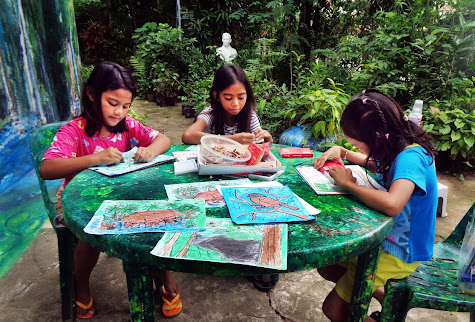
Home, Sweet Home, is our family’s favorite musical composition today. My daughter Anna would accompany me on the piano as I play the violin, and my son Marlo on the flute. There are occasions we play together in local programs, carrying the message that there is no place like home. We also play related compositions like The Last Rose of Summer, Life Let’s Cherish, and Home on the Range. My wife Cecille and our youngest, Leo Carlo, assist in drawing and painting workshops for children every summer with Nature mainly as the theme.
Here are the original lyrics of the musical piece.


The topic of What constitute a happy home was discussed on the school-on-air program - Paaralang Bayan sa Himpapawid. It was one of the liveliest lessons in the last five years of the program (Phase 2). Here are definitions which came from our radio audience here and abroad.
1. Home is a roof for everyone - residents and guests.
2. Home is a wall with large windows that let the sun and the breeze in.
3. Home is where fish in the aquarium sparkle in the morning’s sun.
4. Home is a baby smiling, of children playing.
 5. Home is husband and wife loving and loyal to each other.
 16. Home is a cup of coffee, a sip of wine, a newspaper.
17. Home is a warm bath, a cold shower, a bath tub.
18. Home is National Geographic, Time Magazine, Discovery channel.
19. Home is ripe tomato, succulent radish, dangling string beans.
20. Home is a brooding mother hen in her nest.
21. Home is fresh eggs everyday.
22. Home is the singing of birds and fiddling of crickets.
23. Home is the sweet smell of flowers, falling leaves, swaying branches in the wind.
24. Home is the sweet smell of the earth after the first rain in May.
25. Home is a singing cicada in the tree.
26. Home is a swarming of gamugamo in the evening.
27. Home is a sala too small for so many friends.
28. Home is a cabinet of books, a study table, a computer.
29. Home is Beethoven, Mozart, Abelardo, Santiago.
30. Home is Charlotte Church, Josh Groban, Sharon Cuneta.
31. Home is Juan Luna, Amorsolo. Picasso, Van Gogh.
32. Home is potpourri of appetizing recipes, of the proverbial grandmother apple pie.
 33. Home is pinakbet, lechon, karekare, suman, bibingka.
34. Home is a garden of roses, a grass lawn, a pergola of orchids.
35. Home is a collection of plants, a living gene bank.
36. Home is home for biodiversity, a living museum.
37. Home is doing repairs that virtually has no end.
38. Home is disposing old newspapers, bottles, metal scraps, and used clothes.
39. Home is a midnight candle before an exam.
40. Home is a shoulder, a pillow, to cry on.
41. Home is Noche Buena.
 42. Home is fireworks on New Year.
43. Home is general cleaning on weekends.
44. Home is a soft bed that soothes tired nerves and muscles.
45. Home is a fire place, a hearth, which takes the cold out of the body and spirit.
46. Home is a Prodigal Son returning, The Good Samaritan.
47. Home is a round table where thanksgiving prayer is said.
48. Home is laughter and music, prose and poetry.
49. Home is forgiving, rejoicing, celebrating.
50. Home is Angelus and rosary hour.
Many of the definitions are romantic; they are recollections of happy moments. They are a picturesque of a dream home. They are full of optimism and imagery as well. Apparently the callers must be enjoying the comforts of their home. Many are young and idealistic, and look at the sunny side of life. I suppose everybody, would like to combine a number of these definitions, and synergistically come up with a Utopian Home.
On the other side of these scenarios are realities of life that we face today. Paaralang Bayan sa Himpapawid did some research on current social issues, herein presented in a capsule. *
• There are 32 Million poor Filipinos (39.4 percent of the population); 5.1M poor families (19.9 percent in urban areas and 46.9 in rural areas); and 2.5M families are living on subsistence level. (NSO 2002)
• Only 80 percent have access to safe water; and 86.1 percent to sanitary toilets
• Only 72 percent live in strong houses; and only 67 percent own house and lot; 3.4M are squatters (ADB, 2002).
.Our population experience hunger; 20 to 34 percent are undernourished, among them 15M children.
• About 100M children in the world are living on the street as of 1994. There are 1.5 million street children in the Philippines alone.
• There are 2.8M illiterate Filipinos, while 7.4M others are functionally illiterate. Functional illiteracy refers to the inability of a person to use his skills in reading, writing and counting to improve his life. This is the target audience of Paaralang Bayan sa Himpapawid.
Together let us make the Planet Earth our Home, Sweet Home. ~
 A Little Corner of Eden in acrylic, painted by Dr Abe V. Rotor (30" x 40") for the (Philippine College of Physicians) PCP Foundation Inc, founder and guardian of Dr. Arturo B. Rotor Memorial Awards for Literature.


 * Article and painting are lovingly dedicated to the PCP Foundation, founder and guardian of the Dr Arturo B Rotor Memorial Awards for Literature. Philippine College of Physicians Foundation is the social service arm of Philippine College of Physicians. Founded in 2008, PCP Foundation values social service and envisions a healthier Filipino nation through partnerships to co-create health-centric innovative solutions. 0917 654 8710 secretariat@pcpfoundation.com


"The goal of life is to make your heartbeat match the beat of the universe,


“I firmly believe that nature brings solace in all troubles.” –Anne Frank


1. Man has emboldened the causative agents of human diseases – both old and new - into epidemic and pandemic proportions, which include HIV-AIDS, SARS, Ebola, Avian flu (caused by a new virus H5N1, a hybrid of the human flu virus and the bird flu virus), obesity (caused by Ad36 virus) - and the most recent MERS-CoV (Middle East Respiratory Syndrome Corona Virus), now tagged as Novel 2019 Corona Virus Disease (COVID-19)
2. Through biological specialization or mutation – natural and man-induced – causative agents have crossed natural barriers of transmission across species, such as bird to man (bird flu), civet cat to man (SARS), and primate to man (HIV-AIDS, and Ebola), wild animals like bat to man (COVID-19). Man has built bridges between the non-living to the living as well. We have paved the way for the Prion, an infectious protein, the causative agent of Mad Cow Disease or BSE (Bovine Spongiosform Encephalopathy) to cross from cattle to man and cause a similar disease affecting humans, the Creutzfeldt-Jakob Disease (CJD). Viruses have acquired new ability to infect and spread not only among humans but also in animals and plants. Viral diseases of plants have been responsible for the decrease in agricultural production in many parts of the world.

3. In the midst of enjoying the good life in a postmodern world more and more people are victims of accidents, heart attacks and strokes, anxiety and depression – and various forms of psychosomatic disorder - that often lead to ruined lives and suicides. Cancer, diabetes, and the deleterious consequences of vices (tobacco and alcohol), are on the rise among other modern diseases. Surprisingly, the number of years a person is healthy in proportion to his life span is not significantly longer than that of his predecessors, and that a person’s life span has not significantly increased at all. It is the average longevity of a population that has increased, not the individual’s. The fact is that modern medicine has increased survival of infants and young people, most of them are now in their past fifties, thus gross longevity appears to have increased, up to 78 years in some countries. On the contrary, more and more young people are getting sick and dying.
4. Modern society and science and technology no longer fit into the Darwinian theory of natural selection. There is a growing burden placed on the shoulders of the able and fit in our society who, without choice, is responsible in taking care of the growing number of dependents – many are the infirmed and the aged.
All these lead us to re-examine our values. It challenges us to look deeper into a paradigm of salvation through our concern for the environment. The prolificacy of the human species sans war and pestilence, plus growing affluence of our society has led to a population explosion which had doubled in less than fifty years. We are now more than 7.5 billion. Under this paradigm, there is no master and subject. All must join hands to prevent the exploitation of the earth’s finite resources. Today’s economists must also be good housekeepers of Nature, so with those in the other professions. While man’s aim is directed at the Good Life, he has unwittingly reduced the very foundation of that good life – the productivity and beauty of Mother Earth.
 There are few frontiers of production left today. We have virtually pushed back the sea and leveled off the mountain. Prime lands have all been taken, swamps have been drained, and even deserts are being reclaimed. But as we continue to explore the marginal edges of these frontiers the more we are confronted with high cost of production that is levied on the consumer, and more importantly, the danger of destroying the fragile environment. AVR
The environment and the economy need not be viewed as opposites. It is possible to have a healthy environment and a healthy economy at the same time. More and more businesses have begun adopting this concept as a business philosophy. People behind business organizations are becoming more aware of the ethical decisions they face, and their responsibility for their consequences.
Industrialization and urbanization are akin to each other. Industrial growth spurred the building of cities all over the world. Today there are as many people living in cities as those living the rural places. A mega-city like Tokyo has a population of 15 million people. We are 10 million in Metro Manila. Cities are fragile environments. Cities are more prone to epidemics such as the bubonic plague that killed one-third of the population of Europe in the 13th century. Now we are confronted with HIV-AID, SARs, Meningo cochcimia, Avian flu, and now the dreaded CORID-15 which is gripping the world today as the worst human pandemic disease in recent history. AVR
 There are organizations that have set some rules of governance of the environment, among them, GRI (Global Reporting Initiative), CERES (Coalition of Environmental Responsible Economies), and UNEP (United Nations Environmental Program). In line with these a multi- national corporation came up with the following thrusts:
Nature defiled by genetic engineering, painting by the author




"The artist sees what others only catch a glimpse of.” - Leonardo da Vinci. ~


 A third world war was averted during the 45-year Cold War. As hindsight, an arms race revealed from both sides USA and USSR and their respective allies built a stockpile of nuclear weapons potentially capable of annihilating mankind three times, and irreversibly destroying the earth’s biological and ecological balance.
3. A third world war was averted. As hindsight, an arms race revealed from both sides a stockpile of nuclear weapons potentially capable of annihilating mankind three times, and irreversibly destroying the earth’s biological and ecological balance, with radiation and other poisons that can persist for hundreds, if not thousands of years.
 Fiery scene, painting of an 8-year old. Children's Art Workshop, 2017
6. But what really tore down the boundaries of nations zealously guarded by politics and economics have been the breakthroughs in science and technology, particularly in communication and transportation, disseminating information through multimedia and bringing people together. This ushered the beginning of “globalization.”

1. Home, Sweet Home with Nature
The best home is one where we live in a friendly relationship with Nature. Why don't you share with us your version of Home, Sweet Home?
 Idyllic rural life, mural painting by AV Rotor, circa 1976.
 Courtesy of San Vicente (Ilocos Sur) Municipal Hall
In the movie, The King and I, Anna, an English teacher, sang, Home Sweet Home. It was a popular song in her time when Europeans left their home in the later part of the 18th century in search of a new one on the other side of the globe, the New World, which was to become the United States of America. Others found the Orient. Teacher Anna served as tutor to the children of the King of Siam (Thailand)
To many Filipinos, the song stirs the heart as well. Thousands leave their native land, their homes and families in search for opportunities as Overseas Filipino Workers, and emigrants.
To the returnees or balikbayan, home is a retirement in the place of their birth, most of them on the countryside where they spent their happy childhood that tempered their homing instinct.
Many city dwellers are seeking liberation from the “concrete jungle.” Home is more than walls, high rise apartments, canned entertainment, neon lights and fast lanes.
 And all over the world, there is a general trend to get closer to the concept of “at home” by going natural – the way people dress, the food they eat, the medicine they take, and the many articles they use everyday.
Brick house on the farm, painting by the author
More and more homes do not allow smoking, other vices notwithstanding, following the footsteps of school campuses, government offices and commercial centers. People are going back to cooking at home, shunning away from artificial food like coffeeless coffee (decaf), sugarless sugar (Aspartame et al), fatless fat (Olestra). And the so-called “Frankenfood” made from genetically modified organisms (GMO).
Like many schools and establishments, a home that advocates going natural, has started banning carbonated drinks, Monosodium Glutamate (MSG) or Vetsin, “magic sugar,” and even multivitamins in capsules, being mostly artificial.
The simplicity of homes today goes with the trend of “simple living,” relying less and less on cosmetics and fancy designs. People prefer leather, paper and cotton over synthetics, fresh food rather than processed, baon over fast food. Homestead over condominium. The original bungalow home is back. It is simple and practical designed in such as way that one step leads into the House, and the other to the Garden.
We can imagine with awe and appreciation the homes of people whose lifestyle is friendly to the environment, homes that provide a healthy ambiance to the residents, the neighborhood, and ultimately the whole community. This is a new movement that is gaining worldwide attention – home revolution.
I found a musical piece arranged for the violin and piano in an old wooden chest (baol) containing the personal belongings of my mother who died during WWII. I was told by my father that it was her favorite piano piece. I can only surmise the reason. Many homes were destroyed and families separated during the war. Dad managed to rebuild our old home and farm. This is the place where my sister, brother and I spent our childhood and adolescence. It is the same home we found retirement after a long absence.
Home, Sweet Home, is our family’s favorite musical composition today. My daughter Anna would accompany me on the piano as I play the violin, and my son Marlo on the flute. There are occasions we play together in local programs, carrying the message that there is no place like home. We also play related compositions like The Last Rose of Summer, Life Let’s Cherish, and Home on the Range. My wife Cecille and our youngest, Leo Carlo, assist in drawing and painting workshops for children every summer with Nature mainly as the theme.
Home Sweet HomeBy John Howard PayneMusic by Henry Rowley Bishop (1786-1855)(Arranged for the violin and piano by Henry Farmer)‘Mid pleasures and palaces though we may roam,Be it ever so humble, there’s no place like home;A charm from the sky seems to hallow us there,Which seek through the world, is ne’er met with elsewhere.Home, Home, sweet, sweet Home!
An exile from home, splendor dazzles in vain;O, give me my lowly thatched cottage again!The birds singingly gaily, that came to my call –Give me them – and the peace of mind, dearer than all.Home, Home sweet, sweet Home.There’s no place like Home!There’s no place like Home!


Homes with a romantic setting; neo-colonial design
1. Home is a roof for everyone - residents and guests.
2. Home is a wall with large windows that let the sun and the breeze in.
3. Home is where fish in the aquarium sparkle in the morning’s sun.
4. Home is a baby smiling, of children playing.
6. Home is a “place for everything and everything in its place.”
7. Home is dad and mom waiting for the children from school.
8. Home is a workshop for hobbies, inventions and discoveries.
9. Home is a dog lying on the doormat and waiting for its master.
10. Home is a litter of puppies and kittens.
11. Home is a rooster crowing, nature’s alarm clock.
12. Home is a house lizard’s crispy announcement of a guest coming.
13. Home is a frog croaking in the rain.
14. Home is a safari of wildlife – from insects to migratory birds.
15. Home is a warm embrace of a cat. (avr photo)
7. Home is dad and mom waiting for the children from school.
8. Home is a workshop for hobbies, inventions and discoveries.
9. Home is a dog lying on the doormat and waiting for its master.
10. Home is a litter of puppies and kittens.
11. Home is a rooster crowing, nature’s alarm clock.
12. Home is a house lizard’s crispy announcement of a guest coming.
13. Home is a frog croaking in the rain.
14. Home is a safari of wildlife – from insects to migratory birds.
15. Home is a warm embrace of a cat. (avr photo)

17. Home is a warm bath, a cold shower, a bath tub.
18. Home is National Geographic, Time Magazine, Discovery channel.
19. Home is ripe tomato, succulent radish, dangling string beans.
20. Home is a brooding mother hen in her nest.
21. Home is fresh eggs everyday.
22. Home is the singing of birds and fiddling of crickets.
23. Home is the sweet smell of flowers, falling leaves, swaying branches in the wind.
24. Home is the sweet smell of the earth after the first rain in May.
25. Home is a singing cicada in the tree.
26. Home is a swarming of gamugamo in the evening.
27. Home is a sala too small for so many friends.
28. Home is a cabinet of books, a study table, a computer.
29. Home is Beethoven, Mozart, Abelardo, Santiago.
30. Home is Charlotte Church, Josh Groban, Sharon Cuneta.
31. Home is Juan Luna, Amorsolo. Picasso, Van Gogh.
32. Home is potpourri of appetizing recipes, of the proverbial grandmother apple pie.
34. Home is a garden of roses, a grass lawn, a pergola of orchids.
35. Home is a collection of plants, a living gene bank.
36. Home is home for biodiversity, a living museum.
37. Home is doing repairs that virtually has no end.
38. Home is disposing old newspapers, bottles, metal scraps, and used clothes.
39. Home is a midnight candle before an exam.
40. Home is a shoulder, a pillow, to cry on.
41. Home is Noche Buena.
43. Home is general cleaning on weekends.
44. Home is a soft bed that soothes tired nerves and muscles.
45. Home is a fire place, a hearth, which takes the cold out of the body and spirit.
46. Home is a Prodigal Son returning, The Good Samaritan.
47. Home is a round table where thanksgiving prayer is said.
48. Home is laughter and music, prose and poetry.
49. Home is forgiving, rejoicing, celebrating.
50. Home is Angelus and rosary hour.
Many of the definitions are romantic; they are recollections of happy moments. They are a picturesque of a dream home. They are full of optimism and imagery as well. Apparently the callers must be enjoying the comforts of their home. Many are young and idealistic, and look at the sunny side of life. I suppose everybody, would like to combine a number of these definitions, and synergistically come up with a Utopian Home.
On the other side of these scenarios are realities of life that we face today. Paaralang Bayan sa Himpapawid did some research on current social issues, herein presented in a capsule. *

• There are 32 Million poor Filipinos (39.4 percent of the population); 5.1M poor families (19.9 percent in urban areas and 46.9 in rural areas); and 2.5M families are living on subsistence level. (NSO 2002)
• Only 80 percent have access to safe water; and 86.1 percent to sanitary toilets
• Only 72 percent live in strong houses; and only 67 percent own house and lot; 3.4M are squatters (ADB, 2002).
.Our population experience hunger; 20 to 34 percent are undernourished, among them 15M children.
• About 100M children in the world are living on the street as of 1994. There are 1.5 million street children in the Philippines alone.
• There are 2.8M illiterate Filipinos, while 7.4M others are functionally illiterate. Functional illiteracy refers to the inability of a person to use his skills in reading, writing and counting to improve his life. This is the target audience of Paaralang Bayan sa Himpapawid.
* National Statistics Office, 2002
This lesson aims at offering an alternative to solving current social and economic and problems. We believe that living close to Nature, by respecting her laws and rules, appreciating her beauty and bounty, and helping in her “housekeeping” to make a healthy, clean and comfortable environment will certainly ease the burden of living; in fact it strengthens our will and spirit to live and to enjoy the best life could give. In our resolve to keep the family bond close and firm, build a strong and comfortable dwelling, keep our surroundings clean and green, and above all, elevate our level of consciousness toward goodness and beauty - we are recreating a patch of Eden we call Home, Sweet Home.
Together let us make the Planet Earth our Home, Sweet Home. ~
-------
Acknowledgement with gratitude: Internet photos as indicated
2. A Little Corner of Eden
Dedicated to the Philippine College of Physicians (PCP) Foundation *
" A Little Corner of Eden resembles a tropical rainforest." - avr
Dr Abe V Rotor

"Nature represents the idea of the entire universe in a state of perfection. Nature is one; it unites heaven and earth, connecting human beings with the stars and bringing them all together into a single family. Nature is beautiful; it is ordered. A divine law determines its arrangement - the subordination of the means to the end, and the parts to the whole.
"No one tires with the rhythm of nature – the tides, waves, flowing rivulets, gusts of wind, bird songs, the fiddling of crickets, and the shrill of cicada. In the recesses of a happy mind, one could hear the earth waking up in spring, laughing in summer, yawning in autumn and snoring in winter – and waking up again the next year, and so on, ad infinitum." - AV Rotor, Listen to the Music of Nature!
 The Forest - Living World in Microcosm

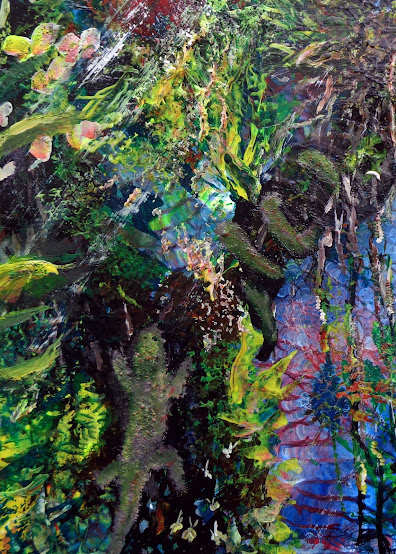 It is estimated that more than half the species of plants, animals and protists live in the tropical rainforests. Imagine a single tree as natural abode of ferns, orchids, insects, fungi, lichens, transient organisms - birds, monkeys, frogs, reptiles, insects and a multitude more that escape detection by our senses.

 Orchids, Family Orchidaceae, is one of the two largest families of flowering plants, with about 28,000 species, and with more constantly discovered. Orchids make up 6 to 11 percent of all species of seed plants, and are the most advanced in the Plant Kingdom, occupying the top position in the phylogeny and evolution of plants.
"I chose the tropical rainforest scenery since it is the richest of all ecosystems in the world. The Philippines, being one of the countries endowed with this natural wealth is indeed an ecological haven. For this reason, I believe that, the tropical rainforest closely resembles the description of the biblical paradise. It is not only a living bank of diversity; it is the most important sanctuary of living matters on earth." - AV Rotor, The Living with Nature Handbook


"Birds sing not only for their own kind,but to the world that shares their joy,in melodies notes may not capture,but the heart and spirit they buoy." -avr

“To see a world in a grain of sand,And heaven in a wild flower;Hold infinity in the palm of your hand,And Eternity in an hour.”- William Blake, Auguries of Innocence
"This verse captures the essence of the title, The Forest - Living World in Microcosm. It condenses the universe into its elemental symbols from which we take a full view of the world we live in. It reduces the complexities and vastness of both non- living and the living world into a microcosm that is complete in itself- a plantilla of creation all contained in the hand and experienced within a lifetime." - AV Rotor, Living World in Microcosm

Cryptobiology and Augury
"Call cryptobiology a pseudoscience, but it is gaining acceptance and support from scholars and people in general, with the discovery of strange creatures like the Coelacanth and Kraken. The ancient Roman religion interpreted omens from the observed behavior of birds. A white dove means “peace”. A black dove means “war”. It could also pertain to matters of the heart, relationships, luck, misfortune, death, Remember the emissary bird in the biblical Noah's Ark? With the breakthrough in cybercommunication, it is evident that soon we will be communicating with Nature more directly, over and above fantasy and imagination, which leads us to the idea of conscientization, in the pursuit of values, truth and the ideal in protecting Nature from the hands of man himself." - AV Rotor, Cryptobiology and Conscientization 


A pair of lovely parrots perched up high,
higher than the flight of butterfly;aimlessly below many a passerbyjust let the world go with a sigh.


Orchids:white, delicate, immaculate, pure;red, flaming, romantic, demure;Orchids:flowing, silky, translucent, queenly;fiery, ascendant, stout, kingly.

Orchids:
endearing, fancy, coy, culpable;
ephemeral, magical, lovable.
* Verse and drawing in pastel by Anna Christina, author's daughter, an enthusiast in the arts, assisted in conducting summer art workshops for children during her student days. Cattleya, Dendrobium and Vanda are native orchids in the Philippines. These are representative images of Vanda and its variants, including Vanda merrillii var. rotorii, named after Dr Arturo B Rotor in his honor as an orchid hobbyist.


"Today, rather than defending himself against nature,
man realized, he needed to defend nature against himself."
- AV Rotor, Light from the Old Arch

Forest: Man's First home, Genesis' Final View
Richest in flora and fauna of all biomes,Big and small, in a common union,Arranged in niches, divided by storeys,In competition and cooperation.Heritage trees rise through the canopy,Living towers of the forest;Divine columns of Nature's Parthenon,Cradle of harmony and rest.Stories about the forest, queer but true,Seat of evolution, of biodiversity,Ultimate of adventure, science laboratory,Man's first home, Genesis' final view.

Message of the Painting, A Little Corner of Eden
"Quite often, images of nature enrapture us. These are reminiscences of childhood, a re-creation of a favorite spot we may have visited or seen, or products of the imagination greatly influenced by society we live in.
But the painting reflects a deep-seated biological longing to be part of nature. Putting it in the biblical sense, it is a natural searching for the lost paradise. The scenery represents a refuge from city living, a respite, and an escape from the daily grind.
But the scenery does not only tell us of what we are missing. Rather, it reminds us of what we are going to miss, perhaps forever, if we do not heed nature's signal towards a fast declining ecosystem. If we do not change our way of life from too much dependence on consumerism, to one more closely linked to conservation of nature, we may end up building memories and future archives of a lost world. " - AV Rotor
But the painting reflects a deep-seated biological longing to be part of nature. Putting it in the biblical sense, it is a natural searching for the lost paradise. The scenery represents a refuge from city living, a respite, and an escape from the daily grind.
But the scenery does not only tell us of what we are missing. Rather, it reminds us of what we are going to miss, perhaps forever, if we do not heed nature's signal towards a fast declining ecosystem. If we do not change our way of life from too much dependence on consumerism, to one more closely linked to conservation of nature, we may end up building memories and future archives of a lost world. " - AV Rotor
A Little Corner of Eden
If I were to return after the FallTo where my forebears once lived;If I were to trace back their footstepsTo their world of make believe.What would I tell to my dear CreatorWhose open arms have waited so longFor man to return, to repent for his Sin -And I, having also failed all along?I would tell Him there is also a place,A little green corner of grass and trees,Of bees and flowers, rainbow and butterflies,Where birds come and sing with the breeze.An emerald river gently flowing,Meandering between hills and on the plain,Palms and trees bowing at its levees,Its waters soothing the day's pain.I would tell Him of this place also forgotten,Abandoned by a bandwagon,By those who nurture the Utopian dream,Now orphaned and virtually alone.Is forgetfulness also Your tool of creationWhere man shall be gone from here on?Paradise is redeemed and once more born?No wonder Nature triumphs when left alone.~
3. A Search for Meaning in Nature
“If you truly love nature, you will find beauty everywhere.”
–Vincent van Gogh


Art lives forever, indeed.
Cracked, broken, abandoned;
be it a vase, urn, pot or jar.
Don't discard it, artists forbid!
“Study nature, love nature, stay close to nature. It will never fail you.” –Frank Lloyd Wright
“Nature is loved by what is best in us.” –Ralph Waldo Emerson


Relics of a tree is as sacred as that
of any living thing the Creator made.
“In nature, nothing is perfect and everything is perfect. Trees can be contorted, bent in weird ways, and they’re still beautiful.” –Alice Walker


You can lift nature in painting,
go find her in her real setting.
“Those who contemplate the beauty of the earth find reserves of strength
that will endure as long as life lasts." –Rachel Carson


White doves hovering sans fear,
their message falling on deaf ear.
“Let the rain kiss you. Let the rain beat upon your head with silver liquid drops. Let the rain sing you a lullaby.” –Langston Hughes


Specimens and art are compatible
in the laboratory and on the wall.
“Sunsets are proof that endings can often be beautiful, too.” –Beau Taplin

How we have disturbed Nature to the core -
DNA's integrity no more - man's gravest sin.
"I think having land and not ruining it is the most beautiful art that anybody could ever want." –Andy Warhol

I painted this on a clear day on August 6, 2025
- Hiroshima atomic bombing. eighty years after.
"There is something infinitely healing in the repeated refrains of nature—the assurance that dawn comes after night, and spring after the winter." –Rachel Carson


Apparition - enshrined faith in a simple artwork.
to match your nature with Nature." –Joseph Campbell


Art is everywhere if we perceive it with our eighth sense
of awe and wonder, valuing and remembering.
"The earth has its music for all who will listen." - Reginald Holmes


After comfort, we throw away the leftover;
treasure it as a souvenir to remember.


Everywhere there's work of the great Creator
who made the rocks, and the Earth as a whole.
“We still do not know one thousandth of one percent of what nature has revealed to us.” –Albert Einstein


From fossil to limestone to marble - to art;
all along images of the great Maker appear..
"If you wish to know the divine, feel the wind on your face and the warm
sun on your hand.” –Buddha

Cradle the small, the weak, the helpless,
the secret of evolution's success.
There are always flowers for those who want to see them.” –Henri Matisse
"In every walk with nature one receives far more than he seeks." –John Muir
4. Biology and Humanities
- Unity and Harmony in Diversity
"It is that range of biodiversity that we must care for - the whole thing - rather than just one or two stars." David Attenborough
Dr Abe V Rotor

Coral Reef Forest in acrylic by the author 2024
Coral reefs are often called "the rain forests of the "oceans" because they are among the richest marine ecosystems in species, productivity, biomass, and distribution.
How unknowingly blind we are to know that on the fringes of land and sea lies a forest
similar in many ways with the ones we know on land - the tropical rainforest, the so-called jungle of Africa, and the coniferous temperate forest called taiga.
And sadly do we know too, that the coral reef, the foundation of the richest marine ecosystem both in vastness and biodiversity, is also dying due to deforestation in like manner our forests are destroyed by exploitation and pollution.
 Coelenterates in acrylic by the author 2024


 Arboreal Niche in acrylic by the author 2022
 Forest Litter in acrylic by the author 2023Forest litter comprises of the accumulated layers of organic debris on the forest floor that consists of dead plant material, such as leaves, twigs, bark, flowers, and fruits. It is rich in organic matter and minerals.

Juvenile Volvox in acrylic by the author, 2000Volvox species can be monoecious or dioecious. Male colonies release numerous sperm packets, while in female colonies single cells enlarge to become oogametes, or eggs.
similar in many ways with the ones we know on land - the tropical rainforest, the so-called jungle of Africa, and the coniferous temperate forest called taiga.
And sadly do we know too, that the coral reef, the foundation of the richest marine ecosystem both in vastness and biodiversity, is also dying due to deforestation in like manner our forests are destroyed by exploitation and pollution.
...

Coelenterates are aquatic invertebrate animals of a phylum that includes jellyfishes, corals,
and sea anemones, in association with fish, seaweeds and other marine organisms.
On the intertidal zone where low and high tides take place at interval everyday lies a world unique to most of us because of its unfamiliarity, and often, its invisible features to the naked eyes, and many of its inhabitants are heretofore unknown to us, more so to our young children.
As I painted this piece I imagined myself with snorkel swimming among seaweeds, corals, hydra, jellyfish, sea cucumber, anemone, seahorse, and the like, which appear in camouflage and mimicry. It is as if I were in a fairyland - a scenario I painted in abstract style as it appears in this painting.

Antibiosis in acrylic by the author 2022
Antibiosis is a biological interaction between two or more organisms where one is negatively affected. It inhibits the growth or activity of other organisms in the system with the production of antimicrobial, fungistatic compounds and enzymes.
When I was painting this microscopic scene, I imagined Alexander Fleming, the serendipitous discoverer of the miracle life-saving antibiotic fungus, Penicililum notatum. Truly, in life something happens or is found by chance or luck. Now, how can you interpret this in art?
This is where impressionism and abstract art come in. It leaves to the viewers things in their own interpretation - even those that do not exist in reality. Can you decipher the disease-causing bacterium being devoured by the Penicillium? Imagine in this painting the presence of other microscopic organisms belonging to the realms of Mycophyta and Protista.

Deadwood mushrooms specimen against a mural of nature by the author 2020
A colony of mushrooms growing like shelves around a dead branch in association with other saprophytes. Saprophytes are nature's scavengers as they feed on dead or decaying matter, thus keeping the environment orderly and clean.
It is adventure on the field, under the trees, along river banks, and other natural features of the landscape where we communicate with the Creator. In this particular case, with organisms in the final stage of their lives, some in advance state whereby their organic compounds are reverted into inorganic forms.
Here compounds are broken into elements. It's Nature at work with little or no intervention of man at all. True to the nature of a cycle, its beginning and end, are closely linked, setting the conditions of subsequent cycles. Bacteria, protists, mycophyta (fungi) are Nature's agents of this phenomenon, earning their status as beneficial organisms.

A niche defines the role and position a species plays in its environment. It describes
how a species responds to and alters the distribution of resources and competitors.
Trees talk, sing, whisper, groan, sigh, and the like, which are unique in their own ways. But if you love nature you are truly a part of their world. Birds build nests and sing lullaby. Crickets play violin, frogs are Caruso; prop roots gongs, passing breeze love notes, fireflies eyes in the night
These make life beautiful, happy, meaningful. Pick up a brush and paint. Arrange some notes into a melody and play it with the flute. Follow the rhyme and rhythm of the river reaching out to the sea.

How do you define waste? In pre-industrial era, waste is mainly the by-product of Nature, meaning, materials left behind by a main product. Rice hull or Ipa for example is a by-product of milling, in the same way peelings are leftover in the kitchen.
In nature dead leaves are residues of photosynthesis, so with hay and stovers.. Under the trees waste pile up layer after layer into a litter of leaves, branches, earthworm castings, wildlife droppings. These become compost, and compost is fertilizer the trees use again as they grow, produce fruits, wood, oil, resin and other materials
This is an interesting subject of art in situ, thus on-the-spot painting would be the best approach to capture this scenery. The artist in us may expand through imagination the process over and above science and technology. The artist reaches out into the mystery of Creation. Here art becomes an expression of reverence and thanksgiving, a prayer in itself.

Mycelia in acrylic by the author 2022
Mycelium (pl, mycelia) is a root-like structure of a fungus consisting of a mass of branching, thread-like hyphae. Its normal form is that of branched, slender, entangled, anastomosing, hyaline threads. Fungal colonies composed of mycelium are found in and on soil and many other substrates.What you can't see is hard to believe, they say. Yet we believe in many invisible things.
The lens unveils the world of the minutiae, living and non-living, and their mysterious connections, often the subject of magic and superstition. Wonder how thunder and lightning produce mushrooms as old folk would tell us.
Scientists trace the mushroom as the visible stage of a mass of microscopic mycelia, the vegetative stage of the organism. Artists bring forth on canvas and screen their versions of this microscopic world, real and imaginary. They connect reality and fantasy, unless they are instructed to adhere to scientific facts. Otherwise art is an expression of freedom, a kind of theory out of the artist's interpretation.
 |
Multicolored Volvox? In nature Volvox is monochromatic, green, sparkling in bright light, its spiked cover making it appear alien by our standards of a living organism. Thus, Volvox is a good subject of art and microphotography. And to the fertile mind, a seventh wonder of the world in microcosm.
I like the oneness and unity of a Volvox colony, a biological design for survival in number and sharing of space and resources, a evolutionary tool of cooperation, though ultimately ending up in rigid competition, illustrating Darwin's "survival of the fittest" in a colony. Would you like to peep into the microscope and paint the Volvox in fantasia? ~
4. Rocks for Study, Art and Hobby
"Geologists have a saying - rocks remember. - Neil Armstrong


Left: Mt Pinatubo's pyroclastic rock mounted for the museum.
The rock formed while still very hot, forming a porous texture.
Right: Floral arrangement of stones gathered from Bacnotan,
La Union beach.


Left: Petrified or fossilized wood. Carbon dating process traces
the origin, age, and habitat of the specimen. Resin, exudate of
Pine tree undergoing metamorphism into amber


Left: Rock collection of a student attracted by the diversity of the specimens.
Right: This is not a fossil, but broken glazed jar often used to store sacred
objects and remains, like an urn in earlier times.


Brain coral in its early stage of fossilization. Operculum of a large seashell undergoing erosion by the elements. Note the counterclockwise spiral, a unique find.


Left: Limestone undergoing metamorphism into marble which
may take a very long time under favorable conditions. Right:
Shades of opal and glitter often make this petrified wood look
valuable when cut and polished, and made into fancy jewelry.


Left: Aggregate rocks in various compositions and structures.
Right: Unidentified layered rock, indicating geologic history.


A nearly perfect round stone shaped naturally by running stream
used as cannon ball in the days of Panday Pira (c. 1488–1576)
a Filipino blacksmith and maker of an early type of cannon.


Fossilized bone fragment of a large animal in the Cretaceous era.
*The Cretaceous is defined as the period between 145.5 and 65.5 million years ago, the last
period of the Mesozoic Era, following the Jurassic and ending with the extinction of the dinosaurs


Probable tusk of an elephant (?) reportedly found in Cagayan Valley,
a subject of study on animal migration and land bridges in ancient past.


Left: A collection of rock samples at author's home.
Right: Early stone age tools, crude and unpolished,
but they served the purpose of primitive hunting.


Rock undergoing weathering; coral remains with imbedded shells
undergoing fossilization


Relief paintings using rocks, clay, wood, and various decors for background.
"The purpose of modern museums is to collect, preserve, interpret,
and display objects of artistic, cultural, or scientific significance
for the study and education of the public." ~
5. Bioethics and Environment
Ethics is the foundation of aesthetics; it is something very difficult to explain that makes beautiful more beautiful, rising to the highest level of philosophy where man finds hope, inspiration, and peace. It is a beacon. While ethics sets the direction of moral life, aesthetics is its beautiful goal.

Concept of Nature as the whole universe, painting by the author
2. Through biological specialization or mutation – natural and man-induced – causative agents have crossed natural barriers of transmission across species, such as bird to man (bird flu), civet cat to man (SARS), and primate to man (HIV-AIDS, and Ebola), wild animals like bat to man (COVID-19). Man has built bridges between the non-living to the living as well. We have paved the way for the Prion, an infectious protein, the causative agent of Mad Cow Disease or BSE (Bovine Spongiosform Encephalopathy) to cross from cattle to man and cause a similar disease affecting humans, the Creutzfeldt-Jakob Disease (CJD). Viruses have acquired new ability to infect and spread not only among humans but also in animals and plants. Viral diseases of plants have been responsible for the decrease in agricultural production in many parts of the world.

The aesthetics of Nature, source of legends, songs and festivities, painting by the author
3. In the midst of enjoying the good life in a postmodern world more and more people are victims of accidents, heart attacks and strokes, anxiety and depression – and various forms of psychosomatic disorder - that often lead to ruined lives and suicides. Cancer, diabetes, and the deleterious consequences of vices (tobacco and alcohol), are on the rise among other modern diseases. Surprisingly, the number of years a person is healthy in proportion to his life span is not significantly longer than that of his predecessors, and that a person’s life span has not significantly increased at all. It is the average longevity of a population that has increased, not the individual’s. The fact is that modern medicine has increased survival of infants and young people, most of them are now in their past fifties, thus gross longevity appears to have increased, up to 78 years in some countries. On the contrary, more and more young people are getting sick and dying.
4. Modern society and science and technology no longer fit into the Darwinian theory of natural selection. There is a growing burden placed on the shoulders of the able and fit in our society who, without choice, is responsible in taking care of the growing number of dependents – many are the infirmed and the aged.
All these lead us to re-examine our values. It challenges us to look deeper into a paradigm of salvation through our concern for the environment. The prolificacy of the human species sans war and pestilence, plus growing affluence of our society has led to a population explosion which had doubled in less than fifty years. We are now more than 7.5 billion. Under this paradigm, there is no master and subject. All must join hands to prevent the exploitation of the earth’s finite resources. Today’s economists must also be good housekeepers of Nature, so with those in the other professions. While man’s aim is directed at the Good Life, he has unwittingly reduced the very foundation of that good life – the productivity and beauty of Mother Earth.
---------------------------------------------------------------------------------------------------
 There are few frontiers of production left today. We have virtually pushed back the sea and leveled off the mountain. Prime lands have all been taken, swamps have been drained, and even deserts are being reclaimed. But as we continue to explore the marginal edges of these frontiers the more we are confronted with high cost of production that is levied on the consumer, and more importantly, the danger of destroying the fragile environment. AVR
-----------------------------------------------------------Nature as socio-economic base in agrarian society, painting by the author
Ecological paradigm endorses an ecocentric approach where all forms of life and non-life are important to human life. Spirituality points out to a unitive force: the sacredness of everything. God’s divinity flows in everything. There is integration in the universe. And we are part of that integration, exceedingly small as we are, notwithstanding. Under ecological paradigm of salvation, the one responsible in the destruction of the environment leading to loss of lives and properties should be held accountable for it to God, nature and fellowmen.
The environment and the economy need not be viewed as opposites. It is possible to have a healthy environment and a healthy economy at the same time. More and more businesses have begun adopting this concept as a business philosophy. People behind business organizations are becoming more aware of the ethical decisions they face, and their responsibility for their consequences.
Industrialization and urbanization are akin to each other. Industrial growth spurred the building of cities all over the world. Today there are as many people living in cities as those living the rural places. A mega-city like Tokyo has a population of 15 million people. We are 10 million in Metro Manila. Cities are fragile environments. Cities are more prone to epidemics such as the bubonic plague that killed one-third of the population of Europe in the 13th century. Now we are confronted with HIV-AID, SARs, Meningo cochcimia, Avian flu, and now the dreaded CORID-15 which is gripping the world today as the worst human pandemic disease in recent history. AVR
 There are organizations that have set some rules of governance of the environment, among them, GRI (Global Reporting Initiative), CERES (Coalition of Environmental Responsible Economies), and UNEP (United Nations Environmental Program). In line with these a multi- national corporation came up with the following thrusts:
Nature defiled by genetic engineering, painting by the author
• Restore and preserve the environment
This approach is gaining respect and more and more businesses are looking at this model with great interest and favor.
The Question of Governance
One of the resource speakers of the 2010 International Congress on Bioethics,
Dr. Tai cited three themes in order that man can live in harmony with nature. Man is part of the ecosystem, Man is steward of the earth, and Man is finite. Dr. Tai cited models with which man can change his views about the environment and change his style of living. We have also models in the business world, in the church, and in the government, in fact all sectors of society. There are models everywhere in this or that part of the world, whether developed or underdeveloped. There are as many models in less developed countries as in highly industrialized countries. It could be that the less developed are closer to tradition, and still have strong ethnic roots, like the old civilizations mentioned in the paper – the native cultures of America and Africa.
But the world has never been one. It has become more diverse in views and interests though in many respects share the same aspirations towards progress and development. And this is the problem. Man is always in a race. In that race awaits at the end not a prize mankind is proud of and honorable. It is tragedy, which Garett Hardin calls, the tragedy of the commons. It is a greedy competition for a finite resource, each his own, until it is gone. The forests are disappearing today, the lake are dying, the fields are getting marginal, the pastures are overgrazed, the air is loaded with destructive gases, the sea is over fished. All these point out to the syndrome - tragedy of the commons. And because time is of the essence, many believe that the world needs a new revolution now? Is revolution the only way to solve global problems of the environment today?
Definitely, while we need to reform to save our environment, any means that is contrary to peace and unity, is definitely unacceptable. And we would not adhere to the rule of force or violence just to be able to succeed. It is said, that revolution starts in a small corner. It starts in this congress.
In closing I would like to thank Dr. Tai, for his scholarly and incisive paper from which I was not only able to prepare myself as a member of the panel of reactors, but found an opportunity to review and expand my current research works in ecology as well.
Lastly, I would like to recite this short prayer I made for this International Congress on Bioethics, and dedicate it through the little child who visited the two workshops in the village and exclaimed. “But there are no neighbors! But there are no trees, birds, fields and mountains!”
• Reduce waste and pollution
• Education of the public on environmental conservation
• Work with government for sound and responsible environmental program
• Assess impact of business on the environment and communities.
This approach is gaining respect and more and more businesses are looking at this model with great interest and favor.
The Question of Governance
One of the resource speakers of the 2010 International Congress on Bioethics,
Dr. Tai cited three themes in order that man can live in harmony with nature. Man is part of the ecosystem, Man is steward of the earth, and Man is finite. Dr. Tai cited models with which man can change his views about the environment and change his style of living. We have also models in the business world, in the church, and in the government, in fact all sectors of society. There are models everywhere in this or that part of the world, whether developed or underdeveloped. There are as many models in less developed countries as in highly industrialized countries. It could be that the less developed are closer to tradition, and still have strong ethnic roots, like the old civilizations mentioned in the paper – the native cultures of America and Africa.
But the world has never been one. It has become more diverse in views and interests though in many respects share the same aspirations towards progress and development. And this is the problem. Man is always in a race. In that race awaits at the end not a prize mankind is proud of and honorable. It is tragedy, which Garett Hardin calls, the tragedy of the commons. It is a greedy competition for a finite resource, each his own, until it is gone. The forests are disappearing today, the lake are dying, the fields are getting marginal, the pastures are overgrazed, the air is loaded with destructive gases, the sea is over fished. All these point out to the syndrome - tragedy of the commons. And because time is of the essence, many believe that the world needs a new revolution now? Is revolution the only way to solve global problems of the environment today?
Definitely, while we need to reform to save our environment, any means that is contrary to peace and unity, is definitely unacceptable. And we would not adhere to the rule of force or violence just to be able to succeed. It is said, that revolution starts in a small corner. It starts in this congress.
Ethics is the foundation of aesthetics; it is something very difficult to explain that makes beautiful more beautiful, rising to the highest level of philosophy where man find hope, inspiration, and peace. It is a beacon. While ethics sets the direction, aesthetics is its beautiful goal.
In closing I would like to thank Dr. Tai, for his scholarly and incisive paper from which I was not only able to prepare myself as a member of the panel of reactors, but found an opportunity to review and expand my current research works in ecology as well.
Lastly, I would like to recite this short prayer I made for this International Congress on Bioethics, and dedicate it through the little child who visited the two workshops in the village and exclaimed. “But there are no neighbors! But there are no trees, birds, fields and mountains!”

Ecology Prayer
By Dr Abe V Rotor
When my days are over,
Let me lie down to sleep
on sweet breeze and earth,
in the shade of trees
I planted in my youth;
since I had not done enough,
make, make my kind live
to carry on the torch,
while my dusts fall
to where new life begins –
even only an atom I shall be,
let me be with you,
dear Mother Earth.
--------------------------------------------
There was once a town in the heart of America where all life seemed to live in harmony with its surroundings…Then a strange blight crept over the area and everything began to change …Mysterious maladies swept the flocks of chickens, the cattle and chicken sickened and died …There was a strange stillness… The Few birds seen anywhere were moribund, they trembled violently and could not fly. It is a spring without voices.
- Rachel Carson, Silent Spring
6. Metamorphosis Expressed through Paintings
“Nothing ever really goes away - it just changes into something else. Something beautiful.” - Sarah Ockler, Twenty Boy Summer
Pre-metamorphosis in acrylic by the author, circa 1998
It's a biological phenomenon in a variety of ways,caterpillar into butterfly, dragonfly from naiad,frog from tadpole - life cycles before our eyes;to humans, a transformation outside and inside,body and soul as one, the essence of rationality,magnificent is Creation's grand design and guide.
Post-metamorphosis in acrylic by the author, circa 1998
Biodiversity means much more in the living world,in a game of competition and cooperation,in the phylogeny of organisms in five sub-kingdoms;metamorphosis, Nature's tool of evolution.
* Metamorphosis is a biological process by which an animal physically develops after birth or hatching, involving a conspicuous and relatively abrupt change in the animal's body structure through cell growth and differentiation. Some insects, fish, amphibians, mollusks, crustaceans, cnidarians, echinoderms, and tunicates undergo metamorphosis, which is often accompanied by a change of nutrition source or behavior. Animals can be divided into species that undergo complete metamorphosis (holometabola), incomplete metamorphosis (hemi-metabola), or no metamorphosis at all (ametabola). Wikipedia
7. Art to Craft
Art and craft are creative activities that involve making
something with one's hands and imagination.
Calabash Lantern
Miracle Fruit (Crescentia cujete), Family Bignoniaceae

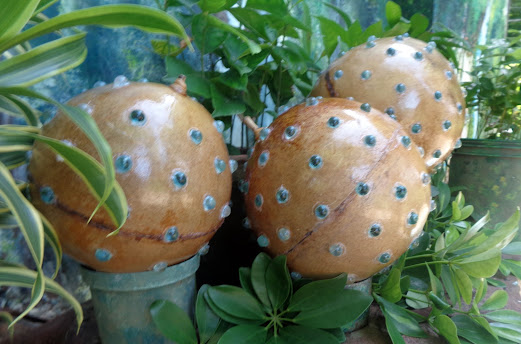
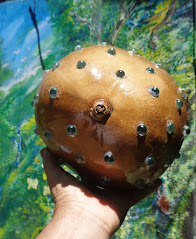
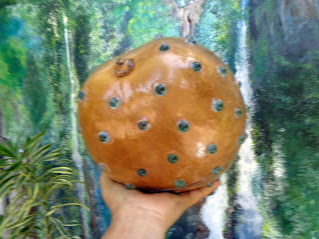
Calabash globes: lantern, savings bank, crystal ball. Crafted by the author 2025
Dichotomous is art today,in schools and movements,aesthetics and utility,indigenous and foreign,fantasy and reality,conventional and abstract.Art and craft, if I may say.


Calabash shell is the hard rind of Miracle Fruit (Crescentia cujete), Family Bignoniaceae. Although botanically distinct, the Calabash fruit has common features and uses with Bottle Gourd, Lagenaria siceraria, Family Cucurbitaceae, an annual climbing plant known as upo in Pilipino and tabungaw in Ilocano.
As old as in biblical times, or earlier,crafts made from this fruit were sacred,grains vessel, jug for wine and water,link of man's faith with his Creator.
The biblical meaning of the calabash encompasses its symbolism as a vessel, metaphorical representation of growth and flexibility, expression of abundance and blessings, and its significance in rituals and offerings. (The Biblical Significance of the Calabash: Unveiling Its Spiritual Symbolism, (Home and Nature, Internet)
Two Faces of our Planet Earth Chandelier

The Pristine Face of our Planet Earth in acrylic
on wood scrap by the author 2020
Imagine this scene before the Fall,nature in unity and harmony;Or is it an aftermath of man's exile,redeeming the Lost Eden's beauty?
The Defiled Face of our Planet Earth in acrylic
on wood scrap by the author 2020
Light in the air, swaying with the wind;heavy in the air dull, still;Pristine, natural in the absence of man,defiled, dead, can't humans feel?
Nature's Trophy
"The object of art is to give life a shape.” - Aristotle

Driftwood, foothold of shells, against a mural background,
crafted by AV Rotor 2024
Hail! But Nature's trophy is not victory,
not grandstanding and glory.
For Nature's distress call is a sad story,
to stop man's greed and folly.


Driftwood, foothold of shells in two views, AVR


Closeup of shells attached to the driftwood;
glass replica of pearls in oysters AVR
Pearl! How beautiful a pearl could be!but its kind today in the laboratoryholds no longer the secret of the sea.
Driftwood into Flower Vase

Main face of the driftwood vase
I am a remnant of a felled tree in a forest long ago,drifting down the river to the sea;braving the elements and patient with time, too;free but knowing not my destiny.For how long I drifted far and wide I do not know,my world was aimless and carefreeamong creatures I met, that would come and go.but to whom can I tell this long story?Until the tides took me one day into another view,to where trees stood happy once like me,where people brought back old memories anew;but I am now but a waste of the sea.Until a curious lass took me for something new,something for the arts, not for money;but some kind of beauty in my ugliness to showNature's hidden artistic quality. ~


Views of the driftwood vase in perspective variations.
"The artist sees what others only catch a glimpse of.” - Leonardo da Vinci. ~
8. "Please, come, and I'll give Thee rest."

Wall mural and pond, at home QC, by AVRotor 2010
The walls I painted hills and valleys and forests,towering to the roof I painted blue, clouds rising,birds flying in flock to meet the rising sun, as freshas the morning air, chirping sweet songs, circling;
And below a dozen pako fish wake in the goldenreflection of morning, eager for food and company;I wonder if ever they feel the confines of a den,for I have faithfully copied Rousseau's scenery.
Dream no more I said to myself, of Paradise Regained -It is here, in the very core of being next to the heartand soul, this Phrygian landscape with touch of vane,the essence of contrition and amendment for my part.
For nothing is unforgivable, that Sin inherited by usfrom our ancestors - we're doomed, deprived of heavenon earth. No! the gifts the Creator have been passedonward, and here I created a piece of that lost Eden.
Here I see God across the wall, and above my head,His harmonious creation over land, across the sea,I am part of the cycle of life everyday, even in bed,as seasons come and go, here I feel always free.
When lakes and rivers dry, and the sky no longer blue;as cities grow, land fills with waste, air no longer fresh;I pick my brush, say a prayer in color, shade and hue,Inviting my Creator, "Please come, and I'll give Thee rest." ~
9. Armageddon* in the Making
Is a Third World War inevitable?
Stockpile of nuclear weapons can annihilate present human
population three times over.


1. Blast, 2. Breakdown


3. Chaos, 4. Doom (Paintings by AV Rotor)
 A third world war was averted during the 45-year Cold War. As hindsight, an arms race revealed from both sides USA and USSR and their respective allies built a stockpile of nuclear weapons potentially capable of annihilating mankind three times, and irreversibly destroying the earth’s biological and ecological balance.
Armageddon an acrylic painting
by AV Rotor
1. A third and final world war is inevitable, it is now long overdue reckoning the first and the second at a generation’s interval. I am a witness to the second at its closing in mid 19th century, and grew up in its ruins in lives and properties, and in the relative peace that followed thereafter;
2. For 45 years until 1989 that peace thrived in fear and uncertainty under the proverbial Damascus Sword. The world was polarized into two warring ideologies – democracy and socialism – with countries, with few exceptions, drawn to either the side of America or that of Russia, then the Union of Soviet Socialist Republics or USSR.
3. A third world war was averted. As hindsight, an arms race revealed from both sides a stockpile of nuclear weapons potentially capable of annihilating mankind three times, and irreversibly destroying the earth’s biological and ecological balance, with radiation and other poisons that can persist for hundreds, if not thousands of years.
4. Year 1989 marked historical events of global significance: the dissolution of USSR to its core which is Russia, liberating its members as independent nations, and the reunification of East Germany and West Germany in a celebrated tearing down of the Berlin Wall that separated them for half a century. This marked the end of the Cold War.
5. The new era favored the transition of People’s Republic of China to open its doors to the free world following Mao Zedong’s death. Earlier the two Vietnams were reunited following the defeat of US-backed South Vietnam. South Africa, like India twenty years earlier, gained independence from Britain with Nelson Mandela at the helm.
6. But what really tore down the boundaries of nations zealously guarded by politics and economics have been the breakthroughs in science and technology, particularly in communication and transportation, disseminating information through multimedia and bringing people together. This ushered the beginning of “globalization.”
7. Man has conquered space in cyber communication, and space travel. The whole world is “wired” and crisscrossed by space lanes, shrinking the world into a village, so to speak. Liberalization brought socialism and other restrictive ideologies to their knees. Unopposed, capitalism rose and dominated the economy of nations and the world.
8. The world became one huge economy under capitalism with trade barriers lifted, trade zones expanded, cartels and monopolies emboldened, regional unions created and expanded (EU, APEC, ASEAN), industrialization and agriculture tremendously grew to meet demands of population explosion, affluence and growth of urban centers.

9. Forests were logged, farmlands and pastures exploited, lakes shrunk (e.g. Aral Sea), waterways polluted, air loaded with carbon and gases (CO2, Sulphur, methane) returning to earth as acid rain - and heat. The Ozone layer is thinned out by CFC compounds. Desertification, erosion, siltation add to the wanton destruction of the environment.
Stonewall of the Heart, by AV Rotor
10. A shift from fossil fuel has long been overdue. For more than a century the internal combustion engine has remained virtually unchanged. A shift to nuclear energy has chilling reminder of Hiroshima and Nagasaki atomic bombing in WWII, and nuclear plant incidents (Chernobyl in Ukraine, Fukushima in Japan), North Korea’s and Iran’s threat as new nuclear powers, notwithstanding.
-----


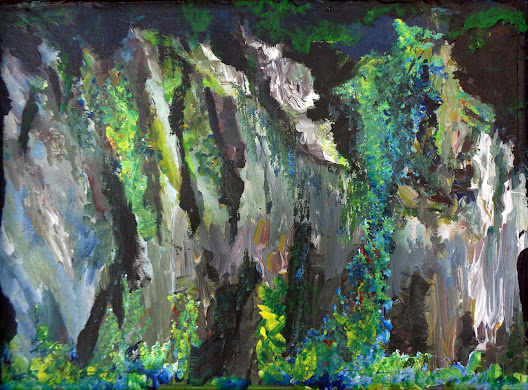


On a clear day we may see the lawin hovering over our subdivision, alone or with a partner in dalliance, simply gliding and circling up in the sky, in a spectacular kind of show that this bird now categorized as threatened is still around. Its home is the La Mesa watershed, just across our subdivision.


Imagine the world of the "lost" - professionals and students, ordinary people notwithstanding. It is a world where

These mini-dioramas were projects of students and became part of the former St Paul School Museum. SPUQC.
This lesson is dedicated to the students who made them, and to many visitors who appreciated the value of these masterpieces.
A diorama is a “view window” reproduced from an actual or imagined event or scene made by artists who have a background of painting, architecture and sculpture combined, and of course, history. In this particular case, the diorama artists must have a working knowledge of ecology and biology.
 The earth once wore a broad green belt on her midriff – the rainforest – that covered much of her above and below the equator. Today this cover has been reduced - and is still shrinking at a fast rate. The nakedness of the earth can be felt everywhere.
One place where we can witness this is right here in the Philippines where only 10 percent of our original forest remains.
Even the great Amazon Basin is threatened. As man moves into new areas, puts up dwellings, plants crops, becomes affluent, increases in number, the more the tropical rainforest shrinks. Our thinking that the forest as a source of natural resources is finite is wrong.
Like any ecosystem, a forest once destroyed cannot be replaced. It can not regenerate because by then the soil has eroded, and the climate around has changed. It is everyone’s duty to protect the tropical rainforest, the bastion of thousands of species of organisms. In fact it is the richest of all the biomes on earth.2. The Ocean
 The vastness of the Pacific Ocean is disturbed now and then by the presence of islands – big and small, singly or in groups - that appear like emerald and pearl strewn on the dark blue water, presenting a most beautiful scenery that attracts people to experience true communion with nature.
Originally these islands were the tips of volcanoes, at first fierce and unsettled, but later became tame to the elements that fashioned them through time into lagoons, and other land forms of varied geographic features. As seen in this diorama, this island typical of Boracay is rich in vegetation, coconut trees grow far into the water and on the white sand that cover the shores.
The coral reef teems with many kinds of marine life, from rare shellfish to aquarium fishes. In fact the whole island is a sanctuary of wildlife. It is a natural gene bank, a natural museum of biological diversity.4. Coral Reef
 Isolated from the lower slopes and adjoining valley, this ecological area has earned a distinction of having plants and animals different from those in the surrounding area.
Because of the unique climate characterized by an intense but short summer and extreme cold the rest of the year, the organisms in this biome have acquired through evolution certain characteristics that made them fit to live in such an environment.
Alpine vegetation is dramatic owing to its ephemeral nature. Here annual plants bloom with a precise calendar, attracting hordes of butterflies and other organisms. The trees are gnarled as they stand against the howling wind, mosses and liverworts carpet the ground, streams are always alive, and migrating animals have their fill before the cold sets in. We do not have this biome in the Philippines, but atop Mt. Apo in Davao and Mt. Pulog in Benguet, the country’s highest mountains, lies a unique ecosystem – a combination of grassland and alpine.
This could be yet another biome heretofore unrecorded in the textbook.6. Savannah
 Scenes of the Sahara flash in our mind the moment the word “desert” is brought about to both young and old, in fantasy or reality. Here lies a wasteland, so vast that it dwarfs the imagination.
Deserts are found at the very core of continents like Australia and North America, or extend to high altitude (Atacama Desert) or way up north (Siberian Desert) where temperature plunges below zero Celsius.
In the desert rain seldom comes and when it does, the desert suddenly blooms into multi-faceted patterns and colors of short-growing plants. Sooner the desert is peacefully dry and eerie once again, except the persistent cacti and their boarders (birds, insects and reptiles), shrubs and bushes that break the monotony of sand and sand dunes. But somewhere the “desert is hiding a well,” so sang the lost pilot and the Little Prince in Antoine de St. Exupery’s novelette, “The Little Prince.” I am referring to the oasis, waterhole in the desert. It is here where travelers mark their route, animals congregate, nations put claims on political borders.
Ecologically this is the nerve center of life, spiritually the bastion of hope, a new beginning, and source of eternal joy particularly to those who have seen and suffered in the desert. The desert is not a desert after all.~


 There are people who live happy and full lives while others do not. This leads us to look into the role of human faculties. When we talk of human faculties we refer to holistic intelligence. It is beyond IQ. It dwarfs the common concept of rationality. In fact, it defies definitions that scientists thought of plotting into various fields.
All of us are endowed with a wide range of intelligence which is divided into eight realms, namely:

Our changing environment refers to the ongoing changes happening to the planet, primarily due to human activities like burning fossil fuels and deforestation. These changes include global warming, rising sea levels, and altered ecosystems. Climate change is a significant aspect of these changes, with impacts including more extreme weather, melting ice, and rising sea levels. AI Overview Internet


“The ultimate test of a man's conscience may be his willingness to sacrifice something today for future generations whose words of thanks will not be heard.” — Gaylord Nelson

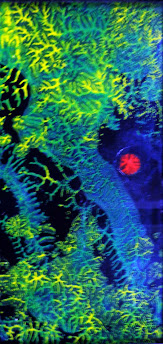
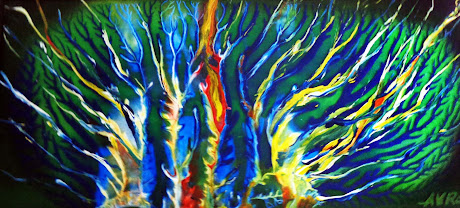
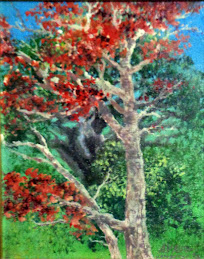


"In Egyptian and early Judeo-Christian traditions, the acacia is linked to life after death and the soul's immortality. It symbolizes spiritual rebirth and the eternal nature of the human spirit." - Oak & Hyde Internet


The eye! The eye!
among the corals watching.
conscience of the sea,
over Homo sapiens fishing.
It never winks, it's alive,
guarding against man's folly,
whose eye, not of man,
disgraced guardian of the sea. ~


 5. Primeval Universe
Primordium Universe in acrylic (38" x 26"), AVR 2011
I wonder at infinity in its very beginning,
of a primeval universe devoid of stars;
I wonder at the prima causa of time and space,
of energy and matter becoming living mass.
I wonder at the blueprint of a Supreme Design,
if found the Big Bang and the Black Hole;
I wonder if there was a kinder universe before,
where Heaven and Earth were one and whole. ~


.jpg)


* Añil is the Spanish word for indigo, a natural blue dye, prepared by fermentation of a plant, Indigofera suffruticosa. Añil was one of the products exported to Europe via Acapulco, Mexico, carried by Spanish Galleon ships from 16th to 18th century (300 years), the longest trading route between the two continents.


* Greek Armageddon, Harmagedōn, is the prophesied location of a final battle between good and evil at the end of time. It's described in the Book of Revelation as a gathering of armies for a great conflict. It is a term often used to refer to the end of the world or a final, decisive conflict.
10. Ecological Paradigm of Moral Life

Finding God in Cyberspace - remote and radical paradigm of
salvation in our postmodern time.

Forest fire induced by man's greed and folly in the pursuit
of the so-called Good Life. Painting by the author
Ecological paradigm endorses an eco-centric approach where all forms of life and non-life are important to human life. Spirituality points out to a unitive force: the sacredness of everything. God’s divinity flows in everything. There is integration in the universe. And we are part of that integration, exceedingly small as we are, notwithstanding.
The kind of person we truly are is reflected by our relationship with Mother Earth, how we comply under her treaties. Clearly, biocide is the greatest sin man commits in this period. Long live, Ceres! And Albert Schweitzer and King Solomon must be smiling up there. So with St. Francis of Assisi, patron saint of ecology. “Reverence for life,” is the key to this paradigm.
The kind of person we truly are is reflected by our relationship with Mother Earth, how we comply under her treaties. Clearly, biocide is the greatest sin man commits in this period. Long live, Ceres! And Albert Schweitzer and King Solomon must be smiling up there. So with St. Francis of Assisi, patron saint of ecology. “Reverence for life,” is the key to this paradigm.
11. The Deep Blue Sea and Greek Mythology Today

Blue Fish AV Rotor 2025
Blue* in the deep sea
makes the fish free,
invisible to their enemy
and to their prey.
* Blue light is known as high-energy visible (HEV) light because it has the shortest wavelengths - and therefore the highest energy - of all visible light. Thus making the ocean and the sky appear blue.

Legendary Cave by AV Rotor 2025
It reminds us of the Minotaur*
slayed by a young hero;
wonder if there's a Theseus today,
to make the story true.
*Minotaur - a mythical creature portrayed during classical antiquity
with the head and tail of a bull and the body of a man


Quo vadis, art?
Author (left) poses with his relatives from Baguio City in their recent visit at the Living with Nature Center, in San Vicente Ilocos Sur, their hometown. (Conrad, Zabeth and Kian Rotor). The back-to-back paintings depict scenarios on the relevance of art in our fast changing world today in two themes: ecology (protection of our natural environment), and mythology (in search of "heroes" in our midst). ~
----------------------------------------------------------------------

Wildlife in acrylic painting by AV Rotor
In less than a human lifetime, dozens of wildlife species have rebounded from the brink of extinction - and are establishing their territory on the countryside and in suburbs. Thanks to growing consciousness in wildlife protection and ecological conservation worldwide, despite massive and wanton destruction of wildlife habitats, and unabated pollution in air, water and land that threaten these and other species.
Painting of a lawin on a basketball backboard by the author
On a clear day we may see the lawin hovering over our subdivision, alone or with a partner in dalliance, simply gliding and circling up in the sky, in a spectacular kind of show that this bird now categorized as threatened is still around. Its home is the La Mesa watershed, just across our subdivision.
Idyllic life on the farm, painting in acrylic by AV Rotor
” 

Women Liberation from conventional role in the home and family, to do what men can in practically all fields of endeavor.. The breed of Tandang Sora and Joan of Arc’s local version, Gabriela Silang, comes to the picture in this period. Recently at one time five world leaders were women sitting side by side with men plotting the course of world affairs.
---------------------------------------------------------------------------------
11. Art and Greek Mythology Today
Blue Fish AV Rotor 2025
Blue* in the deep sea
makes the fish free,
invisible to their enemy
and to their prey.
* Blue light is known as high-energy visible (HEV) light because it has the shortest wavelengths - and therefore the highest energy - of all visible light. Thus making the ocean and the sky appear blue.
Legendary Cave by AV Rotor 2025
It reminds us of the Minotaur*
slayed by a young hero;
wonder if there's a Theseus today,
to make the story true.
*Minotaur - a mythical creature portrayed during classical antiquity
with the head and tail of a bull and the body of a man
Quo vadis, art?
Author (left) poses with his relatives from Baguio City in their recent visit at the Living with Nature Center, in San Vicente Ilocos Sur, their hometown. (Conrad, Zabeth and Kian Rotor). The back-to-back paintings depict scenarios on the relevance of art in our fast changing world today in two themes: ecology (protection of our natural environment), and mythology (in search of "heroes" in our midst). ~
12. Eco-therapy and Postmodern Living

In our postmodern living we are moving away from the natural world which guaranteed our success in evolution as a species. Then, rationality brought us out of the biblical Paradise in search of Utopia. We have been travelers searching for this ultimate destination.

Imagine the world of the "lost" - professionals and students, ordinary people notwithstanding. It is a world where
- Thoughts refuse to close down, even only for respite.
- Energy drains the whole being, even before starting to work.
- Sleep never comes on time and is never enough.
- Relationships are strained, if not alienated.
- Family bond is breaking up.
- Self worth and respect are falling to a point of depression, or suicide.

Relaxation is a discipline, a regimen, to
· switch off your thoughts to release stress before it builds up.
· conserve energy, budget it well
· sleep well to obtain full rest.
· mend relationships, build friendship
· bond closely with your family.
· discover your potentials to enhance self worth and respect.
13. Miniature Dioramas of Nature

Miniature diorama of a Coral Reef
These mini-dioramas were projects of students and became part of the former St Paul School Museum. SPUQC.
This lesson is dedicated to the students who made them, and to many visitors who appreciated the value of these masterpieces.
Hands-on, these dioramas took shape,
Bruised and cut and stained,
Sweat and tears, imagery and faith,
That Nature's image is made.
On-site, these scenes now in glass cases,
Are faithful to science and art;
They reveal the earth's beautiful faces,
But with the spark of life apart.~
The idea of miniaturized dioramas depicting ecological scenes was pioneered by students taking up ecology subject at St. Paul University QC. Their works - two dozen mini-dioramas depicting major ecosystems - were displayed for 15 years at the school museum, then the centerpiece of natural history.
A diorama is a “view window” reproduced from an actual or imagined event or scene made by artists who have a background of painting, architecture and sculpture combined, and of course, history. In this particular case, the diorama artists must have a working knowledge of ecology and biology.
One who may have visited any of the following museums has a better understanding as to what a diorama is in terms of structure, content and medium: National Museum in Manila, Ayala Museum at Greenbelt in Makati, and National Food Authority Grain Industry Museum in Cabanatuan. But the dioramas in these museums are large and spacious. It gives him the feeling that he is right on spot where the event is taking place or where the scene is located. This is enhanced with the right ambiance of lighting, musical background, narration or dialogue and the like.
The mini-dioramas at the former SPUQ museum are much simpler and smaller. They are works of amateurs but nonetheless exude the quality works of artists cum ecologists. Here are seven mini-dioramas depicting the Tropical Rainforest, the Ocean, Pacific Lagoon, Coral Reef, Alpine Biome, Savannah and the Desert,
1. Tropical Rainforest The earth once wore a broad green belt on her midriff – the rainforest – that covered much of her above and below the equator. Today this cover has been reduced - and is still shrinking at a fast rate. The nakedness of the earth can be felt everywhere.
 One place where we can witness this is right here in the Philippines where only 10 percent of our original forest remains.
Even the great Amazon Basin is threatened. As man moves into new areas, puts up dwellings, plants crops, becomes affluent, increases in number, the more the tropical rainforest shrinks. Our thinking that the forest as a source of natural resources is finite is wrong.
Like any ecosystem, a forest once destroyed cannot be replaced. It can not regenerate because by then the soil has eroded, and the climate around has changed. It is everyone’s duty to protect the tropical rainforest, the bastion of thousands of species of organisms. In fact it is the richest of all the biomes on earth.
Scientists today believe that eighty percent of the world’s species of organisms are found in the sea. One can imagine the vastness of the oceans – nearly 4 kilometers deep on the average and 12 km at its deepest - the Marianas Trench and the Philippine Deep - and covering 78 percent of the surface of the earth.
Artists and scientists re-create scenarios of Jules Verne’s, “Twenty Thousand Leagues Under the Sea,” such as this diorama, imagining man’s futuristic exploration in the deep led by Captain Nemo, the idealistic but ruthless scientist. Such scenarios are no longer fantasy today – they are scenes captured by the camera and other modern tools of research.
And the subject is not one of exploration alone, but conservation, for the sea, limitless as it may seem, is facing the same threats of pollution and other abuses man on land, in water, and air. The sea is man’s last frontier. Let us give it a chance.
3. Pacific LagoonArtists and scientists re-create scenarios of Jules Verne’s, “Twenty Thousand Leagues Under the Sea,” such as this diorama, imagining man’s futuristic exploration in the deep led by Captain Nemo, the idealistic but ruthless scientist. Such scenarios are no longer fantasy today – they are scenes captured by the camera and other modern tools of research.
And the subject is not one of exploration alone, but conservation, for the sea, limitless as it may seem, is facing the same threats of pollution and other abuses man on land, in water, and air. The sea is man’s last frontier. Let us give it a chance.

Originally these islands were the tips of volcanoes, at first fierce and unsettled, but later became tame to the elements that fashioned them through time into lagoons, and other land forms of varied geographic features. As seen in this diorama, this island typical of Boracay is rich in vegetation, coconut trees grow far into the water and on the white sand that cover the shores.
The coral reef teems with many kinds of marine life, from rare shellfish to aquarium fishes. In fact the whole island is a sanctuary of wildlife. It is a natural gene bank, a natural museum of biological diversity.
Second to the Tropical Rainforest in richness in species diversity is the coral reef, often dubbed as a forest under the sea. Corals are simple animals of the Phylum Coelenterata, now Ctenophora, that live in symbiosis with algae. Algae being photosynthetic produce food and oxygen that corals need, and in return receive free board and lodging, and carbon dioxide.
Within this zone grow many kinds of seaweeds, some reaching lengths of several feet long as in the case of kelp (Laminaria), and Sargassum, the most common tropical seaweed. As a sanctuary it cradles the early life stages of marine life until they have grown to be able to survive the dangers and rigors of the open sea. Coral reefs are formed layer upon layer through long years of deposition of calcareous skeletons of Coelenterates which is then cemented with sand, silt, clay and gravel to form into rock.
Limestone is a huge deposit resulting from this process Scientists believe that without coral reefs islands would disappear and continents shrink. Above all we would not have the fishes and other marine organisms we know today.
5. Alpine BiomeWithin this zone grow many kinds of seaweeds, some reaching lengths of several feet long as in the case of kelp (Laminaria), and Sargassum, the most common tropical seaweed. As a sanctuary it cradles the early life stages of marine life until they have grown to be able to survive the dangers and rigors of the open sea. Coral reefs are formed layer upon layer through long years of deposition of calcareous skeletons of Coelenterates which is then cemented with sand, silt, clay and gravel to form into rock.
Limestone is a huge deposit resulting from this process Scientists believe that without coral reefs islands would disappear and continents shrink. Above all we would not have the fishes and other marine organisms we know today.
 Isolated from the lower slopes and adjoining valley, this ecological area has earned a distinction of having plants and animals different from those in the surrounding area.
 Because of the unique climate characterized by an intense but short summer and extreme cold the rest of the year, the organisms in this biome have acquired through evolution certain characteristics that made them fit to live in such an environment.
Alpine vegetation is dramatic owing to its ephemeral nature. Here annual plants bloom with a precise calendar, attracting hordes of butterflies and other organisms. The trees are gnarled as they stand against the howling wind, mosses and liverworts carpet the ground, streams are always alive, and migrating animals have their fill before the cold sets in. We do not have this biome in the Philippines, but atop Mt. Apo in Davao and Mt. Pulog in Benguet, the country’s highest mountains, lies a unique ecosystem – a combination of grassland and alpine.
This could be yet another biome heretofore unrecorded in the textbook.
Home of game animals in Africa, the Savannah has the highest number of herbivores of all biomes. It had always been the “grand prix” of hunters until three decades ago when strict laws were passed prohibiting poaching and destruction of natural habitats.
The diorama depicts the shrub-grass landscape, a stream runs into a waterhole where, during summer, attracts animals from the lowly turtle to the ferocious lion which stakes on preys like zebra and gazelle. Beyond lies Mt. Kimanjaro, Hemingway’s favorite locale of his novel of the same title (Snows of Kilimanjaro). It is said that the beginning of the Nile River, the longest river in the world, starts with the melting of snow atop Kilimanjaro, right at the heart of the Savannah.
7. The DesertThe diorama depicts the shrub-grass landscape, a stream runs into a waterhole where, during summer, attracts animals from the lowly turtle to the ferocious lion which stakes on preys like zebra and gazelle. Beyond lies Mt. Kimanjaro, Hemingway’s favorite locale of his novel of the same title (Snows of Kilimanjaro). It is said that the beginning of the Nile River, the longest river in the world, starts with the melting of snow atop Kilimanjaro, right at the heart of the Savannah.
 Scenes of the Sahara flash in our mind the moment the word “desert” is brought about to both young and old, in fantasy or reality. Here lies a wasteland, so vast that it dwarfs the imagination.
 Deserts are found at the very core of continents like Australia and North America, or extend to high altitude (Atacama Desert) or way up north (Siberian Desert) where temperature plunges below zero Celsius.
In the desert rain seldom comes and when it does, the desert suddenly blooms into multi-faceted patterns and colors of short-growing plants. Sooner the desert is peacefully dry and eerie once again, except the persistent cacti and their boarders (birds, insects and reptiles), shrubs and bushes that break the monotony of sand and sand dunes. But somewhere the “desert is hiding a well,” so sang the lost pilot and the Little Prince in Antoine de St. Exupery’s novelette, “The Little Prince.” I am referring to the oasis, waterhole in the desert. It is here where travelers mark their route, animals congregate, nations put claims on political borders.
Ecologically this is the nerve center of life, spiritually the bastion of hope, a new beginning, and source of eternal joy particularly to those who have seen and suffered in the desert. The desert is not a desert after all.~
Other biomes:
- Tundra - type of biome where the tree growth is hindered by low temperatures and short growing seasons. It is the coldest of all the biomes.
Taiga - The Russian word for forest and is the largest biome in the world. It stretches over Eurasia and North America
Temperate Deciduous Forest - dominated by temperate broad-leaf trees that lose their leaves each year. The four seasons are distinct. The trees lose their leaves in colorful display characteristic in autumn; they lay bare often in snow in winter, resume growth in spring, and are most luxuriant in summer which is also the time of flowering and seed formation.
Grassland - characterized as lands dominated by grasses rather than large shrubs or trees. The largest grasslands are the prairies of North America, and pampas in South America
Chaparral - a shrubland or heathland plant community found primarily in the U.S. state of California and in the northern portion of the Baja California peninsula.
Lake - Examples: Sea of Gallilee, Aral Sea, Laguna Bay, Victoria
River - Mekong, Danube, Rhine, Nile, Mississippi, Yangzhe River, Brahmaputra,
--------------------------------
These mini-dioramas were made by students as school projects and were displayed at the then St Paul University QC museum for 15 long years that I was professor and museum curator. The museum has been transformed since I left in 2010 into another purpose. Biomes are defined as the world's major communities, classified according to the predominant vegetation and characterized by adaptations of organisms to that particular environment. The importance of biomes cannot be overestimated. Biomes have changed and moved many times during the history of life on Earth. More recently, human activities have drastically altered these communities. Thus, conservation and preservation of biomes should be a major concern to all.
14. Adventure with Nature
"Do not go where the path may lead, go instead where there is no path and leave a trail." - Ralph Waldo Emerson
Adventure with Nature in acrylic (20"x28") by AV Rotor 2025
Adventure with Nature, in search for meaning, joy-innocence-courage rolled in one, experience treasured in a lifetime, imprimatur of youth in old age, wisdom distilled from knowledge in the field;
Adventure with Nature, in search of man's ancestral past, virtues-values-reverence ensconced as one in the person, his family and community, primordial to unity and harmony of society and humanity;
Adventure with Nature, in search of what lies up high, atop a mountain, beyond the boundaries of horizon, as imagined views and images on the throne of the great Creator as He would watch over His creation;
Adventure with Nature, in search of a home in the four corners of the Earth and beyond, yearning to conquer time and space, suffering and death, ironically man has yet to conquer his own passion and weakness;
Adventure with Nature, in search of the lost biblical Eden, with deep faith of regaining its beauty and glory, through man's role as guardian and sentinel in keeping Nature's beauty and bounty;
Adventure with Nature, in search of freedom from the tender trap of technology, capitalism, sectarianism, fast lane and affluent living, depriving man the true meaning of the Good Life;
Adventure with Nature, in search of genuine World Peace sans fear of Armageddon, genuine happiness shared in Matthew 25, Psalm of Life, Rizal's vision, Milton's Paradise Lost and Paradise Regained.
Nature shares her bounty in many ways:He who works or he who prays,Who patiently waits or gleefully plays;He's worthy of the same grace
- AV Rotor, Living with Nature in Our Times UST 2007 ~
15. Logotherapy* with Nature
“Life is never made unbearable by circumstances, but only by lack of meaning and purpose.” ― Victor Frankl, Man's Search for Meaning
Artwork and wall mural by Dr Abe V Rotor

Tower of Doom Trophy against a wall mural Waterfalls Forever
by AV Rotor 2025. Living with Nature Center, San Vicente, Ilocos Sur
When you feel imprisoned aiming at affluence; your neighbors, friends, and people you may not even know, having set a standard of the Joneses, you too, wish to attain, yet know you cannot;
When you fall short of your expectation in life, your dreams are but effervescences, overtaken by shortcomings and circumstances beyond your control, age and poor health notwithstanding;
When you believe in the Good Life measured by wealth and power, popularity and social standing, yet feel empty inside, seeking for more, for something akin to that of Caesar's dream;
When you triumph over others, friends or enemies, masters or subordinates, in war and peace, and you call this victory, awarding yourself a trophy - and a crown of fig leaf;
When you have stayed too long, you can't remember, in a concentration camp far, far away from Flanders' Field, Shangri-la, or any place of freedom, peace and joy - much less of compassion;
When you have forsaken those you love and care, your family and community, in lieu of the promises of a bigger world of adventure, at the end finding yourself abandoned, and too, forsaken;
When you have fallen into the tender traps of capitalism, modernism, sectarianism and the like, and finding yourself at the receiving end an outcast, feeling alone in this wide, wide world;
* Logotherapy is an existential therapy developed by Viktor Frankl that focuses on finding meaning in life as the primary human motivation.


Tower of Doom Trophy against a wall mural A Li'l Corner of Eden
by AV Rotor 2025. Living with Nature Center, San Vicente, Ilocos Sur
Go out and find Nature, in her simple yet beautiful ways, expressed at sunrise, sunset, in the many faces of clouds, rainbow's arch like cathedral, the countless scenes of awe and wonder;
Go out and follow Nature from the mountains and hills, the watershed feeding the streams, rivers and lakes, making the fields and pastures, green, the grains golden at harvest time, kites flying in the blue sky;
Go and follow Nature down the vast ocean, visit the home of your ancestors in caves, forests, valleys, site of Genesis - the origin of all things, with Homo sapiens as God's masterpiece. Rejoice in thanksgiving! ~
16. Ecology: Reflection of the Good Life

All of us are endowed with a wide range of intelligence which is divided into eight realms, namely:
- Interpersonal (social intelligence)
- Intrapersonal (meditational, spirituality)
- Kinesthetic (athletics, dance, body language)
- Languages or linguistic
- Logic (dialectics, mathematics)
- Music (Auditory art)
- Spatial intelligence (drawing and painting, sculpture, architecture, photography)
- Naturalism (green thumb, relationship with the Natural World)
These realms reside in both left and right hemispheres of our brain, with the left doing more of the reasoning and the right of creativity. How we live a happy and fulfilled life largely rests on how balance we use our brain, making use of these eight God-given faculties. It is also with this premise that we find peace with ourselves and with our environment and ultimately with God. Thus it is not only how much we are endowed with this gift, but more importantly, it is how we make use of it fully and in the right way.
Why don’t you make your own assessment? Rate yourself in each realm. Analyze your top three. Are you not proud of them? Look at the other realms. You may not have tapped them well. Do you realize that there is a big room of improvement, and that there are latecomers in this world?
Lastly, let me emphasize another component of peace, that of sharing. I can not find a shorter way to explain it more clearly than to present this excerpt from “How to Live With Life,” published by Reader’s Digest. To wit:
“Every human being on this earth faces a constant problem: how to make the most of life. There is no simple solution; the art of living is the most difficult of all the arts. But fortunately for all of us, experience can be shared. Insights can be learned. Wisdom can be taught. Experiences, insights and wisdom of men and women – from teachers to clergymen, housewives to scientists, ordinary citizens to statesmen - who have lived deeply, thought profoundly and cared enormously about sharing with others what they learned have found some fragment of truth that cushions the harsh impact of reality or brightens the marvelous tapestry of living. From them we find some answers to the most fundamental of all questions: how to live with life.”
Final Reflections
Let us
Why don’t you make your own assessment? Rate yourself in each realm. Analyze your top three. Are you not proud of them? Look at the other realms. You may not have tapped them well. Do you realize that there is a big room of improvement, and that there are latecomers in this world?
Lastly, let me emphasize another component of peace, that of sharing. I can not find a shorter way to explain it more clearly than to present this excerpt from “How to Live With Life,” published by Reader’s Digest. To wit:
“Every human being on this earth faces a constant problem: how to make the most of life. There is no simple solution; the art of living is the most difficult of all the arts. But fortunately for all of us, experience can be shared. Insights can be learned. Wisdom can be taught. Experiences, insights and wisdom of men and women – from teachers to clergymen, housewives to scientists, ordinary citizens to statesmen - who have lived deeply, thought profoundly and cared enormously about sharing with others what they learned have found some fragment of truth that cushions the harsh impact of reality or brightens the marvelous tapestry of living. From them we find some answers to the most fundamental of all questions: how to live with life.”
Final Reflections
Let us
- Reflect on re-creating Nature with the image of the lost Eden
- Reflect on bringing the dead tree back to life.
- Reflect that everything in this world is interconnected. Reflect on the lost lamb, the prodigal son.
- Reflect on the new concept of heroes, hope of a tired Planet Earth
- Reflect that our lives can not be ruled by the faceless side of
- science and technology
- Reflect on long life but one lived with noble cause
- Reflect on that sailboat riding on the wave and wind towards a destination.
- Reflect on the multiple intelligence which God endowed singularly to man and how we make use of it in gratitude to the Giver.

- And if we think we are too little in this wide, wide world to make any difference, let this verse permeate in our thoughts and heart.

Cumulus
Rise up from the sea and come as rain,
wake the ponds, make the rivers flow,
fill the lakes, make the fields green;
the trees a curtain to hide the sun
a moment of your ephemeral beauty
of changing faces and a myriad figures;
delight many a child to draw,
to dream and grow;
and if one day the water of the sea is not enough,
drink, drink deep
from my little cup.
fill the lakes, make the fields green;
the trees a curtain to hide the sun
a moment of your ephemeral beauty
of changing faces and a myriad figures;
delight many a child to draw,
to dream and grow;
and if one day the water of the sea is not enough,
drink, drink deep
from my little cup.
Rocky cliff against cumulus cloud, in acrylic by the author 2020
17. Four-Seasons-in-One
"... the seasons come and go, never growing old;
each with rhyme, rhythm, and the meter of living,
renewing hope, keeping faith, humbling the bold."

Four-Seasons-in-One, acrylic, AVR 2012
I love the seasons, I want them all at the same time:spring, summer, autumn, winter - rolled into one;for I can't wait each coming, or the trouble to find;one sitting before the canvas and everything's done.
So in my life, seasons crowd in, knowing not which onecomes in the morning or evening, at work or play;I lost track of Vivaldi's Four Seasons, and the bondof creation that brings all together to pray.
The artist in me called, there's order in every thing -the seasons come and go, never growing old;each with rhyme, rhythm, and the meter of living,renewing hope, keeping faith, humbling the bold.~
18. Twenty Art Scenes of Our Changing Environment
“If the environment is happy, people will laugh and your grief will go away.”― Srinivas Mishra
Flow Gently Sweet Afton, local counterpart
“An understanding of the natural world and what’s in it is a source of not only a great curiosity but great fulfillment.” —David Attenborough


Ecosystems endangered - coral reef and forest
“The earth is always changing...readjusting to our existence. Each era is full of unique challenges”― Val Uchendu


Two colonies - marine and terrestrial
“The Earth is what we all have in common.”—Wendell Berry


Birds in the trees; fish in the deep
“Look deep into nature, and then you will understand everything better.” —Albert Einstein


Boys in the woods adventure; family of fish
“To leave the world better than you found it, sometimes you have to pick up other people’s trash.” —Bill Nye


Oil spill in two stages
“Live in each season as it passes; breathe the air, drink the drink, taste the fruit, and resign yourself to the influence of each.” — Henry David Thoreau


Aftermath of oil spill on marine ecosystem.
“Together we can preserve the forest, securing this immense treasure for the future of all these children.”— Chico Mendes


Evolution of life in two stages
And into the forest I go, to lose my mind and my soul.” —John Muir
“The ultimate test of a man's conscience may be his willingness to sacrifice something today for future generations whose words of thanks will not be heard.” — Gaylord Nelson


The Day After dreadful scenarios
“Look after the land and the land will look after you, destroy the land and it will destroy you.” —Aboriginal Proverb
“We are the first generation to feel the impact of climate change and the last generation that can do something about it.”— Barack Obama

New species emerging from genetic engineering
“Earth rejoices our words, breathing and peaceful steps. Let every breath, every word and every step make the mother earth proud of us.”― Amit Ray


Where have all the fire trees - and the children - gone?
"There can be no purpose more enspiriting than to begin the age of restoration, reweaving the wondrous diversity of life that still surrounds us." — E.O. Wilson ~
19. Cryptobiology: The Study of Nature Spirits
Annex - A Collection of Images of Cryptid Trees
Dr Abe V Rotor


Driftwood representing a Philippine eagle, hawk (lawin), and a dragon in biblical times and in fairy books. Displayed as a table top figurines, subject of curiosity and subsequent exchange of stories among young and old alike.
This figure of an aquatic creature apparently swimming, was discovered in an estuary. Old folks claim the creature once lived where sea and river meet, a unique habitat of many strange creatures, animals and plants as well. Mural background adds to the queer ambiance of the figure.

Horned duck with wings half-spread ready for takeoff, gives a fantasy image of a strange creature, which kids relate with cartoon characters and unique specimens like the Pterodactyl, an extinct genus of pterosaurs.


Top photos: Half-serpent, half-avian with distinct eyes, beak and crown (palong Tag); yelping puppy in a greeting pose. Lower photos: Long legged reptile emerging from a broken jar seems to be telling story fit for a horror movie.
Augury is the practice from ancient Roman religion of interpreting omens from the observed behavior of birds. A white dove means “peace”. A black dove means “war”. It could also pertain to matters of the heart, relationships, luck, misfortune, death, Remember the emissary bird in the biblical Noah's Ark? Have you seen a black dove in our real world?


Out of this world creatures haunt the forest, playing the role of guardian against poachers and loggers. Nature spirits are friendly to environmentalists and are believed to be protecting Nature's resources against abuse.
Cryptobiology is traced to our ancestors, and carried on through history, treasured in primitive societies, religious organizations, and time honored beliefs and tradition conveyed in documents and folktales.
Cryptobiology, Keeper of Values and Tradition
One time I asked a man of his true name. He said when he was a boy he was sickly. To overcome his condition, his nickname was changed with one stroke of a bolo (Taga' sa punong kahoy.) To this day Mang Kapok (kapok is cotton tree, Ceiba pentandra), now a senior, is heathy and strong, thanks to the spirit of the place and the village herbolario.
Beginning of Crypto communication
With the breakthrough in cybercommunication, it is evident that soon we will be communicating with Nature more directly than before, more than mere fantasy and imagination, over and above, inferential and psychological.
Cryptobiology and Conscientization
Conscientizatrion conveys the idea of developing, strengthening, and changing consciousness. Consciousness leads us to think further than knowledge in the pursuit of values, truth and the ideal. Here is a piece I wrote for a university lecture on Nature and Literature. ~
Annex - A Collection of Images of Cryptid Trees
Researched by Dr Abe V Rotor
"Cryptids are earthly symbols of communication between
and among creatures - including humans." - avr


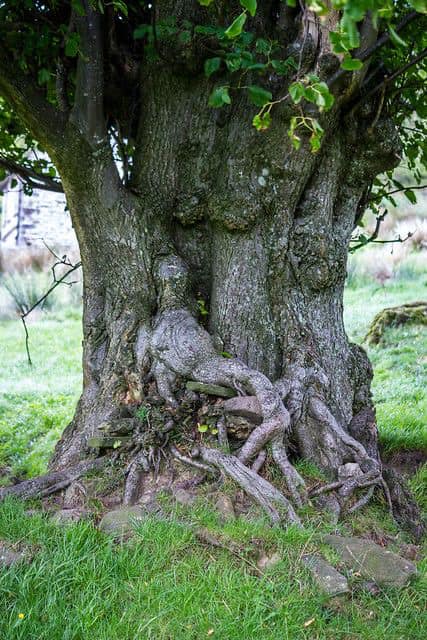
"Cryptids are Nature spirits appealing for understanding
and love from humans." - avr


Monsters are real, and ghosts are real too. They live inside us,
and sometimes, they win. - Stephen King


These and many cryptid figures are encountered on the Internet - blogs, facebook, e-mails, apps - indicating growing awareness of the dilemma of Nature's destruction, cum curiosity and fancy that accompany such experience. Acknowledgement with gratitude to all sources of these photos. -avr


"All that we see or seem is but a dream within a dream.
- Edgar Allan Poe
“Maybe all the people who say ghosts don’t exist are just afraid
to admit that they do.” - Michael Ende, The Never Ending Story


"We seem to take for granted unseen spirits, but we cannot escape
them as a result of our folly, indifference and greed." - avrotor
20. Love the Children through Art
“They always say time changes things, but you actually
have to change them yourself.” Andy Warhol

Author demonstrates basic art under the trees.
Away from the cellphone and mall,
for a time precious however small.
“If I could say it in words there would be no reason to paint.”
- Edward Hopper


Wall mural brings nature to children in imagery.
Reach out for something a dream,
a pot of gold, morning sun beam.
“To create one’s own world takes courage.” Georgia O’Keeffe


A work of art is beautiful and never wrong.
Proudly they stand with their art,
a treasure their lives now a part.
“The main thing is to be moved, to love, to hope, to tremble, to live.”
- Auguste Rodin


Outdoor art workshop under the trees. Living with Nature arboretum.
A school: its roof,
the sky and treetops,
its walls the horizon,
its floor bare earth;
it is Nature's zone.
Shh... these children feel free,
freedom in creativity
“Art washes away from the soul the dust of everyday life.” Pablo Picasso

Art guides children to a healthy socio-cultural life.
Time out, art is not in a hurry,
pause with nature and company.
“The job of the artist is always to deepen the mystery.” Francis Bacon


Author as guardian and tutor
Art has many expressions,in different sessions;shy and cautious at first,'til released like a burst.
“I am seeking. I am striving. I am in it with all my heart.” Vincent van Gogh ~
21. Requiem to a Heritage Acacia Tree
"If you have never loved a tree, life's true magic has ceased to breathe." - Angie Weiland-Crosby

Author points at an on-the-spot painting he made in 1976 of a standing heritage acacia tree. Adjacent to it is a outdoor furniture shop. San Vicente is famous for wood furniture industry. The painting graces the lobby of the San Vicente Municipal Hall in Ilocos Sur.
"A great acacia, with its slender trunkAnd overpoise of multitudinous leaves.(In which a hundred fields might spill their dewAnd intense verdure, yet find room enough)Stood reconciling all the place with green."- Elizabeth Barrett Browning Internet

Author, with coeds from the University of Northern Philippines, pose
with the relics of the heritage acacia he painted in 1976 as seen above.
"Life is like a tree. Every Leaf is a dream, it may be big or small. When the leaves fall, dreams disappear but when the trees have new leaves, life has new wonderful things." - Pinterest

Closeup of the mounted artwork. It serves as a memorabilia,
more than a biological specimen and work of art.
22. Save Nature through Children's Art Workshop
"Lolo," knocking on the gate, they called,
"Why it's gloomy, typhoon's coming," I said;
And the wind had started blowing cold;
Children are children, bless them, oh Lord.
And I, a parent, a teacher grown very old,
Rose from my armchair to meet the three;
"Can we draw?" chorused they cheerfully
What shall they draw when the sky's heavy?

Living with Nature garden with Rizal's shrine as background.
The shrine depicts his life in exile at Dapitan as artist, scientist,
doctor, teacher and farmer, among other roles.

Author and tutor Dr Rotor poses with budding artists, all students of San Vicente Integrated School. at the Living with Nature Center
"Go to Mother Nature when tired, lonely and uncertain,
when all human comfort fails, when abandoned." - avr


Integrated Children's Summer Workshop conducted by the author
at the San Vicente Botanical Garden , San Vicente, Ilocos Sur.
Take time out from TV, computer, malling;life's so dull, busy yet empty;The left brain's overworked, the right idle,growing up is a sad story.
Take time out in summer away from school,put down your books and depart;give imagination a chance over knowledgethrough creativity in the art.
Take time out to be close to Mother Nature,draw and paint under the trees,recreate the world you wish it should be,let your worries go with the breeze.
Take time out to be your real self, discoverbeyond the world of reality,with myriad colors and the paintbrush,the boundless realm of fantasy. ~
Author's Note: From the neighborhood these three children came to learn drawing in the course of weather disturbances caused by a series of typhoons lately. School classes were suspended, but thanks to the brief calm moments the children found respite in drawing. They brought home their works, in order to share their acquired skill and optimism to their family and community.
23. Art Evolution: "Aim at Function, Beauty and Posterity."
UNP Education Students visit the Living with Nature Center
San Vicente, Ilocos Sur
"I hear and I forget. I see and I remember. I do and I understand." - Confucius
Dr Abe V Rotor

Samples of home-made projects - original and simple.
Author's art work 2025.
School projects students must submit,easiest to buy than make their own;unfair to those who labor to make one,but a teacher knows which is genuine.


" Art, craft, teaching aid, laboratory specimen rolled-in-one."
Multi-facet projects challenge creativity;aim at function, beauty and posterity.
“Life is a succession of lessons which must be lived to be understood.” — Helen Keller

Reviving the piggy bank tradition in art. Guests put in the first coins.
Art promotes values,
secures one as he grows old;
to the lavish and bold.
there's no excuse.
“Learning is experience. Everything else is just information.” — Albert Einstein ~
24. Neo-Symbolism Art Movement in Our Times
Dr Abe V Rotor
1. Wounded Peace
Wounded Peace in acrylic by the author 2020
Peace they bring these white doves in the sky;
passing over Flanders's Field of long ago,
when suddenly fired upon from down below;
it's history repeating the battle cry. - avr
2. The Eye in the Coral Reef

The Eye in the Coral Reef, Acrylic Painting by the author 2015
among the corals watching.
conscience of the sea,
over Homo sapiens fishing.
It never winks, it's alive,
guarding against man's folly,
whose eye, not of man,
disgraced guardian of the sea. ~
3. Two Faces of our Planet Earth
The Pristine and defiled faces of our Planet Earth in acrylic on wood
scraps by the author 2020
Light in the air, swaying with the wind;
Heavy in the air dull, still;
Pristine, natural in the absence of man,
Defiled, dead, can't humans feel?
4. Living Columns of Parthenon
Green Parthenon, in acrylic on wood by the author
Living columns, Parthenon of the forest,
your fate in the hands of man,
what time did to a temple of the gods -
ruins of beauty now gone.
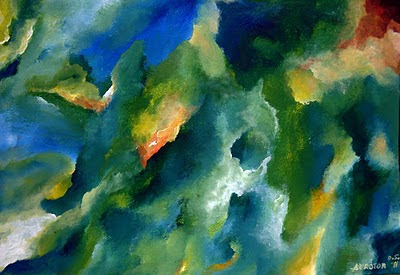
Primordium Universe in acrylic (38" x 26"), AVR 2011
I wonder at infinity in its very beginning,
of a primeval universe devoid of stars;
I wonder at the prima causa of time and space,
of energy and matter becoming living mass.
I wonder at the blueprint of a Supreme Design,
if found the Big Bang and the Black Hole;
I wonder if there was a kinder universe before,
where Heaven and Earth were one and whole. ~
6. White doves at dawn

Silent Spring of Carson warns us of destruction,
from runaway technology and affluent living;
white doves coming down to herald at dawn
peace isn't lost, but waiting for us to redeem.
7. Maze

Maze in acrylic by the author 2025
Symbol of many an interpretation
in life and living, home, at work;
but where has the painter gone?
what really is his own intention?
8. Thorns Hanging

Hard rind of Miracle fruit embedded with cherry thorns,
artwork of the author.
Why thorns on a ball or globe,plaything - or is it our world?Like hanging Damocles' sword,over man, both young and old.
9. Tree of Knowledge

Tree of Knowledge after the Fall in acrylic, AVR
All alone after the Fall, abandoned;regained somewhere, we believe;in our world, cyberspace, searchingfor this Tree of Adam and Eve.
10. Silent Bells

Silent Bells in acrylic AVR
The bells, their mission done,
adorn with flowering vines,
where have the faithful gone? ~
25. Nature is Alive on Wall Murals
Mural Paintings by Dr Abe V Rotor
"Nature inside the house."
Bring nature home to the living room,in make-believe unspoiled landscape;do away with those fixtures and decors -for good health and happiness' sake.
"Fashion" before a waterfall
Natural - a cry today to be happy and free,away from the burgeoning life in the city;it's a school without walls, a true story,take the backseat affluence, luxury.
Picnic at the sala, author's residence
In their mind, it's outdoor with nature,with amenities through art, they are;away from the cellphone, from the mall,as they while away time, worry and chore.
Sidewalk wall mural, author's residence, San Vicente, Ilocos Sur
A dead wall resurrects across the street,a waterfall whispers, douses the heat,slows down pulse, heart, and busy feet;wonder why we are always on the beat.
World War II hanging mural, St Paul University QC, then a novitiate
History in its darkest hour, a work of art,captured from memorabilia long gone,keeps afresh across memory lane and time,in the cycle of life, likened to the sun.
Author-artist plays the violin before a wall mural.
Mural of nature and life by the sea as one,creates music with the wind and sun;oido (by-the-ear), natural, spontaneous,expressed by the artist's own opus!
Baby Waterfall - Spring from the Wall
Refresh your tired hands with spring water,relax after a whole day of teaching;don't reach or even go beyond your limit;Mother Nature is just around waiting.
Guests all in a row before a waterfall mural
Teachers and students often come for field study,while away time from school, even only for a day.
Dead-end Wall Alive, old church wall, San Vicente, Ilocos Sur
Never say, "I've reached dead end."It's not the end of life about;why not get some paint and brush,and clear your way out?

.jpg)
EA Apartelle* wall mural, San Vicente, Ilocos Sur
Apartelle is a Philippine term referring to a type of accommodation
that combines the features of an apartment and a hotel.
Where the busy street settles down on a wall mural,
of an apartment-hotel hallway, away from the city;
take a deep breath of freedom from stress and tension,
commune with make-believe nature, short it may be.
Boundary wall mural 50 meters long, 7 bays. Lubong, San Vicente,
Ilocos Sur
Once site of garbage and shanties for years,beside a historic ruins of añil* vats preserved;I took the reign as owner-and-artist as one,to rebuild the site back anew with cheers.
Catching butterflies
Imaginary butterflies - white, blue and redattract these kids, more than flowers do;a game of the right and left brain compared;
imagination reigns, letting reason go.
Siesta
Relaxation slows down our busy world;it's indeed a most precious word.
A country lass, Kate, hugs a tree on the wall at the author's
residence in San Vicente, Ilocos Sur.
"Come to the woods," this mural seems to say,and find rest in its living shroud,bastion of love, freedom and harmony,away from the maddening crowd.
. "A hug is two hearts wrapped in arms." – Unknown.
* Hugging a tree involves wrapping your arms around its trunk, often to connect with nature and experience its calming presence. This practice can have various benefits, including reducing stress, boosting the immune system, and releasing emotional blockages. It's also a form of mindfulness, encouraging introspection and a sense of belonging. - AI Overview Internet

No comments:
Post a Comment