
Dedicated to our country's National Hero, born June 19, 1861, and whose martyrdom on December 30, 1896 ignited a revolution against Spain leading to Philippine Independence.
Rizal as a student in Europe; right, most popular portrait, in official documents and books; Rizal, had he reached 90. Acknowledgment: Mr. Philip Cabrera, son of the artist; and National Historical Institute.


This article serves as a reference guide to students taking the Rizal Course, a three-unit subject in college.
Dr Abe V Rotor
TRIVIA: Complete name of Jose Rizal: José Protasio Rizal Mercado y Alonso Realonda. The Philippine national hero, Jose Rizal, has his own views and concepts about Global Fellowship which is synonymous to "Internationalism", "Worldwide Brotherhood", "International Alliance", and "Global Fellowship of Humankind". The following concepts are taken from Rizal's own words, speeches, literature, and careful analysis of his personal history and works.
------------------------------------"It is not what your country can do for you, but it is what you can do for your country." Rizal
------------------------------------
Factors that shaped Rizal
------------------------------------
Factors that shaped Rizal
Among the factors that shaped Jose Rizal as a person:
1. Racial origin: Rizal descended from the Malay race and also genetically inherited the mixed Ilocano and Pangasinan bloodline of his mother. He also has Chinese and Spanish lineage.
2. Faith (religion): Christianity also shaped Rizal's way of thinking. He was born, baptized, and raised as a Roman Catholic.
3. His being a reader of books: He read many manuscripts, books, and other publications printed in various languages.
4. His being a linguist: His knowledge of different languages apart from his own. He can speak and understand 22 languages.
5. His voyages: He was able to befriend foreigners from the various nations that he was able to visit.
Rizal's ideas about "Brotherhood" (Fellowship)
These are Rizal's ideas about the subject of having a fellowship or brotherhood of humankind:
1. Education: The proper upbringing and education of children and daughter in order for them to prevent the same fate and suffering experienced by the uneducated and ignorant fellowmen under the rule of the Spaniards.
2. Faith or religion: The belief in only one God. The existence of different religions should not be the cause of misunderstandings. Instead, this existence of many religions should be used to attain unity and freedom. There should be deep respect to every individual's faith; the beliefs that one had become accustomed to and was brought up with since childhood.
3. Fellowman: It is important for one person to have a friend (fellow) and the establishment of an acquaintance with fellow human beings. (It is also important) to recognize the equality of rights of every fellow human being regardless of differences in beliefs and social status.
Rizal's efforts to promote a "Global Fellowship"
Rizal promoted global fellowship through the following:
a. Formation of organizations: Included here are known scholars and scientists recognized as the International Association of Filipinologists.
b. Friendship: In every journey, he was able to meet and befriend foreigners who sympathize with the experiences and events occurring in the Philippines.
c. Maintenance of communication: Before and during his exile at Dapitan, Rizal was able to keep in touch with his friends located in different parts of the world. He was also able to exchange opinions, writings and even specimens which he then studied and examined.
d. Joining organizations: Rizal believed in the goals of organizations that are related to the achievement of unity and freedom of humankind. He always had the time and opportunity to join into organizations.
Basis of "Worldwide Brotherhood" (Worldwide Fellowship)
These are the basis of the above ideas, which were then taken from Rizal's opinions found in his own writings and speeches which intend to establish unity, harmony, alliance and bonding among nations: The fundamental cause or reason for having the absence of human rights is eradicated through the establishment of unity.
One of Rizal's wishes is the presence of equal rights, justice, dignity, and peace. The basis for the unity of mankind is religion and the "Lord of Creations"; because a mutual alliance that yearns to provide a large scope of respect in human faith is needed, despite of our differences in race, education, and age. One of the negative effects of colonialism is racial discrimination. The presence of a worldwide alliance intends to eradicate any form of discrimination based on race, status in life, or religion.
Rizal wishes Peace to become an instrument that will stop the colonialism (colonization) of nations. This is also one of Rizal's concerns related to the "mutual understanding" expected from Spain but also from other countries. Similar to Rizal's protest against the public presentation (the use as exhibits) of the Igorots in Madrid in 1887 which, according to him, caused anger and misunderstanding from people who believed in the importance of one's race.
Hindrances towards the achievement of a "Worldwide Brotherhood"
However, Rizal also knew that there are hindrances in achieving such a worldwide fellowship: Change and harmony can be achieved through the presence of unity among fellowmen (which is) the belief in one's rights, dignity, human worth, and in the equality of rights between genders and among nations.
From one of the speeches of Rizal:
“The Philippines will remain one with Spain if the laws are observed and carried out (in the Philippines), if the Philippine civilization is "given life" (enlivened), and if human rights will be respected and will be provided without any tarnish and forms of deceitfulness. ”
Rizal's words revealed the hindrances against an aspired unity of humankind:
1. The absence of human rights.
2. Wrong beliefs in the implementation of agreements.
3. Taking advantage of other people.
4. Ignoring (not willing to hear) the wishes of the people.
5. Racial discrimination.
Excerpt from one of Rizal's letter to a friend:

“ If Spain does not wish to be a friend or brother to the Philippines, strongly the Philippines does not wish to be either. What is requested are kindness, the much-awaited justice, and not pity from Spain. If the conquering of a nation will result to its hardship, it is better to leave it and grant it its independence. ”
This letter presents Rizal's desire and anticipated friendship between Spain and the Philippines, but one which is based on equality of rights.
 Translation:
"What? Does no Caesar, does no Achilles appear on your stage now,
Not an Andromache e'en, not an Orestes, my friend?"
"No! there is naught to be seen there but parsons, and syndics of commerce,
Secretaries perchance, ensigns, and majors of horse."
"But, my good friend, pray tell me, what can such people e'er meet with
That can be truly great? - what that is great can they do?"
- Friedrich Schiller, "Shakespeare's Ghost," translated by John Bowring
 Translation:
TO MY COUNTRY
Recorded in the history of human suffering are cancers of such malignant character that even minor contact aggravates them, endangering overwhelming pain. How often, in the midst of modern civilizations have I wanted to bring you into the discussion, sometimes to recall these memories, sometimes to compare you to other countries, so often that your beloved image became to me like a social cancer.
Therefore, because I desire your good health, which is indeed all of ours, and because I seek better stewardship for you, I will do with you what the ancients did with their infirmed: they placed them on the steps of their temples so that each in his own way could invoke a divinity that might offer a cure.
With that in mind, I will try to reproduce your current condition faithfully, without prejudice; I will lift the veil hiding your ills, and sacrifice everything to truth, even my own pride, since, as your son, I, too, suffer your defects and shortcomings.~
NOTE: This article serves as a reference guide to students taking the Rizal Course, a 3-unit subject in college.
Anecdotes about Rizal
Acknowledgement: Internet
1. One day, intending to cross Laguna de Bay, the boy Rizal rode on a boat. While in the middle of the lake, he accidentally dropped one of his slippers into the rough waters. The slipper was immediately swept away by the swift strong currents . Do you know what he did? He intentionally dropped the other slipper into the water. When somebody asked why he did such a thing, he remarked, "A slipper would be useless without its mate".
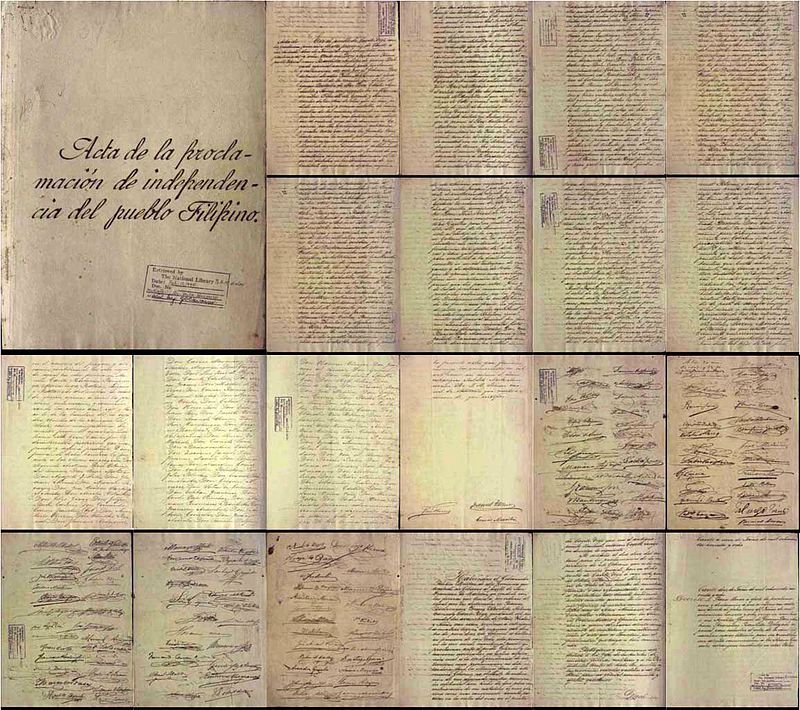 Documents of the Declaration of Philippine Independence on June 1, 1898

Artist's interpretation on Rizal on his way to execution at Bagumbayan. Note lively gait and stride, and apparently jovial conversation with the escorting military officer. It was reported by an attending doctor that Rizal's pulse rate was normal even as he faced the firing squad.-----------
* Dr Abe V Rotor
Former Professor, Rizal Course, UST and SPUQC
References: Rizal as the Father of Filipino Nationalism (Manila: Bureau of printing, 1941), and Rizal's Concept of World Brotherhood, 1958.
Acknowledgement: Internet
1. One day, intending to cross Laguna de Bay, the boy Rizal rode on a boat. While in the middle of the lake, he accidentally dropped one of his slippers into the rough waters. The slipper was immediately swept away by the swift strong currents . Do you know what he did? He intentionally dropped the other slipper into the water. When somebody asked why he did such a thing, he remarked, "A slipper would be useless without its mate".
2. It was Jose Rizal's Mother who told him about the story of the moth. One night, her mother noticed that Rizal was not paying anymore attention to what she is saying. As she was staring at Rizal, he then was staring at the moth flying around the lamp. She then told Rizal about the story related to it.
There was a Mother and son Moth flying around the light of a candle. The Mother moth told her son not to go near the light because that was a fire and it could kill him easily. The son agreed. But he thought to himself that his mother was selfish because she doesn't want him to experience the kind of warmth that the light had given her. Then the son moth flew nearer. Soon, the wind blew the light of the candle and it reached the wings of the son moth and he died.
Rizal's mother told him that if the son moth only listened to what his Mother said, then he wouldn't be killed by that fire.
Rizal's mother told him that if the son moth only listened to what his Mother said, then he wouldn't be killed by that fire.
Rizal must have remembered his mother's anecdote that night a moth visited him in Fort Santiago where he awaited his execution the following morning. He must have thought of the moth dying for his country's freedom. It died for a cause. It is the way martyrs die.
Documents of the Declaration of Philippine Independence on June 1, 1898
Artist's interpretation on Rizal on his way to execution at Bagumbayan. Note lively gait and stride, and apparently jovial conversation with the escorting military officer. It was reported by an attending doctor that Rizal's pulse rate was normal even as he faced the firing squad.-----------
* Dr Abe V Rotor
Former Professor, Rizal Course, UST and SPUQC
References: Rizal as the Father of Filipino Nationalism (Manila: Bureau of printing, 1941), and Rizal's Concept of World Brotherhood, 1958.


