

Sunday, August 15, 2010

Part 3: Insects as Food

 Giant water bug served in a Bangkok restaurant
Abe V Rotor
One practical means of insect control is by harvesting them for food. This practice is not only confined among primitive societies but is still one of the most practical means of controlling insects. Anyone who has tasted kamaro’ (sautéed mole cricket – Gryllotalpa africana) would tell you it is as tasty as shrimps, lobsters or other crustaceans. After all, insects and shrimps belong to the same phylum – Arthropoda.
Locusts may destroy crops but, in a way, bring food to its victims. During a swarm, locust is harvested by the sacks and sold for food and animal feeds. The same goes for gamu-gamu (winged termites – Macrotermes) at the onset of the rainy season, or the salagubang (Leucopolis irrorata), another insect delicacy. Other food insects are the grubs of kapok beetle locally called u-ok, eggs and larvae of hantik (green tree ant), larvae of honeybee and cheese maggots.
When is a pest a pest?
When we see an insect, instinct tells us to kill it. We should not. A caterpillar is a plant eater, but the beautiful butterfly that emerges from it is harmless, efficient pollinator. Hantik ants make harvesting of fruits inconvenient because of their painful bite, but they guard the trees from destructive insects. Houseflies carry germs, but without them the earth would be littered with dead, undecomposed organisms. They are nature’s chief decomposers working hand in hand with bacteria and fungi. Termites may cause a house to crumble, but without them the forest would be a heap of fallen trees.
It is natural to see leafhoppers on rice plants, aphids on corn, bugs in the soil, grasshopper on the meadow, borers on twigs, fruit flies on ripening fruits. These organisms live with us under one biosphere. If we can think we can dominate them, we have to think again. They have been dominating the earth for billions of years, even before man appeared. Just one proof: the total weight of ants inhabiting the earth outweighs six billion human inhabitants.
There is no way to escape pesky creatures. Conflict arises only when their populations increase rapidly to overrun our crops, spoil our stored products, and threaten our health and welfare.
We have set certain thresholds of our co-existence with insects. As long as they do not cross that line, we can cohabit this planet peacefully with them. By so doing, we can ponder at the beauty of their wings, the mystery of the fire they carry, the music they make, the magnitude of their numbers, or marvel at the mystery of their presence.
x x x
Home Sweet Home with Nature, AVR
Thursday, August 12, 2010
Living with Nature
Dr Abe V Rotor
 Farm Life in acrylic, AVRotor
Review Guide in Advanced Ecology, UST Graduate School
1. The pond is a miniature lake, a minuscule of the sea.
2. "The ultimate test of any civilization is the endurance of Mother Nature in keeping up with man's endless needs."
3. Phytoplankton provide three-fourth of the earth's oxygen supply.
4. Natural healing with pet therapy
5. Make your pet dog happy.
6. Hantik is a natural predator, a biological agent in pest control.
7. During WWI wounded soldiers left in the field survived from their wounds.
8. Return of Ipil-ipil shows Nature's healing process.
9. The island of Corrigidor was re-vegetated immediate after WW II.
10. Pesticide-free vegetables.
11. Bryophytes - link of protists and true plants.
12. Home gardening success depends on basic requirements.
13. Bahay Kubo - center of self-sufficiency and good life.
14. Homestead features Home, Sweet Home with Nature.
15. Garlic - oldest natural medicine.
16. Superstitious beliefs in ethnobotany.
17. Gene piracy is the biological counterpart of intellectual rights piracy.
18. Basic landscaping principles.
19. How do you enjoy your favorite fruits?
20. Can you grow pechay without soil?
21. What is the most bitter vegetable?
22. Famine or hunger plants.
23. What is dragon fruit, Alstonia scholaris, Pterocarpus indicus?
24. Most popular sea vegetables in the market.
25. "... and heaven and nature sing, and heaven and nature sing..." ~
References: The Living with Nature Handbook, AVR; and Living with Nature in Our Times, AVR
 Farm Life in acrylic, AVRotor
Review Guide in Advanced Ecology, UST Graduate School
1. The pond is a miniature lake, a minuscule of the sea.
2. "The ultimate test of any civilization is the endurance of Mother Nature in keeping up with man's endless needs."
3. Phytoplankton provide three-fourth of the earth's oxygen supply.
4. Natural healing with pet therapy
5. Make your pet dog happy.
6. Hantik is a natural predator, a biological agent in pest control.
7. During WWI wounded soldiers left in the field survived from their wounds.
8. Return of Ipil-ipil shows Nature's healing process.
9. The island of Corrigidor was re-vegetated immediate after WW II.
10. Pesticide-free vegetables.
11. Bryophytes - link of protists and true plants.
12. Home gardening success depends on basic requirements.
13. Bahay Kubo - center of self-sufficiency and good life.
14. Homestead features Home, Sweet Home with Nature.
15. Garlic - oldest natural medicine.
16. Superstitious beliefs in ethnobotany.
17. Gene piracy is the biological counterpart of intellectual rights piracy.
18. Basic landscaping principles.
19. How do you enjoy your favorite fruits?
20. Can you grow pechay without soil?
21. What is the most bitter vegetable?
22. Famine or hunger plants.
23. What is dragon fruit, Alstonia scholaris, Pterocarpus indicus?
24. Most popular sea vegetables in the market.
25. "... and heaven and nature sing, and heaven and nature sing..." ~
References: The Living with Nature Handbook, AVR; and Living with Nature in Our Times, AVR
Tips in Photography for Communication and Creative Art

1. Subjects are everywhere. But you have to look for your subject. See new angles, dimensions, perspectives, and many other ways to make the most of each subject. Use all senses possible, draw out subjects from imagination. More than a "nose for news" approach or "gut feel", imagine, re-create, and feel your subject.
2. Camera cannot discriminate. "You and I may lie, but the camera does not lie." The camera captures all within its vision. But you can focus only on a particular object or part of it. You can script. Be sure a scripted picture is not obvious.
3. Power of colors. It means appropriate colors for your subject tuned to the occasion, ambiance, purpose - with the sense of moderation and fine taste. Colors are all around. Discern colors to attract, harmonize, create moods, contrast, emphasis. To make your subject look real. Use color schemes to add coherence to your picture, to interpret expressively. Use warm and cool colors properly. Strong colors do not always attract, maybe you need distorted colors like reflection on water. Be guided in color harmony using the Color Chart.
4. Exposure setting. Even with an automatic camera, you need to check and apply the proper exposure. Otherwise you get over exposed or under exposed results. Too high DIN/ASA/ISO under the sun results to granulated photo. (Pointillism effect). Practice bracketing: make a series of shots of the same subject with different modes (aperture, shutter, ISO), and at variable distance. Compare and choose, edit (if necessary), arrange or collage
5. Use lines properly. Lines lead the eye. Lines create moods, emphasis, direction. Break monotony, repetition, prosaic impression. Lines give a sense of measurement like distance, volume, height.
6. Focus to make clear, sharp image. Even with automatic cameras, be sure you get the best focus. The light meter measures light - not necessarily the subject.Use focus for emphasis and viewpoint, and differential focus (sharp and soft). Focus guides you in editing, specially cropping. It emphasizes the value of the picture, its newsworthiness and artistic quality.
7. Shutter freezes action. Or creates mood. Movement is a difficult subject. Split of a second. Passing view. Fast cars, winning shot, fired bullet. Yet a little blur or haze gives a special touch to the picture.
8. Aperture or lens opening. Depth of field must be well defined, unless you have another objective, like eliminating undesirable background. Shallow depth of field makes a particular person to stand out in a crowd. General rule is that the smaller the aperture, the deeper is the depth of field. Infinity mode is usually set on smaller aperture or lens opening just like how the pupil of the eye works.
9. Exposure setting. Even with an automatic camera, you need to check and apply the proper exposure. Otherwise you get over exposed or under exposed results. Too high DIN/ASA/ISO under the sun results to granulated photo. (Pointillism effect). Practice bracketing: make a series of shots of the same subject with different modes (aperture, shutter, ISO), and at variable distance.
10. Composition. This is basic in writing a song or theme, in painting, in architecture, and the like. Adopt necessary format - horizontal, vertical, or square - to the final picture, either with the camera or by editing, or both. Composition is the key to a masterpiece, it tells a story, it leads to the message, it presents a holistic view. It removes the wasteland, so to speak.
11. Viewpoint. This element has a great impact on composition. Is it at the left or right? How close should the subject appear? Close-up? Is it a low or high viewpoint in terms of perspective. Fill up the whole frame? Or give a breathing space? Often we ask, "What's your viewpoint?" You may mean, "How do you see the thing?"
12. Framing. It's like seeing a play. The characters are framed on the stage. In photography it may be a window, arched doorway, or an arch itself like the Arch of the Centuries. These can make a natural frame in your photo. Or you may need background framing, instead, like stained glass behind a praying person.
13. Contrast. This means subject contrast (rock and flowing water, tall and short partners). Or lighting contrast (brightness and darkness, light and shadow). Tonal differences can be subjective (simultaneous contrast, like silver lining of nimbus cloud). Use tone to simplify, or low-key tone to moderate. Contrasting tones make a silhouette effect.
14. Background. Ang ganda ang bundok! Akala mo ikaw ang sinasabing maganda. Sometimes what is beautiful is the background or backdrop, not the subject. Capitalize on the background to enrich your picture. In fact you can arrange it, if you can, to fit to your objective. The background may steal the show, so to speak. It might even ruin it. Don't allow this to happen.
15. Balance. Balance by conformity or balance by contrast. Be sure you know how to differentiate the two. Also, there's balance by position. Avoid rigid symmetry, for all you know the result is a better perception of balance. Variety leads to balance. Center is not always the rule for balance. Don't stand on the center. Have more space at the front than at its back. Move the building to one side to show, say sunset, or the road.
16. Light. Without light there can be no photography. Look at light, natural or artificial, as important element in photography. Use light on translucent object (leaves, cloth). Sunlight tells time and direction, creates repetition or twin patterns. Vary light to create moods, silhouettes, rim-lighting effect, in outlining shapes, flare and glare. Make essence of existing light, make it "spill", hide, appear like curtain or frame an object.
17. Direction refers mainly to the direction of sunlight as it strikes an object. High noon emphasizes the eye sockets, makes trees dwarf, shoulders broad. Light reveals rough surface, bares embossed figures. It's you who adjust to directional effect, you can't fix it. Certain views like buildings and landscapes are best at certain hours of the day.
18. Use lenses creatively. Standard lens can take you far and wide to a variety of subjects. But you may need special lenses. Telephoto for news coverage and bird watching. You may need extended perspective to extend depth of field, wide angle for panoramic view, fisheye lens for circular images and to frame skyscrapers. Telezoom acts in two ways as the term implies - reach out and crop. Mirror lens is designed to reduce the bulk and length of extrema telephoto lenses. They are used in war zone and in astronomy.
19. Filters enhance or change the look of pictures, whether color or black and white. The universal filters are Ultra Violet (UV) filter, and polarizing filter to remove reflection.
Green makes view fresher, blue makes the sea deeper, red a more dramatic sunset, yellow makes the ricefields at harvestime golden.
20. Flash. Today's cameras have built-in flash which automatically flashes when lighting is inadequate. There are cameras that have flash mode irrespective of lighting condition. This is to counteract glare. It equalizes distribution of light. Or it lights the subject without lighting the background. But flash can minimize details. In fact it leads to over exposed pictures.
Key to success in photography is constant practice. Like any other skill, the ability to see and realize is not just automatic response. The skill is best absorbed and used subconsciously through constant practice.
Wednesday, August 11, 2010
Keep off! This billboard is a Damocles Sword to passing motorists and pedestrians.
 Frail skeleton of a giant billboard along Quezon Avenue, QC.
 This billboard is too big for its frame. It's like the proverbial Damocles Sword to pedestrians and vehicles passing under it. A typhoon or earthquake can send the whole thing crashing down and can inflict havoc to lives, limbs and properties. The workers perched on the frame are preparing to mount a huge tarpaulin advertisement, the size of which is bigger than the combined sails of a typical sailing ship in the 18th century.
This article is in memory of my friend who was killed when a billboard fell on him. This happened in Taipei. He had just returned after graduating from the De La Salle University Graduate School, Manila.
Tuesday, August 10, 2010
Part 2: Outdoor Life at UST
Abe V Rotor
 Fountain ponds reflect the moods of Thomasians
engrossed in their work.
 Another favorite spot for outdoor study is the
center lane fronting the main building.
 Studying on historic stones from old Intramuros campus
.jpg) Interlacing roots of balete (Ficus benjamina) strangle an acacia
Interlacing roots of balete (Ficus benjamina) strangle an acacia
tree, hence its name Strangler Fig. To save the host tree the balete
has been completely eliminated.
 The fine art of Arnis is among the indigenous sports that survive at UST.
The university adheres to the preservation of culture and tradition.
 Sprawling playground of UST is the biggest open space in downtown Manila.
.jpg)
 Crown of fire tree (Delonix regia) appears like a veil against
the sky. By summer it will be replaced by fire red flowers
which gave the tree its name.
 Fountain ponds reflect the moods of Thomasians
engrossed in their work.
 Another favorite spot for outdoor study is the
center lane fronting the main building.
 Studying on historic stones from old Intramuros campus
 .jpg) Interlacing roots of balete (Ficus benjamina) strangle an acacia
Interlacing roots of balete (Ficus benjamina) strangle an acaciatree, hence its name Strangler Fig. To save the host tree the balete
has been completely eliminated.
 The fine art of Arnis is among the indigenous sports that survive at UST.
The university adheres to the preservation of culture and tradition.
 Sprawling playground of UST is the biggest open space in downtown Manila.
.jpg)
Talisay (Terminalia catappa) is about to shed its autumn
colored crown, prelude to the coming of the cool months.
colored crown, prelude to the coming of the cool months.
 Crown of fire tree (Delonix regia) appears like a veil against
the sky. By summer it will be replaced by fire red flowers
which gave the tree its name.
Monday, August 9, 2010
Part 1: UST (1611-2011)
Abe V Rotor
 Silhouette of the founder's monument, Rev Miquel Benavides, 1611. UST is one of the oldest universities of the world, older than Harvard.
 University Seal. UST has been granted two titles:
Royal and Pontifical University of the Philippines
 Background is the cross tower, historical landmark
seen at a distance like a lighthouse.
.jpg) Central Library has a large collection of books, journals, archival and other library materials which are accessible to the 48,000 students and faculty members of the university, and to the outside through the Internet.
Central Library has a large collection of books, journals, archival and other library materials which are accessible to the 48,000 students and faculty members of the university, and to the outside through the Internet.


 European Renaissance landscape features animals, fountain,
pool, and manicured hedges and lawn

 Quaintness of the campus for outdoor study and leisure few universities in a city can provide.
 Botanical Garden: Arboretum in the heart of the City of
Manila; oldest Pharmacy garden in the Philippines.
 Benavides Monument: Historical landmark for students and tourists
 Silhouette of the founder's monument, Rev Miquel Benavides, 1611. UST is one of the oldest universities of the world, older than Harvard.
  University Seal. UST has been granted two titles:
 Royal and Pontifical University of the Philippines
 Background is the cross tower, historical landmark
seen at a distance like a lighthouse.
.jpg) Central Library has a large collection of books, journals, archival and other library materials which are accessible to the 48,000 students and faculty members of the university, and to the outside through the Internet.
Central Library has a large collection of books, journals, archival and other library materials which are accessible to the 48,000 students and faculty members of the university, and to the outside through the Internet. 
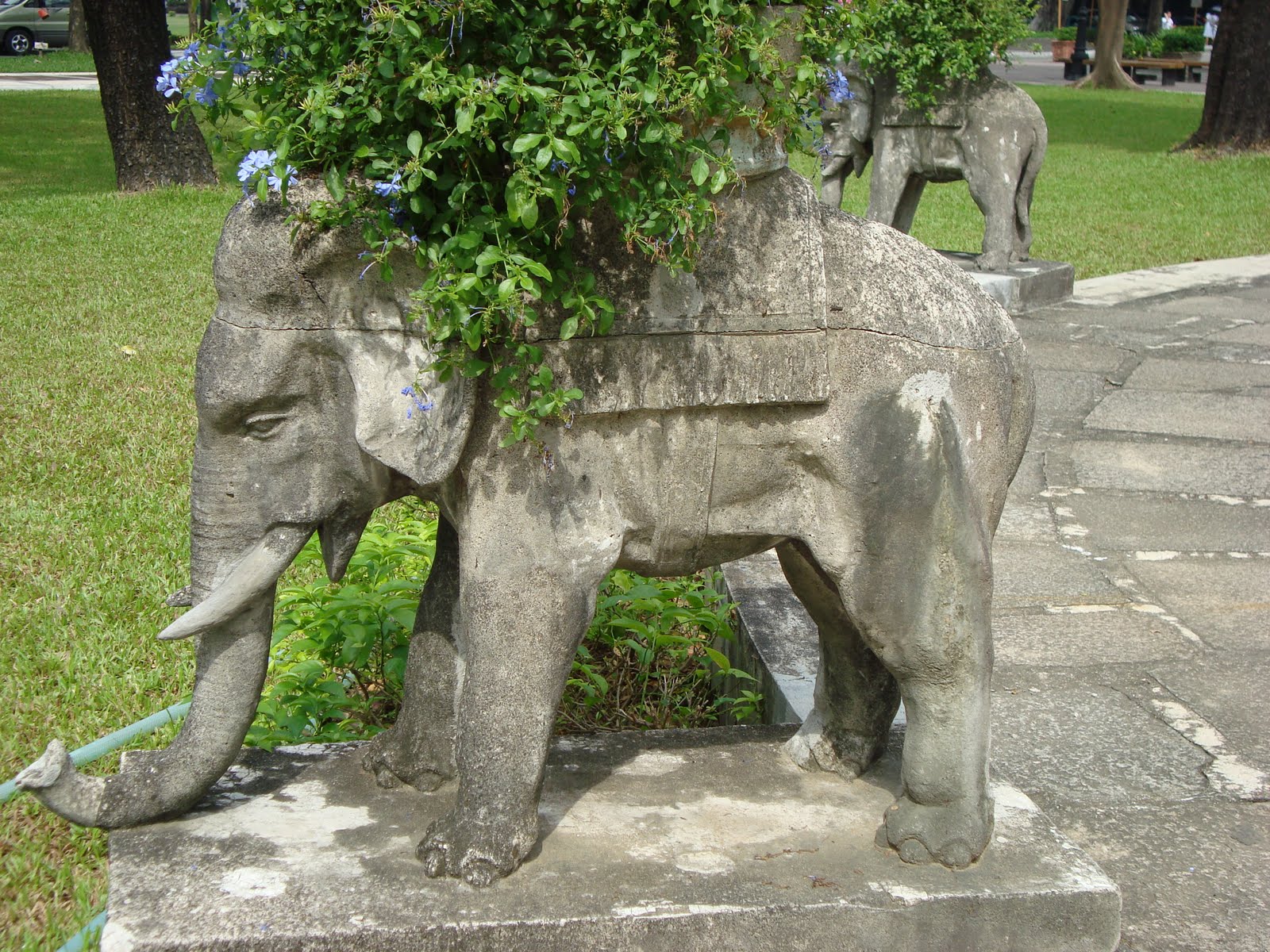
 European Renaissance landscape features animals, fountain,
pool, and manicured hedges and lawn

 Quaintness of the campus for outdoor study and leisure few universities in a city can provide.
 Botanical Garden: Arboretum in the heart of the City of
Manila; oldest Pharmacy garden in the Philippines.
 Benavides Monument: Historical landmark for students and tourists
Subscribe to:
Posts (Atom)