Tuesday, July 14, 2020

Confluence of Nature in Mural and Poetry

Confluence of Nature in Mural and Poetry
"Heaven is under our feet as well as over our heads." 
- Henry David Thoreau 


Mural and Verses by Abe V Rotor
Living with Nature - School on Blog

Painting Lesson: Convert those empty walls, dead end corridors, hanging spaces, blank concrete fences, into Nature mural. Bring Nature inside your home. Instead of facing a blank wall, you will enjoy watching a waterfall. Stair case among rocks is a good idea. Pavements appear wet as a stream flows by. This is of course in the imagination. A rock breaks monotony of space, it creates a hidden view. Trees give a feeling of strength and height, and make you imagine of many creatures living there. Make the cloud a curtain, which opens in part to reveal flying birds, a rainbow, peeping sun, a stairway to the "Lost Horizon."

Make mural painting a family affair. Write a story or poem about your mural. Call author through this Blog for assistance -  avrotor.blogspot.com
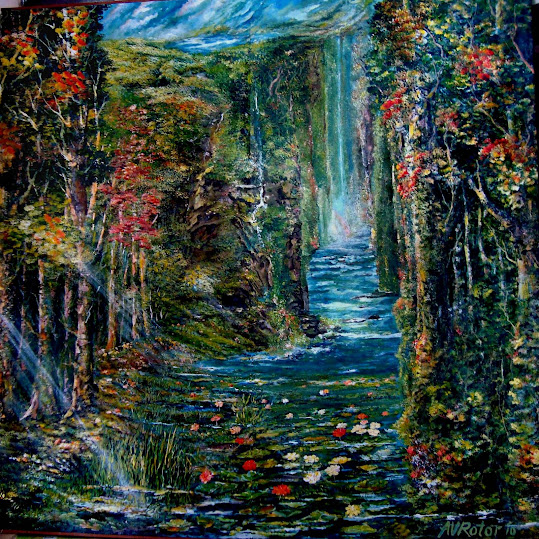


Confluence of Nature mural in acrylic on canvas, (9ft x 8ft) by the author, 2010

Confluence of nature, unity in diversity,
where sky meets land, river flows to sea,
where time and space, matter and energy
are in union and joyful harmony,
omnipotence of no other but Thee.
-----------------------------------------
We don’t inherit the earth from our ancestors, we borrow it 
from our children. - Native American proverb
 ----------------------------------------------------------
Nymphaea wakes up in red, pink and white,
to the rising sun in glory and ease,
but ephemeral these flowers are at sunset
sinking into the night in peace.


Hurry up the bees, the flowers cannot wait,
hurry up the lovers to the morning chime,
the lonely, the old, the sick, the meek;
beauty to behold in the nick of time.


Mirage - vision beyond any sense,
not to the eye or the range of a lens;
the sun peeps under a cloak of green,
something stirs seen and unseen.


Do fish ever sleep?
I wonder like I wonder
if sheep ever sleep
on some grassy hill,
and the gentle fish
in a peaceful cove.

But where is that

peaceful cove
and that grassy hill?


Living on the edge, the land by the sea,
the woods on the levee
cling to the living and dead, new and old,
taming the cruel and bold.
Transient is life, it's just a breathe away;
make it long, we pray.
We live on the edge of time and space,
of mortality and grace.
Nothing is impermeable,
Nothing is impenetrable;
Ask the sun and the wind,
The human mind and will.

Rage with fire, burn the sky, bled the heart, 
Fire the kiss of life, fire the kiss of death;
 
And when your petals fall, so with your seed,
 
Fire the kiss of death, fire the kiss of life;

And beauty the brief passing of time and grief.


How many falls do you tumble all the time?
And songs you sing in rhythm and rhyme?
Oh, you are simply filled with awe and joy.
And I, I wish I were forever a boy -

I ride on your crest, plunge into your floor,
Inside your womb I'm a child once more,
Together we flow, and I'm weaned out to sea
To tell the world of a beautiful story. ~

-------------------------------------
"Adopt the pace of nature. Her secret is patience". - Ralph Waldo Emerson
-------------------------------------
Acknowledgment: Courtesy of Atty Lito and Dr Christine Doria. This mural graces their beautiful new home. The aura of the natural world makes it truly a Home, Sweet Home with Nature.

We Can Re-Create the Garden of Eden

We Can Re-Create the Garden of Eden
Dr Abe V Rotor

Arch of the Centuries and Fountain of Knowledge, University of Santo Tomas, Manila

What really make gardens beautiful may draw two schools of thought – Romanticism and Functionalism. But a typical Philippine garden for one does not take side on the issue – it portrays both schools in an integrated, harmonious design patterned after the richest and the most enviable biome on earth – the Tropical Rainforest.

And here are gardens to see - the Sunken Garden of UP Diliman QC at the back of the Oblation, and the UST Botanical Garden along España in downtown Manila. And for more extensive gardens, go to San Fernando La Union Botanical Garden in Cadaclan at the foothills of Cordillera. When picnicking at the Ninoy Aquino Parks and Wildlife Center visit the vegetation along the lakeshore.

There are striking features of a garden. For example at UST, there are man-made waterfalls.  Trace the flow on a meandering rocky stream that ducks under a footbridge before plunging into the depth of a pond, its bottom murky and cool and rich in detritus. Here clams and snails, and other bottom dwellers, mostly decomposers reside, shy from the sun and ensconced in the very food source that settles down. Such is the niche of these sessile, benthos creatures.

A Garden of Algae and Mosses

The running stream at the UP Sunken Garden keeps the environment fresh and cool, lapping on the rocks and sending spray on its banks. Small waterfalls and boulders lay along its path.  Here thick algae and mosses layer after layer form a carpet on which another niche is found - the domain of bryophytes in Lilliputian imagery, or one depicted in the movie, Honey, I Shrunk the Kids.

But the ultimate source of water is the sky, from clouds that gather and grow atop the forest.  Transpiration from trees on one hand and evaporation on the other attract clouds, pulling them down in shower or downpour at anytime of the day or night. It is for this phenomenon that this biome got its name - rainforest.

Nature's landscape in acrylic by he author 

The garden’s design simulates this condition. The waterfall, streams, a large fountain and a series of ponds maintain high humidity in their environs. High humidity and continuous supply of water are crucial in the formation of multi-storey vegetation and subsequently the presence of a myriad of resident organisms.

An Evolving Ecosystem

It may take years for a new garden to approximate the structure of a typical rainforest. In the process visitors may not be aware of the slow transformation, one sere after another until a climax community is formed, a true measure of it is homeostasis or dynamic balance. The scientific and aesthetic aspects are interesting to study. Inference can be drawn on the viewpoint of ethico-morals that governs man of his role in God’s creation – and the transformation of man himself as one good and faithful steward of the environment.

A botanical garden is thus transforming deliberately like an evolving ecosystem. It is Nature’s laboratory and a playing field of biological diversity.

Biological Diversity

1. As a field laboratory the garden demonstrates ecological cycles – invasion, colonization, competition, and emergence of dominant species, as well as seasonal and long-term succession patterns. We may not have the four distinct seasons, but there are tropical trees that demonstrate some temperate characteristics carried by their ancestral genes, such as the deciduousness of narra (Pterocarpus indicus) and talisay (Terminalia catappa) simulating trees in the temperate region that completely lose their leaves at the onset of winter.

Drynaria fern on a tree in acrylic AVR

2. The garden is a living manifestation of dynamic balance in a changing environment with the organisms constantly adjusting to the demands of the latter, but at the end they also change the environment itself. The transformation process or seres always leads towards homeostasis and the result is the formation of a climax ecological system.

3. As a showcase of natural habitats, the garden adjusts to the development of niches and diversity indices. The garden never sleeps, so to speak. It is an arena and the drama of life goes on and on.

Energy Flow

4. When we look at life, we look at it in the realm of physics and chemistry – the flow of energy through the food chain, food web and their hierarchic order, the food pyramid. The light energy of the sun is transformed into chemical energy by plants through photosynthesis, and is passed on one after another through the links of a chain until the remaining energy reaches the ultimate member – the decomposers that transform organic substances back into inorganic forms so that the next generation of organisms can start all over again. We can  witness this among the residents in the pond, and among insects, arachnids, birds, reptiles, and others that inhabit the garden.

Plant Physiology and Animal Behavior

5. The garden demonstrates physiologic responses of plants - tropisms or reactions to light, touch, and the other elements on one hand, and animal behavior on the other. Why do plants grow tall, while others do not - even if they belong to the same species? Where do toads and frogs hide in summer? How do they survive without food and extreme hot and arid condition?
Dragonflies hover low before a rain. A preying mantis resembles the leaf or flower on which it waits for its prey. These and many more demonstrate intelligence among animals.

6. There are biological indicators of the state of the environment. The garden has a host of these indicators such as lichens and fireflies. The presence of both attest to the pristine condition of the environment and clean of air around. The garden itself is a barometer of El Niño. There are bamboo species that produce flowers at the onset of the cyclical phenomenon.

Gene Bank

7. The garden is a sanctuary of wildlife. In spite of the crowded environment and high-rise buildings around, a garden is always with butterflies. Some people say, if you see butterflies there must be a garden nearby. It is because the garden is their natural abode with plants they feed on and rear their young. The ponds and streams are a sanctuary of dragonflies as well, and their waters teem with both phytoplankton and
zooplankton that students in biology can study with the use of microscope.

Balete trees atop a church ruin, Magsingal Museum, Ilocos Sur.

8. As a gene bank, the garden is a depository of biological diversity, providing access to genetic studies, propagation and exchange with other institutions. A garden must aim at expanding its collection of species, even those that are thought to be weeds and volunteer plants. In many ways nature is the principal architect of biodiversity. Birds, water and wind carry seeds into the garden. When we design the garden we follow Nature rules. For example, plants are classified according to water regime, type of growth, sunlight requirement, seasonality, etc.

9. In another article I wrote, I mentioned about the garden as a microcosm of the biosphere, the pond a minuscule of a lake – and now, the new the garden is a replica of the Tropical Rainforest.

10. This miniature replica of a Tropical Rainforest, where living organisms – macroscopic and microscopic – live in a state of unity and harmony is man’s way of redeeming a lost Paradise. There is more than just romanticism and functionalism, not even human imagination can describe it. Indeed we can re-create a Garden of Eden is some little corner of the Earth, the greatest offering we can make to the Creator who gave us the capacity to build it. ~

Monday, July 13, 2020

Restoring a National Icon

Restoring a National Icon  
"Many flowers bloom and softly die,
where an icon may peacefully lie."

Dr Abe V Rotor

Under the sun and rain night and day,
birds alight and chirp and fly away,
children lilt at play and babies cry.  
among the throng just passing by;
many flowers bloom and softly die,
where an icon may peacefully lie. ~

  Author fixes bust of Philippine national hero Dr Jose P Rizal at
   the San Vicente Botanical Garden (Living with Nature Center
  San Vicente, Ilocos Sur).  The icon is a masterpiece of the late 
                        Francisco “Boy” Peralta, a local sculptor. 

 
  Close-up photos of the icon that needed periodic cleaning from
  dirt and scum. The icon is now enshrined indoor in a reading
  center and family museum. ~

Thursday, July 9, 2020

Twenty Philosophies of Ageing Gracefully

20 Philosophies of Ageing Gracefully 

“Aging is the knowledge and maturity is the wisdom.”  J. Tisa

“Aging is the divine and maturity is the blessing.”  J. Nedumaan

Dr Abe V Rotor
Senior scientist and former professor of St Paul 
University QC, Dr. Anselmo S Cabigan, introduces 
modified methodology of plant systematics.
Dr Domingo Tapiador (right) former FAO official, Mr Dell H
Grecia (center) veteran journalist, and author, examine a
jeep-ferry model for Laguna Bay invented by Dr Tapiador.

1. Ageing like good wine; it becomes mellow with age. But only good wine becomes mellow with age. And the longer ageing is, the better is the quality of the wine. We can compare it also with wood. “A seasoned timber never gives (up).” A seasoned teacher is wise.

2. Ageing is like knowledge – distilled into wisdom. It’s the ripening of fruits on the tree. Knowledge is not all useful; it leaves a lot of wastes. Which I call infollution (information pollution). Like the so many flowers and developing fruits of a huge mango tree, those that fall are useless knowledge; those that do not ripen are knowledge that can’t stand by themselves. Only those that remain full and ripe at the end are like wisdom. Wisdom is tested by timelessness and universality.


3. Old age is harvesting what you planted in youth. The man is the child of yesterday. Start early in life to plant the seed of success, more so, the seed of service. Monuments are not built for no reason at all. And even without a monument a good deed is monumental in the hearts and minds of those you serve and those who believe in you – especially those you have changed their lives.


4. Ageing physically and physiologically - this is inevitable. But don’t let the mind and the heart age prematurely and uselessly. Like faculty, practice makes them alive and full. Reason, thoughts, imagination, love, compassion should not go to waste by chronological age.


5. The child in you must always live. That Little Prince that rules over the grownup in you that says “a matter of consequence is not only those that are urgent and important,” is also preserving the ideal. Idealism must live together with realism.


6. There are those who are late bloomers; they bloom with age. Catalyze the blossoming of the beautiful things – how late they may come in life. It is better to bloom in old age than to blossom early – and the blossom just fades away. You’ll even regret it because it could mean to you as failure.


7. In old age don’t lose your trophies and medals - because of one false move, worst, if deliberate. Or because of a persistent habit you thought you can get away with even in old age. There is nothing more regretful if you fall into disgrace in old age – you don’t have a second life to amend for it.


8. Hold your horses. Stop, look, listen. Getting older adopts “slow but sure” attitude towards situations and decisions. “Quick to think, but slow to act,” may be appropriate in old age. That is why in traditional societies, decision makers are old people, village elders.


9. Make your assets grow for others, as you prepare to leave the world. Have the philanthropic heart. You can’t take your riches to your tomb. The Egyptians never did. The young pharaoh Tutankhamen left his belongs for the afterlife in his tomb, now in the Egyptian Museum. . Economics does not work well with each one of us holding a treasure chest and locking it up. Imagine if the world is dominated by Madoff et al - even with their generosity.


10. Older societies are more peaceful than younger societies. Make peace as you grow older. Old men don’t go to war. It is the brave who dies young. “Where have all the flowers gone?” speaks of the youth cut down in their prime. All wars – ancient, religious, political – the young is the sacrificial lamb. People as they grow older can’t simply be made easy tools for power and greed.

Jules Verne, author of science fiction novels (Journey to the Center of the Earth, Twenty Thousand Leagues under the Sea, Eighty Days Around the World) lived to a very ripe age. 
Rip van Winkle, character of the short story of the same title by Washington Irving, slept for twenty long years. When he woke up the world had greatly changed, and did not even know who he was,   (Photo credit: Internet, Wikipedia) 

11. Expanded family ties; three generations not in a row, but in a chain. For the first time in the history of man that three generations live under one roof. And soon four generations - as longevity increases. While in the city the family is getting small, agrarian families are expanding because of longer life span.

12. Scientific and technological thrusts are toward aging, longevity: rejuvenation, on-site cloning of tissues and organs, ergonomics (designing tools and materials that fits well to the comfort of the user) - geriatrics, gerontology (all about the science and caring of the aged.)


13. Extension of retirement, active retirement – this is the trend today for old people. Soldiers become security guards; teachers become professor emeritus, executives as consultants, professions doing odd jobs. Age of retirement is not after all boring. So when does one really retire?


14. Foster, adopt, and have the needy, the homeless, the orphaned, the abandoned as your own children especially if you are childless. Even then, by the time you are very old, your children shall then be on their own. Be like Brad Pit and Angelina Jolie who have adopted children of different color. Sponsor scholarships for the deserving but are unable to pursue their studies.


15. Resurrection and immortality are myths. Humans will always remain mortals. More than a hundred corpses of rich Americans are in cryonics tanks waiting for the time to resurrect them. DNA extracted from cadavers and human fossils will never make a living replica of the departed or deceased.


Old man (Spencer Tracy) in Ernest Hemingway's  Nobel Prize winning novel, The Old Man and the Sea. (Photo credit: Internet, Wikipedia)  

16. Life cycle biologically - that is a universal given to everything, living or non-living. But with man’s rationality we can plot our life cycle, so with socio-economic matters. The late Justice Secretary Ordoñez wrote a book, Life Cycle. He said the inevitable is biological, but the way we live our lives, is within much under our control and will. “Men choose to live long which they have no control of, yet refuse to live nobly within their will.” So said the great Roman Philosopher Cicero.


17. Nature is selfish within your lifetime – you care so much for those close to your genes, to the point of dying for them. But nature, after you are gone is altruistic; it distributes your genes to where they will most fit in the name of evolution through which a species should be best equipped in order to survive. We can hardly trace our family tree beyond the third generation. Where are the offspring of the pharaohs, of the King of Siam?


18. Kindness is key to fulfillment; it is also the Golden Rule. “Treat an old man as you wish men to treat you when you are old,” say Geoffrey Chaucer in The Pardoner’s Tale. But be kind yourself as an old man or woman. And that kindness must be unconditional. ARK in Evan the Almighty means – Act of Random Kindness. That’s the way to change the world, so said God in that film.


19. Don’t just pass people along the way. Stop, help them, feed the hungry, give water to the thirsty, visit the imprisoned, clothe the naked, comfort the lonely, and heal the sick. In Matthew 25, Christ said, “What you have done to the least of my brother, you have done it to me.” Indeed this is the most meaningful act of human to humanity. You deserve a place in heaven.


20. Facing death is a beautiful thing to one who has reached old age. It’s like a candle in its final brightness. Angelus to the old who is dying unifies the family, gathers the broken fragments of relationships. Bonding is strengthened. It’s time for the living to say the kindest things about the departed. Let the occasion be a memorable and lasting one. Dying is leaving to the living a new hope, renewed love, and a new beginning. ~


                                The Old Man*


 He is old now 
            and the cataract is but a spring.
       He touches the spring -   
            where have all the waters gone?
       Yes, he sighs with relief, 
            his gaze takes him far away;
       And there the last drops of his waterfall 
            meet the sea;
       And the sea roars in gladness,
            roars a thousand cheers. ~

* Dedicated to the late Secretary of Justice Sedfrey Ordoñez, an adviser and friend of the author. 


Sunday, July 5, 2020

San Vicente Botanical Garden Series 1

 Garden Plants 
Living with Nature Center, San Vicente, Ilocos Sur  

"The best place to find God is in a garden. You can dig for Him there." – George Bernard Shaw

Dr Abe V Rotor 
Heritage tree of three generations - native mango (Mangifera indica) is host to viny plants, ferns, and lianas like Rosary Pea and Philodendron
Double-petal flowers of  Sampaguita (Jasminium sambac) in two colors - white and purplish pink. 
Powderpuff lily (Haemanthus multiflorus) blooms in summer emerging from underground bulbs.
 Indigenous White Santan (Ixora finlaysoniana) may grow into a small tree.  Other santan species are trimmed into hedges and figurines.
Perhaps the most common garden plant is croton (Codiaum variegatum).  It comes in many varieties and cultivars.  They are conveniently propagated by cuttings, thus preserving their own genetic characteristics.  As a hobby plant enthusiasts have collections such as these two varieties. 
"If you have a garden and a library, you have everything you need." – Cicero
 Ferns such as the Oak-leaf fern (Drynaria quercifolia) crowd the base of large trees and corners which are cool and shady.  
Corazon de Maria (Caladium bicolor) has this leaf design, mottled with pinkish radial divisions.
"Earth laughs in flowers." - Ralph Waldo Emerson

 
False-Bird-of- Paradise or Lobster's Claw - Heliconia, family Heliconiaceae; Right, Spider Lily - Hymenocallis littoralis, family Liliaceae The stalk leaves and flowers of the spider lily are mildly poisonous but the bulbs are very poisonous. In Japan these flowers are planted routinely around the edges of rice paddies where they are thought to repel insects and rodents. (Internet)

"We can complain because rose bushes have thorns, or rejoice -because thorn bushes have roses." 
    - Abraham Lincoln ~

Thursday, July 2, 2020

The Two Worlds of the Gordiun - House Sparrow

"I once had a sparrow alight upon my shoulder for a moment, while I was hoeing in a village garden, and I felt that I was more distinguished by that circumstance than I should have been by any epaulet I could have worn." 
- Henry David Thoreau


Dr Abe V Rotor
Living with Nature School on Blog


   House sparrows (Passer domesticus)  frolic in a pool left by rain.  


Gordiun, that's how we call this bird in Ilokano, almost a password for us kids in our time with slingshots worn necklace style, our pockets bulging with carefully picked gravel stones. We were "soldiers of fortune" when the gordiun is fat at harvestime, and how we relished it grilled in today's term, and how we raided its nest and took its young. 

This bird together with other Passer members  are products of co-evolution in rice territory - their life cycle jibes with that of rice - the traditional varieties that stay in the field for the whole monsoon season. And then comes October.  By then they number to hundreds, thousands over the horizon. What makes it worse is the gordiun is related to the maya, equally if not more destructive. raiding ricefields about to be harvested, stealing  grains from the mandala and the garung - a giant circular basket to keep threshed palay as buffer stock in today economic term. 

That's why our old folks allowed us to carry this deadly improvised weapon, traced to the history of David, with the enemy a hundred times more than a single Goliath - more elusive, more mean, more intelligent. 

Like its counterpart in the rodent world - the rat - the gordium has likewise learned to live with humans, but never, never allowing itself to be domesticated - unlike the cat and the dog.  Not the gordiun, not the rat as well - two stubborn co-inhabitants in man's dwelling.  And the wonder of it all is that they can adjust to modern living, and in fact to today's postmodernism.  They live in cities among high rise and shanties, the rats on garbage, and the gordiun on food waste and pest.  

We were the Mark Twain kids of the fifties - the likes of Huck Finn and Tom Sawyer.  Like them we were abandoned by time - shall we say, age - and ambition, industrialization, and exodus to the city. We have surrendered our weapons, so with the adventure and fun we were supposed to hand over as heritage to our children and the younger generation of today. 

Pavlov is undoubtedly correct when we talk of the resilience of instinct, its ability to cope with fear, deprivation and aggression for the sake of survival of the species as a whole. That's how the gordiun - and all animals for that matter - succeed in adapting to the changing environment. 

But there is something strange going on, not anticipated by the great psychologist; similarly Darwin did not foresee the impact of modern science and technology: the steady annihilation of species to the point of extinction   In fact hundreds of species of the estimated millions have permanently perished, and more in accelerated pace will follow suit.

I look back at my Gordiun - the one that refuses domestication, the one that plays the most skillful hide-and-seek game, the most challenging target of our slingshots, the one that lives  up to 20 years among humans - not in the forest though, the one that never migrates in neither habagat nor amihan - unlike the migratory birds of the north coming down south and returning after winter. And the one that is the symbol of joy and being carefree, yet the epitome to bonding as family and flock.  

I have long dismissed the gordiun's destructiveness.  In fact I explained to farmers and housewives, the birds do more good in housekeeping - picking morsels, ridding the place of vermin.  They are part of the food web and therefore help in maintaining the integrity of the ecosystem. They are insectivorous and predators, and they keep weeds population down that would otherwise compete with our crops, by eating their seeds during the off season. It is for this matter that their dispersal all over the world in all continents except Antarctica was assisted by man because they are excellent biological agents.  In general we have learned to accept them, as they have learned the same.  

A change of human attitude crept in when the gordiun's population has dropped from the flock we used to watch and admire, the chorus of songs though inferior to the canary, and by their very presence alone that keeps us company. This is what is happening all over the world because of pollution, global warming, loss of habitat, pesticides, and the like.

I watched a gordiun lost its way and ended up in our sala trapped.  It was raining hard and I said, you can stay here.  Restless, it rammed against the wall and ceiling, then perched nervously on the curtain looking at me long and hard.

Suddenly I became a boy once more - this time without the dreaded slingshot around my neck.~ 
Photo Credit: Google, Wikipedia


LESSON on former Paaralang Bayan sa Himpapawid (People's School on Air) with Ms Melly C Tenorio 738 DZRB 8 to 9 evening class, Monday to Friday

Wednesday, July 1, 2020

Don't throw away rice hull or "ipa." Here are 5 practical uses.

Don't throw away rice hull or "ipa." 
Here are 5 practical uses.
Dr Abe V Rotor 
Living with Nature School on Blog


 Top: Cross-section of rice grain; closeup of grain.  Middle: Rice hull stove, building block of rice hull and clay. Bottom: rice hull as litter; newly built vegetable plots.  Acknowledgement: Google search, Wikipedia,  Internet  images
 --------------------------------------------------------
Rice hull is the outer cover of the rice grain which comprises 25 percent of the total weight. The cover is made up of a pair of hull-shape structures - lemma and palea - which are tough and impregnated with silica and cellulose. Considered waste in rice producing areas, now there are uses which this article would like to share - and recommend.
--------------------------------------------------------   

1. Rice hull ash protects mung-beans from bean weevil.
Burnt rice hull (ipa) contains silica crystals that are microscopic glass shards capable of penetrating into the conjunctiva of the bean weevil, Callosobruchus maculatus.  Once lodged, the crystal causes more damage as the insect moves and struggles, resulting in
infection and desiccation, and ultimately death.

This is the finding of Ethel Niña Catahan in her masteral thesis in biology at the University of Santo Tomas. Catahan tested two types of rice hull ash,  One is partly carbonized (black ash) and the other oven-burned (whit
e ash).  Both were applied independently in very small amount as either mixed with the beans or as protectant placed at the mouth of the container. In both preparations and methods, mungbeans – and other beans and cereals, for that matter – can be stored for as long as six months without being destroyed by this Coleopterous insect. 

The bean weevil is a cosmopolitan insect whose grub lives inside the bean, eating the whole content and leaving only the seed cover at the end of its life cycle.  When it is about to emerge the female lays eggs for the next generation. Whole stocks of beans may be rendered unfit not only for human consumption, but for animal feeds as well.  It is because the insect leaves a characteristic odor that comes from the insect’s droppings and due to fungal growth that accompanies infestation

2. Preheated rice hull is used to incubate balot eggs.
Simulating the way the mother duck incubates its eggs old folks bury duck eggs in rice hull (ipa) heated under the sun until they become penoy (incipient embryo) or balot (full grown embryo). For commercial production the eggs are held in bundles made of simamay or fishnet), placed in large holding boxes filled with rice hull. They are harvested in batches to meet market schedules.    

3. Rice hull compost is good soil conditioner for the garden. 
Mix rice hull with other farm residues that are ordinarily used in making compost at varying proportions but not exceeding fifty percent of the total volume.  These include animal manure and chicken droppings, dried leaves, peanut "hay" or tops, scums (lumot, Azolla and Nostoc from ponds and rice fields). Add equal amount of top soil to the final product.  This is excellent medium for potted plants and for germinating seeds, bulbs, and cuttings. When buying commercial potted plants, examine the medium used; the rice hull is still partly visible.    

4. Rice hull as fuel 
There are stoves designed for rice hull as fuel. One has a continuous feeding system for commercial use, otherwise ipa is hand-fed for typical kitchen stoves. Rice hull has a high thermal value because it contains silica that increases temperature level. This means faster cooking. To make full use of this advantage, rice hull must first undergo thorough drying usually under the sun.  It is then stored in sack for ready use. With the spiraling cost of LPG and electricity - and the dwindling supply of firewood - rice hull as fuel  is the best alternative in rice-based areas. 

5. Rice hull as litter of livestock and poultry
To solve muddy animal sheds and corrals, spread rice hull for time to time. This is also good for range chicken, and holding pens of animals in the market. Rice hull binds the soil and other materials such as grass and rice hay. When the litter becomes thick and old, replace it with a fresh one. The old litter is a good fertilizer for the orchard and garden. ~
---------------
LESSON on former Paaralang Bayan sa Himpapawid (People's School-on-Air) with Ms Melly C Tenorio

738 DZRB AM Band, 8 to 9 evening class Monday to Friday