Season of Creation
"Only God Can Make a Tree." - Kilmer
The Season of Creation spans 34 days. It begins Sept. 1, the World Day of Prayer for the Care of Creation. It concludes Oct. 4, the feast of St. Francis of Assisi, the patron saint of ecology.
Dr Abe V Rotor
Living with Nature School on Blog
Part 1 - Code of Life's Values and Man's Relationship with Nature
1.1 -Bioethics and Human Life
1.2 - Environmental Ethics: Human Life and the Environment
Part 2 - Bioethics: A Theological-Ecological Perspective
1.2 - Environmental Ethics: Human Life and the Environment
Part 2 - Bioethics: A Theological-Ecological Perspective
Part 3 - Mother Nature Dismembered by Genetic Engineering
Part 4 - Creation II: Symbiosis and Synergy of Life
4.1 "Childhood is Forever."
4.1 "Childhood is Forever."
4.2 - Children and Nature - An Omnipotent Treaty
Part 5 - The Biological Basis of Selfishness and Selflessness
Part 6 - Devolution of Life - Reverse Evolution
Part 7 - Yes, it is a sin to cut down a tree.Part 8 - We are destroying Paradise with our hands
ANNEX A - Trees: "Only God can make a tree."
ANNEX B - Nature Crucified
ANNEX C - Green Cross in the Sky
ANNEX D - Reverence for Life - 25 Couplets
ANNEX E - Bleeding Heart of the Forest
Part 1 - Bioethics
Code of Life's Values and Man's Relationship with Nature


Pao opens three fingers representing his brief life. Pao at 3 affectionately
poses with his mother Cecille.
Paolo drew one, last deep breath and held it there as if forever. His eyes were wide open, glassy and welled with tears. His pale lips went agape as his whole body tensed. That was the arrival of the inevitable moment when he gave up fighting for life.
Immediately, doctors, working with quick hands put the boy’s body under the command of modern machines like: a high voltage cardiac resuscitator; a lung machine that works on the principle of our diaphragm; and electronic gadgets to monitor pulse rate, body temperature and blood pressure. The sight of wires and tubes all over the young patient, with doctors working double time, reminds one of the desperate, but futile, effort to save the mortally wounded President of the United States, John F. Kennedy, in a Dallas hospital on November 22, 1963.
This situation also reminds one of the celebrated Karen Quinlan case. This is about a young woman, who remained in a state of coma at a US hospital for more than a year. Since her condition was not improving, she was unplugged from her life-sustaining machines. The case became an issue of a long court battle. In the end, the patient was allowed to die, unplugged from her machines.
The court’s decision leaned heavily on the principles of bioethics. These principles continue to influence similar cases some 40 years later. Bioethics, the ethics of the life sciences, offers guidelines for dealing with life-and-death decisions. The ethical principles involved are expressions of values, and the humane foundations of moral values.
Immediately, doctors, working with quick hands put the boy’s body under the command of modern machines like: a high voltage cardiac resuscitator; a lung machine that works on the principle of our diaphragm; and electronic gadgets to monitor pulse rate, body temperature and blood pressure. The sight of wires and tubes all over the young patient, with doctors working double time, reminds one of the desperate, but futile, effort to save the mortally wounded President of the United States, John F. Kennedy, in a Dallas hospital on November 22, 1963.
This situation also reminds one of the celebrated Karen Quinlan case. This is about a young woman, who remained in a state of coma at a US hospital for more than a year. Since her condition was not improving, she was unplugged from her life-sustaining machines. The case became an issue of a long court battle. In the end, the patient was allowed to die, unplugged from her machines.
The court’s decision leaned heavily on the principles of bioethics. These principles continue to influence similar cases some 40 years later. Bioethics, the ethics of the life sciences, offers guidelines for dealing with life-and-death decisions. The ethical principles involved are expressions of values, and the humane foundations of moral values.
In both the cases of Paolo and Karen, we ask, "What is clinical death?" Is the prolongation of life with machines (despite certification of a hopeless condition), justifiable? In short, is keeping people alive through artificial means ethical?


Bioethics and Social Justice
Outside the hospital, people needing immediate treatment, are waiting for their turn. There are those, mostly poor, who have been waiting silently in prolonged agony. In remote towns and villages, it is considered a luxury to have a doctor around. The medical care most poor people know are unreliable, often associated with superstitious beliefs. What an extreme scenario from that of Paolo and Karen!
Thus bioethics and social justice must go hand in hand as we view its application upon the millions of poor people who are dying without benefit of good medicine. Like in war, precious medicine is applied on the potentially salvageable, and denied for those who are dead or beyond help.
Yet there are those who feel privileged with “over treatment”. This is why we question the morality of cryogenics (dealing with the effects of very low temperatures), its lavishness and futuristic goals. There are many rich people in America today whose bodies lie in cryogenic tanks, awaiting the day when medicine shall have found a way to revive them.
“In the real sense, the practice of virtue is what morality is all about, meaning lived morality, the morality that leads to self-realization and ultimately, happiness. After all, virtue is the road to happiness.”- Fr. Fausto Gomez, OP, STD, Relevant Principles in Bioethics
Bioethics and Disease Prevention
Dr. Mita Pardo de Tavera is a doctor who believes in the primary health care approach of involving people’s full participation. She raised ethics of appropriability disease prevention as superior to its cure. This approach should be part of a program to eradicate diseases such as tuberculosis. The solution is not to be dependent merely on medical approaches, but on sound socio-economic programs as well that deal with illiteracy and unemployment.
Pillars of Bioethics
The broad domain of bioethics rests on four pillars, as follows:
§ Truth§ Compassion§ Beneficence§ Justice
Goodness springs from every righteous person when dealing with questions on bioethics. It is conscience, that inner voice which makes us conscious of guilt.
But how good is good enough? To answer this question, we have to qualify conscience as formative conscience. Fr. Tamerlane Lana OP STD, rector of the University of Santo Tomas, emphasizes that the formation of conscience is a life-long task, especially for professionals whose decisions directly affect the lives of people. The goal is for them to attain a well-informed conscience, which is upright and truthful, and that does not rely merely on acquired knowledge. It has to be a conscience guided by the spiritual nature of man.
Growing Application of Bioethics
Today, with man’s growing affluence we find bioethics as part of the expanding fields of science and technology, areas that have direct consequences affecting human life. Thus, we hear people raising questions of morality and ethics in various areas such as:
§ Euthanasia§ Hospice management.§ Organ transplantation and rehabilitation.§ Contraception, abortion and sterilization.§ Social justice in the allocation of healthcare resources.§ The Human Genome Project (HGP), and genome mapping.§ Genetic engineering and human cloning.§ In vitro fertilization (test tube babies).§ Surrogate motherhood.§ Menopausal childbirth technology.§ Induced multiple births.§ Aging and extension of longevity.§ Pollution and global warming.§ Ecosystems destruction.§ Thermonuclear, biological and chemical warfare.
These areas of concern in bioethics are expanded into medical ethics for doctors, lawyers and scientists to know. These include the following cases:
Food Additives and Contamination.
Vital issues of discussion are the manufacture and distribution of food laced with harmful substances like potassium bromide in bread, sulfite in white sugar, nitrate in meat, glacial acetic acid in vinegar, monosodium glutamate (MSG) in cooked food, and aspartame in softdrinks. Many of these substances are linked to cancer, diabetes and loss of memory.
Ecological Bioethics.
“Is it a sin to cut a tree?” a student asked this author.
This is a bioethical question. It is not the cutting of the tree, per se, that causes the “sin”. Rather, it is the destruction of the ecosystem, the disruption of the functioning of natural laws resulting from the tree cutting, that is considered unethical.


In the realm of theological sciences, this tragedy is akin to the paradigm of salvation. According of Fr. Percy Bacani CICM, it is a sin to harm the environment, because it causes people to suffer. To find salvation, the culprits of the Ormoc tragedy should plow back their ill-gotten wealth for rebuilding the community they destroyed. The morality of this paradigm touches deep down at the roots of moral philosophy.
Five Principle in Bioethics
Basic questions are raised where bioethics and moral philosophy are involved. These questions may be categorized under five general types.
§ When are we responsible for the consequences of our actions? (Principle of indirect voluntary).§ How far may we participate in the performance of evil actions done by others? (Principle of cooperation).§ When may we ethically perform an action from which results in two effects, good and evil? (Principle of double effect).§ Are we the lords of our lives and all creation, or only custodians thereof? (Principle of stewardship).§ Is the good of a part subordinated to the good of the whole? (Principle of totality).
These general ethical principles serve as guides in analyzing situations, making decisions, or forecasting the consequences of one’s actions. These principles are used in law, philosophy, theology, management and other disciplines. The values on which they are founded which, in turn, provide the virtues that guide our actions, remain unchanged.
Why do we not always follow the dictates of our conscience? “It is because we are weak, or blinded by sin or vice. Or because we lack virtue and fortitude,” says Fr. Fausto Gomez OP, regent and professor of bioethics at the UST College of Medicine.
Man has yet to learn to avoid evil, and to do good. Temptation leads one to sin, but so does complacency and inaction.
On that fateful day, Paolo my hero, was the focus of a most crucial decision the doctors, my family and I had to make. When we made it, the life-sustaining machines were finally removed that day in 1983. Paolo died in my arms. He was my son. ~
1.2 - Environmental Ethics:
Human Life and the Environment
"To waste and destroy our natural resources, to skin and exhaust the land instead of using it so as to increase its usefulness, will result in undermining in the days of our children the very prosperity which we ought by right to hand down to them." - Theodore Roosevelt


Two Faces of Planet Earth, back-to-back native hanging chandelier by A V Rotor 2021 On display at author's residence, Living with Nature Center, San Vicente, Ilocos Sur
Environmental revolution has actually started with the age of industrialization, and it will take a very long time and a very complex process to be able to settle it. Environmental revolution does not pit man against nature, as it had been since the dawn of mankind. It is not the conventional revolution of society where man is pitted against man, or nation against nation for political reasons. It is not religious war. It is not a war of ideologies.
For the first time we humans must work together to preserve nature for the very survival of our species, and for the sake of saving Mother Earth, our only home and spaceship which carries all of us in our journey into the perilous unknown universe. It is a war we cannot afford to lose because it also spells the survival of the whole living world.
Let me state the some environmental concerns related to the topic of Dr. Tai’s paper, and relate them with current situations, understanding and outlook.
1.There are conflicting views of change. Scientific knowledge and government policies often disagree and run into conflict at each other. Economic and ecology, though they share a common root word and foundation, are strange bedfellows, so to speak.
Yet these entities support common goals geared toward change. Change has to be viewed more than the measures of GNP, ROI, currency exchange rate, balance of trade, and the like, and should not only be confined to Human Development Indices, such as literacy rate, mortality rate and population density. While these are considered immediate parameters mainly to benefit man and his society, certain questions on sustainability and environmental preservation are left unanswered. How do we ensure future generations. We feel more and more wary about the term progress. We ask ourselves what is “progress without conscience?” And whose development? What is the relationship between progress with posterity?
I remember the late Dr. Dioscoro Umali, national scientist, who addressed the graduating class of UP Diliman in 1992 with this moving statement, “Be the heroes we never were.” The essence of his speech is that the previous - and especially the present generation - have left little for the next generations to inherit. “We have not only abused the bounties of Nature,” he said, “we have destroyed her as well. The hero concept of Dr. Umali revolutionizes traditional and conventional definition of a hero. He is more than a nationalist, an economist, or an ideologist as we know, but a hero for Mother Earth, borrowing the term of Time Magazine.
Today, rather than defending himself against nature, man realized, he needed to defend nature against himself. - AV Rotor, Light from the Old Arch
2.Who are heroes for Mother Earth?
Environmental movements have roots traced to ancient cultures as can be gleamed from our own centuries old Ifugao Rice Terraces. Throughout history as civilizations grew and spread the environment became a sacrificial lamb. Such euphoric phrases “all roads leading to Rome,” “the beauty that glory that was Greece, the grandeur that was Rome,” “the sun never sets on English soil,” and the eight wonders of the world may reflect man’s ultimate achievements, yet all these were ephemeral in the mist of time in man’s dreams. In the end, it was nature that took them from the hands of man. The loss of natural environments has lead to the decline of civilizations and their subsequent demise.
Time Magazine came up with a list of heroes for Planet Earth, among them are naturalist philosophers or conservationist philosophers are Ralph Waldo Emerson, Henry David Thoreau, John Muir, Aldo Leopold, and Rachel Carson.
· Emerson claimed that “behind nature, throughout nature, spirit is present.”
 · Thoreau spoke of the side of “truth in nature and wilderness over the deceits of civilization.”
Henry David Thoreau's WALDEN has opened a new way of thinking about the environment - Reverence for the Environment (avr).
· Muir believed that “wilderness mirrors divinity, nourishes humanity, and vivifies the spirit.”
· Leopold was behind the development of policies in wilderness and game management. “Wilderness is the raw material out of which man has hammered the artifact called civilization.”
· Carson published Silent Spring, which dramatized the potential dangers of pesticides to food, wildlife, and humans causing wide spread damage to the ecosystem.
· Chico Mendes was a front liner in environmental conservation. He lost his life defending the concept of “extractive reserves” to conserve the Brazilian Rainforest that provided livelihood of the people against the conversion of the forest into ranches and plantations.
Other heroes of planet Earth cited by Time include
· Barbara Ward, author of Only One Earth which shaped the UN environmental conference.
· Ernest Schumacher who did not believe in endless growth, mega-companies and endless consumption, author of Small is Beautiful, a best seller since the sixties.
· Jacques-Yves Cousteau, oceanographer who espoused the need to arrest the declining health of the oceans.
In the Philippines, Macli-ing, a staunch protector of ancestral lands in Kalinga-Apayao from the encroachment of the mammoth Upper Chico River dam, was gunned down allegedly to silence him. All aver the world there are the likes of Macli-ing, like Chico Mendes, and Ken Saro-Wiwa, a leader from the Ogoni tribe, and many more who, we may compare to the Unknown Soldier, but this time a soldier in defense of nature.
We must be prudent in endorsing people for their contributions to the environment until parameters are clearly set, and that we should allow time to make the final judgment. A case in point is DDT, the miracle pesticide against malaria in the forties and fifties. For this the discoverer received the Nobel Award. But in the following years it was discovered that DDT is a poison that persists in the food chain, making it harmful to living organisms and deleterious to human health. AVR
3. People have varying opinions when defining Environmental Philosophy. There are those who believe that nature shall serve humanity. On the other hand there are those who believe that humanity shall serve nature. And there are those who say, it is “something in between”.
Nature, growth, and progress are concepts that we all use, but which we seldom define either in discussion or to ourselves. We speak about environmental ethics, environmental philosophy, eco-philosophy, and so on, but what do we put into these concepts? We seldom make them explicit or draw conclusions from them. “Trying to answer these philosophical questions does not, of course, in itself solve any environmental problems,” say ecologists Enger and Smith, “but on the other hand it is questionable whether we can solve these problems without discussing them on a philosophical level.”
It is then important to view environmental philosophy with ethics and morals. Ethics is a branch of philosophy that seeks to define fundamentally what is right and what is wrong, regardless of cultural differences. Morals differ somewhat from ethics because morals reflects the predominant feelings of a culture about ethical issues.
How do we illustrate this? A student of mine asked me this question, “Is it a sin to cut a tree?” This question touches ethics and morals, above social and economic considerations. It also pertains to legislation, such as whether we should advocate total log ban or selective logging. It even boils down to analyzing a syndrome known as “tragedy of the commons.” Let us analyze it this way.
How do we illustrate this? A student of mine asked me this question, “Is it a sin to cut a tree?” This question touches ethics and morals, above social and economic considerations. It also pertains to legislation, such as whether we should advocate total log ban or selective logging. It even boils down to analyzing a syndrome known as “tragedy of the commons.” Let us analyze it this way.
 a. The naturalistic concept that trees are the source of life is losing its essence as communities grow, and as people tend to move and live in urban places. It is a concept that is being taken for granted even as people become learned. Yet since evolutionary time plants have been providing the basic needs of man – food, clothing, shelter, medicine and energy.
 Heart of the Forest is a world of Nature - pristine and undisturbed in a state of dynamic balance (homeostasis). Painting in acrylic by the author.
The harvesting of plants and their products has been part of human sustenance, as such they must be used properly. This ethnic view was also the basis of early agriculture. It is the key to a sustainable relationship between man and nature that lasted for eons.
b. Like Gold Rush, new lands became the target of economic exploitation, as the frontiers were pushed to the limit. New lands were placed under agriculture, which included our own Mindanao. Accessibility to forests and the wildlife became more and more feasible. Original forests were replaced with ranches, and plantations. Economics was the name of the game. In spurred the second green revolution, and agriculture dominated the trade and industry of the world. It eroded the ethnic relationship between man and nature. Beliefs about the tree spirit, forest deities (Maria Makiling), and nature worships have become mere superstitions and legends relegated to books and comics.
--------------------------------------------------------------------------------------
Revival of environmental awareness came at the heels of the Renaissance. In the 12th century St. Francis of Assisi brought a new concept of devotion. Brother Sun, Sister Moon, and all the creatures on Earth our friends, laid down the foundation of naturalism in the Christian church reviving much of the Aristotelian naturalism. It is fitting that St. Francis of Assisi is regarded as the father of ecology.
--------------------------------------------------------------------------------------
c. The final blow followed – industrialization. It is not only food that preoccupied man. Want over need incessantly drives man to convert lands into golf courses, human settlements, industrial sites, and all kinds of infrastructures. Imagine how easy, and how short a time it takes to destroy a whole forest which nature built for hundreds if not thousands of years, with giant machines of today. It is said that by the time we finish reading a paragraph of average length, three hectares of forest shall have been destroyed.
d. Post-modernism – a paradox of living tomorrow as we grope at the forefront of progressive innovation which usually means “violating traditional norms or ideas in all fields if human concern,” quoting Dr. Florentino Hornedo. “The human being who has abandoned his essence, nature and origin has also given up purpose and aim of existence. Life then becomes a “free play” of what forces may come which construct existence. Neither is there personhood or self to be ethically responsible for one’s action.”
I use this statement to raise questions of accountability of our actions, individually or by group. A businessman who is armed with a franchise to cut down a forest is understood to have accepted the attendant responsibility stipulated in the contract, which may include provisions in selective logging and replanting. But these are far from sufficient in providing the vital safety net of protecting the community and the environment.
I go back to the question, “Is it a sin to cut a tree?” This time the concept of the action has far reaching consequences based on the above-mentioned premises. I would return the question with reference to actual incidents.
b. Like Gold Rush, new lands became the target of economic exploitation, as the frontiers were pushed to the limit. New lands were placed under agriculture, which included our own Mindanao. Accessibility to forests and the wildlife became more and more feasible. Original forests were replaced with ranches, and plantations. Economics was the name of the game. In spurred the second green revolution, and agriculture dominated the trade and industry of the world. It eroded the ethnic relationship between man and nature. Beliefs about the tree spirit, forest deities (Maria Makiling), and nature worships have become mere superstitions and legends relegated to books and comics.
--------------------------------------------------------------------------------------
Revival of environmental awareness came at the heels of the Renaissance. In the 12th century St. Francis of Assisi brought a new concept of devotion. Brother Sun, Sister Moon, and all the creatures on Earth our friends, laid down the foundation of naturalism in the Christian church reviving much of the Aristotelian naturalism. It is fitting that St. Francis of Assisi is regarded as the father of ecology.
--------------------------------------------------------------------------------------
c. The final blow followed – industrialization. It is not only food that preoccupied man. Want over need incessantly drives man to convert lands into golf courses, human settlements, industrial sites, and all kinds of infrastructures. Imagine how easy, and how short a time it takes to destroy a whole forest which nature built for hundreds if not thousands of years, with giant machines of today. It is said that by the time we finish reading a paragraph of average length, three hectares of forest shall have been destroyed.
d. Post-modernism – a paradox of living tomorrow as we grope at the forefront of progressive innovation which usually means “violating traditional norms or ideas in all fields if human concern,” quoting Dr. Florentino Hornedo. “The human being who has abandoned his essence, nature and origin has also given up purpose and aim of existence. Life then becomes a “free play” of what forces may come which construct existence. Neither is there personhood or self to be ethically responsible for one’s action.”
I use this statement to raise questions of accountability of our actions, individually or by group. A businessman who is armed with a franchise to cut down a forest is understood to have accepted the attendant responsibility stipulated in the contract, which may include provisions in selective logging and replanting. But these are far from sufficient in providing the vital safety net of protecting the community and the environment.
I go back to the question, “Is it a sin to cut a tree?” This time the concept of the action has far reaching consequences based on the above-mentioned premises. I would return the question with reference to actual incidents.
 · Who is responsible for the Ormoc City (Southern Leyte) tragedy caused by mudslide from a logged watershed? In this incident hundreds of residents were killed and millions of pesos were lost.
Author's visualization in rock and acrylic of the 1991 Ormoc Tragedy, a complete contrast he described in his visit to the place as "an ideal place to retire."
· The tragedy was repeated ten years after but on a lesser scale. As the perpetrators in the first tragedy have remained scot-free, so with those in the second tragedy.
· Two years have passed since the Real, Quezon, landslide that was similarly caused by massive illegal logging. What actions have government and society done?
· The Marinduque case of poisoning rivers and coastlines with mine tailings, which as a result, continue to destroy the ecosystem and deprive thousands of fisher folks from their livelihood. To date after twenty years the issue remains unsolved.
· Deserts continue to expand as a result of human activities. So with siltation of rivers and lake, shortening their usefulness and life span.
· Our Pantabangan dam, Ambuklao dam, and Binga dam, are heavily silted as a result of cutting down trees on their watershed. It is indeed a waste.
· All over the world we find similar cases: the shrinking of the Aral Sea in Russia, desertification, and marginalization of farmlands.
· The worst result in the endangerment of natural habitats and species, leading to irreversible loss of ecosystems and biodiversity.
All these lead us to re-examine our values. It challenges to look deeper into a paradigm of salvation through the regard we have on our environment.
4. Ecological Paradigm (Why is Mother Earth complaining?)
The prolificacy of the human species sans war and pestilence, plus growing affluence of our society led to a population explosion which doubled in less than fifty years. We are now over six billion. This paradigm, master and subject have joined hands to exploit the earth’s finite resources. Our best economists may not be good housekeepers of Nature. While the aim is directed at the Good Life, they have unwittingly reduced the very foundation of that good life – the productivity and beauty of Mother Earth.
There are few frontiers of production left today. We have virtually pushed back the sea and leveled off the mountain. Prime lands have all been taken, swamps have been drained, and even deserts are being reclaimed. But as we continue to explore the marginal edges of these frontiers the more we are confronted with high cost of production that is levied on the consumer, and more importantly, the danger of destroying the fragile environment. AVR


· Look for the three-phase symbol of recycling – three interacting arrows to form a triangle.
· When buying a refrigerator or air-conditioner get the one that is Freon-free, ozone friendly. Be sure the purchase is covered by company guarantee.
· Producers of food claimed to be safe, such as organically grown, must be able to show a reliable track record. It is good to trace the source of food that we eat, from beginning with production to processing, and ultimately to the dining table.
· Even materials claimed to be biodegradable, photo-degradable, and the like, may not be readily converted into safe materials. As a general rule, save money from “over-packaged” commodities, and you save the environment as well. Don’t be misled by package advertising, how attractive it may appear.
The prolificacy of the human species sans war and pestilence, plus growing affluence of our society led to a population explosion which doubled in less than fifty years. We are now over six billion. This paradigm, master and subject have joined hands to exploit the earth’s finite resources. Our best economists may not be good housekeepers of Nature. While the aim is directed at the Good Life, they have unwittingly reduced the very foundation of that good life – the productivity and beauty of Mother Earth.
There are few frontiers of production left today. We have virtually pushed back the sea and leveled off the mountain. Prime lands have all been taken, swamps have been drained, and even deserts are being reclaimed. But as we continue to explore the marginal edges of these frontiers the more we are confronted with high cost of production that is levied on the consumer, and more importantly, the danger of destroying the fragile environment. AVR


Forest Ruins, made of termite wood and acrylic, mounted on wall, by A V Rotor.
On display at the author's residence, Living with Nature Center, San Vicente, Ilocos Sur
Ecological paradigm endorses an ecocentric approach where all forms of life and non-life are important to human life. Spirituality points out to a unitive force: the sacredness of everything. God’s divinity flows in everything. There is inte1gration in the universe. And we are part of that integration, exceedingly small as we are, notwithstanding.
Under ecological paradigm of salvation, the man responsible in the destruction of the environment leading to loss of lives and properties should be held accountable for it. Salvation does not come easy in this particular case, because he is not only responsible for the actual loss, but in healing nature back to health, so to speak. He cannot just get away with his ill-gotten wealth, he has to use it – among other resources - to amend his wrong doings.
5. Business versus Environment. The environment and the economy need not be viewed as opposites. It is possible to have a healthy environment and a healthy economy at the same time. More and more businesses have begun adopting this concept as a business philosophy. People behind business organizations are becoming more aware of the ethical decisions they face, and their responsibility for their consequences.
A multi-national corporation, responding to the provisions of GRI (Global Reporting Initiative), CERES (Coalition of Environmental Responsible Economies), UNEP (United Nations Environmental Program), came up with the following thrusts:
· Restore and preserve the environment
· Reduce waste and pollution
· Education of the public on environmental conservation
· Work with government for sound and responsible
Under ecological paradigm of salvation, the man responsible in the destruction of the environment leading to loss of lives and properties should be held accountable for it. Salvation does not come easy in this particular case, because he is not only responsible for the actual loss, but in healing nature back to health, so to speak. He cannot just get away with his ill-gotten wealth, he has to use it – among other resources - to amend his wrong doings.
5. Business versus Environment. The environment and the economy need not be viewed as opposites. It is possible to have a healthy environment and a healthy economy at the same time. More and more businesses have begun adopting this concept as a business philosophy. People behind business organizations are becoming more aware of the ethical decisions they face, and their responsibility for their consequences.
A multi-national corporation, responding to the provisions of GRI (Global Reporting Initiative), CERES (Coalition of Environmental Responsible Economies), UNEP (United Nations Environmental Program), came up with the following thrusts:
· Restore and preserve the environment
· Reduce waste and pollution
· Education of the public on environmental conservation
· Work with government for sound and responsible
environmental program
· Assess impact of business on the environment and communities.
More and more businesses are looking at this model with favor.
Industrialization and urbanization are akin to each other. Industrial growth spurred the building of cities all over the world. Today there are as many people living in cities as those living the rural places. A mega-city like Tokyo has a population of 15 million people. We are 10 million in Metro Manila. Cities are fragile environments. Cities are more prone to epidemics such as the bubonic plague that killed one-third of the population of Europe. Now we are confronted with COVID-19, HIV-AID, SARs, meningo cochcimia – and the dreaded Avian flu which hovers as the next human pandemic disease. COVID-19 alone has changed the way we live, in many ways permanently. It is a neo-Dark Age in our postmodern world. AVR
6. Antarctica, World Park. One of the few places on earth unexploited by humans is Antarctica. Not now, not until recently. With the Antarctic Treaty of 1991 declares that “Antarctica shall be open to all nations to conduct scientific or other peaceful activities there,” seven countries have already laid overlapping claims on the continent, which comprises one-tenth of the world’s total land area. Thousands of tourists are now visiting Antarctica every year. Scientific research is economically motivated, such as oil exploration, with geopolitical or military objectives in mind. Earlier – in the 1970s New Zealand proposed designating an Antarctica World Park, making it an international wilderness area. On the ecological point of view, Antarctica is fragile with simple and short food chains that support few organisms such as the penguin, whales, shrimp-like krill. Any slight disturbance is likely to upset the delicate balance. We have already caused the growing hole of the ozone layer above Antarctica through unabated release of CFCs , and fossil-fuel combustion worldwide.
Would humanity be better served by developing the natural resources of Antarctica than turning it into a world park and preserve its ecological balance? We also ask the same question to areas similar to Antarctica, such as the pristine wildlife of Canada, Greenland, the Yukon Territories, the unexplored islands of the Pacific, and main Amazon Basin.
7. Kyoto Protocol on Greenhouse Gases. On December 10, 1997, 160 nations reached agreement in Kyoto, Japan, to limit emission of CO2 and other gases in order to arrest Greenhouse Effect threatening the whole world. But not all countries, signed the treaty, among them the US and Australia. Actually the Kyoto Protocol is not new. In 1992, some 170 countries ratified a similar treaty reducing emission of gases to the level of 1990 by 2000, but this did not yield the desired result.
 8. Ecology and Stock Exchange. In 2000, Earth Sanctuaries was listed on the Australian Stock Exchange, making it the world’s first conservation company to go public. We know that conservation efforts have been conventionally under foundations and government projects.
· Assess impact of business on the environment and communities.
More and more businesses are looking at this model with favor.
Industrialization and urbanization are akin to each other. Industrial growth spurred the building of cities all over the world. Today there are as many people living in cities as those living the rural places. A mega-city like Tokyo has a population of 15 million people. We are 10 million in Metro Manila. Cities are fragile environments. Cities are more prone to epidemics such as the bubonic plague that killed one-third of the population of Europe. Now we are confronted with COVID-19, HIV-AID, SARs, meningo cochcimia – and the dreaded Avian flu which hovers as the next human pandemic disease. COVID-19 alone has changed the way we live, in many ways permanently. It is a neo-Dark Age in our postmodern world. AVR
6. Antarctica, World Park. One of the few places on earth unexploited by humans is Antarctica. Not now, not until recently. With the Antarctic Treaty of 1991 declares that “Antarctica shall be open to all nations to conduct scientific or other peaceful activities there,” seven countries have already laid overlapping claims on the continent, which comprises one-tenth of the world’s total land area. Thousands of tourists are now visiting Antarctica every year. Scientific research is economically motivated, such as oil exploration, with geopolitical or military objectives in mind. Earlier – in the 1970s New Zealand proposed designating an Antarctica World Park, making it an international wilderness area. On the ecological point of view, Antarctica is fragile with simple and short food chains that support few organisms such as the penguin, whales, shrimp-like krill. Any slight disturbance is likely to upset the delicate balance. We have already caused the growing hole of the ozone layer above Antarctica through unabated release of CFCs , and fossil-fuel combustion worldwide.
Would humanity be better served by developing the natural resources of Antarctica than turning it into a world park and preserve its ecological balance? We also ask the same question to areas similar to Antarctica, such as the pristine wildlife of Canada, Greenland, the Yukon Territories, the unexplored islands of the Pacific, and main Amazon Basin.
7. Kyoto Protocol on Greenhouse Gases. On December 10, 1997, 160 nations reached agreement in Kyoto, Japan, to limit emission of CO2 and other gases in order to arrest Greenhouse Effect threatening the whole world. But not all countries, signed the treaty, among them the US and Australia. Actually the Kyoto Protocol is not new. In 1992, some 170 countries ratified a similar treaty reducing emission of gases to the level of 1990 by 2000, but this did not yield the desired result.
8. Ecology and Stock Exchange. In 2000, Earth Sanctuaries was listed on the Australian Stock Exchange, making it the world’s first conservation company to go public. We know that conservation efforts have been conventionally under foundations and government projects. Genetic engineering has opened a Pandora's Box* of death and suffering in our times of apocalyptic proportion.
But this time this intriguing approach to conserving the environment has raised as lot of questions. Does the market place really have a role in habitat preservation? Is this approach really conserving natural ecosystem or just creating large zoos? Would we rather save and give our children good education that helps rescue an endangered animal? Indeed the conflict between maximizing profits and conservation raises ethical issues.
9. Ecology advertising. In the supermarket we find tags, organically grown, environment-friendly, eco-safe, environmentally safe, children-safe, ozone-friend, and so on. But are these claims true? Consider the following:
· Look for the three-phase symbol of recycling – three interacting arrows to form a triangle.
· When buying a refrigerator or air-conditioner get the one that is Freon-free, ozone friendly. Be sure the purchase is covered by company guarantee.
· Producers of food claimed to be safe, such as organically grown, must be able to show a reliable track record. It is good to trace the source of food that we eat, from beginning with production to processing, and ultimately to the dining table.
· Even materials claimed to be biodegradable, photo-degradable, and the like, may not be readily converted into safe materials. As a general rule, save money from “over-packaged” commodities, and you save the environment as well. Don’t be misled by package advertising, how attractive it may appear.
References
Rotor AV (2004) The Living with Nature Handbook, UST 207 pp Rotor AV (2001) Light from the Old Arch, UST, 215 pp
Enger ED and BF Smith (1992) Environmental Science: A Study on Interrelationship, McGraw NY 486 pp
Scherff JS et al (1991) The Mother Earth Handbook: What you need to know and do – at home, in your community, and through your church – to help heal our planet now, Continuum 320 pp
* Paper presented before the International Congress on Bioethics,
December 5-7, 2005 Reaction to Dr. Michael (Cheng-tek) Tai Paper
** Pandora's box is an artifact in Greek mythology connected with the myth of Pandora in Hesiod's Works and Days. In modern times an idiom has grown from it meaning "Any source of great and unexpected troubles", or alternatively "A present which seems valuable but which in reality is a curse".
Rotor AV (2004) The Living with Nature Handbook, UST 207 pp Rotor AV (2001) Light from the Old Arch, UST, 215 pp
Enger ED and BF Smith (1992) Environmental Science: A Study on Interrelationship, McGraw NY 486 pp
Scherff JS et al (1991) The Mother Earth Handbook: What you need to know and do – at home, in your community, and through your church – to help heal our planet now, Continuum 320 pp
December 5-7, 2005 Reaction to Dr. Michael (Cheng-tek) Tai Paper
----------------------------------------------------- Young fronds of coconut are offered on Palm Sunday. Thousands of coconut seedlings and trees are sacrificed, leading to the death of thousands of trees on a single occasion every year. Estimated loss runs to millions of pesos. The productive life of a coconut may extend to fifty years.


 The value of nuts and other products (tuba, midrib, husk, leaves, firewood, charcoal) produced by a single tree in a year is between P1000 to P5000. The same occasion endangers other species such as buri, anahaw, and oliva or cycad which are living fossils, and are now endangered species.
Food additives like MSG (monosodium glutamate), artificial sugars (aspartame, nutrasweet, saccharin and other brands) destroy human health, in fact cause premature aging and early death.
Intensive monocropping depletes soil fertility, and destroys physical properties, such as tilth, water retention, organic matter content, which are necessary to good production and sustainable productivity.~
"When we see land as a community to which we belong, we may begin to use it with love and respect…. That land is a community is the basic concept of ecology, but that land is to be loved and respected is an extension of ethics." - Aldo Leopold (1949)
---------------------------------------
Part 2 - Bioethics: A Theological-Ecological Perspective
Agony of the Garden and the Groaning of Creation
"The earth actual breathes, the old folks used to tell us kids. I still believe it today." - AV Rotor

You can hear the earth breath, old folks used to tell us kids. We believed in them. It was part of our belief and culture on the farm. In some unspoiled landscape. On a patch of Eden, in romantic parlance. Being keen and observant about nature’s ways is as natural as being a farmhand, taking the carabao to the pasture – and back after school before sunset.
Or flying kites at harvest time. We would stay late after the Angelus keeping company with the harvesters building haystacks (mandala) or gleaning some panicles strewn on the field. Then we would go home keeping our cadence with the breathing earth. A skink dashes here, the bamboo grove creaks in the slightest breeze, a gecko lizard makes a sonorous call. The crickets are happiest in summer. The fowls roost on their favorite tree, synchronized by the drooping of Acacia leaves. Soon fireflies become visible. They light our path inside our pocket. It is picturesque of the Gleaners of Millet or Wheatfield of Van Gogh. The rustic paintings of rural life by our national artist, Fernando Amorsolo.
When we were kids the “sound of creation” was a beautiful one. It was a sound of sigh, of relief, of contentment. It goes with kind words, meekness, and joy. Sometimes it breaks into laughter and peals of thunder. After harvest the earth takes a break. The bounty we get becomes “Santa Gracia” of the family. Like the body, the field takes a rest we call fallowing. Energy is recharged at the end of a cycle in order to prepare for the next one.
Summer wears off easily. The rain comes. And we kids would run into the rain, sans fear, sans anything. It was pure joy. Soon the earth is green once more. And this is the way our world goes round and around, ad infinitum.
You can hear the earth under your feet. But it’s a different sound now. It is groaning. It is the sound of pain, of distress, of agony. It is a different scenario. It’s the opposite.

Our Earth in Distress, acrylic painting by AV Rotor
And to live with polluted air, accumulating doses of pesticide, mutated pathogens, genetically engineering food we call Frankenfood. To live in the confines of a world of computers. And rigid institutions. Yet lose our sense of permanence. Where is home? What is the essence of who we are and why we are here?.
Who are we? The paper asks. Where is the humane in human, the kindness in humankind? Being in human being? Humanus in Humanity?
This is the groaning of creation, a sound that disturbs our sleep. That calls, Don’t go gentle into that good night. Which takes us to the letter of Paul which in part says, “We know that the whole creation has been groaning in labor pains until now.” (Rom 8:22)
 Paul was the best authority in his time to raise such issue, having traveled far and wide on three continents – Europe, Asia and Africa – practically the whole world then. He must have traced some routes of Alexander the Great in his conquest from Macedonia to India and back 500 years earlier. He knew well the Persian Empire – the biggest empire the world had seen, bigger than the Roman Empire at the height of its power. He must have known the uniqueness of different cultures – including the barbaric tribes - the Vikings, Ostrogoths Visigoth, the Saxons, Angles, and even the dominance of the Khans of China and Mongolia. He knew the strengths and weaknesses of leaders like Xerxes, Darius, Hannibal.
Mural, Arrival of the first St Paul of Chartres missionary sisters in the Philippines, SPCQC, by the author and his children - Matt, Anna and Leo.
And the declining power of Rome then. It was when the northern provinces including England were ceding from the centralized authority – All roads lead to Rome. Rome had grown too big, the Dinosaur Syndrome was creeping in. Paul knew when to strike with “a book and a sword.” The message is clear and firm: To spread Christianity and defend it. He was a Roman general, and a general again in the name of Christianity.
Creation to Paul is a holistic one – the biological and physical world, the forest and valley, the rivers and the seas, the land on which humanity was born and being nurtured. The society man built and continues to build. The culture that shares his society. The commonalities and differences of people - their achievements, goals and aspirations.
Paul was a realist, with supreme military background. Thus he was also a strategist, fearless, adventurous.
Yet the inner man – "The Little Prince" in him, to recall Saint-Exupery’s famous novel of the same title – is a gentle kind, hopeful and patient. Which makes him an paragon of change - persuasive, sincere, and selfless.


I can imagine Paul’s concept and description of creation. First he referred to “a creation associated with labor pain.” The giving forth of new life. The birth of a baby. The germination of a seed. The metamorphosis of a butterfly. The rise of a new island. The formation of a valley. The growth of a mountain. Of a new river or a delta.
The sun is born everyday. Buds are born in spring. The desert suddenly bloom after an occasional rain. The fields ripen in summer. Even a volcano erupts and enriches the soil in its surroundings. And there are creatures born with some difficulty. But it is a groan of joy. It is a groan of self fulfillment and victory. It is a groan of happiness which at the end is shared by many.
But why did Paul express frustration in the same subject of creation?
Paul expressed frustration as a result of man’s disobedience. “Cursed in the ground because of you.” He said and pointed at man with a warning of Armageddon, “ … you are dust and to dust you shall return.”

But Paul also saw renewal in man’s sinful ways. He too, was once sinful. But on one dark night on the road to Damascus he changed, a 360-degree turn. His enemies became not only his friends – he became their protector. And helped preserve and nurture their new faith, increased their numbers even through extreme danger and sacrifice. He was leading them to a new Paradise. The Paradise of Salvation.
We have to understand that, on the viewpoint of both faith and history. The “loss of Paradise” comes in three phases in the short history of humankind. The first was when man left the confines of a lush greenery described as a rainforest where he had practically everything for his biological needs and comfort, but it was the dawning of his intellect. Scientists and historians compare the Africa before and the Africa of today – the shifting of that great forest cover to a grassland where game animals roamed, and finally becoming into a dry land – the great Sahara desert – shaping man as Homo sapiens and hunter-gatherer, a life he followed through many generations, and until now for some cultures. Until the second loss of that Paradise came once more.
Again the groaning of creation.
As man formed societies, so with different cultures shaped by each. Cultures united and cultures clashed because of the conflict of interests, of trade and commerce, of thoughts and ideas. Leading to deeper conflict, this time in politics and religion. This is the scenario in which Paul founded his mission. The renewal of a paradise of unity and harmony by embracing a common faith – Christianity. It is Paradise Regained later epitomized by John Milton - the same author of Paradise Lost which he wrote before he lost his eyesight.
Religious wars followed after Paul had done his mission. More people were killed in those religious wars between Christians and non-Christian than all the other wars of history combined. For more than 1000 years the world remained in a state of torpor. The Dark Ages or Middle Ages was a long period of constant fighting, the Roman Empire fell and dissolved into fiefs and small kingdoms fantasized in love stories, fairy tales and children’s books.
Again the groaning of creation.
Paul must have dreamt of the Renaissance though distant it would happen. And it did in the 15th century. The Renaissance was the crowing glory of the church. The Renaissance is the story of the Church. It was Paradise Regained Part 2. West met East, but it was not on mutual terms. Europe invaded and conquered the East, the Orient. A new era was born – colonization. The ideology of conquest and colonization is clearly biased on the part of the invader and master. The conquered were made to appear as barbarians and were doomed unless they submit to a foreign master and a foreign god. Rizal’s books clearly pictured the lives of Filipinos under Spain. Hawaii, a novel by James Michener projects a worse scenario. The colonizers were self anointed masters of the world and of god.
For us in the Philippines as in most colonized countries, we remained subjects of Spain for 400 years. India was colonized by England, Indonesia by the Dutch, Indo-China by the French, and so on down the line. Practically all countries in Africa and South America. Asia and the Pacific became colonies and the natives were “living in hell,” as some historians recall, the slavery of mostly Negroes in the US, notwithstanding. It was Paradise Lost to these countries ruled by the so-called “civilized” masters.
Again the groaning of creation.
Colonialism ended towards the end of the 19th century and in the early part of the 20th century. A new Paradise was born once again – the Age of Nationalism. Liberty, Equality, Fraternity – the trilogy of the French Revolution became the universal cry for Democracy now led by the United States of America. Peace was short-lived. Two world wars shook mankind in disbelief. And when the last major conflict ended a new order came out – the Cold War, the polarization of the whole world into two warring camps – democracy and socialism. If there is a Dark Age here is a Cold War. Though the latter lasted for 50 years, in both cases, the quality of life was drawn down to a level whereby we ask ourselves, What is rationality?
Again the groaning of Creation.
If rationality – the power of reason to know what is good and bad, and even know the best and the worst of situations – is the singular gift of God to man, and to no other else among the millions of living organisms on earth, how come man destroys what he builds? Destroys that very thing he calls beautiful? Destroys other living things, their habitats and the environment itself that he shares with?
Why should man wreck his only spaceship, the Planet Earth? And finally, why should man destroy himself, his race, his entire species? It is a shame to our Creator that we, humans are the only species that is destroying its own kind.
What is this rationality that scholars talk about? What is the meaning of faith? Prayer? Research? Teaching? Progress? Values? How can this thing rationality make us true guardians of God’s creation?
Creation groans. It protests. This time against man. Man is the enemy of the earth.
I presume that this is the “restlessness” of creation the paper discussed, and it could be that restlessness Paul described as the sin-story of Genesis 3. It is restlessness in man in seeking more and more of what he wishes to have – his want over his need. The quest for the highest building, the fastest car, the state-of- the art of entertainment and pleasure and comfort. Quest for a Utopia built from the wealth of the earth. And the restlessness to have more of these even at the expense of others. And at the expense of Mother Earth.
All in the name of civilization.
But what is civilization? Can’t civilization hear and heed the groaning of creation?
It is civilization that wiped out the American Indian from the Great Plains. It is civilization that plundered the Aztecs and Mayas Empires. It is civilization that brought the Spanish Armada’s to its final defeat. It was civilization that killed 6 million Jews during the second world war. It was civilization that built the atomic bomb – and dropped it in two cities to defeat a defeated enemy. It is civilization that made a clone animal, Dolly the Sheep. It is civilization that threatens the whale and the Philippine Eagle. It is civilization that is causing global warming and the many consequences destroying lives and properties. It is civilization that is causing today’s fuel crisis and food shortage. Drastic inflation and loss of currency value, the recession of America and consequently the world, ad infinitum.
All these constitute the groaning of creation. Creation gone wild and free. Creation without boundary. Creation on a global scale.
Man needs a model. Man needs conversion.
Paul is an embodiment of great men. We find in him the influence of Aristotle, the naturalist-philosopher-teacher, one of the greatest teachers of the world – the teacher of Alexander the Great; Plato of his concept of a Utopian Republic, the asceticism of Stephen the first Christian saint he witnessed while being stoned to death.
A touch of Paul is in Gandhi's philosophy of attaining peace through non-violence, in Saint Mother Teresa’s passion to help the poorest among the poor, in Lincoln’s heroic struggle in abolishing slavery, in Maximillian Kolby’s sacrifice by exchanging place with a doomed fellow prisoner, a father of young children, in a Nazi concentration camp.
Paul must have inspired Kenya’s Wangari in planting 40 million trees to reforest denuded and eroded watershed, and the advocacy of Fr. Nery Satur who was killed while protecting the forests of Bukidnon.
There is Paul in the online lessons in ecology, Paul in the syllabus in Philosophy of Man, in the books and manual about caring for the sick. Other than the pages of bible, more than a half of which he wrote or caused to be written, Paul is among the most read saints of the church of all times, indeed truly a doctor and a general of the faith. Paul is in the temples of worship, Christian or non-Christian. Paul is in every Paulinian sister or teacher and student.
Paul set a new horizon of sainthood, he an apostle – in fact, the greatest of them all, yet he was not one of the original apostles – because he never saw Christ, never walked with Him, never talked to Him. Yet Christ was his way, his constant companion. Christ was always in his heart and mind and spirit – and in fact, he gave himself and his life to Him.
Which challenges the church and us today. Around 10,000 saints - 30,000 to 50,000 including the lesser saints and the blessed ones - are venerated as soldiers of Christ and keepers of the faith. The concept of sainthood took a new turn with the case of Kolby - that of sainthood for charity. Along this line are candidates like Mother Teresa. And the latest sainthood, that of children martyrs and victims of our cruel and unjust society.
But we have yet to have a saint for Nature the expression of God on earth, the environment. Indeed there are heroes for Mother Earth featured by Time and cited by governments, private organizations and civil society. Among them, Rachel Carson, Jane Goodall, EC Schumacher, including present leaders like Al Gore and Michael Gorbachev among many others.
But looking back to Paul, the investiture for sainthood is only by Heaven and it is for the glory of God. If that glory is the preservation of His creation, the protection of His face on earth, if that glory means relief from groaning arising from pain, loneliness, hunger, sickness, thirst, imprisonment, then that person who, like Paul, deserves the honor. He could be the first saint for the cause of the environment.
The earth actual breathes, the old folks used to tell us kids. I still believe it. ~
Who are we? The paper asks. Where is the humane in human, the kindness in humankind? Being in human being? Humanus in Humanity?
This is the groaning of creation, a sound that disturbs our sleep. That calls, Don’t go gentle into that good night. Which takes us to the letter of Paul which in part says, “We know that the whole creation has been groaning in labor pains until now.” (Rom 8:22)

Mural, Arrival of the first St Paul of Chartres missionary sisters in the Philippines, SPCQC, by the author and his children - Matt, Anna and Leo.
And the declining power of Rome then. It was when the northern provinces including England were ceding from the centralized authority – All roads lead to Rome. Rome had grown too big, the Dinosaur Syndrome was creeping in. Paul knew when to strike with “a book and a sword.” The message is clear and firm: To spread Christianity and defend it. He was a Roman general, and a general again in the name of Christianity.
Creation to Paul is a holistic one – the biological and physical world, the forest and valley, the rivers and the seas, the land on which humanity was born and being nurtured. The society man built and continues to build. The culture that shares his society. The commonalities and differences of people - their achievements, goals and aspirations.
Paul was a realist, with supreme military background. Thus he was also a strategist, fearless, adventurous.
Yet the inner man – "The Little Prince" in him, to recall Saint-Exupery’s famous novel of the same title – is a gentle kind, hopeful and patient. Which makes him an paragon of change - persuasive, sincere, and selfless.


Dismembered Nature in acrylic by the author.
The sun is born everyday. Buds are born in spring. The desert suddenly bloom after an occasional rain. The fields ripen in summer. Even a volcano erupts and enriches the soil in its surroundings. And there are creatures born with some difficulty. But it is a groan of joy. It is a groan of self fulfillment and victory. It is a groan of happiness which at the end is shared by many.
But why did Paul express frustration in the same subject of creation?
Paul expressed frustration as a result of man’s disobedience. “Cursed in the ground because of you.” He said and pointed at man with a warning of Armageddon, “ … you are dust and to dust you shall return.”
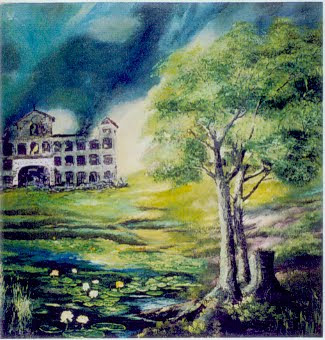
Burning of St Paul Novitiate WWII, hanging wall and ceiling
mural by Leo Carlo Rotor 2000
St. Paul College QC in flames, WW II. mural (8ft x 8ft) by the author 2000
We have to understand that, on the viewpoint of both faith and history. The “loss of Paradise” comes in three phases in the short history of humankind. The first was when man left the confines of a lush greenery described as a rainforest where he had practically everything for his biological needs and comfort, but it was the dawning of his intellect. Scientists and historians compare the Africa before and the Africa of today – the shifting of that great forest cover to a grassland where game animals roamed, and finally becoming into a dry land – the great Sahara desert – shaping man as Homo sapiens and hunter-gatherer, a life he followed through many generations, and until now for some cultures. Until the second loss of that Paradise came once more.
Again the groaning of creation.
As man formed societies, so with different cultures shaped by each. Cultures united and cultures clashed because of the conflict of interests, of trade and commerce, of thoughts and ideas. Leading to deeper conflict, this time in politics and religion. This is the scenario in which Paul founded his mission. The renewal of a paradise of unity and harmony by embracing a common faith – Christianity. It is Paradise Regained later epitomized by John Milton - the same author of Paradise Lost which he wrote before he lost his eyesight.
Religious wars followed after Paul had done his mission. More people were killed in those religious wars between Christians and non-Christian than all the other wars of history combined. For more than 1000 years the world remained in a state of torpor. The Dark Ages or Middle Ages was a long period of constant fighting, the Roman Empire fell and dissolved into fiefs and small kingdoms fantasized in love stories, fairy tales and children’s books.
Again the groaning of creation.
Paul must have dreamt of the Renaissance though distant it would happen. And it did in the 15th century. The Renaissance was the crowing glory of the church. The Renaissance is the story of the Church. It was Paradise Regained Part 2. West met East, but it was not on mutual terms. Europe invaded and conquered the East, the Orient. A new era was born – colonization. The ideology of conquest and colonization is clearly biased on the part of the invader and master. The conquered were made to appear as barbarians and were doomed unless they submit to a foreign master and a foreign god. Rizal’s books clearly pictured the lives of Filipinos under Spain. Hawaii, a novel by James Michener projects a worse scenario. The colonizers were self anointed masters of the world and of god.
For us in the Philippines as in most colonized countries, we remained subjects of Spain for 400 years. India was colonized by England, Indonesia by the Dutch, Indo-China by the French, and so on down the line. Practically all countries in Africa and South America. Asia and the Pacific became colonies and the natives were “living in hell,” as some historians recall, the slavery of mostly Negroes in the US, notwithstanding. It was Paradise Lost to these countries ruled by the so-called “civilized” masters.
Again the groaning of creation.
Colonialism ended towards the end of the 19th century and in the early part of the 20th century. A new Paradise was born once again – the Age of Nationalism. Liberty, Equality, Fraternity – the trilogy of the French Revolution became the universal cry for Democracy now led by the United States of America. Peace was short-lived. Two world wars shook mankind in disbelief. And when the last major conflict ended a new order came out – the Cold War, the polarization of the whole world into two warring camps – democracy and socialism. If there is a Dark Age here is a Cold War. Though the latter lasted for 50 years, in both cases, the quality of life was drawn down to a level whereby we ask ourselves, What is rationality?
Again the groaning of Creation.
If rationality – the power of reason to know what is good and bad, and even know the best and the worst of situations – is the singular gift of God to man, and to no other else among the millions of living organisms on earth, how come man destroys what he builds? Destroys that very thing he calls beautiful? Destroys other living things, their habitats and the environment itself that he shares with?
Why should man wreck his only spaceship, the Planet Earth? And finally, why should man destroy himself, his race, his entire species? It is a shame to our Creator that we, humans are the only species that is destroying its own kind.
What is this rationality that scholars talk about? What is the meaning of faith? Prayer? Research? Teaching? Progress? Values? How can this thing rationality make us true guardians of God’s creation?
Creation groans. It protests. This time against man. Man is the enemy of the earth.
I presume that this is the “restlessness” of creation the paper discussed, and it could be that restlessness Paul described as the sin-story of Genesis 3. It is restlessness in man in seeking more and more of what he wishes to have – his want over his need. The quest for the highest building, the fastest car, the state-of- the art of entertainment and pleasure and comfort. Quest for a Utopia built from the wealth of the earth. And the restlessness to have more of these even at the expense of others. And at the expense of Mother Earth.
All in the name of civilization.
“The ultimate test of any civilizationAVRotor, Light in the Woods.
Is not in its inventions and deeds;
But the endurance of Mother Nature
In keeping up with man’s endless needs.”
But what is civilization? Can’t civilization hear and heed the groaning of creation?
It is civilization that wiped out the American Indian from the Great Plains. It is civilization that plundered the Aztecs and Mayas Empires. It is civilization that brought the Spanish Armada’s to its final defeat. It was civilization that killed 6 million Jews during the second world war. It was civilization that built the atomic bomb – and dropped it in two cities to defeat a defeated enemy. It is civilization that made a clone animal, Dolly the Sheep. It is civilization that threatens the whale and the Philippine Eagle. It is civilization that is causing global warming and the many consequences destroying lives and properties. It is civilization that is causing today’s fuel crisis and food shortage. Drastic inflation and loss of currency value, the recession of America and consequently the world, ad infinitum.
All these constitute the groaning of creation. Creation gone wild and free. Creation without boundary. Creation on a global scale.
Man needs a model. Man needs conversion.
Paul is an embodiment of great men. We find in him the influence of Aristotle, the naturalist-philosopher-teacher, one of the greatest teachers of the world – the teacher of Alexander the Great; Plato of his concept of a Utopian Republic, the asceticism of Stephen the first Christian saint he witnessed while being stoned to death.
A touch of Paul is in Gandhi's philosophy of attaining peace through non-violence, in Saint Mother Teresa’s passion to help the poorest among the poor, in Lincoln’s heroic struggle in abolishing slavery, in Maximillian Kolby’s sacrifice by exchanging place with a doomed fellow prisoner, a father of young children, in a Nazi concentration camp.
Paul must have inspired Kenya’s Wangari in planting 40 million trees to reforest denuded and eroded watershed, and the advocacy of Fr. Nery Satur who was killed while protecting the forests of Bukidnon.
There is Paul in the online lessons in ecology, Paul in the syllabus in Philosophy of Man, in the books and manual about caring for the sick. Other than the pages of bible, more than a half of which he wrote or caused to be written, Paul is among the most read saints of the church of all times, indeed truly a doctor and a general of the faith. Paul is in the temples of worship, Christian or non-Christian. Paul is in every Paulinian sister or teacher and student.
Paul set a new horizon of sainthood, he an apostle – in fact, the greatest of them all, yet he was not one of the original apostles – because he never saw Christ, never walked with Him, never talked to Him. Yet Christ was his way, his constant companion. Christ was always in his heart and mind and spirit – and in fact, he gave himself and his life to Him.
Which challenges the church and us today. Around 10,000 saints - 30,000 to 50,000 including the lesser saints and the blessed ones - are venerated as soldiers of Christ and keepers of the faith. The concept of sainthood took a new turn with the case of Kolby - that of sainthood for charity. Along this line are candidates like Mother Teresa. And the latest sainthood, that of children martyrs and victims of our cruel and unjust society.
But we have yet to have a saint for Nature the expression of God on earth, the environment. Indeed there are heroes for Mother Earth featured by Time and cited by governments, private organizations and civil society. Among them, Rachel Carson, Jane Goodall, EC Schumacher, including present leaders like Al Gore and Michael Gorbachev among many others.
But looking back to Paul, the investiture for sainthood is only by Heaven and it is for the glory of God. If that glory is the preservation of His creation, the protection of His face on earth, if that glory means relief from groaning arising from pain, loneliness, hunger, sickness, thirst, imprisonment, then that person who, like Paul, deserves the honor. He could be the first saint for the cause of the environment.
The earth actual breathes, the old folks used to tell us kids. I still believe it. ~
Part 3 - Mother Nature Dismembered by Genetic Engineering
The advance of genetic engineering makes it quite conceivable that we will begin to design our own evolutionary progress. - Isaac Asimov
Dr Abe V Rotor

Dismembered Nature in acrylic AVR

 The farm becomes an orphan, and we need subsidy, a guardian, benefactor. We need rehabilitation, the cost of which is more than the value of many harvests. Meantime the farm has to recover like a sick person. Where is GM on the rescue.
We asked this question before: Where is modern agriculture on the rescue? When we introduced heavy inputs of commercial fertilizers, pesticides, miracle seeds, (and now GM seeds), coupled with mechanization for large scale production, borrowed money, etc. We shifted from traditional to modern with little innovative transition.

We pushed the frontiers of agriculture too far out to the sea (mariculture), to the hills (Slope Agriculture), and deep into the forest (agro-forestry). Grossly these proved to be disastrous particularly to nature, to ecology, sustainable productivity.
Now we are combining modern agriculture with GM agriculture. GM rides on modern agriculture, the kind millions of farms all over the world failed before. But wait for these scenarios to unfold. GM agriculture with aeroponics (multi-storey urban agriculture), hydroponics (soilless culture) and stem cell farming (laboratory farming of hamburger). All these our Wise Men claim to be agriculture in Postmodern times.
Scenario: A rat glowing in the dark carrying the phosphorescent gene of the jellyfish - for what motive drove the crazy scientist? People jump off their seats, children shriek, there is fun and pandemonium. This new creature became a novelty and celebrity, a symbol of a postmodern technology. It is now an orphan detached from its natural gene pool. To return to its population, it must escape from the laboratory, and share its new gene with its kind. Soon enough a population of glowing rats fills the "village of a Hamlyn". Now we need a modern Pied Piper to wipe these Genetically Modified pest out. Could he?

This is true to GM plants, animal, microorganisms - the foreign gene will remain forever as it crosses the boundaries of fields, colonies, populations, countries, islands, or in short, the boundaries of time and space.
There is no way to sweep away genetic pollution, unlike conventional pollution. It even surpasses radioactive fallout because radioactivity has a self life even if it takes hundreds of years to declare the level safe to health and environment. Perhaps the only time the spread of genetic pollution in a particular carrier comes to an end is when its own species becomes extinct. By then it shall have found other hosts to continue the transfer.

This is true to GM plants, animal, microorganisms - the foreign gene will remain forever as it crosses the boundaries of fields, colonies, populations, countries, islands, or in short, the boundaries of time and space.
There is no way to sweep away genetic pollution, unlike conventional pollution. It even surpasses radioactive fallout because radioactivity has a self life even if it takes hundreds of years to declare the level safe to health and environment. Perhaps the only time the spread of genetic pollution in a particular carrier comes to an end is when its own species becomes extinct. By then it shall have found other hosts to continue the transfer.
When protein gene from say peanut is spliced into soybean, you transfer allergy susceptibility as well, and doctors may not be able to trace it at all. Meantime we say it is safe. How about protein gene coming from non-edible source? The problem with GM products is the lack, or impossible, pre-test guarantee. By the way allergy is not limited to humans; it is universal to living things in various manifestations. This is not good because allergy is a safely valve of the body system.
There is this case called "Suicide Gene" spliced into a high value crops allegedly by the exclusive distributors of a GM crop like hybrid corn. The mechanism is simple. Combine the suicide gene with the DNA of a hybrid corn so that the progeny or F1 will not produce seeds for a second crop, thus preventing farmers to source and share seeds, an age old farming tradition. Because suicide gene is transferable by natural pollination, it easily finds its way to pollute natural gene pools not only limited on a particular crop but other crops as well. It is chain reaction ad infinitum. A never ending Big Bang.
Genetic engineering, through aggressive promotion claims, is the messiah of agriculture. It is as if it is the ultimate solution to feed an exploding population with both its needs and affluence. In the first place it is a senseless race. It may give a feeling of triumph for the day without reference to the future, to our children and children's children.
How can we assure sustainable productivity of our farms ruined by erosion, soil nutrient depletion, water loss due to excessive cultivation? The rule is that,
the more you plant and harvest, the more your farm gets overworked. Declining productivity will result to declining yield of whether GM or non-GM crop.
Genetic engineering, through aggressive promotion claims, is the messiah of agriculture. It is as if it is the ultimate solution to feed an exploding population with both its needs and affluence. In the first place it is a senseless race. It may give a feeling of triumph for the day without reference to the future, to our children and children's children.
How can we assure sustainable productivity of our farms ruined by erosion, soil nutrient depletion, water loss due to excessive cultivation? The rule is that,
the more you plant and harvest, the more your farm gets overworked. Declining productivity will result to declining yield of whether GM or non-GM crop.

We cannot hurry up nature. It needs fallow, it needs to go with the seasons, to complete the natural cycles operating for through eons of time. Destroy the integrity of the Carbon cycle and you will disturb photosynthesis. Nitrogen cycle and you will stunt growth. Phosphorus and fruiting will fail. Lack of Potassium and your plants are sickly and weak. Calcium and your soil becomes acidic. Even minor elements have far reaching consequences. Disturb Iron (Fe) cycle and your plants get anemic (chlorotic). Manganese, which is a catalyst, and nutrient conversion (inorganic to organic compounds) slows down. Disturb the Water cycle and you will end up with drought.
 The farm becomes an orphan, and we need subsidy, a guardian, benefactor. We need rehabilitation, the cost of which is more than the value of many harvests. Meantime the farm has to recover like a sick person. Where is GM on the rescue.
We asked this question before: Where is modern agriculture on the rescue? When we introduced heavy inputs of commercial fertilizers, pesticides, miracle seeds, (and now GM seeds), coupled with mechanization for large scale production, borrowed money, etc. We shifted from traditional to modern with little innovative transition.

We pushed the frontiers of agriculture too far out to the sea (mariculture), to the hills (Slope Agriculture), and deep into the forest (agro-forestry). Grossly these proved to be disastrous particularly to nature, to ecology, sustainable productivity.
Now we are combining modern agriculture with GM agriculture. GM rides on modern agriculture, the kind millions of farms all over the world failed before. But wait for these scenarios to unfold. GM agriculture with aeroponics (multi-storey urban agriculture), hydroponics (soilless culture) and stem cell farming (laboratory farming of hamburger). All these our Wise Men claim to be agriculture in Postmodern times.
Would we ask them again like before, "Where were you when we needed you most?." ~
Part 4. Creation II: Symbiosis and Synergy of Life
Unity in Diversity

Symbiosis* and Synergy** of Life in acrylic on canvas 30"x40" by Alas 5 Films Group University of Northern Philippines, with finishing touches by the author as critic and instructor, 2024,
Two phenomena of life - symbiosis and synergy,
present the brighter side of Darwinian evolution;
not only the fittest survive the test, but unity
and harmony, the key to diversity and stability.
**Synergy is an interaction or cooperation giving rise to a whole that is greater than the simple sum of its parts. The term synergy comes from the Attic Greek word συνεργία synergia from synergos, συνεργός, meaning "working together". Synergy is similar in concept to emergence. Wikipedia


* Mountain climbing is an adventurous experience as it teaches people how to overcome their fears and face their challenges. It is not easy to conquer such great heights, it scares off the toughest of people but the thrill makes it worthwhile.


Migratory birds, detail of painting
Migrating birds fly over the landscape
settle down for a while to rest,
finding it an abode, suitable and safe,
a habitat of peace and caress.
*In 2024, World Migratory Bird Day was celebrated on May 11 in the spring and again on October 12 in fall. The conservation theme this year is Protect Insects, Protect Birds, and focuses on the importance of insects as essential food sources for migratory birds. World Migratory Bird Day 2024 | U.S. Fish & Wildlife Service


*Danaus, commonly called tigers, milkweeds, monarchs, wanderers, and queens, is a genus of butterflies. Migratory in nature Monarch butterflies don't spend winter hibernating but move down in huge numbers down South such as in Mexico where they spend their lives and breed, then return up North with their progeny when it's spring in North America. The same pattern is observed in other parts of the world. The biology of Danaus leaves a lot of mystery scientists are still studying. AVR

Monarch butterflies, detail
From the North down South across,
seasons and boundaries,
and back home the following year -
these majestic butterflies!
*Danaus, commonly called tigers, milkweeds, monarchs, wanderers, and queens, is a genus of butterflies. Migratory in nature Monarch butterflies don't spend winter hibernating but move down in huge numbers down South such as in Mexico where they spend their lives and breed, then return up North with their progeny when it's spring in North America. The same pattern is observed in other parts of the world. The biology of Danaus leaves a lot of mystery scientists are still studying. AVR

Young Mountaineers, details of painting
There's more than reaching the top on a mountain;
conquer the summit and you conquer fear;
an adventure, in a song, to climb every mountain
thereafter, inside you the biggest fear.


Mountain climbing, a beautiful adventure
Mountaineering* is beautiful,
Homo ludens'** man's game for fame,
defying risk of life and limb and all,
all for glory its highest aim.
*There's an incredible view at the top of a mountains that gives a feeling of joy and victory. Climbing is superb for fitness, requiring strength, power and endurance.
** Homo ludens means "man, the player" as compared to Homo sapiens (man, the thinker), Homo faber (man, the builder) and Homo spiritus (the praying man). AVR 

Parrots, Rosellas* and Parakeets, details of painting
Parrots - imitators of human voice and sound,
so with Rosellas and the native Tariktik**;
Parakeets - most common bird pet in cages;
what is freedom? If only they can speak.
**Tariktik is hornbill, now a threatened species. The reason for decline is its habitat destruction, hunting and poaching. It is illegal to hunt, capture or possess rufous hornbills under Philippine Law RA 9147.


A Search for Wildlife*, details
They are all around but you don't see them
in their abode hiding or in camouflage;
active in the day or night - or in between,
among trees, in a stream or in a cave.
Rose Garden

A Bed of Roses in the Wild, details
"A rose is a rose is a rose is a rose."
Gertrude Stein said when asked what is a Rose.
"Sacred Emily" 1913.


Exquisite Flowers of a Rose, details
In The Little Prince, there's but a single rose plant
the Little Prince loved so much.
"How beautiful you are!" he once exclaimed
"Yes, I know." she answered in vanity.
On his visit here on Earth the Little Prince
encountered a garden of roses
so common he soon realized.
Yet the more he loved his only rose on his planet.
What makes a rose so lovable?
8

Rainbow butterfly, an experimental art
The rainbow butterfly carries a symbolism -
a deep spiritual meaning, representing hope,
happiness, renewal, and the promise
of better things to come. Don't give up.
don't.


Prism* on Wings on various planes, detail
On Wings of Song by Felix Mendelssohn** -
it's a butterfly whenever i play it on violin,
fluttering in early sunshine in the garden,
a rainbow on wings in a sacred hymn.
** German composer and pianist (1809-1847), Mendelssohn is considered a renaissance man thanks to his diverse intellectual pursuits. As a child prodigy, he mastered piano, sight reading, violin and viola in his youth. ~


Kristian Jed Dabo, Vince John Ponce, Ken Artajos, Daren Rued Castigo, Beaver Aurellius Carmello, Jericko James Tano, Alvin Lloyd Gampayon, Troy Darren M Reototar, Japer Sotelo, pose with the author, in red shirt.
4.1 - Painting: "Childhood is Forever"
Early childhood experiences from birth to age eight affect the development of the brain's architecture, which provides the foundation for all future learning, behavior and health. A strong foundation helps children develop the skills they need to become well-functioning adults. (Dr. Jack Shonkoff, Director Harvard Center on the Developing Child)
Dr Abe V Rotor
Art Instructor

Childhood is Forever, in acrylic on canvas by Hannah Hediko P Laurente and Harish Hamiko P Laurente, in 3 sessions, under the tutorship of the author at the Living with Nature Center, San Vicente, Ilocos Sur. August 2024,
Childhood is...
- Childhood is a time in our life when everything seems perfect and wonderful.
- Childhood is a world far away from the real world free from burdens and tensions.
- Childhood is a period to learn and master the essentials of life and living.
- Childhood is the full and harmonious development of personality in a family environment.
- Childhood is living in an atmosphere of happiness, understanding and love.
- Childhood is time to enjoy bedside stories, family anecdotes, and life updates.
- Childhood is pure bliss, light moments, treasured memories, captured innocence.
- Childhood is wishing to be older, and when in old age wishing to be younger.
.JPG)
- Full view of the painting (20" x 28") with details shown in succeeding images.
This is a beautiful world to the young:Faces clouds make, and kites fly high,In kaleidoscopic colors of the sun.While nests on trees sweetly cry.If not for the fish and Siberian breeze.The fields sleep, save a songbird;But the clock doesn't stop in hammock's ease -A chime's urging to be heard.Not enough is summer, transient is the gameThat starts with glee and ends with sighAs the season ends; but it is not the aimOf the sky to make children cry.Freud and Thoreau - these great minds before sawWhat makes man, child of years ago,Wading in a pond or climbing a bough,His kite rising to heaven's glow.
.JPG)
.JPG)
Details: A flock of white doves playfully takes care of their fledglings and chicks in their nests, among kites hanging in the trees. Right, treetops serve as playground and home of many creatures like gecko lizard and wild bees, as well as foothold of ferns, lianas and orchids.
"White doves are symbolic of new beginnings, peace, fidelity,
love, luck and prosperity." (A Dove's Love)

.JPG)
Promenading is a pastime in a beautiful scenery, a happy moment communing with Nature. Right, wild fowls, reptiles, amphibians, fish and other living things abound in a pristine and unspoiled environment. They comprise the natural landscape and ecological system. A pristine environment is synonymous with “untouched,” a place where human hands have not intruded into the natural progression of life, and not corrupted by civilization.
Loafing
Oh, how we love the fields like farmers do,But not our classmates in school though;And Nature more than our teachers knowWhat the sun and rain in childhood sow.*
Rest is not idleness, and to lie sometimes on the grass under trees on a summer's day, listening to the murmur of the water, or watching the clouds float across the sky, is by no means a waste of time.”- Sir John Lubbock
.JPG)
Fishing is but a hobby, a kind of sport friendly to nature. Here a fisherboy is not a stranger to the wildlife* indigenous to the place, indeed a manifestation of a friendly and harmonious relationship bound by a primal treaty of man and nature.
Fisherboy**
By a stream on a rock ledge many a dream grew with the water flowing, the clouds rising, the breeze whispering in a nearby tree, its shade creating images of art and fantasy.
Hours lazily passed, but how short was a day fishing, from sunrise to noon and back again when the fish would return, the bamboo pole suddenly becoming heavy with a big catch.
Other boys join the cheer, the louder the bigger the fish was, or fading with a whimper when it got away, and it was always "the big fish that got away," an adage of every fisher folk.
Away from town, away from school, away from home for a while - this freedom in innocence and adventure, the elders would call laziness, stubbornness and aimlessness in growing up.
Boys don't know the difference grownups want them to be, but wait for their own time, when childhood yields to the demands of the world, the world though big is "prison" to grownups.
They too, were children before - the "man in the boy" comes later when there are no more big fish to catch, the tree has overgrown the rock ledge and other boys are longer around.
Like birds migrating and returning, season after season in Vivaldi's refrain, and Mozart's lament, life goes on in rhythm, but time couldn't wait, while dreams sought for reality.
There are many fish in the world, the biggest to catch always a dream - fame, ideas, wealth, sacrifice, honor, popularity - aiming at these to the end, in triumph, surrender or defeat.
Years later a man in gray hair appeared, he saw a familiar boy fishing, his thoughts seemed far away, his fishing pole bending to his excitement, then snapped - it was the big fish that got away. ~
Wildlife is integral to the world's ecosystems, providing balance and stability to nature's processes. The goal of wildlife conservation is to ensure the survival of these species, and to educate people on living sustainably with other species. - National Geographic Society


Workshop attendees include parents of children participants, as well as older art enthusiasts who comprise a separate but similar art workshop sessions at the Center conducted regularly by the author upon requests from the community, organizations and schools, such as the University of Northern Philippines.
Growing Up With Art**
Kids' World Apart from "Kids"
Take a break from computers and the mall,confines of the small;break the wall of idleness, go for the ballfast and make a goal.Solve the puzzle, some genius await youfor all you know;left to right of the brain and back will showa wider view of you.Take the road rough, look ahead, move on,from the bandwagon;it's your adventure, and follow the sun,sunrise to sundown. ~
* AVRotor, Don't Cut the Trees, Don't UST 2010
** avrotor.blogspot.com Living with Nature
4.2 - Children and Nature - An Omnipotent Treaty
Wall Mural by Dr Abe V Rotor (7ft x 90ft)
Author's City Residence, Barangay Greater Lagro QC

"A thing of beauty is a boy forever." AVR wall mural at author's residence,
Barangay Greater Lagro, QC
Three young musketeers are set to conquer the worldaway from the mall, home and school;If Tom Sawyer and Huck Finn were real and alive today,we wouldn't know who's genius, who's fool.
Who is the primitive, who is the civilized, oh brother!when we prefer the city over the quaint village,car for walking distance, processed over fresh food,philosophy over instinctive knowledge.
Everything defined in rich vocabulary, but a rose is a roseand nothing else, energy to matter and back,universal cycles no genius will ever truly understand,Homo sapiens! it is humility we lack.
Innocence in children, we make up for the falsehoodof the world of grownups and sages;Einstein and Darwin never knew the whys of the world,children have been asking for ages.
If genius is reborn in the innocence of children,then knowledge's into wisdom distilled,compensated in old age for the young ones' sake:'tis the fate of humanity in Nature sealed. ~

“When we are children we seldom think of the future. This innocence leaves us free to enjoy ourselves as few adults can. The day we fret about the future is the day we leave our childhood behind.” ― Patrick Rothfuss, The Name of the Wind


 “I do not miss childhood, but I miss the way I took pleasure in small things, even as greater things crumbled. I could not control the world I was in, could not walk away from things or people or moments that hurt, but I took joy in the things that made me happy.” ― Neil Gaiman, The Ocean at the End of the Lane


“... and when all the wars are over, a butterfly will still be beautiful.”
― Ruskin Bond, Scenes from a Writer's Life

"Children and Nature “Because children grow up, we think a child's purpose is to grow up. But a child's purpose is to be a child. Nature doesn't disdain what lives only for a day. It pours the whole of itself into the each moment. We don't value the lily less for not being made of flint and built to last. Life's bounty is in its flow, later is too late. Where is the song when it's been sung? The dance when it's been danced?
"It's only we humans who want to own the future, too. We persuade ourselves that the universe is modestly employed in unfolding our destination. We note the haphazard chaos of history by the day, by the hour, but there is something wrong with the picture. Where is the unity, the meaning, of nature's highest creation? Surely those millions of little streams of accident and willfulness have their correction in the vast underground river which, without a doubt, is carrying us to the place where we're expected! But there is no such place, that's why it's called utopia.
"The death of a child has no more meaning than the death of armies, of nations. Was the child happy while he lived? That is a proper question, the only question. If we can't arrange our own happiness, it's a conceit beyond vulgarity to arrange the happiness of those who come after us.” ― Tom Stoppard, The Coast of Utopia
“Anybody who has survived his childhood has enough information about life to last him the rest of his days.” ― Flannery O'Connor, Mystery and Manners: Occasional Prose
Part 5 - The Biological Basis of Selfishness
and Selflessness
Dr Abe V Rotor
 Honeybee gathers nectar and pollen for the members of its
colony, key to survival of its species.
All organisms, simple or complex, plant or animal – and human – are governed by genes, which through the long process of evolution, are the very tools for survival in Darwin’s treatise on Survival of the Fittest through Natural Selection.
The acquisition of successful genes is key to the survival of present day species, and the explanation on the failure of those which did not. Two words are important: adaptation and competition. This dual attributes are directed to self-preservation through the process of acquiring the basic necessities of life either by adjusting to it passively or actively. Definitely it is not one that is easy to share to the extent of losing its benefit in favor of another.
But if we analyze it, this is true to each individual. Now organisms do not live as individuals; they live as a community, as a society. Which leads us to the logical inference that if the individual organism, in order to survive must be selfish, then how can it be able to establish a community in which it ultimately become a part?
This is very important because the community is the key to resource sharing from food to space; it is the key to collective bargaining in times of peace or war. The community is like a bundle of individuals behaving singularly. It is collective planting time when the monsoon arrives, harvesting when it ends. The rituals that go with such activities enhance the success of bonding, and enshrine it into an institution.
Institutions were born from socio-economic needs which spontaneously developed into cultural and political rolled into one complex society. To answer where selfness starts is easier to answer than where selflessness begins.
If the premise is biological what proofs can we show that it is so?
• Social insects – ants, bees and termites – bind themselves as a colony. Any attack on the colony sends soldiers to fight the enemy. Paper wasps sting as intruders. The honeybee does not consume the nectar and pollen it gathers, but brings the harvest into the granary from which it get its share later. An ant clings to death at an enemy. When a bee sting, its abdomen is ripped away and is surely to die.
• Starve an aphid or a mealybug, and it will produce young prematurely – even without first becoming an adult. This is called paedogenesis. Or an adult may produce young without the benefit of mating and fertilization. This is parthenogenesis.
• A plant stressed by drought will cut its life cycle short in order to use the remaining energy to produce offspring. This is true to grasshoppers or caterpillars – they skip one or two moulting and metamorphose so that they can mate and reproduce.
• The spacing of plants is determined not only of soil and climatic conditions that control the growth and development, but by a biological mechanism known as allelopathy. A date palm will kill its own offspring around its trunk and under its crown. Those that grow outside its shadow becomes a part of the oasis’ vegetation.
• Bacteria, yeasts, and other microorganisms go into luxury feeding where there is plenty, and nature seems not to mind, until they consume the food, and worse until their waste accumulates and becomes toxic. This is called autotoxicity. Thus in fermentation, it is the toxic material - alcohol - that eventually kills the yeasts themselves, and another process follows until the organic forms of compounds are transformed and ultimately returned as inorganic ready for use by succeeding organisms.
• The dalag and many other species of fish eat their young leaving only those that can escape. Here the advantage of controlled population and survival of the fittest are shown.
• Vultures seldom attack a living prey; they wait to its last breath. A male lion will kill a cub which it did not sire. But we know too, that there are surrogate mothers in the wild like the cuckoo, and among domestic animals.
Because of the complexity of social behavior, Dr E O Wilson of Harvard University, attempted to explain many of the observed behavior into a field of biology he called sociobiology. In a simple illustration, if your child is about to be hit by a fast oncoming vehicle, a mother would risk her life to save him. Dr. Wilson would then asks a third party if he or she would do the same thing to a child who is not his own – much less without any relations.
This leads us back to our previous question: When does selfishness end and selflessness begin?~
Part 6 - Devolution of Life - Reverse Evolution
“Man has reversed the natural process of evolution and has put into his hands the pattern and trends as he wishes, playing the role of his Creator.” - AVR
Dr Abe V Rotor
Living with Nature School on Blog
avrotor.blogspot.com


Author's son Leo Carlo holds two endangered Philippine species of hawk and owl, Avilon zoo, Rizal

1. From the first Green Revolution – the transformation of man from hunter to farmer some 10,000 years ago – man has narrowed down the diversity of crops and animals according to his needs.

3. Global Warming is causing sea level to rise and flood low lying area. On the polar ice and ice caps are melting down. Global warming stirs climate change which is causing climatic disturbances. There is a increasing rate and intensity of typhoons, hurricanes, tornado, flooding, drought, and the like,
4. Pollution on land, water and air, in increasing levels brought about by industrialization, growing population and affluence of living, has triggered man-induced phenomena that threaten species and life itself.
Formosan Bear - now extinct.

6. Man intrudes into the wildlife which continues to shrink. Gone is 80 percent of the rainforest of the world. Ninety percent of the coral reefs have been destroyed by over fishing and by reckless means. The grasslands are shrinking giving way to farming. The sea is being farmed. Islands are now owned by private persons and organizations.
Author's children are dwarfed by a Dinosaur fossil,
at an exhibit in QC 1986
8. Evolution it seems is no longer a natural process, but one dictated by human intelligence that continues to build from the indulgence on the fruits of the “Tree of Knowledge that makes man as powerful as God,” the very thing that vanished his first ancestors from the biblical Garden of Eden.
Where have all the cereal varieties gone?
There are more than 50,000 reported cultivars of rice presently stored in the Gene Bank of the International Rice Research Institute at UP Los Baños, Laguna. According to IRRI scientists this number represents but a fraction of the possibly rices (the plural of rice to denote distinct genetic variations) of the world since agriculture began some 5000 years ago or so.
Similarly at the Centro Internacional de Mejoramiento del Maiz y Trigo (CIMMYT)* in Mexico the gene bank for wheat and corn faces the same problem as in rice, and if this is the case, it is logical that many varieties and cultivars of field crops we know today are but the selected few that man, the farmer, has intentionally preserved. In short, what these banks as well as those conserved by other organizations, are but the remnant of the world’s naturally occurring genetic pool on the one hand, and those genetically modified by man.
A cursory examination of rice sold in the market makes a short list of about a dozen misleading varieties as sinandomeng, wagwag, intan, which are pseudonyms to attract customers for the likeness of quality with those they have been named after.
To validate this observation through field survey one is likely to find even a simpler classification as upland and lowland rice, or aromatic, glutinous, red rice and the like. This is the same observation in the former prairies of North America, now the biggest cereal granary of the world extending across the Canadian border covering the provinces of Alberta, Saskatchewan and Manitoba.
According to the Food and Agriculture Organization of the United Nations, there are only 10 major wheat varieties planted on the vast plains. For corn, the indigenous varieties are rare to find on the farm. Hybrid corn – a cross of two or more purified varieties – makes up the bulk of corn produced. Hybrids are unstable genetically. In the succeeding generations the lose hold on the genetic vigor of their parents, resulting in drastic decline in yield.
What is the implication of narrowing down the choice of varieties to be planted commercially?
First, it will result in indirect elimination of varieties in the bottom of the list, by displacement by the preferred ones and by neglect on the [art of the farmer in maintaining them.
Second, fewer varieties planted is food security risk. Severe damage to even only one major variety is likely to result in economic disaster.
Third, the narrowing down of genetic diversity disturbs the ecosystem, laying much on man’s care the survival not only of the cultivated crops but other living things in the area as well, thus leading to the further decrease in diversity and population. The loss of diversity in cereal lands applies as well in other areas as evidenced by the following:
• Vegetables sold in the market are limited to those that are salable, leaving out those that are not, and the so-called “wild vegetables” represented by such vegetables as bagbagkong, papait, sabawil, sword bean, and alukong or himbaba-o.
• The kinds of fruits may be counted by the fingers, and like vegetables, only those that are acceptable dominate the fruit stands. Today it is rare to find such indigenous fruits as tampoy, sapote, batocanag, anonang and the native counterparts of guapple and ponderosa.
• Industrial crops are also suffering of the same fate. Take the following:
1. Dipterocarp species of forest trees (narra family) are now endangered.
These include apitong , yakal, tanguili, and guijo.
2. Fiber plants such as maguey (Agave family), ramie, kenaf, jute, abaca, have bee vastly neglected since the introduction of synthetics fibers.
3. Today bamboo groves occupy the fringes of wastelands and certain watershed areas. Traditional bamboo areas, like the Dipterocarp forests, are vanishing, so with many of the species and variety of this so-called giant grass.
4. The increasing demand for firewood has decimated many indigenous sources, what with the open exploitation for day-to-day gathering of firewood in marginal communities. These include madre de cacao, ipil-ipil, acacia, and aroma.
5. Even plants of medicinal value are being exploited severely such as quinine for malaria, banaba for kidney trouble, derris for insect control.

6. Seaweeds suffer the same fate as more resorts are put up, aquaculture selective only to those species of major importance are raised, deleterious effects of pollution, notwithstanding.
Whenever a land is cleared for agriculture five consequences are likely to happen. These are
• Direct elimination of plants and animals which interferes and does not constitute or conform with farming practices.


• Breaking up of the food chain and therefore, the disruption of the food web leads to the disorganization of the ecosystem. For example, a swamp converted into riceland will necessarily lose its natural biological and ecological properties. Loss of habitats results in migration or death of affected species.
• Modern agriculture, with the use of chemical pesticides and fertilizers, is destructive to the ecosystem.
Philippine crocodile is a threatened local species.
Malaysian Tapir, highly endangered - result of habitat loss
Biotic Potential is equal to
Carrying Capacity/Productivity divided by Environmental ResistanceDecreasing productivity therefore, means decreasing biodiversity – which means devolution of life. ~
* The author was visiting scientist at CIMMYT Mexico in 1992, presented a paper on growing wheat in the Philippines.
Part 7 - Yes, it's a sin to cut down a tree

In a conference-workshop a participant asked me, being the resource speaker on ecology. “Is it a sin to cut down a tree?”
The question is not to be taken literally, or jokingly either. It permeates into something bioethical. It is not the cutting of the tree per se – or similarly, the spewing of CFC in the air, or throwing mercurial waste into the river, that the issue should be examined. It is the destruction of the ecosystem, the disruption of the functioning of natural laws and processes, and therefore the integrity of whole system is the one that is at stake.
The unabated logging of the watershed of the once beautiful city by the sea – Ormoc City in Southern Leyte – resulted into an unprecedented massive mudflow that swept the central part of the community killing thousands of residents, and causing untold sufferings.
There followed after five years another massive landslide that claimed hundreds of lives near Maasin, Southern Leyte, burying a whole school with pupils and teachers conducting their classes at the time of the tragedy.
In Real, Quezon, scores perished in a similar incident, also attributed to the cutting down of trees on the watershed - or logging of the forest itself. These are becoming rampant cases not only in the Philippines but all over the world.
Yet the ethics and morality of these acts of destruction, particularly on the part of the loggers and their accomplices, were never given importance as much as that of the criminal offense committed. I would like to view these tragedies in the realm of theology, that of a paradigm of salvation.
According of Fr. Percy Bacani, it is a sin to harm the environment, because it causes people to suffer. How could it be that the culprits of these tragedies find salvation in the mere act of contrition - even without plowing back their ill-gotten wealth to rebuild the community and help nature regain its former state and stability? This is other than the compensation deserved by the victims.
This paradigm touches deep into the roots of moral philosophy itself and the foundation of ethical principles. It is embodied in the proclamation of the Vatican that destroying the environment constitutes a cardinal sin, one of the seven cardinal sins the church has lately affirmed.
Yes, it is a sin to cut down a tree.
x x x
(Original Title: Paradise Lost in Our Midst)

 Life on the Countryside mural painted by the author 1976
 The endangered Philippine deer enshrined in a fountain at UST, Manila

+p157+-+Copy.jpg)
 Cattle ranch on a steep slope ripped off the skin of the mountain in Santa, Ilocos Sur - an example of the irreversible ill consequences of "Tragedy of the Commons." *
 Sunken town of Pantabangan Nueva Ecija resurfaces during a extreme drought. Nature is sacrificed to human needs, more so to human wants in pursuit of affluence.


*The tragedy of the commons is a term used in social science to describe a situation in a shared-resource system where individual users acting independently according to their own self-interest behave contrary to the common good of all users by depleting or spoiling that resource through their collective action. Proposed by Garrett James Hardin an American ecologist and philosopher who warned of the dangers of overpopulation.
This article serves as reminder in observing the Season of Creation,
and World Environment Day.*

Dead Tree Standing, Mt Pulag, Benguet
“As politics starts with good citizens, so ecology starts with us who in
mind and spirit respond to the call of unity and harmony with nature.” - AV Rotor
Recently I was a speaker on ecology before students at St. Paul College QC. It was in observance to Guidance Week with emphasis to values education. It was also a demonstration of integrating art in science teaching, an alternative methodology that makes a subject not only better understood but experienced. Hence it is also called experiential learning.
When I received the invitation, I said why can't I try the approach I used at St. Paul? Prof. Arlene and I had a lengthy talk regarding the outline of my discussion which I am going to present - and if you would allow me – I will use it in conducting a similar exercise with you which would take some ten minutes.
First, “governance in the hands of the few,” mean autocratic and monopolistic rule, which has led to abuses of power in manipulating the affairs of the state.
v Throughout history such abuses have been committed not only in closed societies, but in open societies as well.
v Dictatorship – call it benevolent dictatorship which was claimed as the trademark of Lee Kwan Yu, Park Chung He, Chang Kai Sek, et al *– is without the shade of radical dictators like Pol Pot and Stalin.
v We often hear people asking, “What about World Bank and IMF, GATT which led to World Trade Organization? Do they also bear the brand of dictatorship?”
Second, there is “low priority of government on effective resource management” is true. Let us look at it this way as gleamed from Prof. Arlene’s paper.
v Environmental management today focuses on ecology and conservation. There is much debate until now whether it is better to adopt total log ban or selective logging. It is a sort of battle between fundamental and practical ecology. Remember the Alaska oil pipeline conflict?
v The thrust of environmental management in colonial times was exploitation. Our best timber was exploited during the Spanish and American colonization, and Japanese occupation. The Japanese mined Taiwan’s ancient forest. The Dutch thinned the Indonesian forest. Other colonies suffered the same.
v The strength of our economy when we were second to Japan in Asia was based on a vibrant exportation of raw materials such as lumber, copra, sugar, ores, etc.
v Cash crops economy as dollar earner bears the design of our sound economy in the past, but the player is the agri-businessman and not the small farmer.
Third, environmental degradation is a syndrome of modern society.
v It dates way back to pre-history, but the problem is exacerbated by the growth of population and affluence.
v Aborigines too, were also destructive to the environment. Slash-and-burn is the most destructive method of farming. Today Easter Island is a no man’s land. Much of Peru’s original vegetative cover started to decline with the Incas, so with the forest around Lake Teotihuacan in Mexico.
v The first recorded animal that became extinct in the hands of man is the mammoth.

Courtesy of San Vicente Municipal Hall, Ilocos Sur
Fourth, forest denudation follows the concept of the Domino theory, a kind of chain reaction. It is loss in diversity on three levels, namely
v Genetic diversity. Varieties and cultivars of plants, breeds of animals, strains of microorganisms are forever lost.
v Species diversity. The species itself can be eliminated on the surface of the earth. Examples are the saber-tooth tiger and the dodo fowl. Thousands of species all over the world are endangered as their natural populations continue to dwindle mainly because of human exploitation.
v Ecosystems diversity. The loss of natural habitat is the worst kind of environmental destruction. Deforestation will not only eliminate the resident organisms, the forest itself is lost. It will never be one again, contrary to the belief of many.
Fifth, authoritarian rule in the Philippines from 1972 to 1982 spawned politicians and cronies whose concern for the environment cloaked a distinct privilege of exploiting our natural resources.
v This opened a floodgate in post-martial era leading to drastic decline of forest resources, as shown by deforestation records.
v Forest reserve was stable for years at over 15 million hectares until 1972. It fell in 1982 by 14 percent and continued on to decline after.
v The plunge was in 1990 when our forest reserve was cut to almost half that of the end of martial law.
v By 1997, our forest reserve represents only 18 percent of our total useful land (land-use area) which is 30 million hectares. It continued to decline after.
v What is appalling is that our land area devoted to different uses (other land-use area) such as subdivisions, industrial zones, golf courses, resorts, and the like, grew to 75 percent in 1997 as compared to 12 percent only in 1960. Our farmlands today have shrunk tremendously, the main reason we resort to importation of rice and corn, fruits and vegetables, and other commodities.
v Without forest we will experience desertification. Much of Southern Cebu, Northern Luzon, the two Mindoro provinces, Eastern Samar, Masbate and other provinces have virtually lost their original forests.
Six, people’s participation in environmental conservation through community organizations and NGOs is a potent force barely tapped.
Let us consider the following:
v Growth of Civil Society. Citizens from different parts of the world regardless of affiliation, ideology, race and belief picketed the hall where the World Trade Organization was to be signed. They nearly succeeded.
v Greenpeace, a radical organization blocked the trade route of wildlife items, demanded governments and corporations to comply with environmental laws.
v Time launched the search for Heroes for the Earth. They are the likes of Rachel Carson (Silent Spring), Schumacher (Small is Beautiful), Cousteau (Oceanography pioneer), Macliing (Chico River project rebel)
Seven, there are social scientists who believe that ecology struggle is part of a larger ideological struggle.
v Andre Gorz (pen name Michel Bosquet) sees ecology struggle not as an end in itself but as an essential part of the larger struggle against capitalism and technofascism. He champions a “shifting of power from government the state and political parties to the local community and the web of social relations that individuals establish amongst themselves.”
v Rudolf Bahro, a German philosopher, wrote “Historical Compromise” in which he blamed monopoly capitalism’s constant search for new profits as the major cause of the environment crisis threatening humanity.
Without being ideological however, there are pieces of thoughts we can gather in creating a world order of ecology. Let us consider this excerpt. To wit:
“The privileged today are not those can consume most but those who can escape the negative by-products of industrialization – people who can commute outside rush hours, be born or die at home, cure themselves when they are ill, breathe fresh air and build their own dwellings.” (Ivan Illich a social thinker, and author of “Vernacular Conviviality”1980.
This is related with the lessons on non-cash technology advocated by the Asian-Pacific Food and Fertilizer Technology Center in Taipei. I had the privilege to study in the center under Dr. H.T. Chang, the proponent of this concept which is in line with those of Ernest Schumacher who wrote a book, “Small is Beautiful” which offers a people-based beyond the corporate formula of development, and Dr. James Yen, adviser to PRRM (Philippine Rural Reform Movement), the precursor of the International Institute of Rural Reconstruction (IIRR) which was headed by Senator Juan Flavier, then its director general for many years before becoming Health Secretary and Senator.
“The progressive farmer is one who prepares his land more thoroughly, manages his nursery better, keeps his field more cleanly and has better water control – mainly through his effort and those of his family or community. Non-cash extends further than mere savings of direct expenses. It keeps him away from debt and compromised market deals. It means more harvest, free from residues of chemical fertilizer and spray. Ultimately non-cash technology means better home, education for his children, and a healthy environment.”
I remember the principal character of the “Mountain Man” who discovered the Redwoods of California and fought for their preservation. President Lincoln took no time in signing the declaration of the area as a national park. This same man was dying, and it was his wish to die on the mountain alone. As he waited for death he saw the living giants that he thought he was already in another world. It was a turning point in his life, a new beginning.
I am sure there are amongst us persons of his own kind. And if none can meet his measure, then we the members of the academe must create one – a thousand – from among the youth under our care.
May I invite you to reflect on this piece I wrote.
An Ecologist’s Prayer
When my days are done
let me lay down to sleep
on sweet breeze and earth
in the shade of trees
I planted in youth and old;
and if this were my last,
make, make others live
that they carry on the torch,
while my dust falls
to where new life begins -
even an atom let me be
with you dear Mother Earth.
- AV Rotor 2000
Updated 2013 ”A Reaction Paper to the Political Ecology of Deforestation. Paper presented by Prof. Arlene A. Ancheta in a Social Sciences Research Colloquium, University of Santo Tomas, Nov. 23, 2000


+p157+-+Copy.jpg)
Skull of whale (Museum of Natural History, UPLB Laguna; whole trunks of forest trees carried down by flood on Fuerte Beach, Vigan Ilocos Sur


Sunken pier, Puerto Sto Domingo, Ilocos Sur; Shipwreck, Tacloban, Leyte.
To some scientists the "uselessness" of technology is likened to Lamarck's theory of use and disuse, though biological in perspective. Lamarck believed that disuse would result in a character or feature becoming reduced. 
Ruin of Intramuros, Manila, left by WWII 60 years after.
Death of cities is on the rise all over the world.
.jpg)
Death of cities is on the rise all over the world.
.jpg)
Berlin wall falls, Germany is re-united in 1989 since end of WWII.
But more walls are built dividing cultures and politics.
But more walls are built dividing cultures and politics.
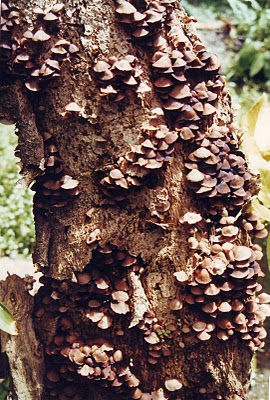
Death of trees and forests is happening all over the world.
ANNEX A "Only God can make a tree."
Trees
Joyce Kilmer 1913
I think that I shall never see
A poem lovely as a tree.
A tree whose hungry mouth is prest
Against the earth's sweet flowing breast;
A tree that looks at God all day,
And lifts her leafy arms to pray;
A tree that may in Summer wear
A nest of robins in her hair;
Upon whose bosom snow has lain;
Who intimately lives with rain.
Poems are made by fools like me,
But only God can make a tree.
I think that I shall never see
A poem lovely as a tree.
A tree whose hungry mouth is prest
Against the earth's sweet flowing breast;
A tree that looks at God all day,
And lifts her leafy arms to pray;
A tree that may in Summer wear
A nest of robins in her hair;
Upon whose bosom snow has lain;
Who intimately lives with rain.
Poems are made by fools like me,
But only God can make a tree.
ANNEX B - Nature Crucified
"Above me rises a dead tree..."
Dr Abe V Rotor

Lady devotee Angie Tobias turns her attention to Mother Nature in the
midst of today's massive destruction of the environment symbolized
by this driftwood artwork made by the author for Lent 2024.
When the sky is gray and red in sorrow,
the fields bare and dry all around,
the sun beats hard on ev'ry levee and furrow;
I wonder where I am and bound.
No shade to find comfort even for a while,
save a tree standing on a hill,
where some birds briefly rest and again fly,
leaving me empty at the scene.
I look up and wonder, "Is this Golgotha?"
No sound, no breeze, but eerie
like I were in the heart of the Sahara;
above me rises a dead tree. ~
ANNEX C - Green Cross in the Sky

Green Cross in the Sky
Umbrella Tree (talisay) - Terminalia catappa,
San Vicente Botanical Garden
Photo by AVR 2021
You lost your crown, but not your glory,
your function as umbrella tree;
a ladder leans abandoned and empty;
is this symbol of man being free?
If this is lesson to remind of man's folly
and pride against the Almighty,
rise up on a Hill that was once holy
for all humanity to see.

Skeleton of a 50-year old mango tree, QC 1970
Photo by AVR
A Cross in the Sky
I have lost you forever,
now a silhouette in the sky,
spreading a gospel to remember
for the mindless passerby.
You lived half of your life,
yet fullest at the Throne,
earning it well with strife
where every seed is grown.
The birds you cared now a flock,
many a child into man;
you bid them all good luck,
and now they are gone.
For many years you sheltered me,
a thought I can't be free;
I atone for your brevity
by planting a million tree.~
Light in the Woods, AVR Megabooks 1995

Arbor Tree Cross, avr 2021

Stone Cross, avr 2022
-------------
ANNEX C - Reverence for Life - 25 Couplets
Couplets are two lines of verse, usually in the same meterand joined by rhyme, that form a unit.
Researched and Organized by Dr Abe V Rotor
Living with Nature - School on Blog
.jpg)
Selected from Auguries of Innocence by William Blake
A Robin Red breast in a Cage
Puts all Heaven in a Rage.
A dove house filled with doves & pigeons
Shudder Hell thro’ all its regions.
A dog starv’d at his Master’s Gate
Predicts the ruin of the state.
A horse misus’d upon the Road
Calls to Heaven for Human blood.
Each outcry of the hunted Hare
A fibre from the Brain does tear.
A Skylark wounded in the wing,
A Cherubim does cease to sing.
The Game Cock clip’d & arm’d to fight
Does the Rising Sun Affright.
Every Wolf’s & Lion’s howl
Raises from Hell a Human Soul.
The wild deer wand’ring here & there
Keeps the Human Soul from Care.
The Lamb misus’d breeds Public strife,
And yet forgives the Butcher’s Knife.
The Bat that flies at close of Eve
Has led the Brain that won’t Believe.
The owl that calls upon the Night
Speaks the Unbelievers’ fright.

He who shall hurt the little Wren
Shall never be belov’d by Men.
He who the Ox to wrath has mov’d
Shall never be by Woman lov’d.
The wanton Boy that kills the fly
Shall feel the Spider’s enmity.
He who torments the Chafer’s sprite
Weaves a Bower in endless Night.

The Caterpillar on the Leaf
Repeats to thee thy Mother’s grief.
Kill not the Moth nor Butterfly,
For the last Judgment draweth nigh.
He who shall train the Horse to war
Shall never pass the Polar Bar.
The Beggar’s Dog & Widow’s Cat,
Feed them & thou wilt grow fat.
The Gnat that sings his Summer song
Poison gets from Slander’s tongue.
The poison of the Snake & Newt
Is the sweat of Envy’s Foot.
The poison of the Honey Bee
Is the Artist’s jealousy.
The Prince’s Robes & Beggar’s Rags
Are Toadstools on the Miser’s Bags.
The Bleat, the Bark, Bellow & Roar
Are waves that Beat on Heaven’s Shore.
William Blake (28 November 1757 – 12 August 1827) was an English painter, poet and printmaker. Largely unrecognized during his lifetime, Blake is now considered a seminal figure in the history of the poetry and visual arts of the Romantic Age. Although Blake was considered mad by contemporaries for his idiosyncratic views, he is held in high regard by later critics for his expressiveness and creativity, and for the philosophical and mystical undercurrents within his work. His notable works are Songs of Innocence and of Experience, The Marriage of Heaven and Hell, The Four Zoas, Jerusalem, Milton.~
ANNEX E - Bleeding Heart of the Forest
"Oh, the bleeding drops of red
where once a forest stood,
victim of greed and gold,
now barren, cold and dead."
Dr Abe V Rotor
Living with Nature School on Blog

Bleeding Heart of the Forest, acrylic painting (11"x14")
by AVRotor, 2015
It is I, Homo sapiens, the thinking man
who changed the concept of creation,
Nature to serve man,
master and guardian.
It is I, Homo faber, the maker,
wilderness to tame, resources to harness,
untouched these are,
they go to waste.
It is I, Homo ludens, the playing man,
forest to hunt, mountain to climb,
work and leisure to me
keep my sanity.
It is I, Homo spiritus, the praying man,
mysteries I submit, mistakes I atone,
I, too, have a heart that bleeds,
the essence of being human. ~
forest to hunt, mountain to climb,
work and leisure to me
keep my sanity.
It is I, Homo spiritus, the praying man,
mysteries I submit, mistakes I atone,
I, too, have a heart that bleeds,
the essence of being human. ~
Lesson on former Paaralang Bayan sa Himpapawid (People's School-on-Air)
with Ms Melly C Tenorio; 738 DZRB AM Band, 8 to 9 evening class Monday to Friday